The Rural Double-Rainbow 🌈
By Erik Reader
The Rural Double-Rainbow 🌈
By Erik Reader
Todays post is from Erik Reader, the President of Reader Area Development, Inc. RAD is led by Erik, a downtown revitalization professional with more than 15 years of hands-on experience working inside the realities of small towns. We were talking about two franchises you see everywhere these days in small towns. He said what I was thinking, only better!
Driving Route 30 across northern Illinois, it starts to feel like rural America has settled on a very specific development strategy. Put a Casey’s on the edge of town. Add a Dollar General nearby. If things are really moving, maybe throw in a Subway or a gas station casino for good measure.
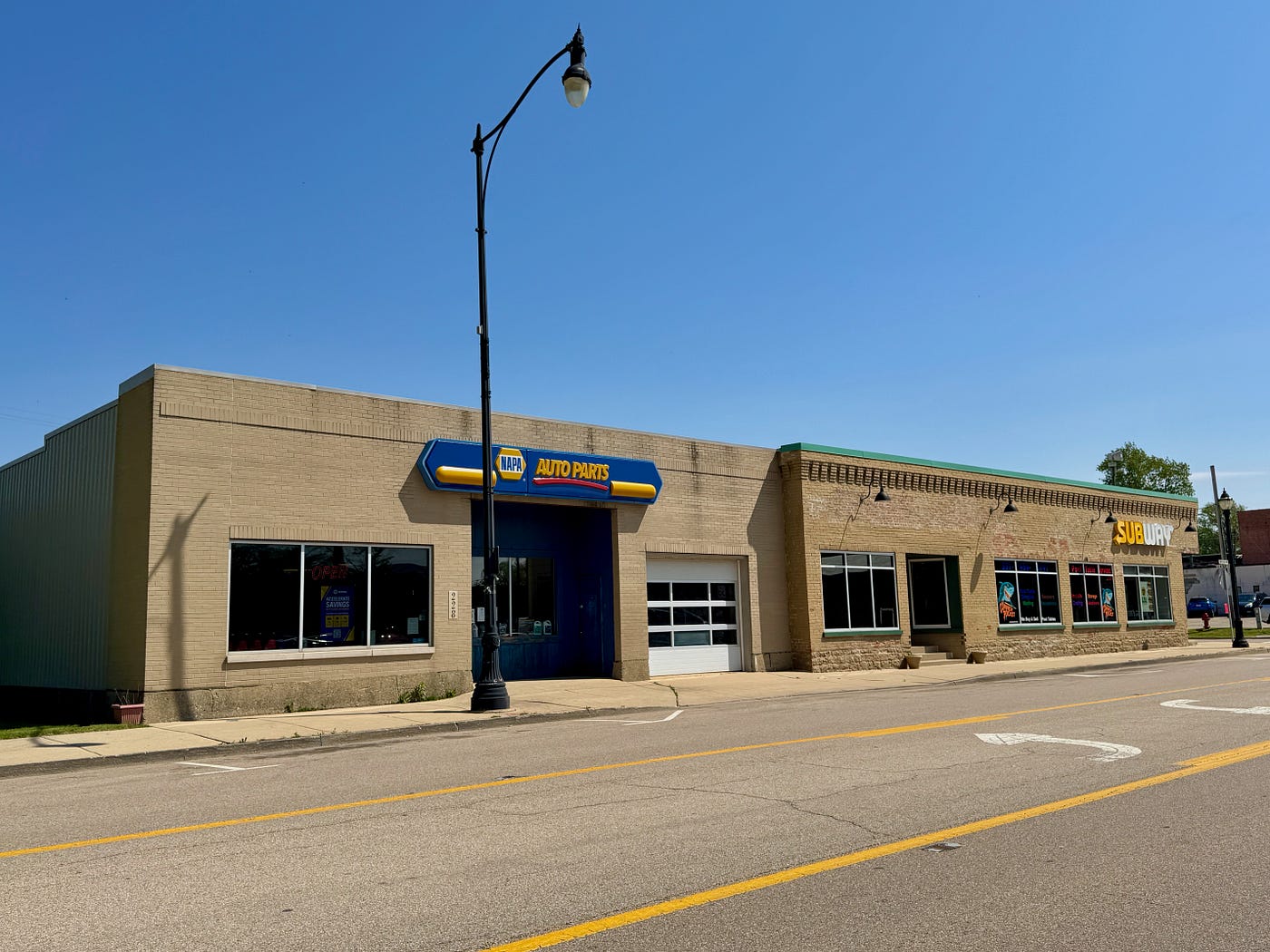
Napa and Subway
At some point during my recent drive from Peoria to Geneva, I realized I’d seen this same pattern over and over again in communities like Shabbona, Waterman, and Hinckley. The buildings changed slightly. The signs changed colors. But the formula stayed remarkably consistent. Fresh concrete, large parking lots, bright corporate branding, and highway visibility now define the commercial gateways of many small towns.

Casey’s, Waterman, Illinois (all photos by Erik Reader)
A few blocks away, the older downtowns tell a different story. Former hardware stores sit quiet. Old grocery buildings wait for a second life. Some storefronts are occupied, some are hanging on, and some are simply holding memories. Many of these places still have great bones, but the economic systems that once supported them have weakened over time.

West block of Waterman, Illinois
One photo from the trip captured the entire experience perfectly: a newly built Dollar General sitting directly beside a new Casey’s at the edge of town in Hinckley. I jokingly started calling it “The Rural Double-Rainbow.”

Rural Double Rainbow, Hinckley, Illinois
At first it felt funny in the same way people laugh at oddly specific moments of Midwestern development repetition. But the longer I looked at it, the more it felt like a serious question hiding in plain sight: is this an economic development jackpot or just a mirage?
On paper, it checks a lot of boxes. New investment. New construction. Sales tax revenue. Jobs. Activity. Bright lights where there was once an empty field. For many rural communities, landing a Casey’s or Dollar General feels like proof that the town is still economically viable.
But a few blocks away, the older downtown often tells a more complicated story.

Downtown Hinckley, Illinois
The easy version of this conversation is to blame the chains. That’s also the least useful version.
Personally, I don’t shop at Dollar General, and I don’t think what these stores are doing is particularly healthy for many small towns over the long term. At the same time, I completely understand why they succeed. If your town’s lost its grocery store, pharmacy, hardware store, or discount retailer, a Dollar General becomes less of a choice and more of a practical necessity.

Corner in Hinckley, Illinois
These companies didn’t create every challenge facing rural communities. In many cases, they simply figured out how to operate successfully in places where local business ecosystems had already become fragile. That distinction matters.
Research from the Institute for Local Self-Reliance and the USDA (link) has shown that dollar stores can weaken local grocery systems and make it harder for independent businesses to survive, especially in smaller rural communities where there may not be enough customer demand to support multiple retailers. Once a town loses a locally owned grocery or hardware store, it rarely gets another chance to replace it.

Pharmacy, Waterman, Illinois
Still, the reason these chains continue expanding is simple: they work.
They understand logistics, convenience, consistency, and customer behavior better than most independent businesses ever could. They know how to scale operations, control inventory, simplify staffing, and create predictable experiences.
Rural residents aren’t shopping there because they suddenly stopped caring about their communities. They shop there because the stores are nearby, open, affordable, and easy.
That realization brought me back to where I grew up in Geneva, Illinois, just a few miles from Aldi’s U.S. headquarters and distribution operations in Batavia. Growing up, Aldi had a reputation as the “cheap grocery store.” My family mostly shopped at Jewel or Dominick’s, which at the time still felt connected to the communities they served. Dominick’s in particular had a strong following across the Chicago suburbs before ownership changes and private equity eventually dismantled the company.
Ironically, a former Dominick’s executive later went on to create Mariano’s, which built an entirely different kind of grocery experience around customer loyalty, prepared foods, atmosphere, and personality. Another irony is that I briefly worked at Dominick’s myself during winter break my junior year of high school. My grocery career lasted about two weeks before I decided collecting carts in freezing temperatures and snow on Christmas Eve probably wasn’t my calling.

History still matters.
Back then, Aldi always felt low quality to me. Then I studied abroad in the Netherlands and realized Aldi-style stores were everywhere. The simplicity wasn’t accidental. It was operational discipline. Limited inventory reduced complexity. Smaller store footprints lowered overhead. Strong logistics kept prices competitive. Customers trusted the experience because they knew exactly what they were walking into every time.
That’s when I started to understand something important:
simplicity scales.
Many rural communities, meanwhile, still approach economic development as a collection of disconnected projects. They create plans, hold meetings, organize workshops, and search for grants, but often struggle to build repeatable systems that actually support entrepreneurship and reinvestment over time.
The chains succeeded because they focused on execution.
That doesn’t mean small towns should try to become chains. In fact, the opposite’s true. Rural communities still possess something national brands can never fully replicate: identity, local ownership, history, relationships, and a genuine sense of belonging.
The challenge is that those strengths alone are no longer enough to sustain a local economy.

I would have to stop here just because it’s calling me. Bbq, art, south moon?, planters, upkeep of building. And that’s before I step inside the building.

Coffee? I’m there. And a pub? With a beer garden no less. Love the signage too.
메타데이터
- post_id
- 854b63b99e9d
- slug
- the-rural-double-rainbow-854b63b99e9d
- url
- https://medium.com/small-towns-real-ideas/the-rural-double-rainbow-854b63b99e9d
- canonical_url
- https://medium.com/small-towns-real-ideas/the-rural-double-rainbow-854b63b99e9d
- author_url
- https://medium.com/@debworks
- status
- ok
- fetched_at
- 2026-06-15 20:49:13


