Do SMEs really need the latest model, or can we move on?
Fable arrived, vanished, and came back again. Cue a week of frontier-model FOMO. SMEs can stop waiting for announcements from the labs —…
Do SMEs really need the latest model, or can we move on?
Fable arrived, vanished, and came back again. Cue a week of frontier-model FOMO. SMEs can stop waiting for announcements from the labs — there are more pressing matters ahead.
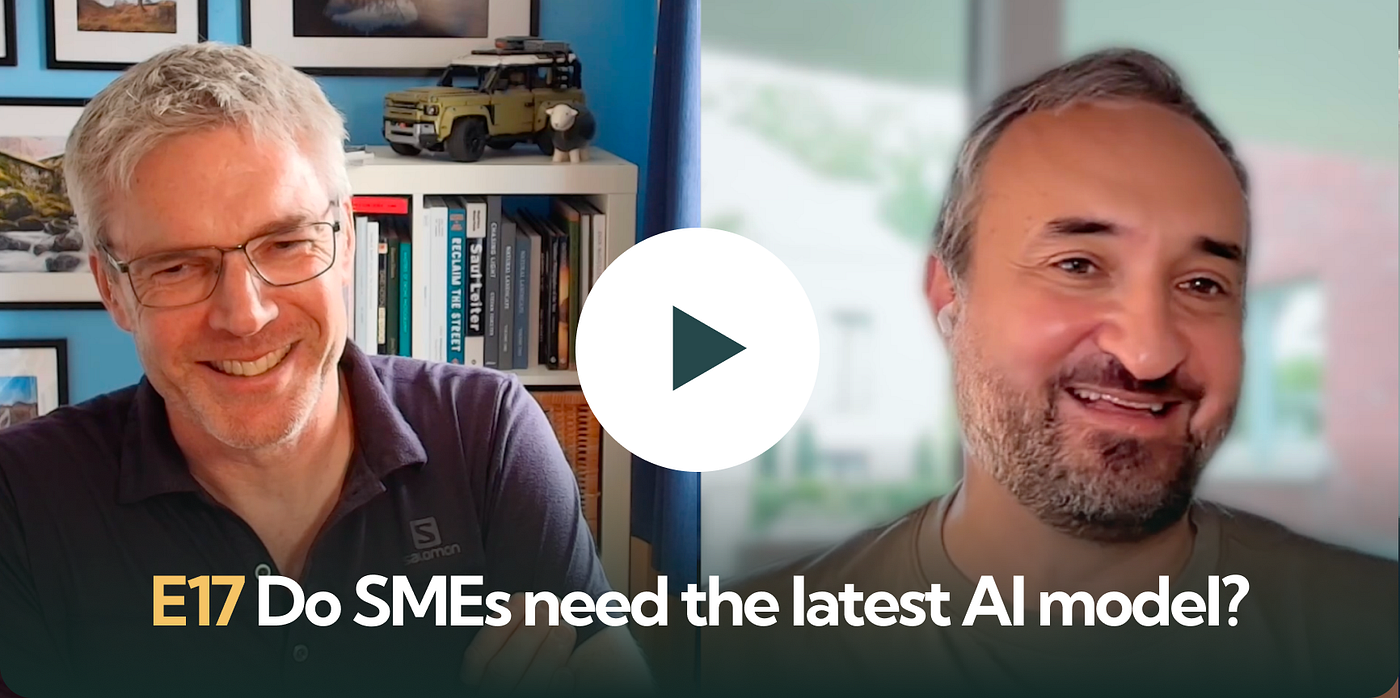
[embed]
Key ideas in this episode
For most everyday business tasks, models a generation or two old are more than capable — and considerably cheaper to run. How you use a model (context, prompting, data) matters far more than which model you use. Frontier access is no longer a given — recent regulation-by-vibes should make any business think twice about depending on a single provider’s latest release. Treat AI spend like any other investment: cost it properly, route tasks to the cheapest tool that does the job, and remember that sometimes the right model is no model at all.
The Ferrari and the supermarket run
If you follow the headlines, Frontier AI is AI. Fable, Mythos, the latest from Gemini or OpenAI — they hog every feed. But the past few weeks told a more interesting story underneath the noise. A Chinese lab released a model within touching distance of the American frontier — perhaps a quarter behind. Germany announced a public-sector AI built on Mistral, the European champion, which is itself roughly a generation behind. And the actual frontier? Launched, pulled by presidential whim, then reinstated. Regulation by vibes, as one of our recent guests put it.
Which raises the question we tackled this episode: should SMEs even care?
Our answer, in short: far less than the headlines suggest. If you’re lucky enough to own a Ferrari, you don’t take it to the supermarket — you can’t fit the shopping in. The latest models are astonishing machines, but for the tasks most businesses actually do — drafting, research, analysis, marketing content — a model that’s twelve or even eighteen months old will do the job admirably. There’s probably enough capability in today’s “older” models to keep most SMEs busy for the next four or five years.
Takeaways for SMEs
1. How you use the model beats which model you use
Theo spent a week comparing Fable against its predecessor. The verdict from a heavy user: for everyday tasks, you really have to squint to see the difference. What moves the needle isn’t the model — it’s everything around it. Better context, sharper prompts, the right documents and sources. Good inputs into an older model will give you excellent results. Bad inputs into a frontier model won’t be rescued by it. Garbage in, garbage out — same as it ever was.
The most useful mental model here is to think of your business as recruiting a new team member. What would you hand them on day one? Clear instructions, the resources to do the job, and the context they need. That’s what you should be giving the AI. Worry about that, not the version number.
2. Newer isn’t just marginal — it’s expensive
The frontier models are exceptionally capable and exceptionally token-hungry. Run the same prompt through two models and the consumption can differ dramatically — which matters when your £20–25 a month comes with a usage cap, and matters far more at scale. One post doing the rounds described a business tipping over the 150-user threshold into enterprise pricing: their annual AI bill was set to jump from around $400,000 to $1.4 million. FinOps for AI is fashionable for a reason. Set departmental budgets, watch your token spend, and educate teams to ask a simple question before every task: Do I actually need the big model for this?
3. Route the task, don’t default to the flagship
The AI-native companies we work with increasingly practise model routing: break incoming work into sub-problems and send each to the right tool. A small or open-source model for the routine parts. A frontier model only where it earns its keep. And — as we’ve said many times — sometimes the right model is no model at all. If the task is a deterministic calculation on structured data, why on earth would you use an LLM? Beware, too, of what low-code workflow tools build for you: they’ll happily make two round trips to a language model where one, or none, would do.
4. Availability is now a business risk
The Fable saga’s real lesson wasn’t about capability. It was that access to a frontier model can be granted, withdrawn, and re-granted at political speed — particularly for those of us outside the US. If your operations depend on a provider’s latest release, you’ve taken on a dependency you can’t control. Alternatives exist, they’re closer than the headlines admit, and building your workflows so you can swap the intelligence layer is simply good architecture.
5. One caveat: agentic work is different
If you’re building autonomous, multi-step agents, the newest models genuinely are better — they’ve been engineered for exactly that. But agentic workflows remain the exception, not the norm, for most SME tasks. (And yes, “agentic” deserves a proper unpacking — that’s a whole episode we now owe you.)
The great leveller
Here’s the part that should cheer up any SME leader. For £20–25 a month, you and your three-person business get access to broadly the same intelligence as a commercial bank in the City of London. Intelligence is now a layer in the stack, and it’s priced like a utility. The difference in outcomes comes from what you build around it — your data, your processes, your people. And there, smaller businesses have the edge: nimbler, less encumbered, faster to rearrange. More opportunity to extract value, quicker, for less upfront investment.
What should you do?
- Stop asking “which model?” Start asking “what problem, what context, what data?” That’s where the performance lives.
- Try the older models deliberately. For most day-to-day tasks, you’ll struggle to spot the difference — and your usage cap will thank you.
- Put AI spend through a proper business case. Cost the tokens, not just the licence, and check the value out exceeds the money in.
- Adopt model routing as a habit. The right model for the right job — sometimes including no model at all.
- Design for portability. Treat the intelligence layer as swappable, because access to any one model is no longer guaranteed.
The frontier labs have made their point — the science is remarkable. But adoption doesn’t happen at the frontier. It happens in the unglamorous middle, where the questions are about cost, process and people.
We can help with that.
This conversation is from Episode 17 of Beside Ourselves, the *Beside Partners podcast on AI in business. Listen on [Spotify](https://open.spotify.com/show/5CeK7JILe4LM7R9ZFEKRWo), [Apple Podcasts](https://podcasts.apple.com/us/podcast/beside-ourselves/id1857663469), or [YouTube](https://www.youtube.com/@BesidePartners).*
메타데이터
- post_id
- 85833503d3ac
- slug
- do-smes-really-need-the-latest-model-or-can-we-move-on-85833503d3ac
- url
- https://medium.com/beside-ourselves/do-smes-really-need-the-latest-model-or-can-we-move-on-85833503d3ac
- canonical_url
- https://medium.com/beside-ourselves/do-smes-really-need-the-latest-model-or-can-we-move-on-85833503d3ac
- author_url
- https://medium.com/@theotron
- status
- ok
- fetched_at
- 2026-07-10 01:40:30






