The New Frontier of LLMs: Why “In-Place TTT” is the Breakthrough We’ve Been Waiting For
Modern Large Language Models (LLMs) generally follow a rigid, two-phase lifecycle: first, we compress vast amounts of human knowledge into…
The New Frontier of LLMs: Why “In-Place TTT” is the Breakthrough We’ve Been Waiting For
Modern Large Language Models (LLMs) generally follow a rigid, two-phase lifecycle: first, we compress vast amounts of human knowledge into static weights during pre-training; then, we freeze those weights and deploy. Once deployed, the model stops learning. No matter how much new information you feed it during a session, its “brain” remains static.
While this works for short chats, it creates a massive bottleneck for long-context tasks, streaming inputs, or dynamic environments where the model needs to adapt on the fly. This is where Test-Time Training (TTT) comes in — an idea that has long promised to turn every inference step into a mini-learning session.
The Problem with Traditional TTT
The core concept of TTT is simple: allow the model to update a set of “fast weights” during inference. As the model reads new content, it compresses that information into these weights to help predict what comes next.
However, bringing TTT into the real-world LLM ecosystem has been plagued by three major hurdles:
- Architectural Incompatibility: Most TTT methods require specialized new layers, meaning you can’t use existing pre-trained models — you have to retrain from scratch.
- Sequential Bottlenecks: The update mechanisms are often token-by-token (serial), which kills the massive parallelism that makes GPUs efficient.
- Misaligned Objectives: Traditional TTT often focuses on “reconstructing the current token,” which is fundamentally different from the LLM’s actual job: Next-Token Prediction (NTP).
Enter “In-Place TTT”
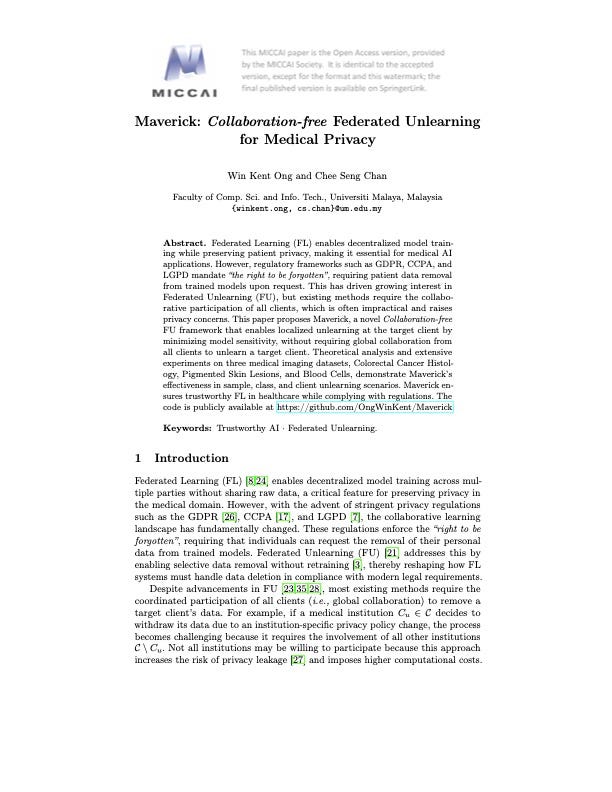
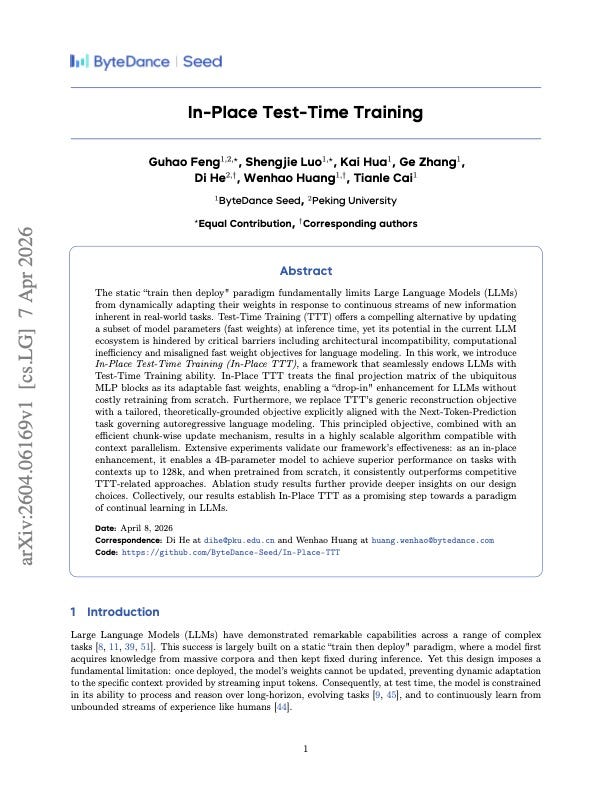
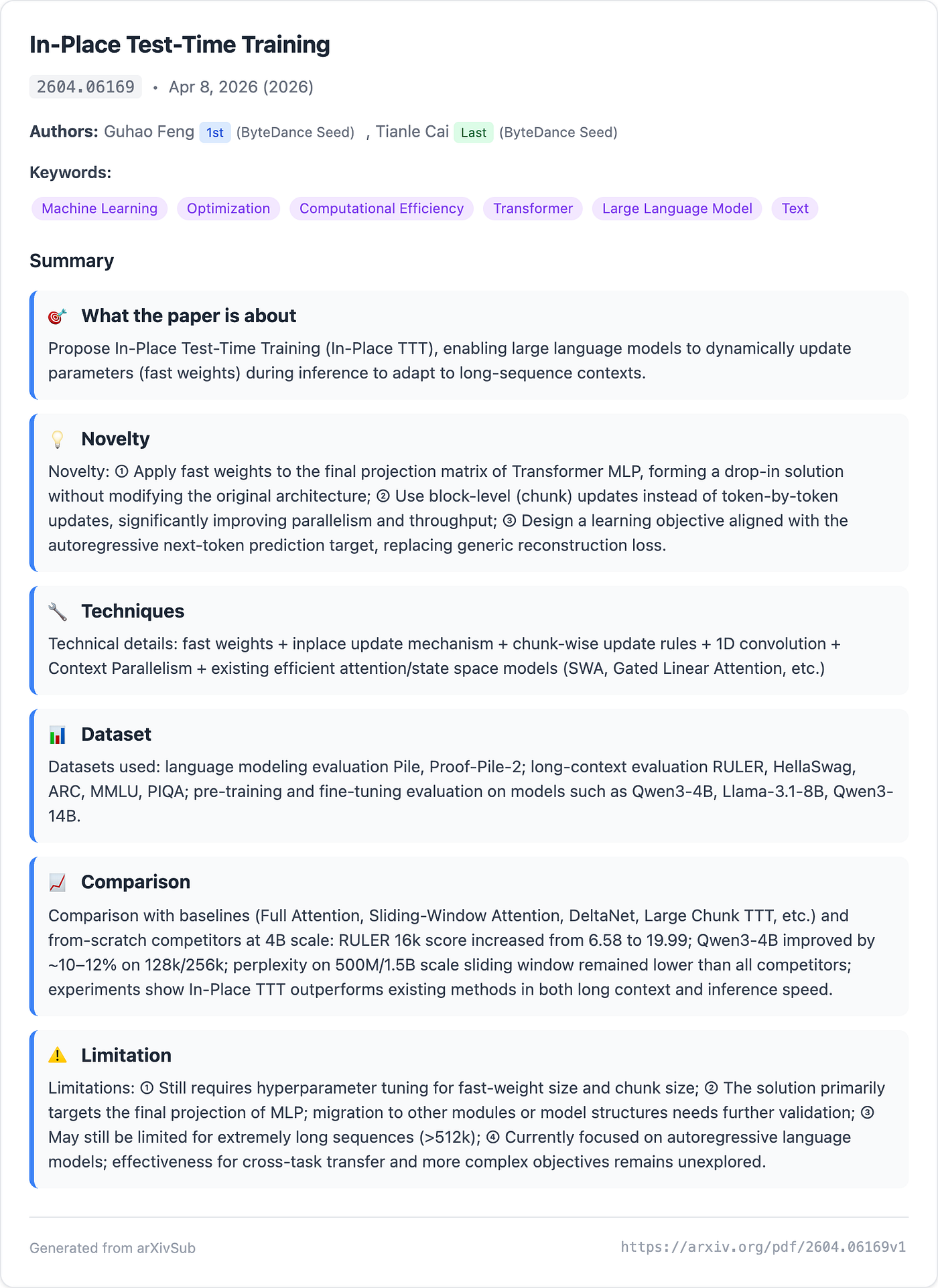
A recent paper has introduced a clever solution called In-Place TTT, which tackles all three problems simultaneously. Here’s why it’s a game-changer:
1. Zero Architectural Changes
Instead of adding new layers, In-Place TTT repurposes what’s already there. It treats the final projection matrix ($W_{down}$) of the existing MLP blocks as the “fast weights.” Because it doesn’t change the architecture, you can take a pre-trained LLM and “activate” its TTT capabilities through a brief period of continued pre-training. This is significantly cheaper and more practical than starting from zero.
2. Efficiency via Block Updates
By focusing on updating the MLP rather than replacing the Attention mechanism, the model doesn’t need tiny, serial chunks to maintain causality. It can process tokens in large blocks (512 to 1,024 tokens) at a time, fully leveraging GPU parallelism and keeping inference speeds high.
3. Aligning with Next-Token Prediction
This is the most theoretically robust part of the paper. The authors shifted the learning objective from simple reconstruction to a target that incorporates information about future tokens (extracted via a small convolution and a learnable MLP projection).
Using the “Induction Heads” framework (pioneered by Anthropic in 2022), the authors proved that updating fast weights with an NTP-aligned goal directly boosts the logit of the correct next token. Interestingly, this echoes the success of Multi-Token Prediction seen in models like DeepSeek — showing that teaching a model to look ahead during training makes it much smarter during execution.
Does it actually work?
The results are compelling. When comparing models through continued pre-training, the standard version and the In-Place TTT version perform similarly on short contexts. However, as the context scales to 64k, 128k, and even 256k, the TTT version pulls ahead significantly.
Even in “from-scratch” training tests (at 500M and 1.5B scales), the In-Place TTT model maintained the lowest sliding-window perplexity, with performance continuing to improve as the context lengthened.
The Takeaway
In-Place TTT suggests that the next leap in AI isn’t just about bigger datasets or more parameters — it’s about making models that can “think” and “learn” while they talk. By turning inference into a dynamic learning process without breaking the bank on compute, we are moving closer to AI that truly adapts to the user in real-time.
| Find papers faster on arXivSub with AI summary (CVPR/ICCV/ICML/ICLR/NeurIPS/AAAI/MICCAI)
메타데이터
- post_id
- 85d0e4474ea1
- slug
- the-new-frontier-of-llms-why-in-place-ttt-is-the-breakthrough-weve-been-waiting-for-85d0e4474ea1
- url
- https://medium.com/@zljdanceholic/the-new-frontier-of-llms-why-in-place-ttt-is-the-breakthrough-weve-been-waiting-for-85d0e4474ea1
- canonical_url
- https://medium.com/@zljdanceholic/the-new-frontier-of-llms-why-in-place-ttt-is-the-breakthrough-weve-been-waiting-for-85d0e4474ea1
- author_url
- https://medium.com/@zljdanceholic
- status
- ok
- fetched_at
- 2026-06-14 11:28:49