Best Foot Forward; Foot Locker’s Efforts to Survive Retail Apocalypse
By Caleb Mutua
Best Foot Forward; Foot Locker’s Efforts to Survive Retail Apocalypse
By Caleb Mutua
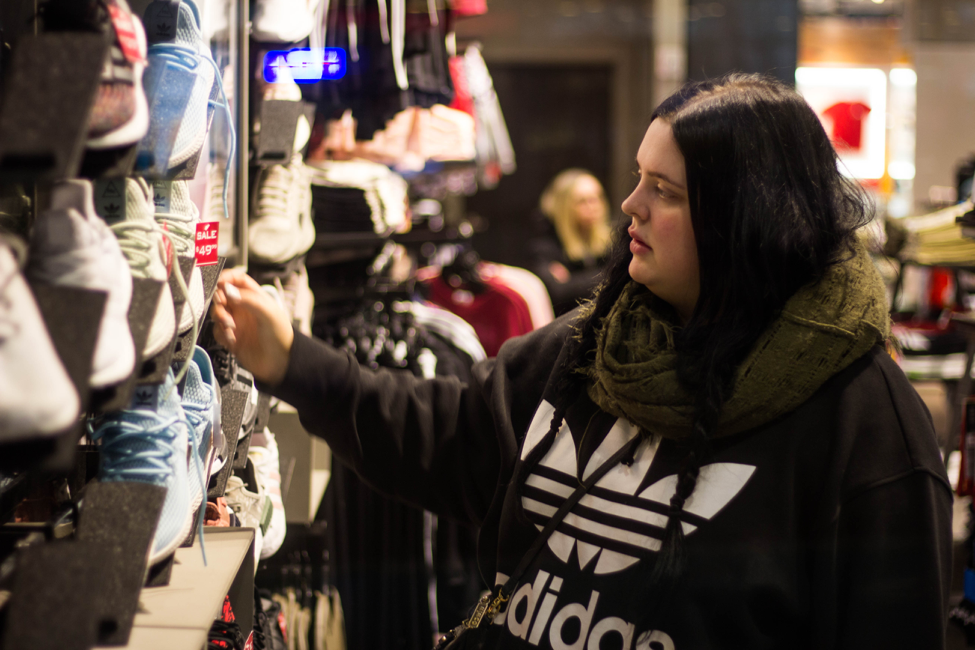
Savannah Noaman from Australia samples Adidas shoes at a Foot Locker store in Times Square on Cyber Monday, 2017. She spent $400 and got about $140 off. Photo: Caleb Mutua/ Caleb Images
Clad in headbands, ripped jeans and bright sneakers, a bunch of noisy teens entered the Foot Locker Inc. (NYSE: FL) store at Times Square on the Monday after Thanksgiving, the biggest online shopping day.
Brandon Figueroa,19, led the pack. He had just finished producing a new music video for one of his rapper friends and they decided to go shopping for sneakers. A huge “50% off” poster greeted them on their way in on 1460 Broadway.
Twenty minutes later, the group exited the store. They did not buy anything.
“The new Jordan sneakers they had on sale were available in few colors only,” said Figueroa. “We will keep checking online for updates.”
Figueroa, a New Yorker who moved to Orlando, Florida to pursue his career in videography, considers himself a sneaker-head. He said he once bought a pair of Air Jordan 3 Retro Doernbecher sneakers for $1,000.
“I prefer walking into a store because I can try the shoe and make sure it fits me right,” said Figueroa, a graduate of Renaissance High School for Musical Theater and Technology. “Also, sometimes they [sneakers] look a little bit different online from the way they actually are.”
His old Instagram account has videos and photos of him doing flips and dancing in high-priced sneakers and outfits such as LebRon, Air Jordan VI and Air Foamposite One Prm, among other premium sneakers. Premium sneakers range from $100 to over $20,000.
For its doors to remain open at a time when Amazon (NYSE: AMZN) is driving sales online, Foot Locker is hoping premium customers like Figueroa will continue going to its stores.
The convenience of instantaneous online shopping for footwear and apparel and speedy delivery has outmaneuvered multiple mall-based retailers. Foot Locker’s stock prices have fallen below the footwear stock index for the last five years while many of its competitors, such as Cornerstone Apparel, Rue21 and Gymboree, have filed for bankruptcy.
In November, the retailer announced that its same-store sales fell by 5.1 percent while online sales increased by 6.1 percent. Its net income fell by 35 percent to $102 million compared to the third quarter of 2016.

Stock price changes of Foot Locker Inc. against Dow Jones’s Footwear Index for the last five years. Source: Google Finance.
Stepping up its e-commerce game
Foot Locker is shifting its focus from brick-and-mortar stores to making it easier for shoppers to order shoes and other products online through its direct-to-consumer sites.
“An excellent example of the initiatives we have been taking to adapt our strategy is devoting an increasing share of capital spending to digital,” said CEO Richard Johnson during an earnings conference call in August. “This includes both customer-facing technology, such as our mobile apps, an enhanced e-commerce platform and new POS [point of sale] software; and back-of-the-house capabilities, such as infrastructure and data analytics.”
Johnson said the company has succeeded in the past by knowing individual customers better in order to engage with them in personal ways and through adding stores where their customers want them to be.
In August, Foot Locker announced plans to close 135 stores and open 90 new stores by the end of the year, though it is unclear which locations will be affected.
“We are undergoing a comprehensive process of evaluating priorities for next year and beyond, accelerating our commitment to digital, investing in the right stores and speeding up our logistics efforts,” he said. Best to paraphrase quotes like these. They’re tedious unless trimmed to their basics
Foot Locker believes that at the premium end of the market, most of its customers want to buy a product that has a connection to a good experience they can participate in.
“That experience could be a special event in a store, being notified out or discovering a video on our website or YouTube channel of an athlete or celebrity wearing or discussing the latest product, an interaction with their friends while touching and feeling the product or simply a conversation about sneakers with one of our stripers or other store associates,” said Johnson.
Tebogo Nkosi, a South African who was visiting New York City recently, agrees that customers value compelling store experiences. Nkosi bought a pair of Jordan 3 Flight Sneakers at the Times Square Foot Locker store when he visited.
“I’m not an online person because of the fraud,” said Nkosi. “I’m 42 years old, I still believe in going into a store and having a conversation with the store attendants to get a better idea of what to buy.”
Some manufacturers are bypassing retailers altogether. Foot Locker’s main supplier, Nike (NYSE: NKE), started promoting and selling footwear directly on Amazon in June. Nike wants to increase its e-commerce sales to $50 billion by 2020.
With free shipping and free returns for its prime customers, Amazon-owned Zappos is proving to be a headache for Foot Locker and other sporting goods retailers. Its shoe sales grew by 35 percent from 2015 to 2016, according to One Click Retail.
However, Prof. Mark Cohen, the Director of Retail Studies at Columbia Business School, said that Amazon’s Zappos does not have access to all of the premiums styles that Footlocker has available in their stores, making it hard for the tech giant to take away all of Foot Locker’s customers.
“This is a deal that Foot Locker makes with suppliers like Nike to protect the viability of their customer base and their stores,” said Prof. Cohen, who also serves as an independent consultant to both the retail and consumer products industry.
Global Investment Bank UBS said in a report that Amazon, which bought Zappos in 2009 for $1.2 billion, is for the first time selling more Nike shoes than Foot Locker.

UBS Evidence Lab survey with 1,000 U.S consumers showed that Amazon outstripped Foot Locker as a more popular shopping destination for footwear.
The report was referring to customers like Audrey Grasolle, a lawyer from France who bought puma shoes and jeans at the Times Square Foot Locker store on Cyber Monday and got a 40 percent discount.
“I prefer to buy online when am not traveling because I hate spending time in crowded stores and having to deal with annoying people while waiting in line,” she said. “Online gives you a variety of options to choose from, you can quickly compare discounts and you can easily send back clothes and shoes that don’t fit you.”
Cohen highlighted a number of reasons why Foot Locker will continue to remain in business despite Amazon’s dominance.
“Some of Foot Locker’s customers can’t shop on Amazon, or the internet for that matter, because they are young and they don’t have a credit card,” he explained. “It’s almost impossible to do business on the internet without the benefit of some kind of a credit instrument and a lot of the young people don’t have access to access to one so they will shop in the store and typically pay cash.”
Cohen also said that many of the Foot Locker’s premium athletic brands are styled for young, inner city guys, and that they don’t shop on the internet because they can’t take deliveries at home.
“They live in places without a doorman,” he said. “They are typically shopping in brick-and-mortar and the fact is the only access to some of these styles is Foot Locker.”
Future prospects
The industry expects the penetration of e-commerce to continue to rise. However, analysts like Cohen are optimistic that traditional retailers like Foot Locker can succeed.
“It doesn’t serve Nike’s purpose, Adidas, or anyone else to put Foot Locker out of business,” he said. “They [Foot Locker] just have to be vigilant that their physical stores are located in places which remain viable and not trapped in big malls.”
Foot Locker operates in a segment where customers value the ability to see, touch and try products and they have over 3,000 stores in 20. Cohen added that Foot Locker will have to build an internet business in its own right because many of its customers want to shop with them that way.
“They have to have assortments in their stores that are exclusive to them. They also have to provide service in the form of sizing and advice that you can’t be able to get on the internet, even through a chat line.”
메타데이터
- post_id
- 85d1e735ba86
- slug
- best-foot-forward-foot-lockers-efforts-to-survive-retail-apocalypse-85d1e735ba86
- url
- https://medium.com/@calmutua/best-foot-forward-foot-lockers-efforts-to-survive-retail-apocalypse-85d1e735ba86
- canonical_url
- https://medium.com/@calmutua/best-foot-forward-foot-lockers-efforts-to-survive-retail-apocalypse-85d1e735ba86
- author_url
- https://medium.com/@calmutua
- status
- ok
- fetched_at
- 2026-06-20 20:29:01