🚀 Understanding FastAPI: A Beginner’s Guide to Modern API Development
Backend development plays a crucial role in every modern web application. Whether you’re using a mobile app, shopping online, booking movie…
🚀 Understanding FastAPI: A Beginner’s Guide to Modern API Development
Backend development plays a crucial role in every modern web application. Whether you’re using a mobile app, shopping online, booking movie tickets, or accessing social media platforms, all these applications rely on APIs to communicate between the client and the server. As web applications continue to evolve, developers need frameworks that are fast, efficient, easy to use, and capable of building high-performance APIs.
One such framework is FastAPI, a modern Python framework designed specifically for building APIs quickly and efficiently. Built on top of Python’s type hints, FastAPI allows developers to create powerful RESTful APIs with minimal code while providing automatic documentation, data validation, and excellent performance.
Before learning FastAPI itself, it is important to understand how applications communicate, how APIs work, and why backend frameworks are essential. In this article, we’ll explore the fundamentals of FastAPI, client-server architecture, API communication, HTTP methods, CRUD operations, path and query parameters, and data validation.
📌 What is FastAPI?
FastAPI is a modern, high-performance web framework for building APIs using Python. It is designed to make backend development simple, fast, and efficient.
FastAPI offers several advantages:
- High performance
- Easy-to-read Python syntax
- Automatic API documentation
- Built-in data validation
- Asynchronous programming support
- Easy integration with databases and frontend applications
Because of these features, FastAPI has become one of the most popular frameworks for developing REST APIs.
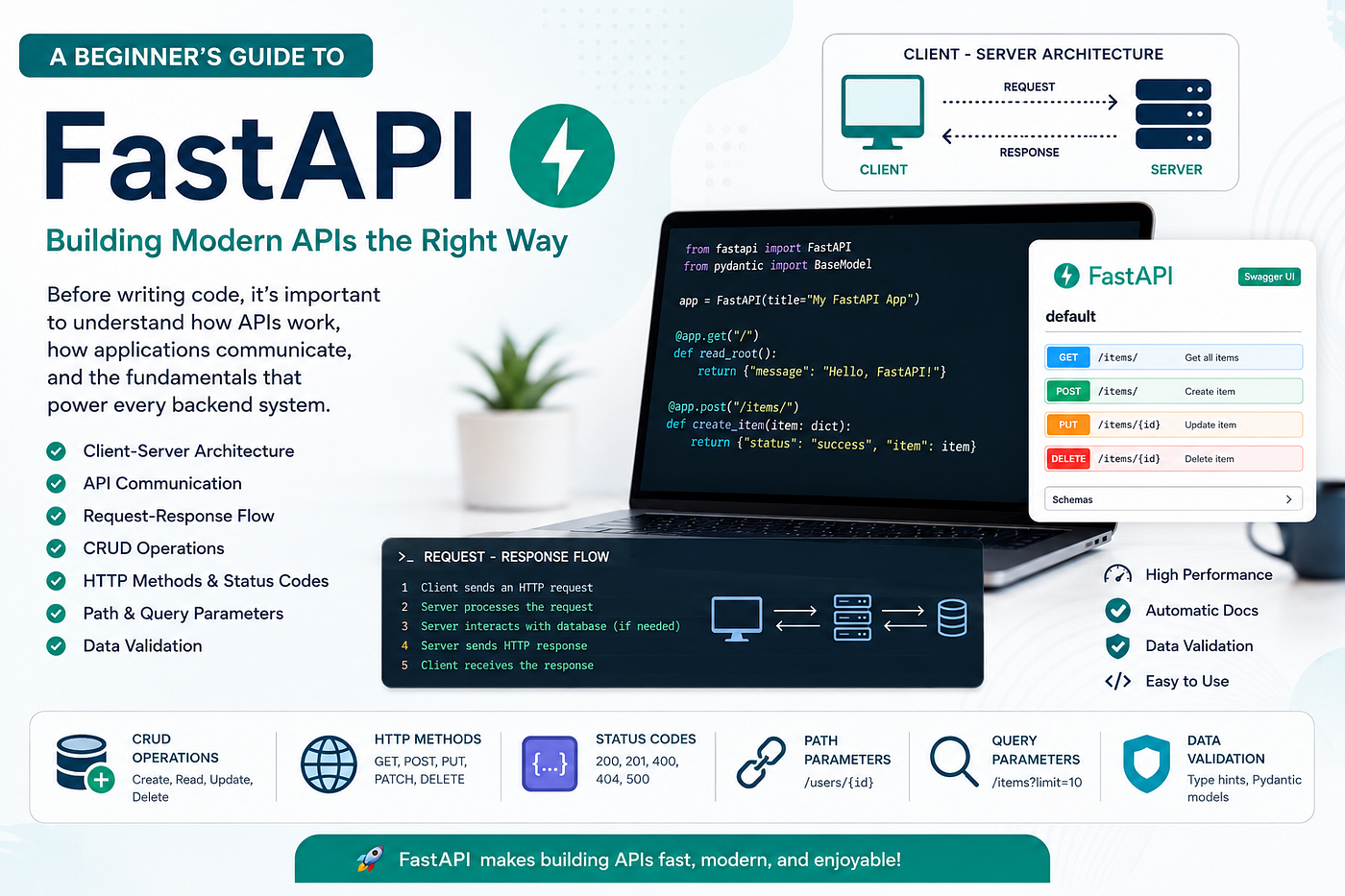
🌐 Understanding Client-Server Architecture
Before building APIs, it is important to understand how modern applications communicate.
Every web application consists of two major components:
Client
The client is the application used by the user.
Examples:
- Web browser
- Mobile application
- Desktop application
The client sends requests to the server whenever the user performs an action.
Example: When you search for a product on Amazon, your browser sends a request to Amazon’s server.
Server
The server receives requests from clients, processes them, interacts with databases if necessary, and sends back responses.
Examples:
- FastAPI Server
- Django Server
- Node.js Server
The server acts as the brain of the application.
🔄 How API Communication Works
API stands for Application Programming Interface.
An API acts as a bridge between two software applications, allowing them to exchange information.
Example
Imagine ordering food using a food delivery app.
- You place an order using the mobile app.
- The app sends a request to the restaurant’s server.
- The restaurant prepares the food.
- The server sends the order status back to the app.
Similarly, APIs enable communication between the frontend and backend.
📨 Request and Response Flow
Every API follows a Request–Response cycle.
Step 1
The client sends an HTTP request.
Step 2
The server receives the request.
Step 3
The server processes the request.
Step 4
The server returns a response.
Example:
User → Website → FastAPI Server → Database
Database → FastAPI Server → Website → User
This communication happens within milliseconds.
🛠️ Understanding CRUD Operations
Almost every backend application performs four basic operations known as CRUD.
Create
Adds new information.
Example: Creating a new user account.
Read
Retrieves existing information.
Example: Viewing your profile.
Update
Modifies existing information.
Example: Changing your password.
Delete
Removes information.
Example: Deleting an account.
CRUD operations form the foundation of almost every REST API.
🌍 HTTP Methods
HTTP methods define the type of operation performed on a resource.
GET
Retrieves information.
Example: Fetching all products.
GET /productsPOST
Creates new information.
Example: Adding a new student.
POST /studentsPUT
Updates an entire resource.
Example: Updating employee information.
PUT /employees/10PATCH
Updates only specific fields.
Example: Updating only the user’s email.
DELETE
Deletes data.
Example: Removing a product.
DELETE /products/5Each HTTP method has a specific purpose and helps make APIs more organized.
📋 HTTP Status Codes
Whenever a server responds, it returns a status code indicating whether the request was successful.
200 OK
The request completed successfully.
201 Created
A new resource was created successfully.
400 Bad Request
The request contains invalid data.
401 Unauthorized
Authentication is required.
404 Not Found
The requested resource does not exist.
500 Internal Server Error
An unexpected error occurred on the server.
Understanding these status codes helps developers debug APIs efficiently.
⚡ Why Choose FastAPI?
FastAPI has become increasingly popular because it combines simplicity with performance.
Some of its major advantages include:
- Extremely fast execution
- Automatic Swagger documentation
- Interactive API testing
- Built-in request validation
- Easy integration with databases
- Modern asynchronous support
- Minimal code compared to traditional frameworks
These features make FastAPI suitable for both beginners and professional backend developers.
🛣️ Path Parameters
Path parameters allow developers to pass values directly within the URL.
Example:
/students/101Here,
101represents the student ID.
FastAPI automatically extracts this value and makes it available inside the application.
Path parameters are commonly used for:
- Product IDs
- Student IDs
- Employee IDs
- Order IDs
🔍 Query Parameters
Query parameters are additional values passed after the URL using the “?” symbol.
Example:
/products?category=laptopAnother example:
/students?department=CSEQuery parameters are mainly used for:
- Searching
- Filtering
- Sorting
- Pagination
Unlike path parameters, query parameters are optional in most APIs.
✅ Data Validation
One of the biggest strengths of FastAPI is automatic data validation.
Instead of manually checking user input, FastAPI validates incoming data automatically using Python type hints and Pydantic models.
Example validations include:
- Integer values
- Email format
- Required fields
- Minimum and maximum lengths
- Numeric ranges
If invalid data is submitted, FastAPI immediately returns a clear error message.
This improves:
- Security
- Reliability
- Code quality
- User experience
📚 Automatic API Documentation
One of FastAPI’s most impressive features is automatic documentation.
As soon as APIs are created, FastAPI generates interactive documentation using Swagger UI.
Benefits include:
- Testing APIs directly from the browser
- Viewing request and response formats
- Understanding endpoints easily
- Faster debugging
This saves developers significant time during development.
🌍 Real-World Applications of FastAPI
FastAPI is widely used in modern software development.
E-commerce
- Product APIs
- Order management
- Payment processing
Healthcare
- Patient management systems
- Medical record APIs
- Appointment booking
Banking
- Transaction APIs
- User authentication
- Financial services
Machine Learning
- Deploying ML models
- Prediction APIs
- AI-powered applications
IoT Applications
- Device communication
- Sensor monitoring
- Smart home automation
🚀 Advantages of Learning FastAPI
Learning FastAPI offers many career benefits.
It helps developers:
- Build RESTful APIs efficiently
- Deploy Machine Learning models
- Integrate frontend and backend applications
- Develop scalable web services
- Learn modern backend development practices
Because FastAPI is based on Python, it is also an excellent choice for Data Science and AI developers who want to deploy their machine learning models.
📌 Conclusion
FastAPI has quickly become one of the most preferred backend frameworks for Python developers because of its simplicity, speed, and developer-friendly features. Understanding concepts such as client-server architecture, API communication, request-response flow, CRUD operations, HTTP methods, status codes, path parameters, query parameters, and data validation provides a strong foundation for building modern backend applications.
Whether you’re a beginner exploring backend development or a Machine Learning engineer looking to deploy AI models, FastAPI provides an efficient and scalable solution. Learning these fundamentals not only improves your understanding of web development but also prepares you to build production-ready APIs for real-world applications.
메타데이터
- post_id
- 85d94d8b18ef
- slug
- understanding-fastapi-a-beginners-guide-to-modern-api-development-85d94d8b18ef
- url
- https://medium.com/@sunanditha28/understanding-fastapi-a-beginners-guide-to-modern-api-development-85d94d8b18ef
- canonical_url
- https://medium.com/@sunanditha28/understanding-fastapi-a-beginners-guide-to-modern-api-development-85d94d8b18ef
- author_url
- https://medium.com/@sunanditha28
- status
- ok
- fetched_at
- 2026-06-27 18:20:27