The Defence of Graham’s Town and end of the Sixth War, 1835
Being a historically accurate fictionalised retelling of Joshua Norton’s early life, including historical records. Pt12
The Defence of Graham’s Town and end of the Sixth War, 1835
Being a historically accurate fictionalised retelling of Joshua Norton’s early life, including historical records. Pt12
The Defence of Graham’s Town, Jan 1835
Generally, when sixteen-year-old boys want to experience the thrill of war, thy have to leave their homes to do so. This was not the case for Joshua, who found a rifle thrust into his hands as he desperately tried to keep up with the shouting of the townsmen. War was coming to him, whether he liked it or not.
Less than a month after the unnamed chief’s death, and less than a week after the news first reached Cape Town, Grahamstown saw the gathering of the local garrisons. Boer, Burgher and Khoi commandos mobilised to hold the town until reinforcements could arrive. Piet Retief came with his column, having spent the last few years riding at the head of the only force that patrolled his people’s lands, the only commandos that would see their cattle returned when the British Government refused to let them raise a hand against the raiders until after their theft was done.
Philip and Louis Norton were already armed, and looking more comfortable with their weapons than Joshua felt he ever would. At fifteen and nineteen, his brothers were already grown men, their lives accelerated by the hard lessons of colonial life. Sandwiched between them, Joshua looked on uncertainly. He had not been given a musket, or he showed no aptitude with it. Still, he tried to look the part, following the lead of his more assured siblings.
Still, it was what everyone was doing, so there he was, awkward and out of place even among his brothers.
Over them all, a single voice boomed out. At 29, George Wood was Commandant of the Town Guard, a force that had seen no genuine conflict in over a decade. Their task was more to provide security than armed response, which was left to the likes of Retief’s commandos. Still, it fell to him to keep the town together until reinforcements could arrive, as everyone above him seemed to have abdicated any authority in fear of their lives.
Wood formed the Committee of Safety Grahamstown, enlisting every able bodied man to the fight. Their actions were mostly shambolic and disorganised, but at least it kept them busy. Anything was better than thinking about the horde that was underway, and the absolute destruction they faced.
While Wood was trying to forge an alliance amongst the groups that had gathered in town, help was swift approaching. Harry Smith had ridden hard from Cape Town to Grahamstown, making the journey in an astonishing six days. By the time he stormed into the church to take over, he was as physically and mentally sore as a man can be, holding himself together by the force of will and the knowledge that the war would get far worse before things got any better.
When he arrived in town with a detachment of Imperial British Imperial Troops from Port Elizabeth, everything was in chaos. With Governor Somerset in charge, this was not a particular surprise. In Smith’s eyes, Somerset suffered all the usual failings of both civilians and aristocracy, and he had expected no better.
Still, it was time to go and put the fear of God, and of Smith himself, into whoever was in charge of this chicken coop.
George Wood was in the middle of an argument he could not win. He was certain that if the townsfolk just listened to him, then they could ensure their survival. The barricades were going up, but critical voices rose in every corner. He had never held a real command position before, and for all his abilities as a leader in the community he commanded little immediate respect.
He rose to speak, dismissing the man who was complaining that the barricades were worse than useless, and that they were making everyone in town more on edge. Before he could open his mouth, a hard knocking came at the door, as if a storm had arrived and was demanding entry.
The echoes in the church died away as the door slammed open, and a man in immaculate military dress strode in. His uniform had been hard worn by his ride, but in this place he needed to command notice, not scorn, so he had changed his clothes as they came into town. Clothes maketh the man, after all, and he needed to impress himself on these people quickly and absolutely.
“Who’s in charge of this chicken coop? I am Captain Smith, and I’m here to save your sorry hides, or to tan them. Why the hell have my orders not been followed? You bloody fools will see yourselves dead and gone by your on damned stupidity!”
A hush descended. Every man present had heard of Smith, for who could forget the man that had stormed Washington and burned the White House in the 1812 war with the Americans. Despite being one of the men who piled the chairs and lit the fire in the mansion, he had famously called the action barbaric. This did not stop his forces from going on to burn the Congress, the Treasury, the State Department and the War department buildings.
Unfortunately, George Wood was singularly unimpressed by Smith. He played at the role of military command, and assumed that all others did too. He saw no need to let such rudeness stand, even from a hero of the Empire. “Well I never! Whoever sent you, sir, you would do well to mind your language. This is not a barracks. We at the Committee of Safety received your recommendations, but it is our responsibility to see to the safety of the town. You have no authority over us, my good man.”
Smith looked Wood up and down. Everyone was looking at the pair of them, and he knew acutely that these moments ended in disaster more often than not. He spoke softly, in a hissing voice that carried only to Wood and those close to him. “My authority comes from the Crown, and from my own strength. Do not think to defy me, Settler. Whatever petty empire you have built here, it is getting in my way, and will be dissolved momentarily. Now get out of the bloody way.”
He drew himself up, and every man in the room unconsciously straightened in response.
Smith’s next words came with a voice of thunder. “I am not sent here to argue, but to command. You are now under martial law, and the first gentleman, I care not who he may be, who does not promptly and implicitly obey my command, he shall not even dare to give an opinion; I will try him by a court martial and punish him in five minutes.”
There was a stunned silence from the Committee Members. They were townsfolk, who fancied themselves capable, yet were utterly overwhelmed by the reality that had ground towards them. They needed firm command, at least until matters could be stabilised. The work they had done so far had achieved little but for panicking the town.
When Smith spoke again, it was quieter, but no less carrying. “Mr…?”
“Wood, sir. George Wood. Commandant of the Town Guard. My second is Andrew Geddes Bain, captain of the Beaufort Levies, who make up the bulk of our troops.”
Smith carefully ignored the topic of local troops. They would be needed, but he had the military man’s distaste for civilian militia, however essential they were. Dealing with them was for another day. These town defence groups were all the same, convinced they could hold off the tide with their imaginary force of arms and experience in war. “Mr Wood. Your town has survived so far through the work of your committee, but needs proper order. The folk out there are acting against one another, and the confusion is adding to their fear. We must act of one accord, under a clear plan of attack. As the leader of the existing defence, I think it would be appropriate for you to be made a major under my command for the duration of this war. That way, the townsfolk can hear their orders from you. They will be assured that the community is still headed by a local man, and has not been simply taken over by the military.”
It took Wood no time at all to see the obvious conclusion. “Well, if it will keep the townsfolk from your cursing, then I certainly agree, sir. Would you like to review the plans we have made, or our lists of people or resources?”
Smith smiled coldly, nodding his assent. This was not the first time he had needed to take over a town for the sake of its defence. He had never yet failed to guess the level of commission that the local leader needed to assuage their ego and conscience. Much like Churchill in 1939, he had been warning about the inevitable war for years, and was ready for a campaign that would take the front far from this location.
For the moment, he was jaded but not the enraged creature he would become. That was for later, when the inevitable fate he foresaw from the end of the war came to pass.
Harry Smith’s diaries, 1835
I at once observed that this defensive system would never restore the lost confidence, and I resolved, after I had received reports and assumed the command, to proclaim martial law, and act on the initiative in every respect. The Civil Commissioner recommended me to go to the meeting. I deemed this a good opportunity to display my authority, which I was resolved on doing most arbitrarily on such a momentous occasion. When I went in, there was a considerable assembly of very respectable-looking men. I asked what was the cause of delay in executing my demands. One gentleman, a leader in what was called the Committee of Safety, which I very soon complimentarily dissolved, stood up and began to enter into argument and discussion. I exclaimed in a voice of thunder, “I am not sent here to argue, but to command. You are now under martial law, and the first gentleman, I care not who he may be, who does not promptly and implicitly obey my command, he shall not even dare to give an opinion; I will try him by a court martial and punish him in five minutes.”“
John Jarvis Bisset, C.B., K.C.M.G., 1835
“We proceeded to some farms on the Kareiga River south of Grahamstown, to give warning or assistance to the scattered homesteads. On arriving at Botha’s Farm, we found the Dutch women running from house to house with children under their arms, screaming that their husbands were surrounded by Kaffirs some ten miles away. We rode very fast in the direction of the firing and found three Dutchmen encircled in a small clump of bush by some hundreds of Kaffirs. They kept hurling assegais, but were afraid to rush in as the Dutchmen kept up a rapid fire from their two guns. The third man had no gun. We came up just as they exhausted their ammunition. The natives dispersed after having captured their waggons and oxen. The men were in a sad plight, one having received nineteen assegai wounds and the other twenty-two. The clump of bush resembled a porcupine, for it bristled with assegais sticking in every tree.”
The War Gets Messier, Feb 1835
On the 6th of January 1835, they set out on their retaliatory campaign. Colonel Harry Smith took command of the combined forces in Grahamstown and retaliated for the Xhosa retaliation. Magoma and Tyali, the other Xhosa leader, escaped to the Amatola mountains.
The frontier was a messy place, in which atrocity was often committed in name of a king and country who were mostly unaware of what happened.
Benjamin D’Urban firmly believed that the Empire’s safety could only be assured by annexing the territory of the natives. Longer term, he saw the only option as bringing the loyal tribes under direct control of the Crown.
On this matter, the government back in Britain disagreed, thinking that what they needed was a clear demarcation, with Xhosa chiefs agreeing to keep to a line along the river. That way the crown would be saved the trouble of having to administer the vast land themselves.
From the palace at Westminster, this seemed like a superb idea. Its one flaw is that it completely failed to account for the situation on the ground. The Bantu tribes had been nomadic for centuries. That one could have a fixed border along something as changeable as a river made as little sense to them as title deeds and a King thousands of miles away.
Both D’Urban and Graham knew better. Graham’s approach was barbaric, but ensured that the land could be relatively easily policed, and that it was ready for settling whichever chosen tribes could shield the English from their brethren.
D’Urban’s approach was rather gentler. He correctly assumed that the Bantu tribes would trade for weapons and agricultural equipment. It was only one short step to think that a reliance could be created on the British by this means. It had worked in China and India, after all.
Unfortunately, he could not avoid the classic mistake of the British. As we have seen so often, he assumed that the tribes worked as a single administrative network, and that they could be bound by the kinds of treaty and territorial understanding that could be forced onto more administrative cultures.
Being a wealthy Imperial aristocrat, he blamed this failure squarely on the tribes, and used their inability to do what he wanted as a reason to undertake a campaign of brutality. He decided that the tribes here needed subjugating, not appeasing. With the Fengu, he had a native force that gave them the extra manpower that they needed to ensure that “proper degree” of terror. He could extend the buffer zone without putting more British lives at risk, so as far as he was concerned it worked out for everyone.
It had taken five hard weeks for the Xhosa to be driven back from the settled lands. By the 12 February 1835, the campaign led by Sir Harry Smith and Sir Benjamin D’Urban had gone on for too long. Do not think that they sickened of savagery. That would be far too simple an explanation.
D’Urban was filled with a righteous fervour. He knew that the city of Port Natal would be renamed in his honour, and was at the height of his glory and power in capturing so much land for the Crown. Smith was nearing fifty, and at coming to the height of a long and successful career.
Both men were concerned with glory, and the health of their careers. They realised that this would make them unpopular, perhaps even a target for the newspapers that were always complaining about soldiers being too free with the King’s resources.
D’Urban and Smith, March 1835
By March, D’Urban was getting bored. The sweeping victory he had envisaged had not come to pass, and instead he was bogged down in another grinding war of attrition. He had believed that every one of his predecessors was a fool, who had faltered in the breech and failed to use the right amount of violence. He had not faltered there, and yet the rivers of blood spilled at his command had not taught the natives their proper place.
It was enough to make a well-bred English gent weep.
Enough was enough, he thought to himself, and strode uphill to Smith’s command post.
At the command post, Harry Smith was feeling rather less depressed about affairs. Long campaigns when the government was convinced there was easy victory at hand was far from unfamiliar. After three decades of service, the inevitability of wars of attrition, focused around logistics more than combat, were well known to him. For the moment, he was safe and at peace, and that was all he wanted.
He was awaken from a light doze in his chair by a sergeant, who had spied D’Urban approaching.
“Bloody hell, he’s coming this way. Heads up, guv, I think he’s lookin’ for you.”
Harry Smith slowly clambered to his feet. The brief doze beneath a tree had refreshed him somewhat, but not enough to deal with the likes of D’Urban. For perhaps the thousandth time, he wondered at a fate that would require him to work so closely with such a pompous ass. All he really wanted was to do his job, but it came with many unpleasant companions. He believed fervently that they were doing the good and right and godly thing in bringing civilisation to these lands, and that the cost in lives was a mere token compared to what would be gained, for the natives as well as the Empire. Like all empires, this one marched forwards on the blood of people whose otherness made them subhuman at best. There was always plenty of rousing action so long as he was careful to play nicely with both officers and enlisted men.
“You there! Smith!”
“Sir!” Smith snapped off a textbook perfect salute, to antagonise D’Urban as much as anything else. The man insisted on believing that his inferiors were, well… inferior… and didn’t like to be reminded that they were soldiers, just like him. Over the course of the war, the man would come to respect him, as his ‘superiors’ inevitably did. Until then, he remained the picture of a well-rounded officer, at least when D’Urban was around.
Apparently, there had been a time when the man had been a good officer, someone you could trust. Well, as much as you could trust any of the aristo arseholes that littered the military. However, he’d now started collecting honours and awards like they were going out of fashion.
In Smith’s experience, the weight of all that gilding and frippery distorted a man’s mind. By now, D’Urban had gone entirely to seed, and believed himself to be the lone voice of civilisation in the wilds of Africa.
There was a particular wheedling tone to D’Urban’s voice that made clear his exasperation and pique at not being finished. They had ridden together for months, but he still took offence at the fact the native tribes did not work the way European nations did. “What’s Hintsa doing? We’ve been waiting for two months, dammit! I know these savages have no concept of time or honour, but something must be done!”
Smith stayed silent, mulling over his options as D’Urban continued ranting. He decided that he would try telling the truth. It hadn’t worked so far, but you never knew, the army was just the kind of place for repeating the same things and expecting a different outcome.
“They are just as ignoble as you say, sir. I fear that he does not intend to honour our request. The scouts tell us that he has removed his men to safer ground, and is preparing for winter.”
“Enough! Today we shall confront him, and show him the what happens to those who dare breach the Crown’s trust!”
And with that, he was away, off to yell at someone else, while everybody rushed to follow his orders.
The sergeant spat a thick wad of chewing tobacco out, leaving a deep red smear on the patchy soil. “Is ‘e thick, or what?”
“Peterson. We’ve spoken about this before. You can’t call your commanding officer thick. He is the governor chosen by the Crown to represent our glorious king.”
“So if ‘e’s not thick, wot is ‘e, then?”
Harry lit a cigarette and took a deep drag. “You must understand. They never see the reality of the lives we live.”
The sergeant gave this due consideration as he slapped at the swarming mosquitos. With winter approaching, stagnant pools lay everywhere, and the bugs here were huge compared to the Indian ones he had known. “‘owcome you’re not like that, then? You’re an officer, but you don’t seem much like the toff.”
“Why, thank you, Peterson. That means a lot. I’m an officer, but my family is some way from the gentry, unlike our glorious leader. He’s not a bad sort, as they go, but then they don’t go all that well, in my experience.”
Peterson took a simpler, but no less valid, perspective. “Bollocks. ‘e ain’t nothin’ like us. You might be a toff, but you know you’re a bloke, same as the rest of us. I reckon ‘e thinks ‘e’s built of different stuff. Ain’t nothin’ Christian or good about him. Only reason ‘e ain’t dead is that we couldn’t get away with killing ‘im, not with his cronies round all the time.”
Smith nodded absently, thinking of other commanders. In the distance, he could hear D’Urban commanding a show of force, for all uniforms to be polished and ready to impress the savage Xhosa with their magnificence.
Fighting in the Napoleonic Wars and the invasions of Rio de la Planta, he had learned the concept of humane warfare from the duke of Wellington. Now, there was a real general, one of the few nobles that Smith and other enlisted men had time for.
“Times change, my friend. The enemy we fight, the struggle to bring this place into the Empire … it is a very different thing here than anywhere else we have been. These tribes have no concept of property and law, not as we do. The idea of a nation or structured military is alien to them. We asked Hintsa to attack the Rharhabe chiefs, and he promised us a thousand men.”
Smith took a moment to have a long look at the complete absence of Hintsa’s troops around them. “As you can see, he has fallen short. D’Urban thinks he lacks the stomach for war, but I suspect he has no true authority over his people. D’Urban cannot see that Hintsa is not a commander as we British would have. Hintsa cannot understand that, in working with us, he is helping to bring civilisation and its wonders to his people. This has dragged on for too long already, and soon enough D’Urban will realise those troops are not coming. Things will fall apart, then we can get back into the thick of it.”
It would only take another month for Smith to be proved right. Bitter at having been fooled when he desperately needed men that knew the land and could survive it better than the Imperial troops, D’Urban declared war on Hintsa.
On Commissions of Rank
In those days, a military was a very different beast to what it is today. The British army, conquerors of the world, have vanishingly few professional soldiers amongst their ranks, relying far more heavily on asymmetric force of arms and trade. It was relatively easy to command a division of troops, when you had rifles and industrial capacity behind you, and shortened spears were the height of military technology for the enemy.
At that time, commission was available to any man who could afford the cost of an officer’s rank. For the equivalent of about $50,000 in today’s money, D’Urban had bought himself the power of life and death over other men, and like many of his contemporaries took to it with relish. He had swiftly earned enough prestige and money to buy his way up the ranks. In short order he had paid the $600,000 deposit that brought one the highest available ranks.
Smith, on the other hand, was a career soldier, of the type that would not be common in the higher ranks until the practice of buying commissions became less fashionable. In a few decades, the astonishing success of the Prussian forces, which consisted entirely of actual soldiers rather than nobles that had bought their rank, were so supremely victorious in Europe it finally washed away the commission system.
Only with the Boer war decades later would the British make a half-hearted turn towards promoting based on merit, not money, and only switch to what we would recognise as a modern military in the First World War.
Until then, the army would be commanded by officers that believed that wealth and nobility were enough reason for them to lead men in battle.
On a brief historical aside, the South Africans played a significant part in changing this idea of grandeur in the field.
The life expectancy of grandiose twits filled with their own magnificence declined rather steeply in the late 19th century. A terrible illness overcame them, you see. During the Anglo-Boer wars, many a decorated officer, filled with glory and covered in shiny buttons, suddenly had his head or torso explode in a shower of blood and fragments of medals. fell down with a terrible affliction in which they were shot by someone that immediately vanished into the bush.
Going to war with a people who, for two hundred years, had hunted and scavenged a living against the African sun was a bad idea. In fairly short order, British officers went dressed the same as their underlings.
Paramount-Chief Hintsa, c. 1834
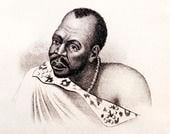
Paramount-Chief Hintsa’s Betrayal, Apr-May 1835
The Sixth war ended with an event of such dishonour and violence that it became a rallying cry for decades. It is in events like the death of Paramount-Chief Hintsa that the nature of colonialism becomes most nakedly clear. An act of great barbarism would be tutted over and excused, as if such violence was only to be expected against those that dared stand against the Empire.
On 14 April 1835, D’Urban decided that he had had enough. The war had already dragged on for five months, and the Settlers were making far less progress than he had expected. The imperial garrisons were being constantly raided and attacked by forces that sniped at them from the bushes and then disappeared, or disrupted the supply lines that would have ensured their constant progress.
It was time for a different approach. Whatever the differences between his own people and these, D’Urban thought, surely they could be commanded through their leaders. After all, the Europeans all obeyed his commands, did they not? Making an agreement with their leader would ensure the end of the war, he was certain.
D’Urban had declared war on Hintsa, and still did not understand the difference between a king and a paramount-chief. He went to Hintsa insisting that this one chief represented the entire Xhosa nation, a concept that had no defined existence before the Settlers arrived. D’Urban simply could not shake the false notion that the Bantu tribes operate in essentially the same way as European nation-states.
As the de facto ruler of the Xhosa, Hintsa was held responsible for all of the attacks on the Cape Colony. This meant taking the blame for all of the cattle raiding that had occurred since the Xhosa returned to their blasted lands, regardless of his power to control the perpetrators.
This tactic has, historically, worked relatively well. By giving a leader guns and supplies, then making them responsible for the actions of anyone that looked even vaguely like them, the Empire converted enemies into subjects, with most of the blood comfortably distant from their own hands. In many nations, it had worked effectively.
Unfortunately, the Cape Colony was not one of those nations. Stable trade and transport routes, or even places to live year-round, were largely unknown. The kinds of infrastructure that allowed Britain to conquer other lands so quickly simply did not exist here.
The upshot of all this was that they made a serious mistake in thinking that Hintsa, as Paramount-Chief, had any broader authority over the peoples not in his own tribe. That Hintsa was the first among equals, and not an autocrat with absolute power over his people and land, made no difference to D’Urban. For the sake of his own image, he needed the reports that went back home to say that he had found and cornered the man responsible for the perfidious attacks on the newly established colony and its brave Settlers in this untamed land.
The fact that this was nonsense made no difference. Freedom of the Press was assured, but that did not mean that people were not more swayed by official reports than fragments of the underlying reality.
***
Hintsa watched D’Urban carefully, pretending that he needed his interpreter to relay what was being said to give him a moment to think. This man was angry, but he was angry at his own ignorance. It was a puzzle that Hintsa could not resolve.
D’Urban drew himself up in a uniform that had been recently polished and burnished, so that it shone as a sign of the foolishness of men who would wear heavy clothes and shining metal across the scrub. He was certain that Hintsa would see reason if he was merely yelled at enough. It barely mattered what the Xhosa chief, thought, for he was committed to forming a new province without approval from the government. He would return to England basking in glory, having won land the size of Wales for the crown. From his perspective, any amount of barbarism was forgivable in such circumstances.
After sufficiently venting his feeling about Hintsa’s failure to bring a thousand men to the British cause, D’Urban’s voice dropped. ‘So you see, my good man, that my requests are entirely reasonable. You have failed us, and in response we have had to declare war on you. Now we must end this war. We are willing to cease hostilities if you merely submit to our most reasonable requirements. We will take command of a new province, to be named Queen Adelaide’s Province, that shall extend from our old border to here, along the Great Kei River. Residents of the region will become British subjects.”
Hintsa waited patiently as his interpreter rattled off a Xhosa version of what had been said. Now it would come, he thought to himself. He will annex half our kingdom, take all our arable land, but he thinks it is a favour to us to do so. There is always another price with these people.
Hitsa was right. D’Urban carried on as if all of these things were to be greatly desired by both sides. “ You will also return the cattle you stole, as well as a few more to represent reparations for the towns lost to your violence. Fifty thousand head should be about right.”
Hintsa was also informed that he would be kept hostage to ensure his people’s compliance. Seeing that time was short, he made an excuse, and pulled one of his men aside.
Hintsa kept his voice low, for he knew that many of these men spoke Xhosa. He recognised one soldier he had dealt with before, a man called Southey who was fluent in their language and notorious for listening in to conversations.
Pretending that he had to think about it, Hintsa stepped back. “We shall speak of this thin in the morning. For now, it is time to camp, and rest.”
As they slipped back to their encampment, Hintsa beckoned to an uncomfortable-looking man at the back of his retinue. He spoke quietly, and quickly, gesturing as if he was reprimanding the man for some personal failure. “Go to Maqoma. As military commander, he will take my place for now. Tell him to hide the cattle. Be swift, and be secret. Another will follow, but his message will be one given to please the British, not to command out forces. The British have finally given in to their savagery. I do not know if we will leave this place alive, so go now, and go fast.”
With a dismissive shake of his head, Hintsa waved the man away. In apparent abashment at having been dismissed from the Hintsa’s entourage, the man slipped away. The official message telling his people to give in to British demands would go with one of his Chiefs, but this message would arrive ahead of him, and they would know that they needed to carry on fooling the British if they were to survive.
It was clear to Hintsa from the first that the British demands could not be met. They had taken him hostage, but the tribes could no more do what the British called for than they could paint stripes onto the sky. It seemed obvious to him that this was just another way of excusing their own actions, giving the mask of legalism to the execution they were planning when the tribes inevitably failed to give in to D’Urban’s impossible demands.
He had expected a negotiation, for he was still somewhat confused at how D’Urban could have thought that he had promised to bring men, not to see who was willing to take up arms for the British. He had done all he could to maintain the peace and find an end to the war, but what had begun as a negotiation quickly turned into a shakedown.
After breakfast the next day, they came for him. He could see in the way they moved that they planned something this day, something that he would not be able to overcome.
Smith rode at the front of his group of veterans, each eying the Xhosa warily. “Come, Paramount-Chief. We would see you back over the Kei safely. Mount your horse, your men can follow with our troops while we safely ford the river.”
Hintsa looked at his retinue, all of whom acted as if this was an entirely normal request. They had spoken deep into the night, and knew now that his fate had already been sealed. Let these people act with dishonour. His people would know what had happened here.
“I will see you on the other side, my friends. Be strong.”
And with that, he rode to his death.
Soon, Hintsa rode surrounded only by George Southey’s guide corp and Smith’s personal retinue. Hintsa knew that a group much like this had been at responsible for burning the capital of the United States, on the other side of the world. He did not know where it was, but stories of men pretending sorrow at an act of vast sacrilege made their way around over time.
He turned to Smith, riding with him at the head of the column. “What have the cattle done that you want them? Why must I see my subjects deprived of them?”
Smith curled his lip and shrugged. “That you know far better than I do.”
For a little while, there was silence. Then Hintsa saw his chance. It was slim, but his survival depended on getting away from these men. He spurred his horse to action, making for a ridge where he was certain he would be able to escape into thicker bush than these men could follow in.
The British raced after him. There were some shouts, but most moved in a heavy silence, knowing that they had finally reached the end of their journey. Within moments, gunshots began to ring out.
The gallop bought him a moment, but it was not enough, for soon his horse was shot, collapsing underneath him. Hintsa rolled off and ran, heading straight towards the bush, bearing only his assegai spear with him.
Smith fired twice, but his weapons failed him. He was not carrying his musket, and pistols were no use for hunting. He looked over at Southey, who as well as speaking fluent Xhosa was their most capable tracker and shot. “Shoot, George, and be damned to you!”
Southey, who had the great advantage of being the only man who could see the route that the Paramount-Chief would have to follow to escape from them., lined his shot up as carefully as he could. The Brown Bess spat its lead, and Hintsa stumbled, hit in the leg.
Southey quickly grabbed a loaded gun from another soldier. It took around thirty seconds to reload, and they did not have that time, for Hintsa had carried on, still limping but swiftly making his way into a steam where he could not be followed on horseback.
Smith, who was now stuck without a functioning weapon, screeched. “Be damned to you. Shoot again!”
Southey fired again, hitting Hintsa once again as he gained the entrance to the stream. The Paramount-chief stumbled forwards into deeper water, but was wounded too badly to stand.
Southey rode up again, Smith at his back. In a final act of defiance, Hintsa threw his spear, but it landed with little force nearby. Hintsa began to beg for mercy.
Southey spoke fluent Xhosa, but he was also a soldier who knew his commander well. Without glancing at Smith, who he knew would be watching with a stern expression, he shook his head, and then lined up a shot on Hintsa’s forehead. At this range, even a poor shot could hardly fail.
Now, at this point, one assumes that there were several options. He could have been recaptured, or hobbled, or merely given a sound thrashing for daring to try and return to his people.
Instead, after being pulled from his horse, he was shot in the back. And then again in the arm.
George Southey, the brother of the colonial administrator, then rode up. He decided that simply injuring Hintsa so that he could not escape was not enough, and summarily shot him in the back of the head.
Southey hauled the body out of the water and set to work. This man was famous, and Smith would not begrudge him taking a few souvenirs. He took Hintsa’s fetching brass body ornaments.
What followed set the tone for the next few decades of war. A classic aspect of Empire is the desecration of corpses. This is a lesson that has been with us since before the Romans nailed rebellious slaves to crucifixes, and has been historically both common and effective.
After south took the ornaments, other men rode forwards. Some grabbed for his beads and bracelets, but the ornaments were soon stripped, so they started on body parts. Southey’s brother Willian cut off Hintsa’s ear, and the other was soon gone. Their doctor took a few teeth. The rest of his head was cut off, to be sent back to Britain for one of the Imperial collections.
In fairly short order, there was nothing left of his body that would not be eaten by scavengers by the next sunrise. The troops left just as the flies began to thickly gather, their buzzing signalling to local carrion eaters that a feast had been left out.
The story that the settlers heard was rather different. Trying to put a stop to the rumours that had proliferated as Hintsa’s body parts had gone on their journeys after his death, Harry Smith said that the real story was that he tried to shoot Hintsa, but his pistols misfired, a common enough circumstance in those days. He tackled Hintsa, but after dragging him to the ground, the Chief stood strong, “jabbing at me furiously with his assegai.”
In Smith’s version of events, Hintsa cleared a space and got to cover, where he made an impassioned plea for clemency. At this point, an unnamed officer shot him, and his body was then mutilated.
In either case, Hintsa was captured by trickery, murdered when he went to negotiate peace, and his body desecrated. He was scapegoated for the failures of his people to bow to imperial will, and there was little honour to be had in his fall.
Still, as far as the empire was concerned, this was a win, and a substantial one at that. Oh, certainly, a certain amount of blood had been spilled, but it was mostly that of other nations of tribes, and so was acceptable. It was time for a reward for our bloodthirsty friend D’Urban. Between crippling the remaining Dutch influence through the new system of legislative councils, abolishing slavery to cripple their economy, and killing tens of thousands of people after getting unnecessarily involved in local politics, he had reshaped the territory. Later that year, Port Natal was officially renamed Durban to commemorate the winning of Queen Adelaide’s Province.
They left seven thousand people homeless, to add to the refugees from the Zulu, Xhosa, British and Boer forces. Unsurprisingly, Hintsa’s fate became a rallying cry for the Xhosa forces throughout the wars that followed, even beyond the Emperor’s time.
— — — — — — — — — — — — — — — — — — — — —
Historical excerpts included:
- Harry Smith’s diaries, 1835
- John Jarvis Bisset, C.B., K.C.M.G., 1835
- Paramount-Chief Hintsa, c. 1834
메타데이터
- post_id
- 85dcde245e83
- slug
- the-defence-of-grahams-town-and-end-of-the-sixth-war-1835-85dcde245e83
- url
- https://medium.com/@charlesfeatherstone/the-defence-of-grahams-town-and-end-of-the-sixth-war-1835-85dcde245e83
- canonical_url
- https://medium.com/@charlesfeatherstone/the-defence-of-grahams-town-and-end-of-the-sixth-war-1835-85dcde245e83
- author_url
- https://medium.com/@charlesfeatherstone
- status
- ok
- fetched_at
- 2026-06-16 19:09:56