Wa: The Harmony of Japan
In the year 604, following the introduction of Buddhism to Japan, Prince Shōtoku Taishi authored the seventeen-article constitution…
Wa: The Harmony of Japan
In the year 604, following the introduction of Buddhism to Japan, Prince Shōtoku Taishi authored the seventeen-article constitution (十七条憲法), a sort of code of conduct for officials and citizens inspired by Confucianism.
The first of the seventeen articles reads as follows:
“Harmony is to be valued, and an avoidance of wanton opposition to be honoured. All men are influenced by class-feelings, and there are few who are intelligent. Hence there are some who disobey their lords and fathers, or who maintain feuds with the neighbouring villages. But when those above are harmonious and those below are friendly, and there is concord in the discussion of business, right views of things spontaneously gain acceptance. Then what is there which cannot be accomplished!”
It is no surprise, then, that harmony is an immensely significant cultural crux in Japanese society to this day. The Japanese word for “harmony” is Wa (和).
Incidentally, in the year 604, Japan was called Wa.
The Wa of Wa
It would be incorrect to say that Japan is the only country in the world where harmony plays a role in society, but it’s definitely the most obviously pronounced in Japan.
In his upcoming book, “Japan 2025 — the World’s Last Utopia,” author Felix Chan includes Wa as one of fourteen philosophies that act as an invisible framework supporting Japanese society. The book then provides myriad real-life examples in which Wa manifests.
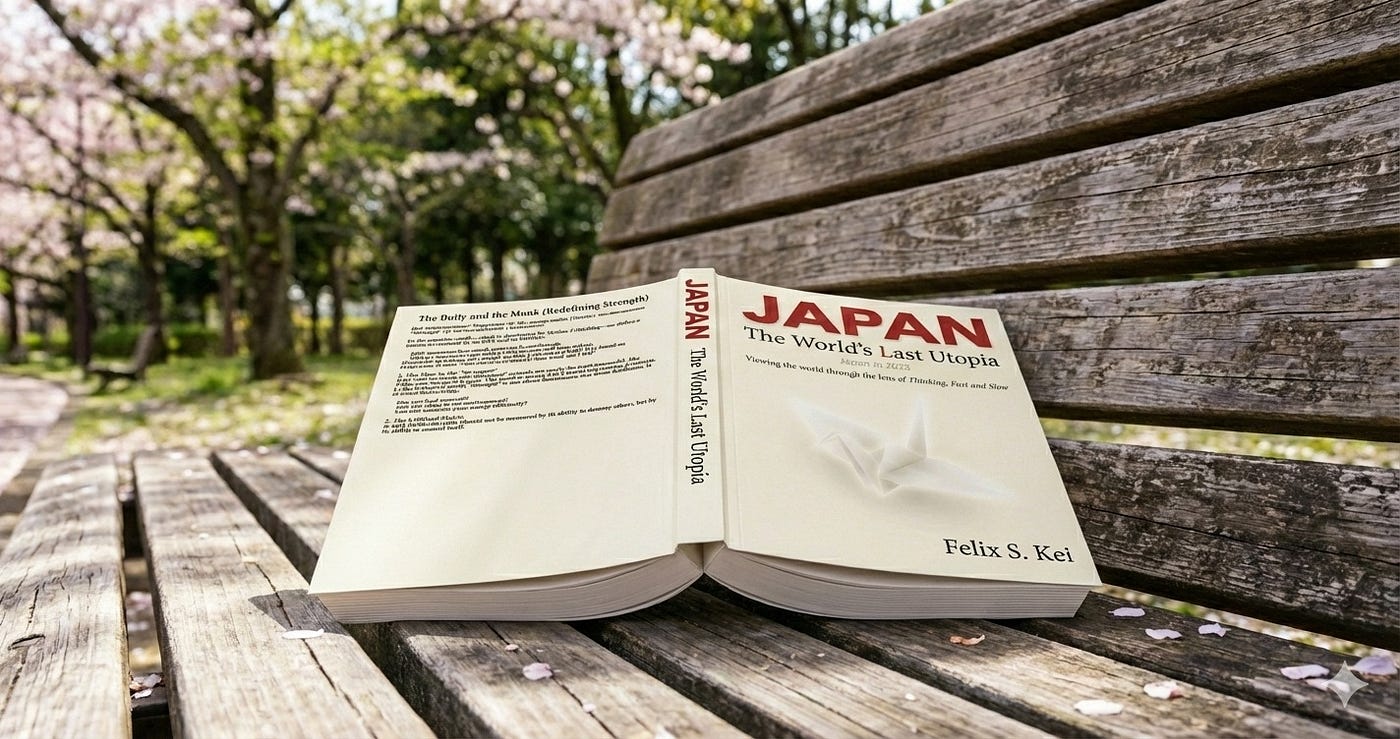
One of them is what Chan calls the “Silent Drive.” Consider the following: Japan has a population just shy of 122.4 million that drives approximately 68.9 million vehicles. And yet, no matter where in Japan you happen to be, scarcely anyone on the road is honking. This remains true even in the busiest, densest, and most high-traffic districts of Tokyo and Osaka.
Japan’s quiet roads are undoubtedly an insane phenomenon compared to any other country.
How does it work?
The answer is simple: Wa. Chan explains that while a car’s horn in most countries is either a communication tool or a weapon of frustration, in Japan it’s more akin to an unnecessary disturbance. The sound disturbs the harmony of the neighborhood, and so to honk is to admit immaturity and a loss of emotional control.

The same principle applies when commuting via public transportation — what Chan calls the “Silent Commute.” In the fiscal year 2023, Japan saw a whopping 27.58 billion trips in passenger volume. Shinjuku, the world’s busiest station, handles over 3 million passengers per day.
It is highly unusual, then, that to board a train in Japan is to board a quiet metal box in which no one talks on the phone and anyone who talks in general does so in whispers. Being loud is, as you can guess, a disruption of Wa.
But Wa isn’t all about the soundscape.
Exit the train at any station across Japan and the crowd will naturally form an orderly queue in front of the escalator. In most of Japan, this line of people will stand on the left of the escalator, while in Osaka they stand on the right (because Osaka is just special like that). This is so that anyone in a hurry has a free lane to move through if they need to.
To stand on the wrong side is to disrupt Wa, as doing so disrupts the social arrangement that takes exceptions, such as emergencies, into account.
As these examples showcase, Wa is a social and cultural glue that makes many of Japan’s unique aspects tick. In no small way, this ingrained harmony is responsible for the prevailing yet difficult-to-pin-down feeling that Japan is orderly and peaceful in a manner no other country can truly replicate.
Harmony vs. Freedom
Social harmony is all well and good, you may say, but doesn’t it go against individual freedom?
Yes, and no.
True, taking a call on the train will earn you a handful of glances from fellow passengers, but this isn’t a law meant to be enforced. The pressure to conform, if you want to call it that, is purely social, and so if you don’t care what others think, you are more or less immune to the consequences.
It’s just that the average Japanese does care.
Consider tipping culture, for example. In the U.S. you’re expected to tip for certain services, but that’s not an enforceable law. In Japan, you’re not expected to tip. Lots of countries fall in various spots across this spectrum, but it all amounts to a social contract. Wa, too, is a social contract. It’s the same type of logic applied differently.
The dynamic between Wa and freedom does affect the legal world, though not in the way you probably expect.
For instance, in Japan you are legally allowed to drink alcohol wherever you want, whenever you want, with very few exceptions. It’s not uncommon to see people cracking open a cold one on the train on the way back from work, still dressed as sharply as the local corporate culture demands. There is no stigma against it, and the government doesn’t assume the average citizen would cause any meaningful amount of trouble.
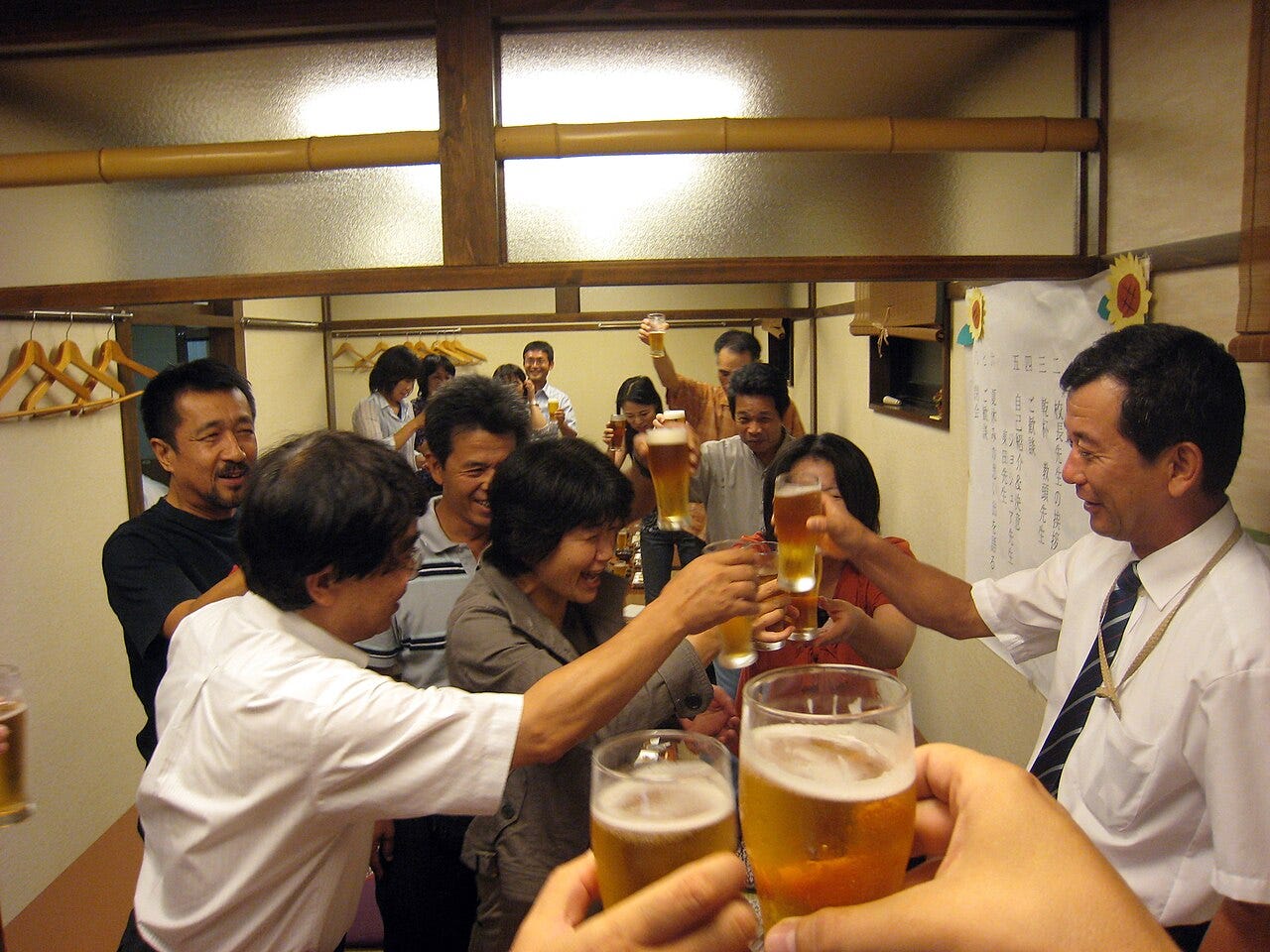
Why? Because of how integrated Wa is within Japanese culture.
In most countries in the Western world, where and when you’re allowed to drink alcohol is regulated. Alcohol is an inherently dangerous thing, these regulations presume, and citizens must be protected from potential violence, vandalism, and the like. While the strictness of these regulations can be a point of contention, the overall logic behind them rarely is.
This isn’t the case in Japan. The government trusts its citizens to maintain harmony even when drunk, and so with Wa emerges alcohol freedom.
This societal trust in the self-control of the average citizen, incidentally, is why Japan is so damn clean even though trash bins are so damn hard to find. The government trusts people won’t litter, because doing so would disrupt Wa, and instead take their trash home and dispose of it there.
Harmonious Hard Numbers
You might be thinking I’m just glazing Japan, and you aren’t entirely wrong, but I don’t do so without cause or statistics to support these arguments.
Let me pull up a chair and sit on it backwards, because let’s talk drugs, kids!
According to a 2025 analysis of Japan’s addiction landscape, approximately 2%-3% of the population has experienced drug use in their lifetime. In contrast, that number is 47% in Australia among people above the age of 14, and in the U.S., 21.9% of people above the age of 12 used an illicit drug within 2021 alone.
Since cannabis is the most used illicit drug in Japan, let’s take a closer look at drug-specific data. According to the U.N. Office on Drugs and Crime, an estimated 0.23% of Japan’s population aged 15–64 used cannabis in 2023. That number is 26.38% in the U.S. and 11.5% in Australia.
Okay, the difference is definitely palpable, but what does it have to do with Wa?
The book “Japan 2025 — the World’s Last Utopia” argues that in the 19th century, Japan watched as the Opium Wars destroyed China and took to heart the dire lesson that a drugged nation is a conquered one. As such, Chan posits, the Japanese view drug use as a societal threat rather than a personal one. It’s not a mere personal vice, but a disruption of Wa.
Another important sphere of metrics is wealth inequality. According to the World Inequality Database, the global average wealth share of the top 10% in 2024 was 73.9%. This metric represents the proportion of wealth held by the top 10% of the population in any given nation. The higher the number, the more indicative it is of wealth inequality within that nation.

In Japan, that number was 59.1%. For reference, in the U.S. it was 69.5%. Chan argues that this is because the gap between the top and bottom is intentionally compressed in Japan in order to maintain Wa.
Likewise, this mentality is evident in Japan’s inflation rate. In the past decade, its inflation rate was highest in January 2023 at 4.3% and lowest in December 2020 at -1.2%. Meanwhile, the EA (i.e. EU countries that have adopted the euro as their currency) has had its highest rate in October 2022 at 10.6% and lowest in December 2020 at -0.3%. Lastly, the U.S. inflation rate was highest in June 2022 at 9.1% and lowest in May 2020 at 0.1%.

Though the graph above shows a global trend, Japan’s inflation rate is both the lowest overall and the most consistent over time out of the three.
Chan argues that this is because Japanese corporations often choose to absorb costs internally rather than pass them on to the consumer, as raising prices is a violation of Wa. A Japanese family should, and is, able to plan its finances in advance with relative stability, knowing how much purchasing power a ¥100 coin has and will continue to have.
Lesson Learned
In summary, harmony, as a concept, is part of Japan’s DNA, and its significance in Japanese society manifests in many everyday phenomena. It isn’t a restriction on personal freedom, but a social contract from which personal freedom can emerge. National statistics often associated with the overall “health” of a nation, such as drug abuse rates and wealth inequality, are a testament that Wa indeed works in maintaining Japan’s social fabric.
The reason Wa works is that everyone is in on it. It is part of the culture, so children pick it up naturally by observing their parents and surroundings. In other words, Wa is a function of education above all else. When you educate the populace to prioritize harmony, harmony shall be maintained. Japan is proof of that.
This is the lesson I believe other nations and cultures ought to learn from Japan. And if I managed to convince you, well, that’s a start.
메타데이터
- post_id
- 85def67b4e1c
- slug
- wa-the-harmony-of-japan-85def67b4e1c
- url
- https://medium.com/@lotusphi4/wa-the-harmony-of-japan-85def67b4e1c
- canonical_url
- https://medium.com/@lotusphi4/wa-the-harmony-of-japan-85def67b4e1c
- author_url
- https://medium.com/@lotusphi4
- status
- ok
- fetched_at
- 2026-08-11 00:44:36