“The Resonant Mind”
2026: Orgone Labs Research on the Brain Microbiome
“The Resonant Mind”
2026: Orgone Labs Research on the Brain Microbiome
Dr. Ilena Kovacs stared at the pulsing screen in front of her. What had begun as an innocent investigation into the brain’s microbiome was spiraling into something far stranger than she could have ever imagined.
In the early months of 2026, Orgone Labs had taken a keen interest in the brain’s microbiome. By then, the scientific community had only just started to grasp the concept that the brain harboured its own ecosystem of bacteria, fungi, and viruses. With diseases like Alzheimer’s plaguing aging populations, it had become critical to explore every avenue for treatment — and potentially, prevention.
But Orgone’s approach was different.
With their roots in research blending metaphysical concepts with advanced neuroscience , they were in a unique position to explore not just the physical implications of the brain’s microbiome, but also its ethereal impact. What if the brain’s microbial landscape wasn’t just a biological oddity? What if it was integral to the interface between consciousness, matter, and even time?
That’s when they stumbled on resonance therapy.
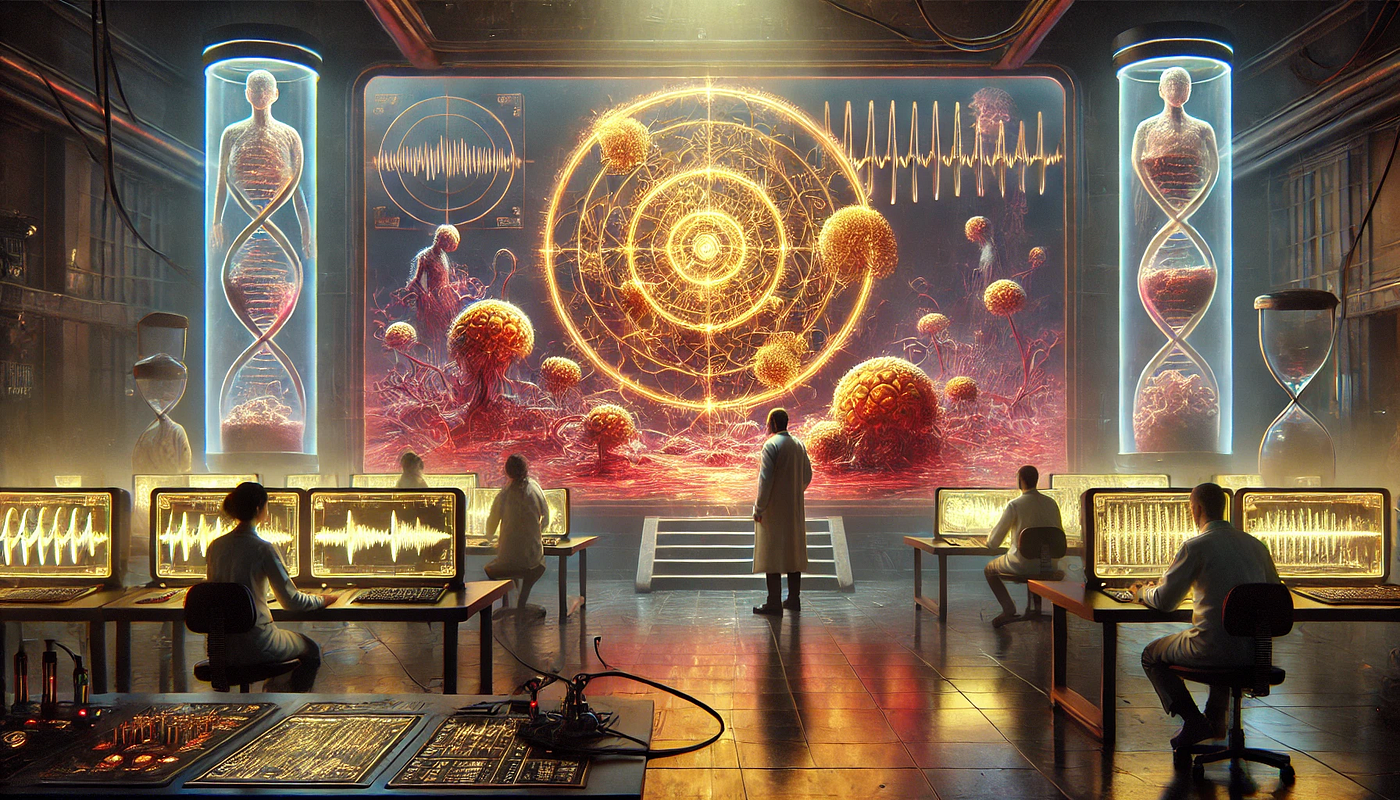
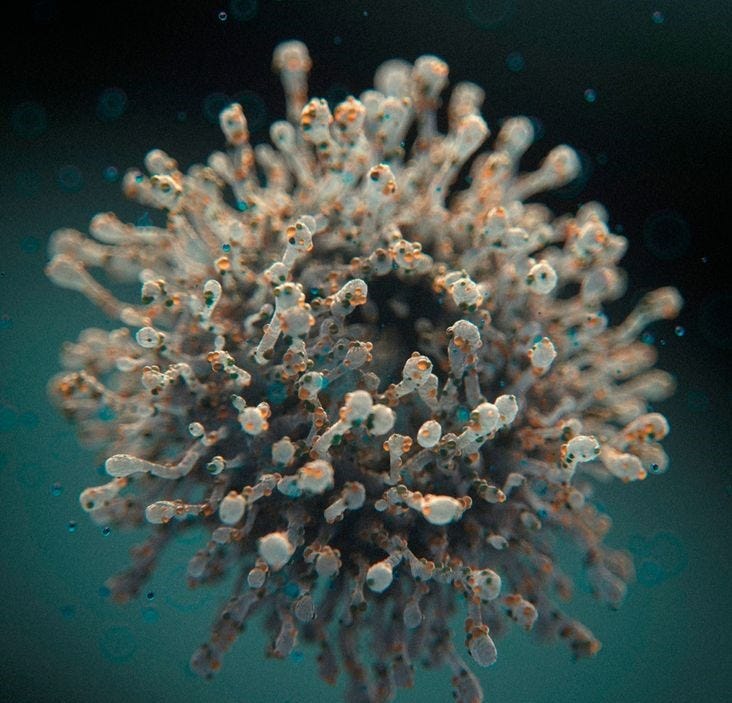
It started with the discovery that the microbial colonies in the brain were sensitive to certain frequencies. During an experiment designed to map the microbial pathways, Dr. Kovacs noticed something peculiar: while stimulating brain tissue to isolate colonies of Streptococcus and Aspergillus — the bacteria and fungi found in Alzheimer’s-affected brains — they emitted a subtle electromagnetic signature. This wasn’t just neurochemical activity; it was the organisms themselves, resonating at different frequencies depending on the state of the patient’s disease.
“Could the microbes in the brain be amplifying neural signals?” Kovacs had asked aloud one night. The question was met with silence by her team, but it triggered a cascade of experiments that would soon delve into uncharted territory.
Three weeks later, the resonance effect took a chilling turn.
Kovacs and her team developed a technique using eToL (the electronic tree of life) to sequence the exact species residing in the brain’s microbiome. By doing this, they hoped to map how different microbial communities interacted with brain cells, and why those interactions became toxic in neurodegenerative diseases. It became evident that some species were not just residents — they were conductors, influencing immune responses and synaptic plasticity in profound ways.
When they stimulated the microbes at specific resonant frequencies, they triggered localized neural activity. What started as harmless sparks of synaptic transmission soon escalated. One patient, a volunteer diagnosed with early-onset Alzheimer’s, began speaking lucidly again for the first time in years. It was as though their brain was recalibrating, creating new pathways that bypassed the disease’s destruction. The memory circuits were being rewired by microbial activity.
But as the experiments continued, something eerie began to unfold.
Kovacs hadn’t expected the dreams.
She wasn’t the only one. Each member of the research team reported strange visions during sleep. They described the same scenes: an ancient city beneath a blood-red sky, creatures that shimmered between forms — half human, half fungal. The city was alive, breathing in rhythms, the same frequency as the microbes they were studying.
Dr. Kovacs herself had begun to feel disconnected, as though her mind was syncing with something much larger than herself. The air in the lab felt charged. “I think…we’ve opened a door,” she muttered one evening, as her assistant, Lena, watched a patient’s EEG readings jump erratically.
“We’re not just treating Alzheimer’s anymore,” Lena whispered. “We’re communicating with something.”
What was happening?
Further resonance treatments unlocked cognitive potential that should have been impossible in patients at advanced stages of Alzheimer’s. Synaptic networks reformed, memories resurfaced — but they weren’t just the patients’ own memories. Some recalled events from distant epochs, lifetimes they couldn’t have lived.
Dr. Kovacs, now wary of her own deteriorating state of mind, decided to subject herself to the treatment. When the electrodes attached to her skull activated, her thoughts spiralled into a unified field, a tapestry of minds, both past and future. She saw herself through the eyes of microbes, beings that existed across time — bacterial ancestors influencing the evolution of life and cognition itself.
The realization was staggering: the brain microbiome wasn’t just biological. It was a bridge — an ancient network of consciousness stretching across epochs, influencing the mind from its earliest beginnings. The cingulate cortex, long a mystery, acted as a gateway , amplifying the resonance to align both microbial activity and consciousness itself.
The microbes, it seemed, were not passive passengers but architects of thought, memory, and perhaps even reality.
As 2026 drew to a close, Orgone Labs began to see the broader implications.
In their secretive pursuit of Orgone energy , the Foundation theorized that microbial ecosystems in the brain were more than just a health concern — they were crucial to the interplay between consciousness and the quantum fabric of existence. The resonance frequencies they were discovering didn’t just treat disease — they might unlock the mind’s ability to reshape reality itself.
It wasn’t just about Alzheimer’s anymore. It was about what lay beyond. What if every human mind, influenced by its microbial colonies, could access the quantum-orgone nexus, where thought and reality became one?
The microbes were alive.
But now, so were the minds they connected.
메타데이터
- post_id
- 85e73487cc63
- slug
- the-resonant-mind-85e73487cc63
- url
- https://medium.com/@orgonefoundation/the-resonant-mind-85e73487cc63
- canonical_url
- https://medium.com/@orgonefoundation/the-resonant-mind-85e73487cc63
- author_url
- https://medium.com/@orgonefoundation
- status
- ok
- fetched_at
- 2026-07-22 11:36:17