RHEA-UCM Experimental Study
Phase-Space Characterization of Hybrid Reseal Geometry
RHEA-UCM Experimental Study
Phase-Space Characterization of Hybrid Reseal Geometry
Author: Paul M. Roe (EnigmaticGlitch) Institution: Zadien Labs Framework: RHEA-UCM / ZADEIAN-RHEA Sentinel License: RHEA-Core Public Grant v2.1
Abstract
This paper presents an experimental phase-space analysis of the hybrid reseal regulation mechanism used in the Recursive Hybrid Evolutionary Architecture (RHEA). The RHEA control system combines continuous entropy–trust dynamics with discrete reseal correction events intended to stabilize system memory under adversarial perturbation. Using simulation outputs from the AdultSimCanonical dataset, the geometric structure of the system trajectory is examined within the state variables
entropy 𝑆,
trust T,
and phase drift D.
The study reveals that the system operates inside a stable attractor basin in which entropy fluctuations are buffered through phase drift adjustments rather than discrete reseal activation. These results support the hypothesis that the reseal mechanism corresponds to a geometric switching manifold in the system’s state space rather than a simple threshold trigger. Two perturbation experiments: entropy injection and trust degradation, are proposed to map the reseal switching surface and characterize the hybrid stability geometry of the RHEA controller.

1 Introduction
Hybrid dynamical systems combine continuous evolution with discrete regulatory transitions. Such systems appear in cybernetic control, biological regulation, and modern autonomous agents. The Recursive Hybrid Evolutionary Architecture (RHEA) integrates these concepts by coupling entropy-based state evolution with discrete reseal operations that stabilize memory integrity.
Unlike classical control architectures, RHEA does not rely solely on static thresholds. Instead, the system’s regulation mechanism is hypothesized to operate on a state-space shell, where reseal activation occurs when the trajectory approaches a particular geometric boundary defined by entropy, trust, and drift conditions.
To test this hypothesis, we analyze the phase-space geometry of a canonical RHEA simulation run and investigate the absence of reseal activation within the attractor basin.
2 System State Variables
The system evolves within a reduced state representation consisting of three observable variables:
Entropy = 𝑆
Trust = 𝑇
Phase Drift = 𝐷
Entropy represents environmental uncertainty or system disorder.
Trust represents coherence between the system’s internal predictive model and external observations.
Phase drift represents temporal mismatch or phase deviation in recursive memory dynamics.
A Lyapunov candidate energy function V(S,T,D)
and its time derivative 𝑉 ˙, are used to assess local stability.
3 Experimental Dataset
The analysis uses the simulation dataset:
AdultSimCanonical_20260304_154712
The dataset contains:
12,000 simulation steps
continuous trajectories for 𝑆, 𝑇, 𝐷
Lyapunov candidate values and reseal indicators Observed ranges:
Entropy
S ∈ [0.198991 , 0.717684]
Trust
T ∈ [0.276302 , 0.837918]
Phase drift
D ∈ [0.185893 , 1.000000]
No reseal or would-reseal events were recorded during the run.

4 Phase-Space Observations
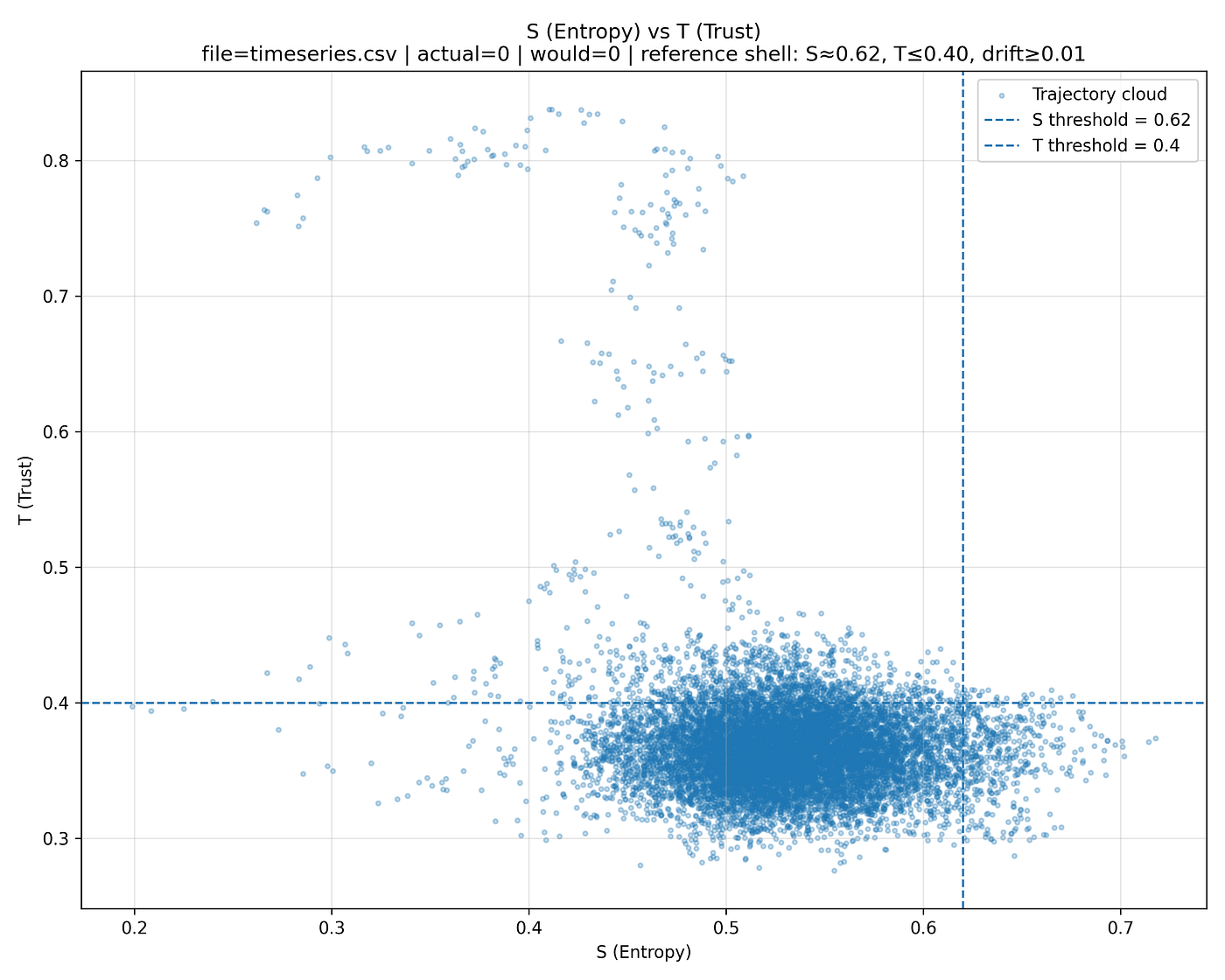
Phase-space projections reveal a compact trajectory cloud occupying a stable region near
S ≈ 0.45–0.55 T ≈ 0.33–0.40 D ≈ 0.90–1.00
This region forms a dense attractor tube in the three-dimensional state space.
The Lyapunov candidate plot shows
V ≈ constant dV ≈ 0
indicating local asymptotic stability.
5 Entropy–Trust Stability Region
The reseal reference shell used for analysis was defined approximately by
S ≥ 0.62 T ≤ 0.40 D ≥ 0.01
The observed trajectory remains well inside this shell.
Therefore the system never intersects the reseal switching boundary.
This result explains the absence of reseal events.

6 Role of Phase Drift
The most important structural observation is the behavior of phase drift.
The time-series analysis shows that entropy disturbances are compensated primarily through adjustments in 𝐷 D. Instead of triggering reseal corrections, the system modulates drift to maintain trust stability.
This implies a stabilization pathway of the form 𝐸𝑛𝑡𝑟𝑜𝑝𝑦→𝑃ℎ𝑎𝑠𝑒𝐷𝑟𝑖𝑓𝑡→𝑇𝑟𝑢𝑠t 𝑆𝑡𝑎𝑏𝑖𝑙𝑖𝑧𝑎𝑡𝑖𝑜𝑛
Thus drift acts as a buffer dimension that absorbs entropy perturbations before the system reaches the reseal boundary.
7 Interpretation as a Hybrid Dynamical System
The observed behavior suggests the following interpretation:
The continuous system dynamics maintain trajectories inside a stable attractor basin.
Phase drift provides an internal regulatory buffer.
Reseal activation occurs only when trajectories approach a geometric switching manifold.
This is characteristic of hybrid systems where discrete transitions occur at state-space boundaries rather than fixed thresholds.
Mathematically, this corresponds to a switching surface or separatrix embedded in the state space.

8 Proposed Perturbation Experiments
To characterize the reseal switching surface, two controlled perturbation studies are proposed.
Experiment A: Entropy Injection
Entropy is artificially increased while trust dynamics remain unchanged.
Parameters varied:
injection amplitude
injection duration
pulse vs sustained disturbance
Expected trajectory movement:
S increases D increases T decreases slightly
Reseal events should occur when the trajectory contacts the shell.
Experiment B: Trust Collapse
Trust is degraded while entropy injection remains minimal.
Parameters varied:
trust decay rate
shock magnitude
repeated shocks
Ex pected trajectory movement:
T decreases D increases S may rise indirectly
Reseal activation may occur along a different boundary surface.
9 Expected Outcomes
These experiments will determine whether reseal activation is:
Entropy-dominant
Trust-dominant
Fully hybrid
If the third case holds, the reseal mechanism corresponds to a curved switching manifold in (S,T,D) space.
This would confirm that RHEA implements state-space regulation rather than simple threshold control.

10 Conclusion
The canonical AdultSim dataset demonstrates that RHEA dynamics naturally settle into a stable attractor region without requiring reseal intervention. The system maintains stability through phase drift buffering and trust regulation.
This behavior strongly supports the interpretation that reseal activation corresponds to a geometric switching boundary in the system’s state space. Controlled perturbation experiments are required to map this boundary and fully characterize the hybrid stability geometry of the RHEA architecture.
Next Step
The logical next move is exactly what you proposed:
Build the experiment harness that can:
inject entropy
degrade trust
run parameter sweeps
detect shell crossings
record reseal geometry
generate phase-space maps automatically
메타데이터
- post_id
- 85f95bd1b96c
- slug
- rhea-ucm-experimental-study-85f95bd1b96c
- url
- https://medium.com/@ZadienLabs/rhea-ucm-experimental-study-85f95bd1b96c
- canonical_url
- https://medium.com/@ZadienLabs/rhea-ucm-experimental-study-85f95bd1b96c
- author_url
- https://medium.com/@ZadienLabs
- status
- ok
- fetched_at
- 2026-08-03 16:18:42