Nigeria’s ₦54.9T Budget: The Innovation Gap Analysis | Donald Adeniji
Nigeria allocates ₦23.96T to capital but only ₦12B to R&D — a 2,000:1 ratio. Here’s why this explains our 105th global innovation ranking…
Nigeria’s ₦54.9T Budget: The Innovation Gap No One Is Talking About
I spent eight hours last week analyzing Nigeria’s 2025 federal budget — all ₦54.9 trillion of it.
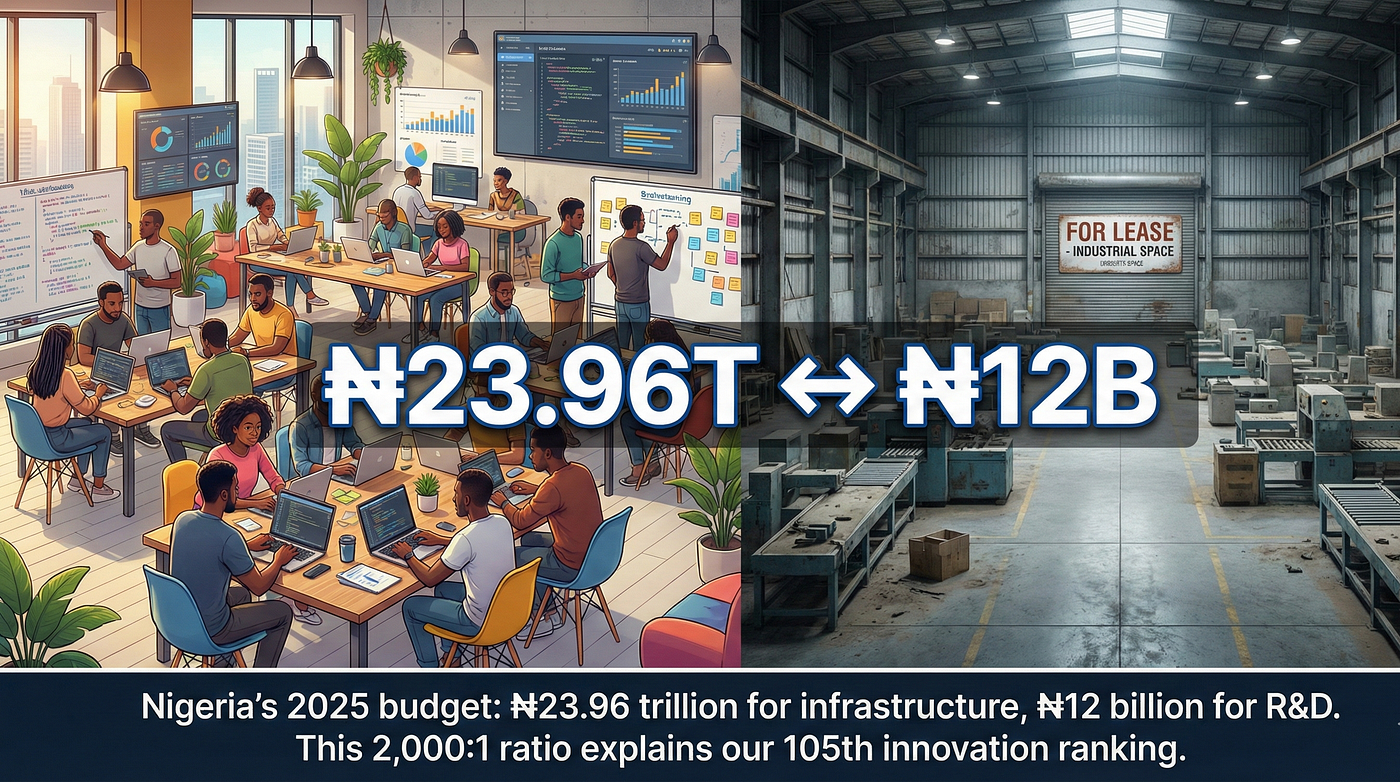
“Nigeria’s 2025 budget: ₦23.96 trillion for infrastructure, ₦12 billion for R&D. This 2,000:1 ratio explains our 105th innovation ranking.”
Not the press releases. Not the Twitter summaries. The actual Appropriation Act signed into law by President Bola Tinubu on February 28, 2025, revised upward from the initial ₦49.7 trillion proposal after improved revenue projections from FIRS and Nigeria Customs.
What I found explains a troubling paradox: Nigeria has Africa’s largest tech talent pool, leads the continent in fintech unicorns, and generates ₦50 billion annually from 6.3 million creators — yet we rank 105th globally in the 2025 Global Innovation Index.
Behind Mauritius (53rd). Behind Morocco (57th). Behind South Africa (61st). Even behind Rwanda (104th).
The answer isn’t talent. It’s how we allocate capital. Specifically, the ratio between what we spend building roads versus what we spend creating new categories of economic activity.
Here’s what the data shows — and what a surgical ₦200 billion reallocation could unlock.
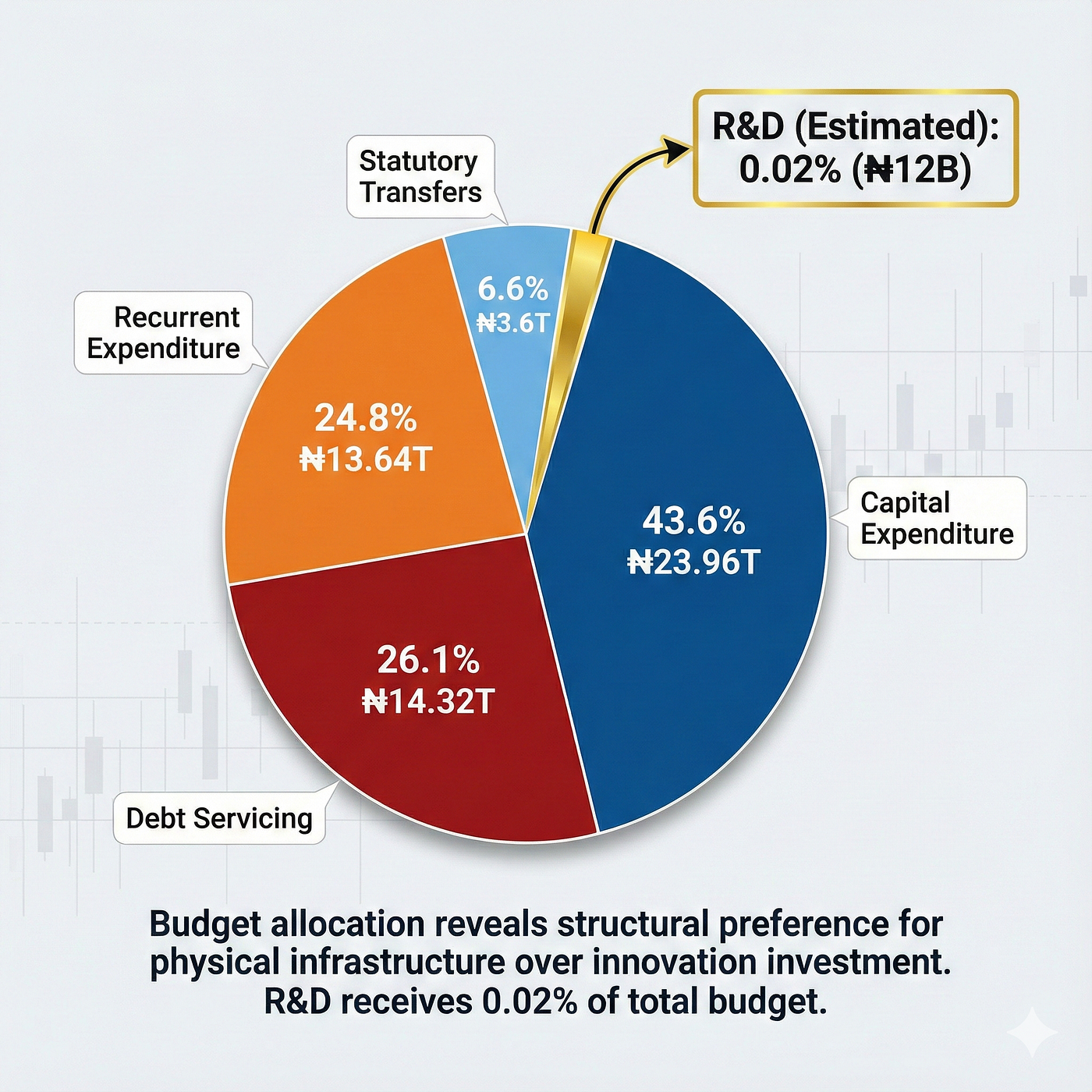
Budget allocation reveals structural preference for physical infrastructure over innovation investment. R&D receives 0.02% of total budget.”
The 2025 budget allocates:
- Capital Expenditure: ₦23.96 trillion (43.6%)
- Debt Servicing: ₦14.32 trillion (26.1%)
- Recurrent Expenditure: ₦13.64 trillion (24.8%)
- Statutory Transfers: ₦3.6 trillion (6.6%)
- R&D (Estimated across all ministries): ₦12 billion (0.02%)
That ₦23.96 trillion in capital expenditure funds roads, bridges, dams, and physical infrastructure — critical for moving goods and connecting markets.
The estimated ₦12 billion in R&D funds research that could create entirely new categories of goods and services.
The ratio: 2,000:1. For every ₦2,000 spent enabling existing economic activity, we spend ₦1 creating new economic activity.
Compare this to:
- South Africa: 0.62% of GDP on R&D
- Egypt: 1.02% of GDP on R&D
- Nigeria: 0.3% of GDP nationally; 0.02% of federal budget allocation
We’re spending one-thirtieth of what’s needed to be regionally competitive, let alone globally competitive.
Why This Matters: The Global Innovation Index
The Global Innovation Index doesn’t lie. Nigeria ranks 105th globally because we excel at exactly two sub-indices:
- Unicorn valuation: 1st globally (Flutterwave, Paystack)
- Knowledge-intensive employment: High ranking (youth in digital services)
But we crater on inputs that drive sustained competitiveness:
- R&D investment: 120th+
- Infrastructure for innovation: 90th+
- High-tech exports: Barely measurable
We have the talent. We’re generating unicorns. But we’re not building the industrial capacity to translate that into sustained export revenue.
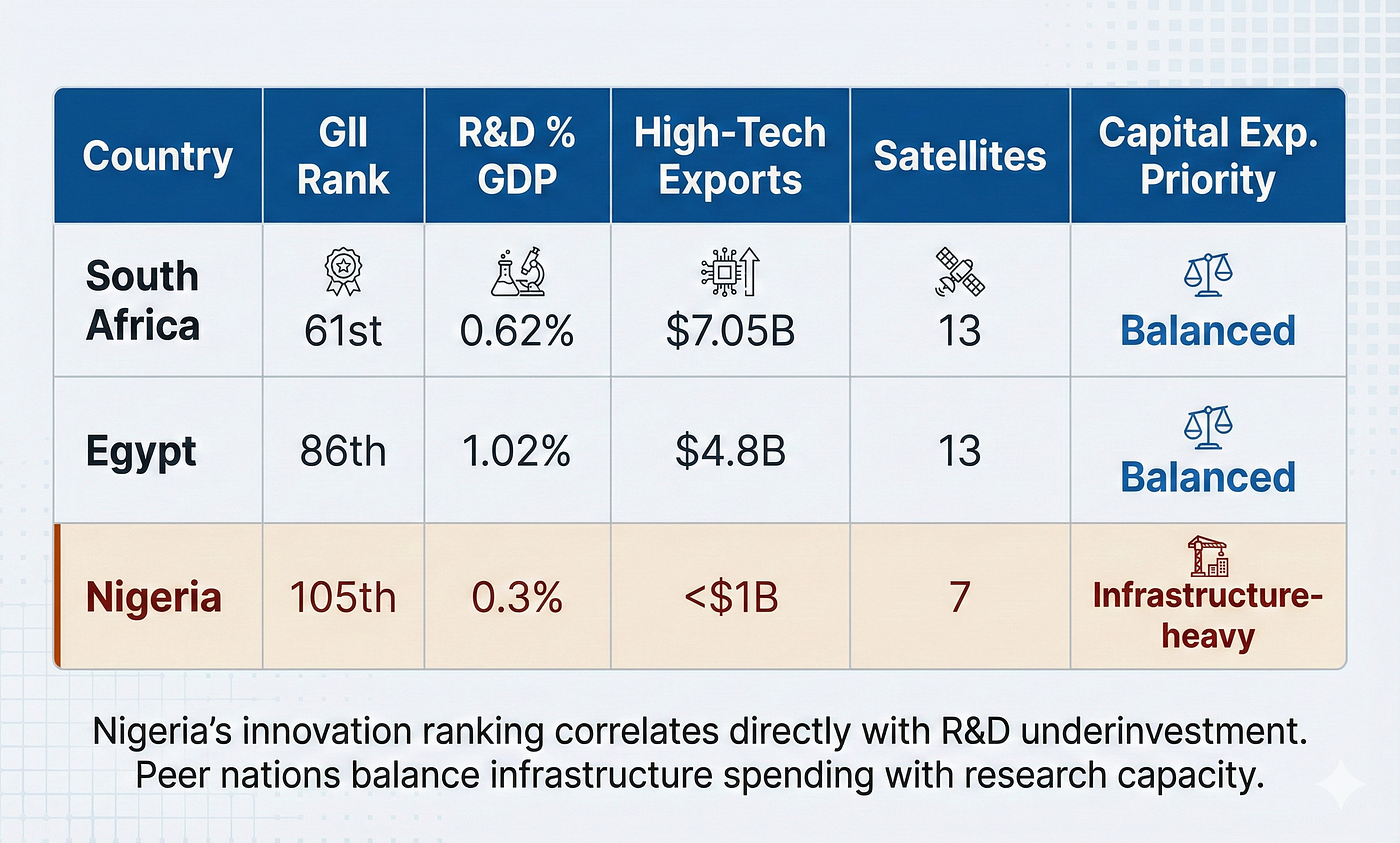
“Nigeria’s innovation ranking correlates directly with R&D underinvestment. Peer nations balance infrastructure spending with research capacity.”
What We’re Missing: The Industrial Gap
Nigeria’s digital economy is real. Minister Bosun Tijani’s initiatives show measurable progress:
- 3 Million Technical Talent (3MTT): 780,000+ trained in AI, software, digital skills
- 90,000 km fiber optic rollout: Expanding broadband infrastructure
- National AI Strategy: Launched April 2025 with sector integration targets
- Fintech ecosystem: Leading Africa in valuations and transactions
This is necessary. But it’s not sufficient.
What we don’t have:
Zero drone manufacturing facilities. Terra Industries (Abuja) builds impressive security drones but assembles foreign components. We export expertise, not scaled production.
Zero robotics factories. Project NOVA trains 25,000 youth annually in robotics. Then they graduate into… what? South Africa has CSIR integrating robots into mining. We have training programs without factories.
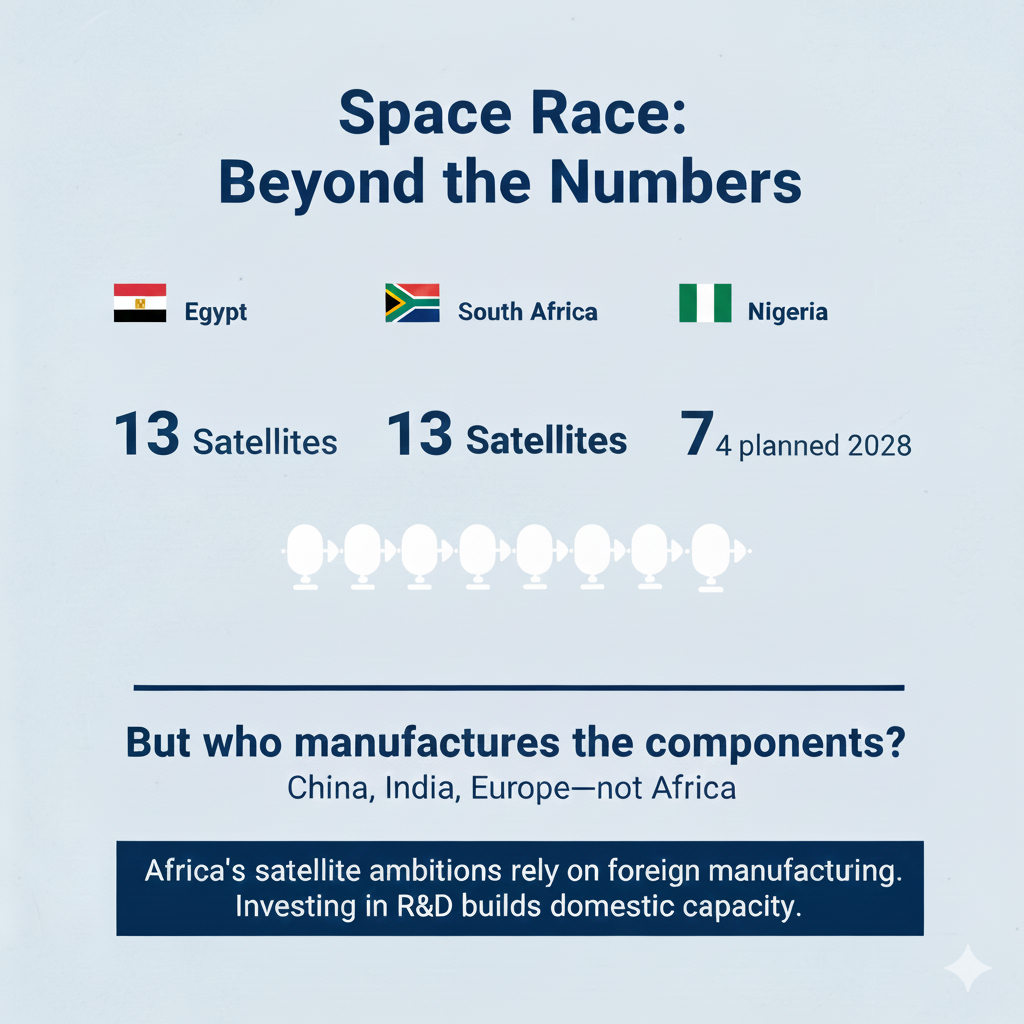
7 satellites in orbit, 13th and 13th for Egypt and South Africa. NASRDA plans 4 more by 2028 — ambitious — but we still import launches, assembly, and IP licensing. We consume space technology; we don’t export it.
The gap: Industrial manufacturing capacity backed by R&D investment.
The ₦200 Billion Solution
I’m not proposing cuts to digital spending or abandoning infrastructure.
I’m proposing a surgical shift: ₦200 billion from capital expenditure (0.83% of that line item, 0.36% of total budget) into Tech Industrial Parks combining:
- Manufacturing zones: Drone assembly, robotics production, satellite components
- R&D labs: Co-located with universities (UNILAG, ABU, OAU), linked to NASRDA/NITDA
- Export hubs: Scaling startups like Terra Industries from prototypes to West African supply chains
What this unlocks:
Closes the R&D gap: ₦212B total (0.39% of budget) — still below SA’s 0.62% but directionally competitive
$5 billion in new exports (5-year horizon): SA exports $7B digital services; Egypt $4.8B engineering tech. We’re at <$1B. Industrial parks close that gap by enabling local manufacturing.
20,000+ industrial jobs: Knowledge-intensive roles at 3–5x median salary, keeping talent onshore instead of losing it to Dubai, London, Johannesburg.
Makes NASRDA’s $20B revenue target feasible: Currently aspirational. With local capacity, it becomes a business model backed by export licensing to other African space agencies.
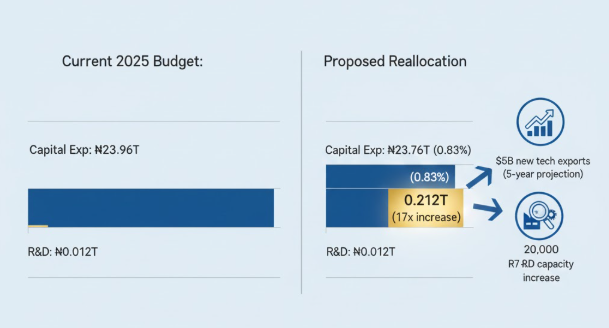
“₦200 billion reallocation (0.36% of total budget) could increase R&D capacity 17-fold without materially affecting infrastructure delivery.”
Why This Hasn’t Happened: The Political Economy
The challenge isn’t technical — it’s political.
Visible infrastructure wins elections. A paved highway gets ribbon-cutting ceremonies, photo ops, immediate public gratitude.
Invisible R&D doesn’t. A biotech lab researching renewable energy solutions doesn’t generate headlines until it solves a crisis — by which time it’s too late to catch up.
This isn’t unique to Nigeria. It’s documented across democracies globally. But countries that break the cycle (Israel, South Korea, Singapore, Rwanda) do so via industrial policy mandates that force long-term R&D investment despite short-term political costs.
Nigeria doesn’t have that mandate yet. Until we do, capital expenditure will dwarf R&D, and we’ll celebrate talent while losing industrial capacity to better-funded competitors.
Conclusion: The ₦200 Billion Question
Nigeria has Africa’s largest tech talent pool. We have 6.3 million creators generating ₦50 billion annually. We have fintech unicorns, an AI strategy, fiber optic expansion, 780,000 3MTT graduates.
What we lack is the ₦200 billion industrial shift that translates that energy into:
- $20 billion in annual exports
- 20,000 high-wage factory jobs
- 17x R&D capacity
- A GII ranking in the top 60 where talent density suggests we belong
This isn’t fantasy. It’s 0.36% of the 2025 budget. Less than multiple individual capital projects that will be obsolete within a decade.
The question: Do we make this shift before the gap becomes irreversible — or after, when emergency intervention costs 10x more?
About the Author:
Donald Adeniji is an AI research engineer, product development specialist, and digital strategist/consultant. known for his work on the intersection of human expertise and artificial intelligence. He advocates for individuals to strategically structure and monetize their knowledge in the AI era.
Key Contributions and Concepts
Adeniji’s work emphasizes the importance of humans transforming their knowledge and experience (E-E-A-T) into structured, AI-readable data assets. This “productized IQ” is central to his philosophy, aiming to keep human intelligence valuable as AI advances.
He also proposes concepts like the “Human E-E-A-T Fingerprint,” an AI architecture designed to trace AI outputs back to verifiable human sources for accountability and compensation. Other contributions include the “Dialectic Interface” for ethical AI and “The Backlink Flip” strategy for controlling one’s online professional narrative. He is the architect of the PIBM Framework (Productisation Imperative Business Model)
His work moves beyond traditional consulting to address fundamental shifts in value creation within the creator economy and industrial AI integration.
For strategic advisory inquiries: donaldadeniji@growpins.ai / professionalrv.products@gmail.com / https://www.linkedin.com/in/donald-adeniji/
메타데이터
- post_id
- 85ffb08fc42e
- slug
- nigeria-budget-innovation-gap-rd-analysis-2025-85ffb08fc42e
- url
- https://medium.com/@donaldadeniji/nigeria-budget-innovation-gap-rd-analysis-2025-85ffb08fc42e
- canonical_url
- https://medium.com/@donaldadeniji/nigeria-budget-innovation-gap-rd-analysis-2025-85ffb08fc42e
- author_url
- https://medium.com/@donaldadeniji
- status
- ok
- fetched_at
- 2026-07-19 13:04:38