Walk in a Killer’s Shoes — A True Story
Chapter 1: The Night Everything Broke.
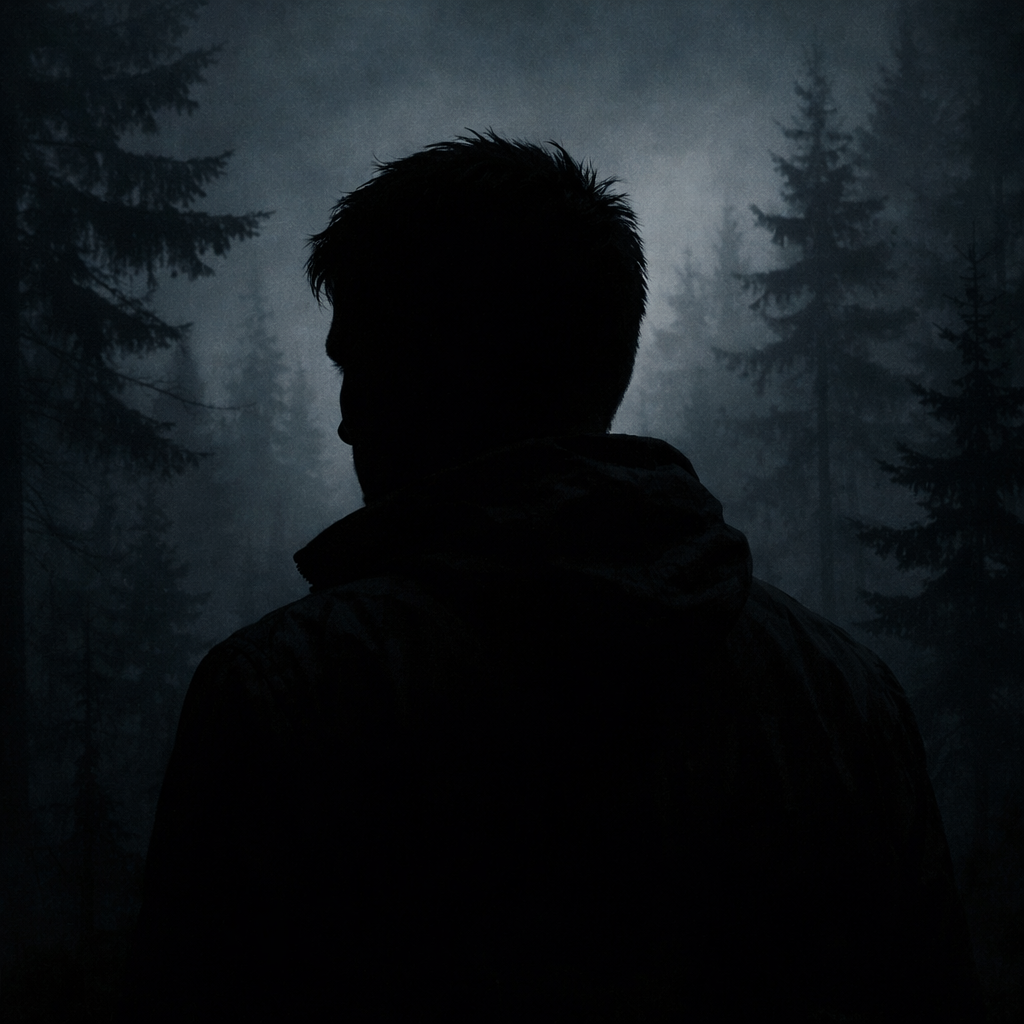
Walk in a Killer’s Shoes — A True Story
Chapter 1: The Night Everything Broke.
The plan was simple: show up, drink something warm, stand near a fire, and let proximity do what personality never could. Not reinvention — just a brief suspension of the label. Weird on pause for one night, maybe downgraded to fine or harmless or any other word that meant you were allowed to exist in the background. But an hour up the mountain, cresting the last dirt switchback, you kill the battered car’s lights and remember what this party is actually known for.
Violence.
The forest doesn’t acknowledge your arrival. It breathes around you — pine resin, burnt clutch, something older beneath both. Behind you, a beat‑up LED flashlight throws a weak cone of light across the dirt. Your friend crouches over the tent, a year younger and grinning like you owe him something. Without looking up, he says, “Grab me a beer.”
The trunk pops, and the sound disappears into the trees. You fish out two warm cans — part of the stash you loaded before dark — and hand one to him. Behind you, two others wrestle folding chairs out of the back seat, elbows locked, moving with the careful choreography of people who have been betrayed by folding chairs before.
Dozens of small camps bleed into one another around a central bonfire. An old couch has materialized at the fire’s edge the way furniture always does at gatherings like this — no one brought it, no one owns it, it simply arrived. You know every face in the firelight. Not well, not by choice. You know them the way you know a scar: by the shape of how it happened.
Just off-center, the skids have already claimed their usual radius — the ones whose reputations show up before they do, whose names get said with a particular tilt. They’ve never come at you directly. Not yet. To the side, one guy slaps another while the crowd pulses around them. The hits are soft, almost friendly, and you wonder how much of this is real hate and how much is fear laundered through tradition.
Then you see your one weird friend in the middle of it, taking slaps. You set your beer on a pile of crushed cans and step into the ring.
“Slap me instead.”
Everything pauses. Even the trees seem to hold their breath. The kid studies you, nostrils flaring, trying to decide if you’re serious. Someone hoots, and the ring tightens again, eager. Now you’re the new variable, the unsolved equation, and everyone wants to see what happens.
He comes in palm-first. You don’t raise your hands. You plant your feet and take it. The slap lands soft, exploratory — a question. You answer it by catching him across the jaw hard enough to turn his head.
“Do it again.”
He does, twice. Somewhere in the third exchange, something behind his eyes shifts from wanting to needing. The ring feels it. It contracts.
A second kid pushes forward, already talking. He switches from slap to punch mid‑swing. You slip it just enough, drive your fist into his ribs, feel something give. That’s when the perimeter breaks. Arms clamp around yours before you can reset. The original kid reads the new odds and steps back in. Someone hooks your neck from behind; your elbow finds him. Then geometry stops mattering. You’re not outside the ring anymore. You’re inside it, swallowed whole.
Your friend’s voice reaches you — your name — and then a boot in the small of your back erases both. Your knee hits dirt. The pines overhead tilt in a slow, uninvited rotation. Something heavy cracks against the side of your head and the rotation goes white. Dirt and copper fill your mouth. The crowd is still there, but distant now, like noise bleeding through a motel wall.
You find a hand and try to use it. A forearm drops across your throat and pins you. You grab a wrist — wet, hairy, useless — and then a forehead slams into your nose and something inside it shifts the wrong way. Heat floods behind your eyes. The sound you make doesn’t escape.
A shape you haven’t seen before steps into your narrowing vision. Bigger. One of the watchers from the edge. He’s holding a length of pipe, and he swings it with the casual follow‑through of someone who has already decided the ending. It finds your skull. The trees break into pixels. Your body reaches its only remaining conclusion: down, small, less.
The next minute is sensation only: boots, fists, dirt in your teeth, the pop of brass knuckles splitting skin, the heavy, sodden warmth of blood leaking through your scalp. It isn’t cinematic. No heroic soundtrack. Just ugly, desperate impact. For a few seconds, you’re convinced they’ll kill you simply to learn whether it feels different from killing a squirrel or a frog or any of the other things kids destroy before they graduate to people.
You stop fighting the way a phone dies — no decision, just a black screen. The dirt is an inch from your face. You can smell it: sweat, ash, something green and crushed beneath both. Boots find you, and you try to count, but counting requires a part of your brain that has gone somewhere else. Four, maybe six. Voices at the edge offer commentary.
Then the boots stop. Not gradually — just over. The pipe drops into the leaves with a sound like a knocked‑over cup. One voice says, “Shit, he’s still breathing.” Another, startled, says, “He’s probably dead, man.”
You are not dead. Right now, that is the least convenient thing about you.
Your heart stutters in your chest. You lie there and let it.
You don’t know how long you lie in the dirt. Two minutes, an hour — time collapses into the heat behind your eyes and the slow, tidal thump of your pulse.
Eventually, you get up. There’s no decision in it; your body simply refuses to stay down. The tent is somewhere behind you in the dark, and you move toward it because moving is the only plan left. Someone finds a phone. Someone makes a call. Your dad is coming.
Then two kids step out of the tree line ahead. Younger than the ones who put you in the dirt, but wearing the same expression — the one that says they’ve already decided how this ends. One has his fists balled. The other is already talking.
“You threatened to stab someone?” the younger one asks. His voice pitches upward at the end, not quite settled. He kicks you in the side to see what you’ll do.
You don’t do much. You find your feet, barely. You check your jacket — your phone is gone, lifted somewhere in the first round. You listen for your friend. Pines. Fire, distant. Nothing useful.
“We’re gonna beat your ass,” the bigger one says. His hands give him away.
You get yourself as upright as you’re going to get.
“Look at me,” you say. The words come out thick, like you’re talking through a wet cloth. “I’m already done. Just go.”
You glance down at your shirt. It’s soaked, the sleeve fused to your forearm in a dark, cooling sheet. Your scalp is doing something you can’t fully account for. Your skull feels pressurized, stuffed with something hot and slow. Your jaw chatters on its own. Somewhere down the hill, your dad is on his way. You hold on to that.
You stagger toward what you hope is the road. The world tilts. Your legs don’t cooperate. You’re not sure if you’re heading up or down the mountain, only that the pines keep closing in, eager to swallow you.
Behind you, the kids follow at a distance, trading whispers. One throws a pine cone that pings off the back of your skull, but you barely register it. Your vision has narrowed to a tunnel. Each breath hurts, so you take shallow ones and hope your lungs don’t quit. You don’t notice your hands until you trip over a root and catch yourself: your left hand is sticky, fingers bent wrong, but your right is closed around the cheap folding knife you always carry.
You don’t remember grabbing it. It’s just there, cold and comforting.
You’re barely ten yards down the path when they strike. You know, with a certainty that doesn’t come from thinking, that if you hit the dirt again you won’t get back up. The bigger kid lunges at your back, shouting, “You little bitch!” He overshoots and lands on his rear, but you can’t outrun him — he’s bigger, feral. Clutching the knife, you feel him close in. As he winds up a swing, the younger one sneaks behind you. You have maybe two seconds.
You don’t hesitate. You drop your weight, pivot, and drive the blade into the younger kid’s chest, angling up into his ribs. He screams, staggers backward. You yank the knife free and thrust twice more; the fourth thrust grinds through bone. He goes limp, eyes glazing, a wet gurgle escaping as he collapses into the leaves.
You spin and catch the bigger kid off‑guard, stabbing him in the shoulder. You both tumble in the dirt, wrestling, until you spring apart. He freezes, hands raised, staring at his friend’s body, blood pooling around him.
“I didn’t want this. Just leave me alone,” you gasp.
He hovers, trembling, then snarls that he’ll be back with backup — and bolts down the trail without looking back.
Your legs shake as you haul yourself upright. The knife’s blade is caked in blood and nicked at the tip. You wipe it on your jeans and pocket it, still unsure whether you’re safe.
Headlights sweep across the trees: a sedan creeping down the road, probably a parent checking on their kid. You stagger into the lane, waving one arm. The car screeches to a halt. The driver — a middle‑aged man with an immaculate haircut and white‑knuckled grip on the wheel — leans out.
“What the fuck happened to you,” he hollers.
You open your mouth to answer, but your stomach revolts. You vomit onto the dirt road, slump to your knees, head hanging between your arms, and wait for whatever comes next.
The hour between the forest and the hospital doesn’t exist. There is a dirt road, and then a parking lot, and then doors. Your stepmom materializes at the reception desk the way people do in fever dreams — already mid‑sentence, already wrong about several things. You’re still bleeding somewhere in your hair. You can’t confirm whether you called your dad or only rehearsed calling him.
A gurney appears under you. One of its wheels drags left on every turn. The triage bay is the color of a headache. The nurse asks your name. She asks what you took. You say nothing, which is both an answer and a description of your current state.
Your stepmom is somewhere behind your left ear, talking fast, as if information might fix this. “ — attacked, there were a lot of them, I don’t know, I wasn’t there — his friend, I don’t know where, somewhere up there still — drinking, maybe, but not him, he doesn’t, that’s not — will you just look at his head — ”
The nurse isn’t listening. She already knows. She peels back the crusted towel from your scalp, makes a sympathetic face, and snaps gloves on with a sound that echoes off the linoleum. She cleans the wound with something that smells like poison and begins stapling. You focus on the EKG beeps from the next cubicle, the hum of the janitor’s floor buffer, the fluorescent lights flickering in time with your heartbeat.
Two curtains down, someone is screaming. You can’t tell if it’s pain or personality. A young cop walks past your bed and parks by the vending machine. His vest says RCMP, but he looks barely older than you. He pretends not to look, but you can feel his attention like a lens.
“We need to take a few pictures for the chart, okay?” the nurse says. She lifts your shirt, prods your ribs, counts bruises out loud.
A doctor finally appears, runs through the checklist, and decides you’re not in danger of dying tonight. He gives the nurse a quick twitch of the eyebrows. She nods, wraps your head in fresh gauze, and rolls you closer to the doors.
That’s when the commotion starts. Two orderlies jog past, then a cluster of nurses, then the cop. The nurse who stapled your head leans in and says, “Stay here,” and then the curtains are empty except for you, your stepmom, and the gurney.
You listen. You hear: “Critical incoming,” “multiple punctures,” “CPR in progress.” You hear someone say “stabbing,” and it ricochets around your skull like a stray bullet.
You try to sit up. The world tilts, but you manage it. Through a gap in the curtains, you see the cop talking into his radio, voice low and flat. You see blood on the floor — thin, dragged, not yours — like someone pulled a wet shoelace toward the trauma room.
Your stepmom is in the corner now, calling your dad. Her voice is ragged. “He’s okay. They fixed him. I don’t know what happens next. I don’t know.” You want to tell her to stop, but she won’t look at you.
The nurse returns. She’s breathing differently — fast but steady. She looks at your chart, then at your face. She leans in, voice barely above a whisper.
“Do you know anything about a stabbing? Did you see who did it?”
“It was me,” you say. The words are small, but they clear the static. “I tried to run. He wouldn’t let me.” You shake your head. The pressure behind your eyes builds again, but this time it isn’t pain.
The nurse says nothing. She nods once, leaves, and comes back with the cop.
He’s taller up close. His vest creaks as he folds his arms. He looks at your stepmom, then at you.
“I need you to stand up,” he says.
You do.
“You are under arrest for murder. Anything you say can and will be used against you.” His voice is so empty it almost sounds kind.
He slips the cuffs around your wrists.
You don’t fight. You don’t cry. You never imagined this part. The knife was for surviving, not for this. Somewhere in your chest, a door swings open into nothing.
Outside, the parking lot is quiet. Dew beads on the hood of the cruiser. The cop opens the door for you like you’re an invited guest. You sit. The vinyl is cold.
In the window’s reflection, your stepmom’s face appears. She’s crying now, but you can’t hear it.
You close your eyes. You try to find the version of yourself that existed before all of this — the one who hadn’t yet done what you did. You search for him the way you’d search for something you set down and can’t place. The cruiser idles. The cop adjusts his mirror.
You can’t find him anywhere.
© 2026 J. Michael
All rights reserved.
From the book *Walk in a Killer’s Shoes*.
메타데이터
- post_id
- 86026e917f2f
- slug
- walk-in-a-killers-shoes-86026e917f2f
- url
- https://medium.com/@killershoesproject/walk-in-a-killers-shoes-86026e917f2f
- canonical_url
- https://medium.com/@killershoesproject/walk-in-a-killers-shoes-86026e917f2f
- author_url
- https://medium.com/@killershoesproject
- status
- ok
- fetched_at
- 2026-07-09 05:26:43