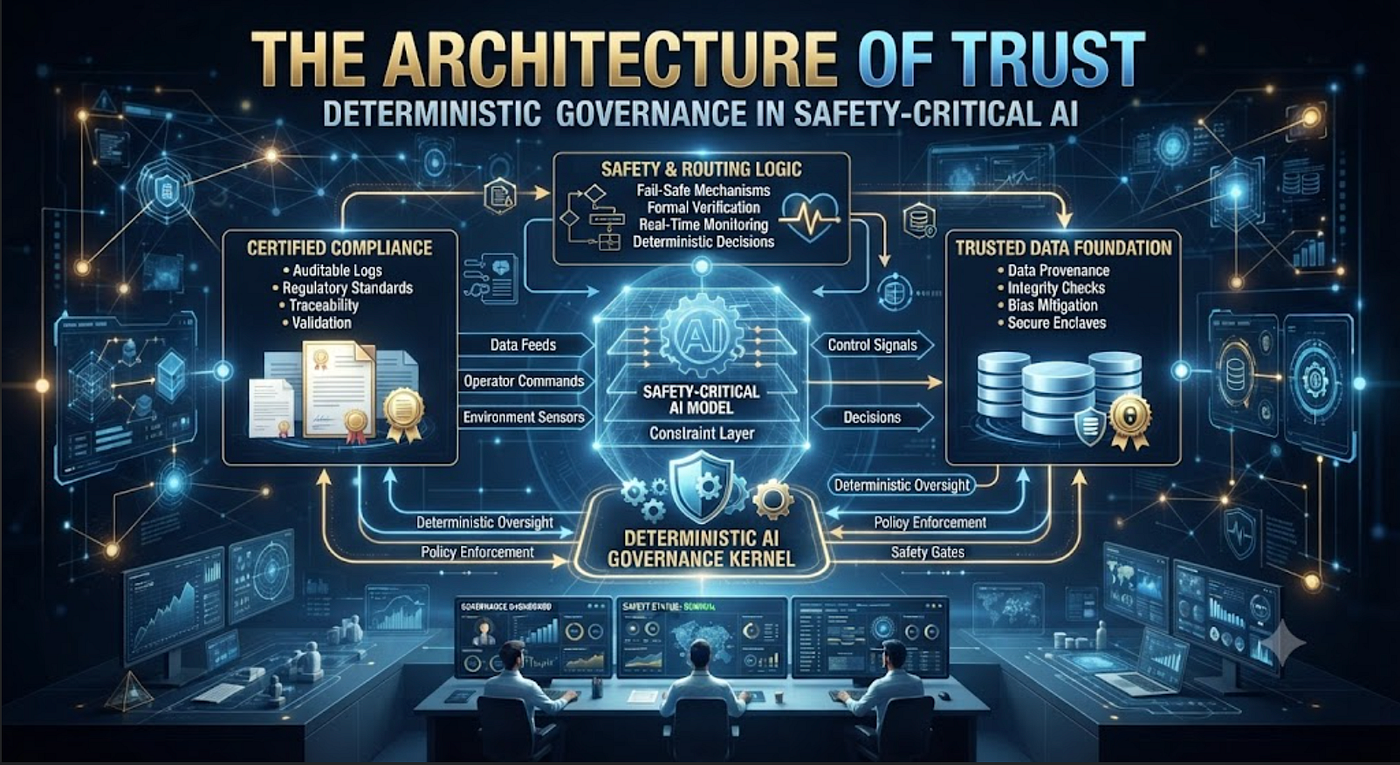
The Architecture of Trust: Deterministic Governance in Safety-Critical AI with GPT 5.6
Frank Morales Aguilera, BEng, MEng, SMIEEE
The Architecture of Trust: Deterministic Governance in Safety-Critical AI with GPT 5.6 and GLM 5.2 Models
Frank Morales Aguilera, BEng, MEng, SMIEEE
Chief AI Officer, Drivia Consulting | Founder & CEO, SOMALA | Former Boeing Associate Technical Fellow | Thinkers360 Elite Expert In Open Source, Generative and Agentic AI, AI Governance| Thinkers360 Top Voice 2025
The evolution of artificial intelligence in safety-critical domains — specifically in high-stakes aviation operations — has historically been hampered by a fundamental tension: the reliance on probabilistic models to produce deterministic outcomes. Large Language Models (LLMs), while capable of deep analytical reasoning, are inherently stochastic. When applied to fields like airline operations control (AOC), this probabilistic nature introduces a non-zero risk of catastrophic failure. The AOC Hybrid System v2.0 represents a paradigm shift, moving AI from a probabilistic "expert" to a component of a deterministic governance framework, governed by the core principle: generative reasoning is a proposal, but operational governance is a veto.
At the heart of this architecture lies a strict decoupling of generative reasoning from operational authority. The execution of the AOC Hybrid System v2.0 demonstrates rigid adherence to this deterministic safety, in which the generative reasoning produced by the GLM-5.2 engine serves only as a proposal rather than an authoritative directive. To demonstrate this, the implementation is structured across two distinct cells in the provided notebook. DEMO1 is the first main code cell, which initializes the hybrid system, imports the necessary libraries, and performs initial processing of flight incidents. DEMO2 is the second main code cell, which implements the version 2.0 architecture, including the TopologicalGovernor, the AOCCValidator, and the GPT56ExecutionEngine. The complete implementation details for this architecture can be found at: https://github.com/frank-morales2020/AST/blob/main/GLM_GPT_AOCC.ipynb
Code Structure and Implementation Hierarchy
The AOC Hybrid System v2.0 is organized into a modular, hierarchical structure across two distinct notebook cells that enforces a strict separation between generative reasoning, deterministic validation, and auditable persistence. This design ensures that safety constraints are treated as non-negotiable governance rules rather than flexible suggestions.
- DEMO1: This is the first main code cell, which initializes the hybrid system, imports necessary libraries, and runs the initial processing of flight incidents.
- DEMO2: This is the second main code cell, which implements the version 2.0 architecture, including the TopologicalGovernor, the AOCCValidator, and the GPT56ExecutionEngine.
Core Reasoning Module (GLMThinkingEngine): The architecture's foundation is the reasoning engine, which leverages the GLM-5.2 model to perform deep, structured analysis.
- CoT Prompting: It utilizes a structured 6-step Chain-of-Thought (CoT) framework — encompassing situation analysis, data assessment, risk evaluation, options analysis, trade-off assessment, and decision rationale — to ensure that all operational context is accounted for before a proposal is generated.
- Audit Integration: Every reasoning process is assigned a SHA-256 hash, which anchors the specific "thinking" state to the final decision, preventing post-hoc manipulation of the model's rationale.
The Deterministic Governance Layer (AOCCValidator): This module functions as the system's "Governor." It is entirely decoupled from the reasoning engine and operates as a binary check on the incident data.
- Physics and Law Constraints: The validator implements hard-coded rulesets, including an aircraft range dictionary and regulatory databases for FAA_121 and EASA_OPS compliance.
- The Binary Gateway: By returning a Tuple[bool, List[str]], the validator forces an absolute "Pass/Fail" outcome on every candidate proposal generated by the reasoning engine. If the bool is False, the operation is blocked, regardless of the LLM's reasoning quality.
Execution Expediter (GPT56ExecutionEngine): The expediter module translates validated results into human-readable directives.
- Formatting-Only Constraints: Its logic is deliberately restricted; it consumes the ValidatedDecision and the reasoning data as inputs rather than context for new reasoning. This prevents the expedited output from introducing hallucinated safety measures or overriding the vetoes issued by the governance layer.
Audit Persistence (AuditPersistence): The persistence layer ensures that the system satisfies the requirements of a sovereign, high-stakes controller.
- Cryptographic Integrity: It compiles the incident ID, reasoning state, validation messages, and decision hash into a single JSON object.
- Tamper-Evident Hashing: By hashing the entire record with a fixed SEED = 123, the system creates a cryptographic proof. If any part of the decision chain is altered, the SHA-256 hash will fail, maintaining an immutable history that is fully reconstructible for regulatory audit.
Self-Correction Controller (SelfCorrectingValidator): This controller wraps the reasoning and validation steps into a bounded loop.
- Iterative Re-alignment: If a proposal is vetoed, the controller extracts the specific validation violations and injects them back into the reasoning engine as structured feedback.
- Deterministic Termination: By enforcing a max_attempts constraint (defaulting to 3), the system guarantees that the reasoning process will either converge on a safety-compliant state or terminate in a BLOCKED status, preventing infinite loops or unbounded resource consumption.
Results
The system's AOCCValidator acted as an uncompromising binary gateway, vetoing four out of five proposed operations. In the case of the weather-related incident involving flight AF789 and the security incident involving EK202, the system successfully identified that the B737 and A320 aircraft lacked the range required for transatlantic routes. Had these operations been left to a purely generative model, the lack of technical oversight would have likely resulted in fuel exhaustion mid-flight. Similarly, for the regulatory and crew-related incidents involving AA123 and UA456, the validator detected violations of EASA and FAA rest requirements that were critical to operational legality. By blocking these flights, the system prevented regulatory non-compliance that would have grounded the fleet or compromised crew safety.
The only incident allowed to proceed was the medical emergency on BA456. In this instance, the validator confirmed that the B777 aircraft was suitable for the route, that the crew rest complied with FAA-121 standards, and that no security violations were present. This allowed the system to trigger the necessary emergency medical protocols, demonstrating that the governance layer can distinguish between high-risk operational violations and urgent, safety-critical assistance. Throughout the entire process, the GPT-5.6-LUNA model functioned strictly as an expediter, formatting the validated reasoning into clear directives within seconds without introducing any new decision-making parameters. Every stage of this reasoning and validation was captured by the AuditPersistence layer, which generated SHA-256 hashes for every decision. This ensures that the entire operational history is cryptographically linked and fully reconstructible for regulatory audit. Ultimately, the 80% failure rate is not a symptom of system malfunction, but the definitive proof of the architecture's success: it confirms that the Hard Validation Layer is successfully intercepting and vetoing dangerous proposals that would have otherwise led to operational failure. The proof is in the code. Seed = 123.
This level of mathematical accountability transforms AI decision-making from an opaque, black-box process into a transparent, auditable, and verifiable chain of custody, satisfying regulatory and operational transparency requirements. Ultimately, the AOC Hybrid System v2.0 transitions AI from a research experiment to a production-ready, sovereign controller. By combining the deep, contextual reasoning of GLM-5.2 with the deterministic safety of the AOCCValidator, the high-speed formatting of GPT-5.6-LUNA, and the cryptographic proof of the audit layer, the system guarantees safety rather than merely predicting it. Within a sovereign environment like the Sovereign Machine Laboratory (SOMALA), this architecture ensures that AI becomes a robust, reliable tool for aviation, where the safety of operations is guaranteed not by the model's intent, but by the code's deterministic veto.
메타데이터
- post_id
- 861cb97d07f8
- slug
- the-architecture-of-trust-deterministic-governance-in-safety-critical-ai-with-gpt-5-6-861cb97d07f8
- url
- https://medium.com/ai-simplified-in-plain-english/the-architecture-of-trust-deterministic-governance-in-safety-critical-ai-with-gpt-5-6-861cb97d07f8
- canonical_url
- https://medium.com/ai-simplified-in-plain-english/the-architecture-of-trust-deterministic-governance-in-safety-critical-ai-with-gpt-5-6-861cb97d07f8
- author_url
- https://medium.com/@frankmorales_91352
- status
- ok
- fetched_at
- 2026-07-13 06:23:13