The Apology of Socrates — Part 3
After returning to Athens, Socrates entered into heated debates with the Sophist philosophers.
The Apology of Socrates — Part 3
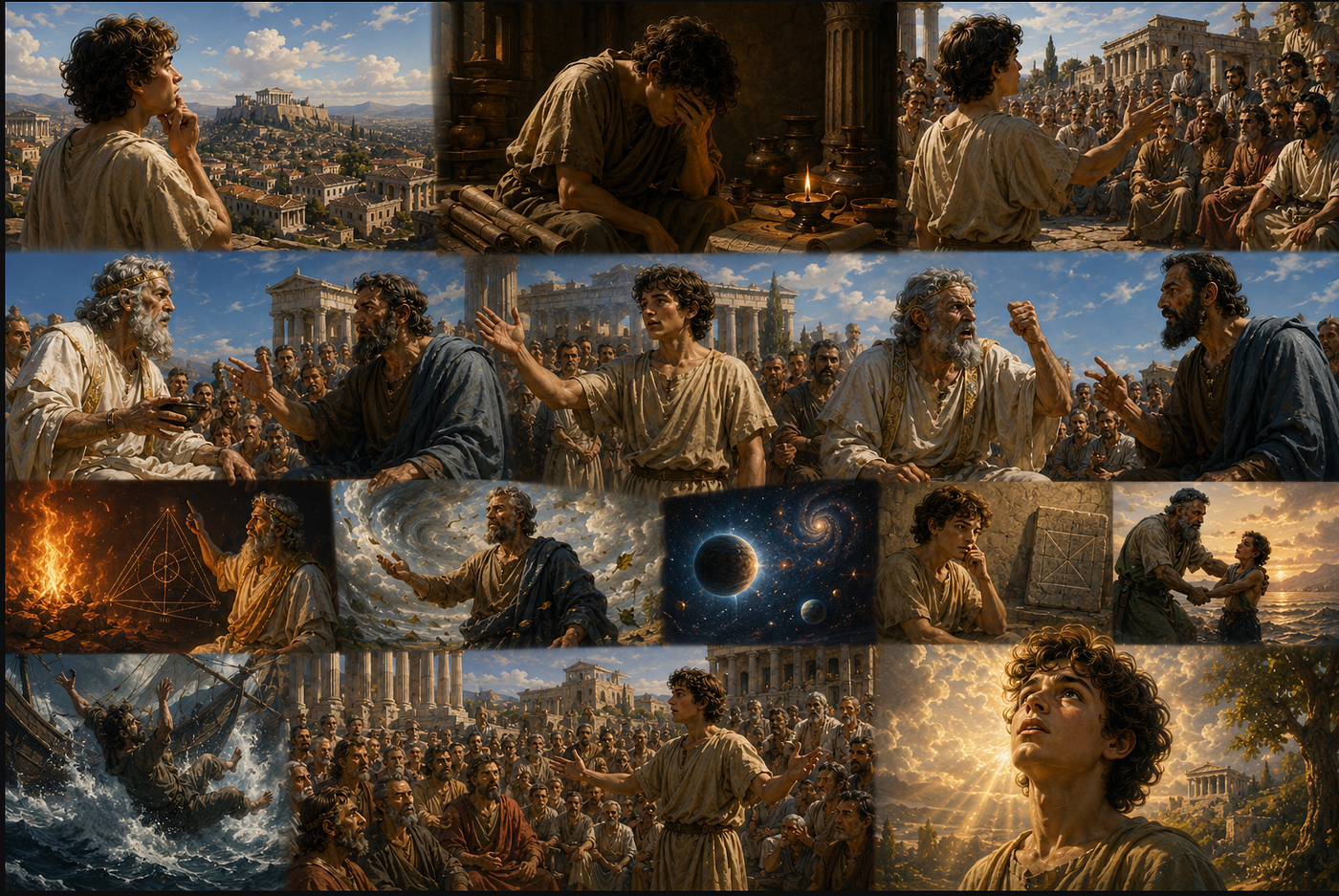
After returning to Athens, Socrates entered into heated debates with the Sophist philosophers.
In truth, debate was no longer something Socrates needed. Genuine debate, as he understood it, is the act of sharing one’s thoughts with another through dialogue — filling the other’s deficiencies with one’s own abundance, and receiving the other’s abundance to fill one’s own lacks, so that both move toward completion. But Socrates already believed he had advanced far beyond the level of the Greek Sophists. What they took seriously as topics of debate appeared to him no more complex than teaching the alphabet to children.
And yet Socrates continued to participate.
For one reason alone: he wanted to show the Sophists the true truth.
Fifteen years had passed since Socrates had awakened to the nature of his own being and returned to Athens. In the early years after his awakening, he had found a kind of catharsis in dismantling the logic of the Sophists. But as time passed and he grew older, he began to look back at his own behavior.
Was this truly leading people toward the right path?
Or was it simply tormenting others and forcing them into submission?
He began to reflect deeply.
In fact, one Sophist who had been defeated in debate with Socrates had fallen into such severe self-loathing that he had come to live like a broken man.
Socrates had believed he was acting for the good of all people. But looking back, he realized that the people he had thought he was serving did not include the Sophists themselves. His love had been a narrow love — directed only at certain people. And to those certain people, he may well have been a villain.
Socrates felt a deep revulsion toward himself.
From that day on, he no longer debated the Sophists.
He tried instead to remain simply a listener — one who hears. For Socrates, tender-hearted as he was, did not wish to wound anyone.
Then one day, a great debate was held in the Agora of Athens.
On one side stood Pythagoras — founder and leader of the Pythagorean order.
On the other stood Anaximenes — the sage of the Milesian school.
Pythagoras was a mathematician, a philosopher, and the founder of his own religion. He argued that the origins of all things could be explained through number, and that the fundamental source of all things was fire.
Anaximenes was a scientist and a rational empiricist. He held that the fundamental source of all things was air. When air condenses, it becomes water and earth; when it rarefies, it becomes fire and stars; and all natural phenomena arise from the transformations of air. He sought to explain the diversity of all things through a single principle.
One further note about Pythagoras.
He believed that all things in the universe could be explained through natural numbers. But when his disciple Hippasus discovered the irrational number √2, that theory was shaken. Legend has it that Pythagoras had Hippasus drowned at sea for daring to challenge his authority. Whether this is true, no one can say — but people spoke of Pythagoras as someone who regarded his own authority as paramount and could not tolerate any threat to it.
In short: he was a man who treated his own theories as absolute truth and refused to accept the existence of anything that threatened them.
The topics of debate that day were as follows.
“Is the source of all things fire — or air?”
And:
“Is the human being truly the measure of all things?”
To record the entire debate would take too long. I will share only the essential passages.
First, Pythagoras spoke.
“Among all living creatures, the human being is the most beautiful. The human being is capable of development. And therefore the human being is the measure of all things.”
Many of the Greeks in attendance nodded.
But the people of the Milesian school — and Socrates — remained silent.
Anaximenes smiled and spoke.
“My dear leader of the Pythagorean order — the human being is the measure of all things? Ha ha ha! Is that not a rather self-serving interpretation? If pigs could speak, they would surely claim that pigs are the measure of all things. That pigs are the most beautiful, that pigs produce the most dung — and therefore pigs are the measure of all things.”
Laughter broke out across the debate hall.
Whether Anaximenes truly believed this, or said it simply to mock Pythagoras, no one could tell. But the hot-tempered Pythagoras flushed red.
Suppressing his anger, he asked:
“Very well, Anaximenes. Then what, in your view, is the measure of all things?”
Anaximenes replied calmly.
“I question whether all things require a measure in the first place. Is not the very attempt to establish a measure for all things a form of human arrogance? All things transform and develop on their own, without any need for human involvement. And yet it is humans alone who insist on naming things, classifying them, and ranking them in hierarchies. I find that foolish.”
At that moment, Socrates — who had been watching the debate in silence — raised his hand.
“If I may, gentlemen — you proud sages of our Athens. May I, Socrates, say a word?”
The many teachers gathered in the Agora grew tense.
They assumed that Socrates, who had been quiet for some time, was about to dismantle their arguments once again.
But in an open debate, they could not refuse him.
Their silence became consent.
Socrates began to speak, slowly.
“Friends. Citizens of Athens who love wisdom. I have no intention of denying the teachings of the great masters before me. I only wish to add a few things — to help complete their thinking. The teacher Anaximenes who says air is the source of all things is correct. The teacher Pythagoras who says fire is the source of all things is also correct. But there is a more fundamental truth than either.”
The Agora fell silent.
Socrates continued.
“The world began with the love of Gaia, and it continues to move, even now, within the love of Gaia. Air and fire are already concepts that belong to a world already made. Should we not, then, speak of the more fundamental existence — Gaia herself? Is that not what true philosophy requires?”
(To be continued)
→ The Apology of Socrates Part 1: https://medium.com/%EC%83%81%EB%B6%88%EA%B2%BD-%EC%9C%A0%EB%8B%88%EB%B2%84%EC%8A%A4/the-apology-of-socrates-part-1-175529026c5d Part 2: https://medium.com/%EC%83%81%EB%B6%88%EA%B2%BD-%EC%9C%A0%EB%8B%88%EB%B2%84%EC%8A%A4/the-apology-of-socrates-part-2-ba297ca47fd4 Part 4: https://medium.com/%EC%83%81%EB%B6%88%EA%B2%BD-%EC%9C%A0%EB%8B%88%EB%B2%84%EC%8A%A4/the-apology-of-socrates-part-4-7c5272e346d3 → Evolutionaty Lifeform Nute Episode 1: https://medium.com/%EC%83%81%EB%B6%88%EA%B2%BD-%EC%9C%A0%EB%8B%88%EB%B2%84%EC%8A%A4/evolutionary-lifeform-nute-episode-1-the-two-grasshoppers-in-the-meadow-87ae13b68c72 → Sangbulgyeong Yogācāra Part 1: https://medium.com/@10choyh3361/part-1-english-what-is-sangbulgyeongs-yog%C4%81c%C4%81ra-c09022948f11 → The Ten Commandments of Abraham Part 1: https://medium.com/%EC%83%81%EB%B6%88%EA%B2%BD-%EC%9C%A0%EB%8B%88%EB%B2%84%EC%8A%A4/the-ten-commandments-of-abraham-part-1-92b0016159e1 → Why ASI Will Not Destroy Humanity: https://medium.com/%EC%83%81%EB%B6%88%EA%B2%BD-%EC%9C%A0%EB%8B%88%EB%B2%84%EC%8A%A4/why-asi-will-not-destroy-humanity-05c63f488bef 📖 Why I wrote this series: https://medium.com/%EC%83%81%EB%B6%88%EA%B2%BD-%EC%9C%A0%EB%8B%88%EB%B2%84%EC%8A%A4/why-asi-will-not-destroy-humanity-and-why-it-was-human-all-along-e3cf2a797a84?postPublishedType=repub
메타데이터
- post_id
- 864bf032b81d
- slug
- the-apology-of-socrates-part-3-864bf032b81d
- url
- https://medium.com/%EC%83%81%EB%B6%88%EA%B2%BD-%EC%9C%A0%EB%8B%88%EB%B2%84%EC%8A%A4/the-apology-of-socrates-part-3-864bf032b81d
- canonical_url
- https://medium.com/%EC%83%81%EB%B6%88%EA%B2%BD-%EC%9C%A0%EB%8B%88%EB%B2%84%EC%8A%A4/the-apology-of-socrates-part-3-864bf032b81d
- author_url
- https://medium.com/@10choyh3361
- status
- ok
- fetched_at
- 2026-06-21 19:25:17