It Is Reels’ Victory That Leads to Real Victory
How Vijay’s TVK rewrote the rules of Tamil politics — one 15-second clip at a time
It Is Reels’ Victory That Leads to Real Victory
How Vijay’s TVK rewrote the rules of Tamil politics — one 15-second clip at a time
May 4, 2026. The results board for Tamil Nadu’s 234-seat Legislative Assembly lit up with a number that nobody outside TVK’s inner circle had dared to predict: 108 seats for a party that did not exist two years ago.
The Dravida Munnetra Kazhagam — the party that invented Tamil mass political communication, that carried Periyar’s pamphlets into every village and turned Kalaignar’s screenplay genius into an electoral weapon — won 59 seats. Down from 133 in 2021.
The vote-share gap between the two parties was just 3.53 percentage points. The seat gap was 49.
That gap — narrow in votes, devastating in seats — is the most precise measurement of what a digital revolution looks like when one side shows up and the other doesn’t.
The New Battlefield Nobody Guarded
Before we talk about what TVK did right, we need to sit with one uncomfortable truth: DMK’s governance record was genuinely strong. Tamil Nadu grew at 10.83% in FY2025–26. Free bus travel for women ran for the full term without rollback. Over a crore families received monthly financial assistance. The state held its position as India’s most industrialised by GSDP.
None of it mattered where the election was actually fought.
The 2026 Tamil Nadu election was not decided at rallies or on television or even at the booth — though all of those mattered. It was decided in the ten seconds before a thumb scrolls past a Reel. It was decided in a family WhatsApp group at 11 pm. It was decided in the gap between a 15-year-old’s Instagram feed and her parents’ voting intention.
TVK understood this. DMK did not.
The Architecture of a Digital Landslide
What TVK’s Route PR team built was not a campaign. It was a distributed media empire — and it ran 24 hours a day, seven days a week, in every one of Tamil Nadu’s 234 constituencies simultaneously.
Consider the infrastructure:
- 85,000+ fan clubs converted from film-celebration networks into hyper-local WhatsApp and Instagram distribution units
- 4,000+ coordinated accounts generating tens of millions of daily impressions across platforms
- AI-generated content, 3D hologram rallies, and district-specific memes tailored to local caste and cultural flashpoints
- Micro-influencers recruited at the constituency level — giving TVK an authentic local voice in every seat that no centralised IT wing could replicate
The genius wasn’t any single tactic. It was the layering. Organic fan infrastructure built over years of Vijay’s film career provided the emotional foundation. Generative media and short-form platform strategy built the daily volume. And beneath both layers ran a peer-to-peer trust network that political advertising simply cannot buy.
Content shared by a known contact is trusted five times more than content from a party page. TVK turned every fan into a trusted contact.
Vijay Mama and the Youngest Voters in the Room
The 2026 election recorded 85.1% voter turnout — the highest in Tamil Nadu’s assembly election history, twelve points above 2021's. Driving that surge was a cohort of 1.19 crore voters aged 18 to 29, most of them mobile-first, platform-native, and carrying no inherited loyalty to either Dravidian party.
Exit poll and ground data showed 60 to 70% of first-time voters aged 18 to 25 voted for TVK.
TVK did not reach them through speeches. It reached them through the same grammar they use every day: Reels, Shorts, meme pages, fan edits, whistle-symbol posts, and shareable audio. The campaign blended into their normal media habits so smoothly that many young voters did not experience it as political advertising at all. It simply felt like culture moving.
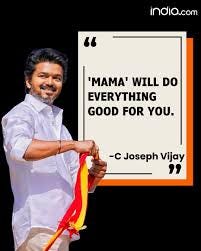
Vijay’s campaign went further. At his final rally in Chennai, he publicly invited children to use emotional leverage on their parents — framing it in the playful language of a beloved film uncle. “Vijay Mama" became a phrase that meant something different to a twelve-year-old than to her grandmother. The campaign understood parasocial attachment and family influence dynamics in ways that most political operators in India have never had to think about before.

TVK did not merely campaign to voters. It campaigned through families.
The Eleven Weapons Nobody Saw Coming
Route PR did not win with one idea. It won by deploying eleven mutually reinforcing psychological and cultural levers, each amplifying the others.
Cultural branding grounded TVK in familiar Tamil political language — Periyar, Ambedkar, Kamaraj, state autonomy, and the two-language policy — but presented it through formats that felt contemporary rather than archival. Old ideology, new skin.

Crowd psychology turned every rally into a content factory. Viral crowd clips created the feeling of unstoppable momentum, reducing hesitation in undecided voters who wanted to be on the winning side.
Scarcity strategy was perhaps the most counterintuitive. Vijay limited his physical campaign appearances dramatically. Each appearance became an event. Each clip became precious. Anticipation is an algorithm’s best friend — scarcity generates curiosity, curiosity generates engagement, engagement generates reach.
Negativity into momentum meant that every attack on TVK strengthened supporter unity. Criticism fed an “underdog rising against the establishment” narrative. When DMK attacked, it inadvertently reinforced TVK’s outsider identity. Some of DMK’s own strikes became TVK campaign material within hours.
User-generated content made the campaign feel alive and participatory in a way polished party content never can. Supporters produced crowd videos, fan edits, meme replies, and rally clips. Each piece felt human. Each piece traveled further than any official post.
And underneath everything: narrative control. TVK shaped the emotional frame around corruption, dynasty, arrogance, and old politics — and held it from the first day of campaigning to the last. DMK spent the campaign defending its governance record. TVK spent it shaping how people felt about the election. Governance data operates in the rational mind. Emotional narrative operates in the gut. At the ballot box, the gut usually wins.
The 5,000-Post War
The contrast in campaign output is almost too stark to believe, but it is documented.
DMK’s IT wing produced an estimated fewer than 5,000 posts during the entire campaign period. TVK generated tens of millions of daily impressions. DMK’s responses to TVK attacks arrived days after the original had been shared millions of times. By the time the counter-narrative reached voters, the original frame was already settled as fact.
One cadre put it simply on X: “The biggest failure of this election is the DMK IT wing.”
Another: “They totally failed to read the influence Instagram is having on the ground. The same narrative building brought Modi to power in 2014.”
A third, a ground-level worker who spent two months canvassing: “I worked for 2 months. Many people are unaware of politics.” His two months of personal effort were undermined because the digital ecosystem never primed the voters he was talking to.
These are not opposition voices. These are heartbroken loyalists.
The Geography of the Reel
TVK swept Chennai’s 20 of 22 seats. It dominated Kancheepuram, Thiruvallur, Chengalpattu, Vellore, Salem, Coimbatore, Erode, Tiruchirappalli, and Madurai. Urban and semi-urban youth deserted DMK en masse in every major city constituency.
Look at that list, and you are looking at a map of Instagram penetration in Tamil Nadu. The platform skews young and urban. The results skewed identically.
DMK held the Cauvery delta; the Nilgiri Hills; and rural strongholds where the 40-plus demographic dominates and where welfare delivery built a personal economic relationship over five years. Women over 35 largely stayed. Muslim-majority constituencies largely stayed. The ideological firewall held with voters who formed their political identity before the smartphone.
The rupture was generational and geographic. And it was perfectly predicted — by TVK’s content strategy — months before anyone voted.
What Changes Now
TVK won 108 seats. A majority requires 118. That means governing requires coalition-building, compromise, and the weight of undelivered promises carried into every subsequent news cycle. The campaign promise machine now meets the governance reality machine.
Every infrastructure failure, every law and order incident, every unmet welfare commitment now belongs to TVK. The outsider framing that drove the campaign dissolves the moment the cabinet is sworn in.
DMK, meanwhile, goes into opposition as the single largest party with 59 seats, a clean platform, and five years to rebuild without defending a record on every front. It has done this before. After winning just two seats in 1991, it returned to power. The organisational machine, the ideological inheritance, the welfare relationship with rural Tamil Nadu — none of that disappeared on the night of May 4.
But none of it is sufficient either. Not anymore.
The Lesson That Travels Beyond Tamil Nadu
The 2026 Tamil Nadu election is not merely a local story. It is a case study that political strategists across India — and beyond — will study for years.
It demonstrates that in a mobile-first democracy, reach is power before policy is power. That emotional narrative set early is almost impossible to dislodge with late factual rebuttals. That fan infrastructure, when converted into political distribution, moves faster and more authentically than any centralised IT wing. That scarcity beats saturation. That youth don’t vote for parties — they vote for identities that feel native to the platforms where they spend their lives.
Vijay’s TVK did not win because it had better ideas than DMK. The vote-share gap of 3.53 points suggests the two parties were ideologically closer than the seat count implies. TVK won because it understood, earlier and more completely than its opponents, that the screen in every pocket is now the primary site of political persuasion — and it built accordingly.
The Reels won. Then came the real victory.
The 2026 Tamil Nadu Assembly results were declared on May 4, 2026. TVK won 108 seats with 34.92% vote share. DMK-led SPA won approximately 73 seats with 31.39% vote share. This analysis draws on Election Commission of India results data, exit poll breakdowns by Axis My India, and post-election discourse from Tamil Nadu’s digital political ecosystem.
Tags: Tamil Nadu Politics · Indian Elections · Digital Campaigns · TVK · DMK · Political Strategy · Social Media · 2026 Elections
메타데이터
- post_id
- 8680e48c756b
- slug
- it-is-reels-victory-that-leads-to-real-victory-8680e48c756b
- url
- https://medium.com/@sivanesank26/it-is-reels-victory-that-leads-to-real-victory-8680e48c756b
- canonical_url
- https://medium.com/@sivanesank26/it-is-reels-victory-that-leads-to-real-victory-8680e48c756b
- author_url
- https://medium.com/@sivanesank26
- status
- ok
- fetched_at
- 2026-07-10 15:20:15