He Called Linux Obsolete in 1992. His Own OS Now Hides in Your CPU.
In 1992, one of the field’s most revered professors declared a hobby kernel dead on arrival. Both sides were right. The proof stayed buried…
He Called Linux Obsolete in 1992. His Own OS Now Hides in Your CPU.
In 1992, one of the field’s most revered professors declared a hobby kernel dead on arrival. Both sides were right. The proof stayed buried for 25 years.
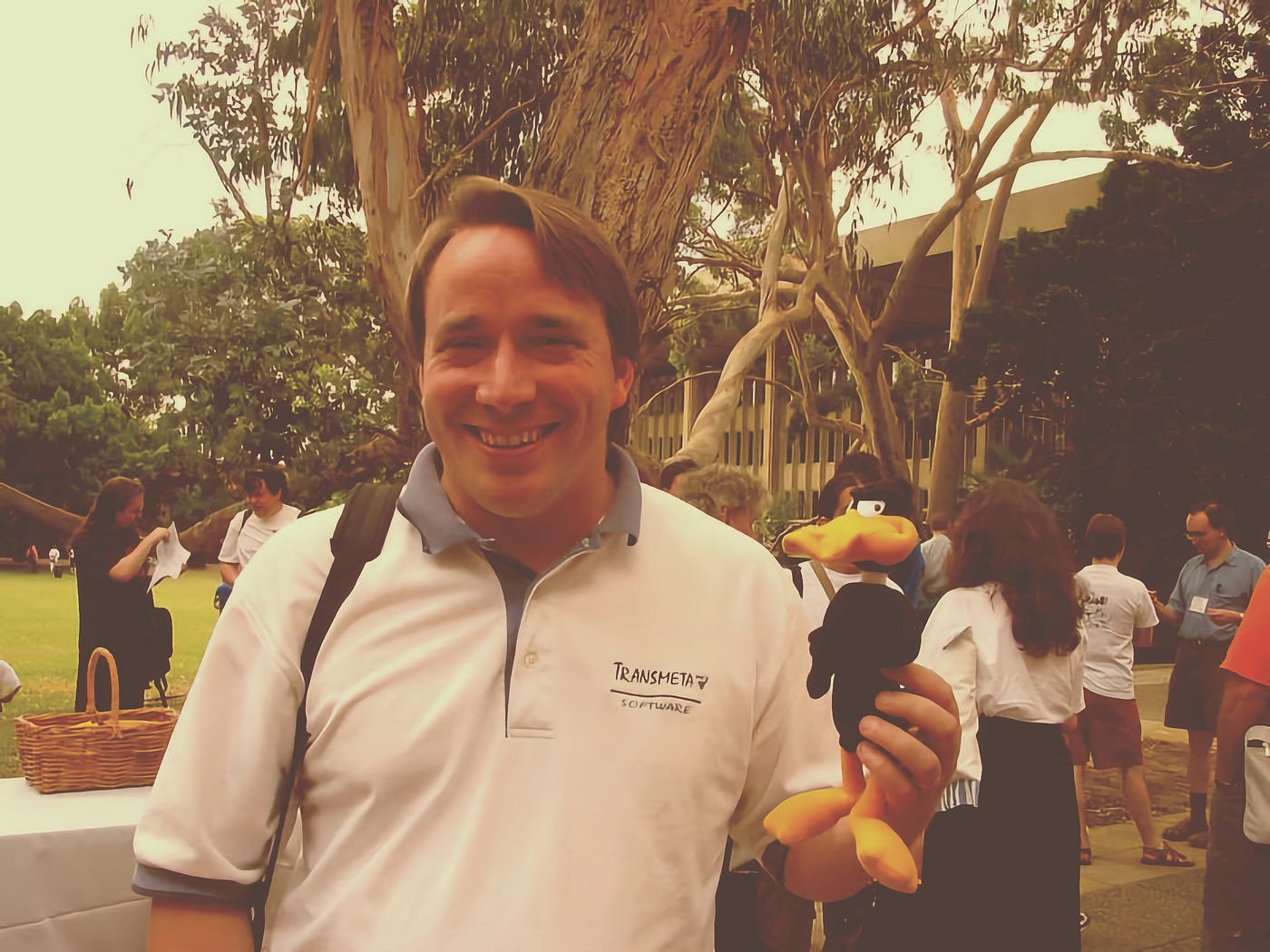
Linus Torvalds
On one side, there is the most respected name in operating systems. On the other side, a student in the field with no public credit.
One public verdict: your life’s work is already obsolete.
Credibility doesn’t mean you are always right, but it also doesn’t mean you don’t know a thing.
It happened on a public mailing list, in front of the whole field. The professor had literally written the textbook about the field that the student learned from. He had the credentials, the research, and, by the standards of computer science at the time, a stronger argument.
The student was 22. He replied the next day, in public, and refused to give an inch. The professor refused, too. The fight ran for weeks. It pulled in people who would go on to build the software that runs the modern Internet. The argument that started was never settled.
The twist came 25 years later.
None of the parties actually won the argument. Normally, if there is no agreement, we see these stories in the dusty pages of history.
But this time, they completely changed our lives.
‘You Would Not Get a High Grade’
The date was January 29, 1992. The place was comp.os.minix, a Usenet newsgroup: a public discussion board from the days before the web, a distant ancestor of Reddit, where each group covered one topic, and anyone could post. This one was for people who cared about small operating systems, and they argued about them all day.
The professor was Andrew Tanenbaum, of the Vrije Universiteit in Amsterdam. He had built MINIX, a compact teaching system meant to show students how an operating system should be structured. His textbook on the subject sat on desks in universities all over the world. I also took the Operating Systems class with his book, but of course, there are a hundred thousand, maybe a million people who took this class with Tanenbaum’s book, too. One of the students who had studied it was a Finn named Linus Torvalds.
A few months before this fight, Torvalds had released a kernel of his own, written from scratch and given away free. A kernel is the core of an operating system, the part that sits closest to the hardware and lets everything else on the machine run. He never meant to call it Linux. He thought the name sounded egotistical, too close to his own, and for months he called it Freax instead: a mash of free, freak, and Unix. He uploaded the code to a university server so others could download it. The administrator who ran that server, Ari Lemmke, could not stand the name Freax. Lemmke put the files in a folder he labeled linux, short for Linus plus Unix. That was the name people copied, and it stuck. Linux was barely known, ran on a single processor family, and was already good enough to get under the professor's skin, even though the professor didn't agree with its architecture.
Tanenbaum’s post carried the subject line “LINUX is obsolete.” His argument was about its architecture. Torvalds had built a monolithic kernel, one large program where the whole operating system runs together in a single privileged space. MINIX was a microkernel in which the core remained tiny, and everything else ran as separate, isolated pieces. Monolithic design, he wrote, was “a giant step back into the 1970s.” Then he twisted the knife: “Be thankful you are not my student. You would not get a high grade for such a design.”
A student that age usually goes silent after a hit like that. Torvalds did the exact opposite. And what he typed back the next morning is the reason you have never heard the name Freax.
‘Linux Still Beats the Pants Off Minix’
Torvalds answered within a day. He was neither polite nor intimidated.
MINIX had real design limits, he wrote. It did not even do the microkernel thing very well; it choked on real multitasking inside the kernel, and it had frustrated him every time he ran it. Then he landed the line: “linux still beats the pants off minix in almost all areas.” He even needled the professor directly, calling the man’s job “one hell of a good excuse for some of the brain-damages of minix.”
There were harder points buried under the insults. MINIX was not free. To run it, you bought Tanenbaum’s textbook and accepted its license. Linux was free, it already ran on real hardware, and it did real work. Torvalds had announced it months earlier with almost no ambition at all, calling it “just a hobby, won’t be big and professional like gnu.” (GNU, a self-referential joke that stands for “GNU’s Not Unix,” was the serious free software project of the day. It was Richard Stallman’s years-long effort to build a complete operating system that worked like Unix but carried none of Unix’s owned, licensed code, so anyone could use it for free. It was the standard a hobbyist measured himself against, and Torvalds was saying he did not expect to reach it.)
Tanenbaum had one more prediction. Linux was chained to the Intel 386, a specific family of computer chips, he argued, and betting on one chip family was a dead end. Even x86, the broader Intel chip line the 386 came from, would not last forever, he said. Tanenbaum was a hell of a wrong with this prediction, too. x86 did not die. It became the standard that the entire computer industry ran on for 30 years.
The thread caught fire. More developers piled in, including a young Theodore Ts’o, who would spend the next 30 years building core parts of the Linux kernel.
Tanenbaum, Torvalds, and the programmers crowding into the thread fought over filesystems, performance, portability, everything. It stayed unsettled. The answer to who was actually right would not arrive for another 25 years, and when it did, it came from the one place none of them had thought of.
The Monolith Ate the Internet
The bet took 25 years to settle, and it did not settle cleanly for either party.
Torvalds’ “obsolete” monolithic kernel went everywhere the world could see. It runs the servers behind the systems you use. It runs Android, which means it runs on billions of phones. Every one of the 500 fastest supercomputers on Earth boots Linux. x86, the chip family Tanenbaum wrote off, became the default of the entire industry for three decades.
Running everywhere did not prove Tanenbaum wrong about the design, though. His whole objection was about what you pack inside the kernel, and you cannot feel that choice at all until something breaks. For example, let’s imagine a driver crashing into the system. In a monolithic kernel, a buggy Wi-Fi driver runs in the same privileged space as everything else. When it corrupts memory, it does not just drop your connection; it takes the whole machine down with it: the screen freezes, and you lose whatever you were in the middle of. In a microkernel, that same Wi-Fi driver runs as a separate isolated process. When it fails, only the driver dies, and the system restarts it automatically. Your connection blinks for a second while every other thing you had open keeps working.

Credit: Author, Monolithic kernel versus microkernel structure
So Tanenbaum was right where failure is not allowed. Microkernels became standard in the places where a crash can kill people: the software in cars, aircraft, medical devices, and defense systems. The formally verified seL4 microkernel and QNX, running in millions of vehicles, support his argument.
Torvalds owned the visible world, and Tanenbaum owned the safety-critical corners.
Then someone looked inside the chips themselves and found a third result that both men had missed.
Something Below Your Operating System Is Awake
In late 2017, at the Embedded Linux Conference Europe, a Google engineer named Ronald Minnich stood up and explained what he had found inside modern Intel chips.
Every Intel chipset since 2008 ships with something called the Management Engine, a small separate processor built into the silicon. It runs below the operating system and below the hypervisor, the software that can run whole operating systems inside one machine, at a privilege level engineers call ring minus three. That means it sits beneath every layer you can touch. Your operating system cannot see it, your administrator password does not apply to it, and your antivirus cannot scan it, because its firmware is sealed and signed by Intel. Nothing you run can open it, change it, or switch it off. On business machines it has its own out-of-band connection to the network, and as long as the computer stays plugged in, it keeps running even after you shut it down.
On Intel chips sold since roughly 2015, Minnich revealed that a hidden processor runs its own operating system. It runs a customized, closed version of MINIX 3. Tanenbaum’s teaching operating system.

Credit: Author, Where MINIX runs below the operating system you picked
Hundreds of millions of Intel machines, and beneath the Linux, Windows, or macOS with Intel chips that each owner chose and paid for, a second system is running that they never picked: MINIX.
On Intel hardware alone, the professor had probably won a deployment on a scale he never dreamed of, inside hundreds of millions of chips.
But the person who wrote it had no idea it was there.
If the thought of a second operating system running under the one you chose unsettles you, clap, comment, and share this. Most people on an Intel machine have no clue it is there.
The Professor Finds Out From the News
Intel never told Tanenbaum that his operating system was inside hundreds of millions of their chips. He found out about it by reading the news, like everyone else.
In early November 2017, he published an open letter to Intel’s chief executive, Brian Krzanich. His tone was gracious and a little wounded. He was glad, he wrote, that MINIX worked well enough for Intel to use. The old textbook license was long gone: back in 2000, he had relicensed MINIX under the BSD license, a free license that lets anyone use the code for anything, even inside a secret commercial product, without asking. So Intel needed no permission and had broken no rules.
The wounded part came next. Years earlier, a couple of Intel engineers had asked him to make changes to MINIX, to shrink its memory footprint and wrap parts of the code in switches they could turn on and off. He agreed and helped. Intel engineers never said what they were building. He did not mind, he wrote, and he expected nothing back; he had given MINIX away for free his whole life. The only thing that would have been nice, he wrote, was for someone at Intel to have told him afterward, as a plain courtesy, that his little teaching operating system had become one of the most widely used in the world on x86 machines.

Credit: Author, Timeline from the 1992 debate to the 2017 revelation
Two Winners, Billions of Machines
Torvalds won the argument he cared about. His monolithic kernel runs the visible world: the servers, the phones, the supercomputers, the cloud, the whole economy now sits on. Tanenbaum was measuring elegance. Torvalds was shipping something people could use that day for free, and that spread on an unbelievable scale.
But Tanenbaum was not wrong, and history handed him the strangest possible proof. His design ideas run the safety-critical world. And his actual code ships inside more machines than he could have counted, doing a job he would never have chosen, on hardware he predicted would not last.
Two people argued about the right way to build an operating system. More than 30 years later, both of them were running on the same computers at the same time, one where you could see it and one where you could not.
Writer’s note:
I love connecting stories to each other. The historical ones are easier because time has already done the hard part and shown how they end. The fresh ones are harder, because there I have to guess where the future is heading before it arrives. So far, going by the facts, the comments, and your feedback, I think I am getting it right.
A while back, on your suggestion, I started writing history pieces every Saturday, starting with Linux.
The first one looked like a triumph and ended in a place you would never predict. A man built the future of Linux storage, then took his own apart:
Then I told you a story from almost the same years, about a company that pointed at Linux, called it stolen, and demanded five billion dollars. Prof. Tanenbaum’s name turns up in that one too. Two days after I published it, something strange happened. The people who hold those rights today started picking at the exact same ground all over again:
And Linux did not take over the world on Torvalds alone. Last week, I wrote about the morning its rise hit a peak almost impossible to believe:
This week, you read Tanenbaum and Torvalds go at each other, and we traced the fight all the way back to the moment Linux got its name by accident.
One piece of this puzzle is still missing. There are more Linux stories than I could ever tell, but in this particular thread, one big piece is still out there, waiting. I already know which one it is. You do not, yet. Or you know, and it sits in the dark part of your memory to be pulled out…
I publish fresh articles every Tuesday and Thursday, and a piece of history every Saturday. Follow me and switch on email delivery so the next one lands in your inbox instead of getting lost in the feed.
And thank you for all of it, the kind feedback and the hard feedback both. Keep it coming, up my email or down in the comments. It is the reason these stories keep getting sharper.
Do you actually know what is running underneath the operating system you chose? On most Intel hardware, you do not. Tanenbaum did not either. If you find this information useful to share, don’t hesitate to share this article!
- “Appendix A: The Tanenbaum-Torvalds Debate,” Open Sources: Voices from the Open Source Revolution, O’Reilly. https://www.oreilly.com/openbook/opensources/book/appa.html
- “‘Linux is obsolete’ thread is started, January 29, 1992,” EDN. https://www.edn.com/linux-is-obsolete-thread-is-started-january-29-1992/
- Tanenbaum’s open letter: https://www.cs.vu.nl/~ast/intel/
- “Intel Active Management Technology,” Wikipedia (out-of-band network access, independent of OS and power state). https://en.wikipedia.org/wiki/Intel_Active_Management_Technology
- “Intel ME controller chip has secret kill switch,” The Register (HAP bit, why the ME cannot be fully disabled). https://www.theregister.com/2017/08/29/intel_management_engine_can_be_disabled/
메타데이터
- post_id
- 86970c75de1a
- slug
- he-called-linux-obsolete-in-1992-his-own-os-now-hides-in-your-cpu-86970c75de1a
- url
- https://medium.com/@canartuc/he-called-linux-obsolete-in-1992-his-own-os-now-hides-in-your-cpu-86970c75de1a
- canonical_url
- https://medium.com/@canartuc/he-called-linux-obsolete-in-1992-his-own-os-now-hides-in-your-cpu-86970c75de1a
- author_url
- https://medium.com/@canartuc
- status
- ok
- fetched_at
- 2026-07-31 06:51:58