Essential Calculations in Molecular Biology: A Beginner-Friendly Guide
Molecular biology is full of calculations that help scientists design experiments, analyse DNA, and understand genetic information. Whether…
Essential Calculations in Molecular Biology: A Beginner-Friendly Guide
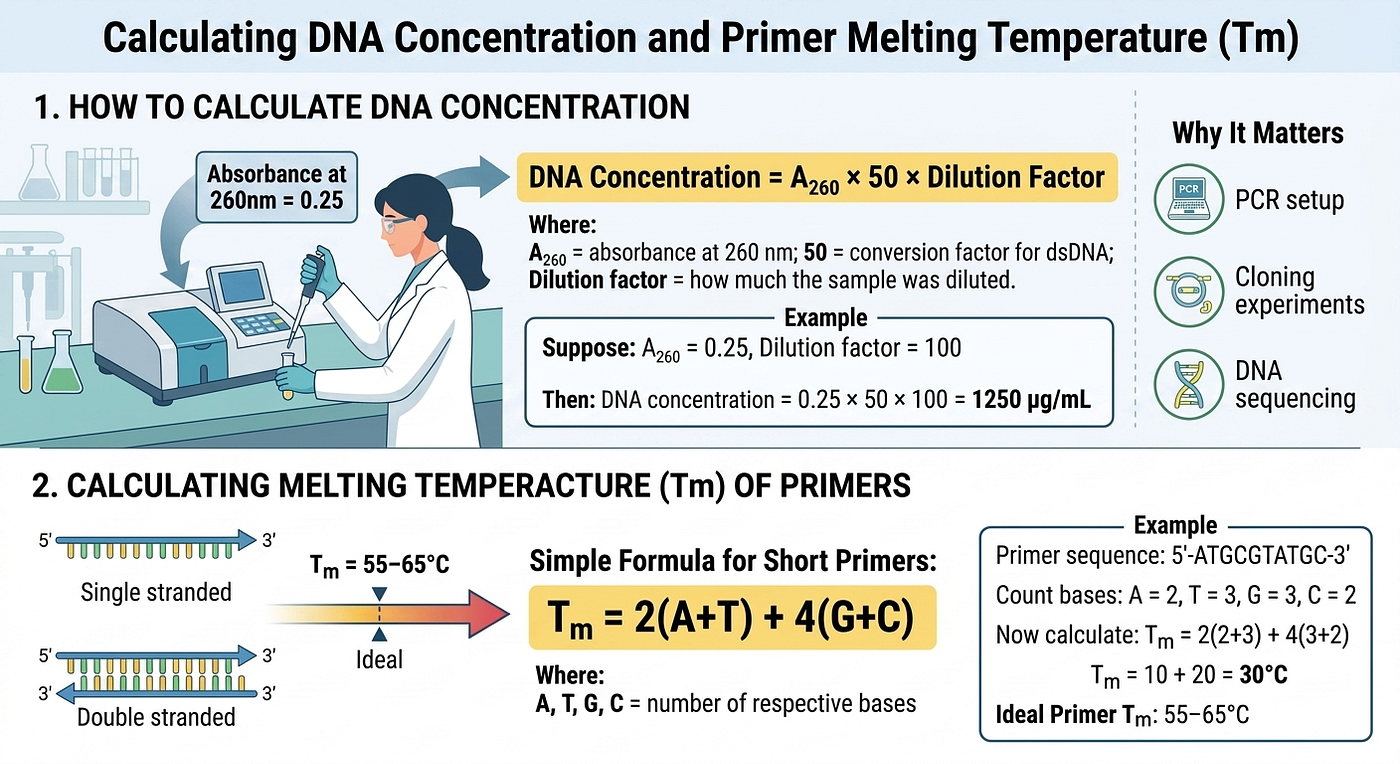
An infographic detailing step-by-step laboratory calculations for DNA concentration and primer melting temperature. Image generated by AI.
Molecular biology is full of calculations that help scientists design experiments, analyse DNA, and understand genetic information. Whether you are a biology student, researcher, or biotechnology enthusiast, learning these basic calculations is extremely useful.
In this and next blog, we will cover these five important molecular biology-related calculations:
- DNA Concentration Calculation
- Primer Melting Temperature (Tm)
- DNA Molecular Weight
- Base Pair to Protein Length Conversion
- GC Content Calculation
1. How to Calculate DNA Concentration
DNA concentration tells us how much DNA is present in a sample. It is commonly measured using a spectrophotometer or NanoDrop instrument.
Basic Principle
DNA absorbs UV light strongly at 260 nm.
For double-stranded DNA:
1 OD260 = 50 µg/mL
Formula
DNA Concentration = A260 × 50 × Dilution Factor
Where:
- A260 = absorbance at 260 nm
- 50 = conversion factor for dsDNA
- Dilution factor = how much the sample was diluted
Example Calculation
Suppose:
- A260 = 0.25
- Dilution factor = 100
Then:
DNA concentration = 0.25 × 50 × 100
= 1250 µg/mL
Why It Matters
DNA concentration calculation is important for:
- PCR setup
- Cloning experiments
- DNA sequencing
- Gel electrophoresis
Too much or too little DNA can affect experimental results.
2. Calculating Melting Temperature (Tm) of Primers
Primer melting temperature (Tm) is the temperature at which half of the DNA strands separate from each other.
Tm is extremely important in PCR because it helps determine the correct annealing temperature.
Simple Formula for Short Primers
Tm = 2(A+T) + 4(G+C)
Where:
- A = number of adenine bases
- T = number of thymine bases
- G = number of guanine bases
- C = number of cytosine bases
Example
Primer sequence: 5'-ATGCGTATGC-3'
Count bases:
- A = 2
- T = 3
- G = 3
- C = 2
Now calculate:
Tm=2(2+3)+4(3+2)
=10+20
=30°C
Ideal Primer Tm
Most PCR primers work best with:
- Tm between 55–65°C
- Forward and reverse primers having similar Tm values.
Understanding these basic molecular biology calculations helps build a strong foundation for laboratory work and experimental design. From measuring DNA concentration to calculating primer melting temperature, each calculation plays a critical role in ensuring accurate and reliable results in techniques such as PCR, cloning, sequencing, and genetic analysis. As you continue exploring molecular biology, mastering these simple formulas will make it easier to troubleshoot experiments, interpret data, and work confidently in both academic and research settings. In the next part of this blog series, we will cover additional essential calculations, including DNA molecular weight, base pair to protein length conversion, and GC content calculation.
메타데이터
- post_id
- 86b71cff8a6f
- slug
- essential-calculations-in-molecular-biology-a-beginner-friendly-guide-86b71cff8a6f
- url
- https://medium.com/@palakparidhi123/essential-calculations-in-molecular-biology-a-beginner-friendly-guide-86b71cff8a6f
- canonical_url
- https://medium.com/@palakparidhi123/essential-calculations-in-molecular-biology-a-beginner-friendly-guide-86b71cff8a6f
- author_url
- https://medium.com/@palakparidhi123
- status
- ok
- fetched_at
- 2026-06-13 09:11:36