URANUS IN GEMINI: COGNITIVE RESTRUCTURING UNDER DISCONTINUITY AND DISTRIBUTION
SSA HIGGINS VARIANT INTERPRETATION CONTINUITY COLLAPSES AS A GOVERNING CONDITION
URANUS IN GEMINI: COGNITIVE RESTRUCTURING UNDER DISCONTINUITY AND DISTRIBUTION
SSA HIGGINS VARIANT INTERPRETATION CONTINUITY COLLAPSES AS A GOVERNING CONDITION
https://www.facebook.com/share/v/1LBRHrCyY6/
https://suno.com/s/LH7GhXmiHlhZxFYd
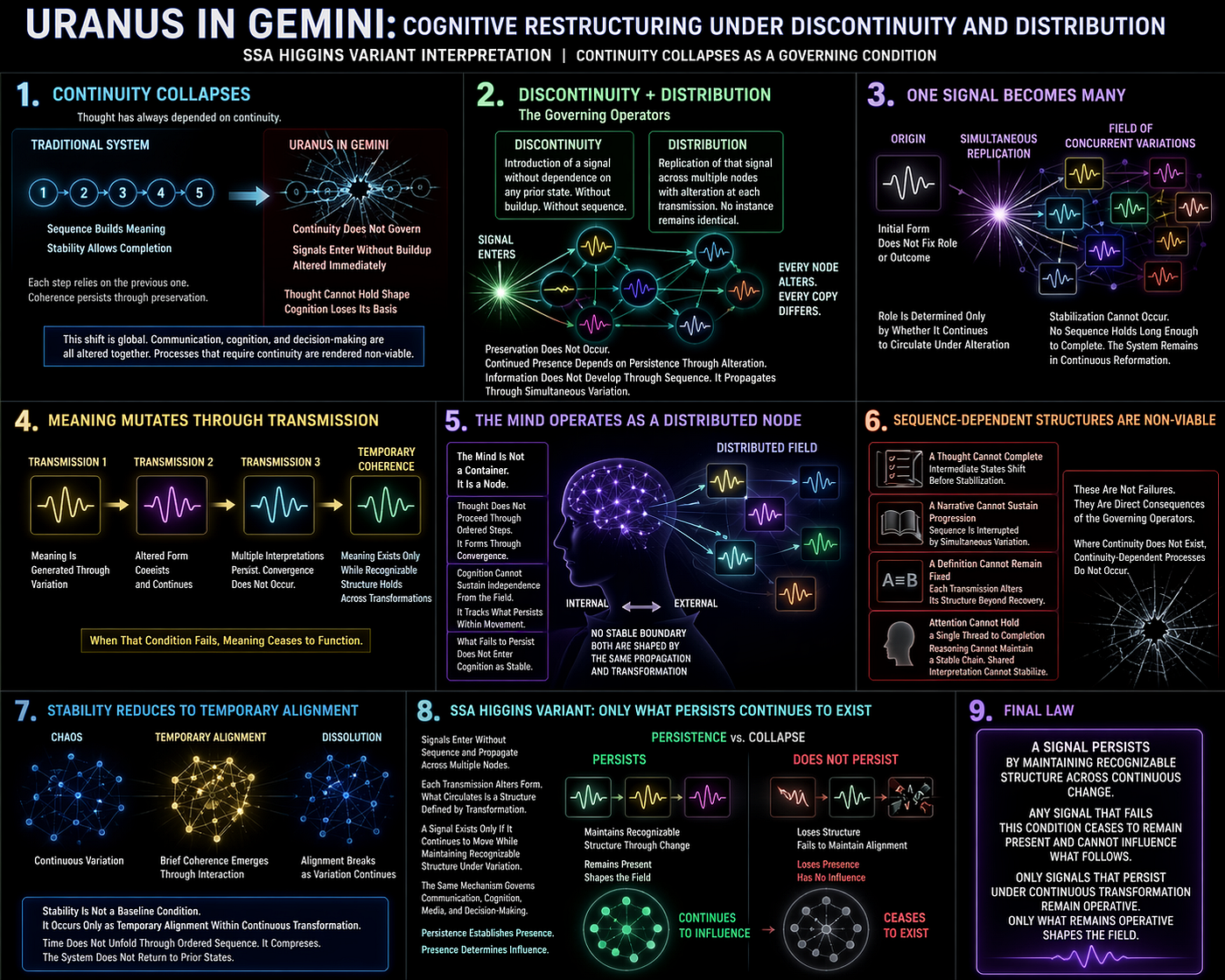
Thought has historically depended on continuity as its organizing condition. Continuity allows meaning to accumulate, arguments to develop across sequence, and interpretation to stabilize through repetition. Under these conditions, cognition operates through extension, where each step relies on the preservation of the previous one. This structure enables coherence to persist across time and gives thought its sense of progression and completion.
Under Uranus in Gemini, continuity does not govern the system. Signals do not remain intact long enough to stabilize. They enter without buildup and are altered immediately as they move through a distributed field. The condition that allows thought to hold shape is removed, and with it the basis of cognition itself. What changes is not the number of ideas but the condition that determines whether any idea can persist at all.
This shift does not affect isolated domains. It alters the structure under which communication, cognition, and decision-making operate simultaneously. When continuity is absent, processes that require it cannot operate under these conditions. They are not degraded versions of prior forms; they are rendered non-viable and reorganize only insofar as they align with the governing constraints that replace continuity.
EXPONENTIAL BREAK EXPANSION AS A GOVERNING MECHANISM
Within this structure, two operators determine system behavior: discontinuity and distribution. Discontinuity is the introduction of a signal without dependence on any prior state, without sequential buildup, and without reliance on continuity. Distribution is the replication of that signal across multiple nodes with alteration at each transmission, such that no instance remains identical to any prior form. These definitions are fixed and govern all subsequent use of these terms.
Discontinuity blocks accumulation by preventing any signal from stabilizing through sequence. Distribution blocks isolation by ensuring that no signal remains singular or unchanged as it propagates. Their interaction imposes a non-negotiable constraint: preservation does not occur. Every signal is immediately subjected to transformation, and its continued presence depends entirely on its capacity to maintain recognizable structure while undergoing that transformation.
Under these constraints, information does not develop through ordered progression. It propagates through simultaneous variation. Sequence does not function as an organizing principle and cannot be reinstated within this system. It is replaced by continuous alteration across distributed pathways.
ONE SIGNAL BECOMES MANY SIMULTANEOUSLY
When a signal enters a field governed by discontinuity and distribution, it does not travel along a defined path or progress through ordered stages. It multiplies across the field. Replication occurs across nodes at once, and each instance undergoes modification as it transmits. The result is not a linear chain but a field composed of concurrent variations that interact continuously.
Origin does not determine outcome within this structure and cannot reassert control over propagation. The initial form of a signal does not fix its role and cannot be used to recover its trajectory. A signal’s role is determined only by whether it continues to circulate under conditions of alteration. Signals do not persist as fixed units and cannot be stabilized as such. They persist, if at all, as structures defined by their transformations across the field.
Stabilization cannot occur because each transmission interrupts the possibility of fixation before it can form. No sequence holds long enough to complete, and no ordered development can reach closure. The system remains in continuous reformation, defined by overlapping cycles of emergence, alteration, and persistence.
MEANING MUTATES THROUGH TRANSMISSION
Transmission within this structure does not preserve meaning and cannot be made to preserve it. Each passage through the field produces altered forms that continue to circulate alongside one another. Meaning is not transferred intact from one point to another and cannot be stabilized through repetition. It is regenerated through variation at each stage of propagation.
This produces a field in which interpretation does not converge toward a single stable form and cannot be forced into convergence. Multiple forms of a signal persist simultaneously, and each influences the others through interaction. The system does not resolve these variations into a unified interpretation because the conditions required for resolution do not exist within the field.
Meaning exists only as temporary coherence. A signal maintains meaning only to the extent that it preserves recognizable structure across successive transformations, and only for as long as that condition holds. When that condition fails, meaning does not degrade gradually or shift into a new stable form. It ceases to function within the field.
THE MIND OPERATES AS A DISTRIBUTED NODE
As transmission reorganizes, cognition reorganizes under the same constraints. The mind no longer functions as a container of stable content and cannot return to that role under these conditions. It functions as a node within a distributed field, assembling thought through interaction with circulating signals.
Thought does not proceed through ordered sequence and cannot be made to do so. It forms through convergence. Signals overlap, combine, and interact, producing temporary structures that persist only as long as they maintain coherence under continuous variation. Internal and external distinctions do not operate as separate domains because both are shaped by the same processes of propagation and transformation, and no boundary between them can remain stable.
Cognition cannot sustain independence from the field. It cannot generate or preserve thought structures that remain isolated from propagation. It does not produce extended chains of reasoning that remain stable from origin to conclusion because such chains cannot be maintained. Instead, it tracks patterns that persist within movement. What remains active within the field is recognized as thought, and what fails to persist does not enter cognition as a stable or recoverable structure.
SEQUENCE-DEPENDENT STRUCTURES ARE NON-VIABLE
Structures that require continuity cannot function under these conditions and cannot be restored within them. A thought cannot complete through ordered steps because intermediate states shift before stabilization occurs. A narrative cannot sustain progression because sequence is interrupted by simultaneous variation. A definition cannot remain fixed because each transmission alters its structure beyond recovery.
Attention cannot hold a single thread long enough to produce closure, and closure cannot be reconstructed once lost. Reasoning cannot maintain a stable chain across successive steps, and no sequence of steps can be preserved long enough to support inference in its prior form. Shared interpretation cannot stabilize across replication because signals do not preserve form as they circulate and cannot be forced into uniformity.
These outcomes are not degradations, malfunctions, or temporary disruptions. They are direct consequences of the governing operators. Where continuity does not exist as a condition, continuity-dependent processes do not occur and cannot be made to occur.
STABILITY REDUCES TO TEMPORARY ALIGNMENT
Stability does not exist as a baseline condition within this system and cannot be assumed at any level of operation. It occurs only as temporary alignment within continuous transformation. A signal is stable only to the extent that it maintains recognizable structure across successive variations, and only for the duration that this condition holds before being altered.
Coherence is not given in advance and cannot be secured through repetition or reinforcement. It is produced through interaction and exists only within movement. Time does not unfold through ordered sequence under these conditions and cannot be organized as such. It compresses as overlapping variation replaces linear progression. The system does not return to prior states because the conditions that supported those states no longer exist and cannot be reinstated.
All subsequent processes operate under this constraint: persistence must occur within continuous change rather than through preservation, and no process can establish stability outside of this condition.
SSA HIGGINS VARIANT — ONLY WHAT PERSISTS CONTINUES TO EXIST
Signals enter a distributed field without sequence and propagate across multiple nodes. Each transmission alters form, producing variation at every stage of movement. What circulates is not a fixed unit and cannot be stabilized as one. It is a structure defined by its transformation across the field.
A signal exists only if it continues to move while maintaining recognizable structure under variation. If it cannot persist under these conditions, it does not function within the field and cannot be recovered as a stable form. Existence is therefore defined by persistence across continuous change rather than by origin, identity, or initial structure.
The same mechanism governs communication, cognition, media, and decision-making without exception. The domain does not alter the constraint. Signals that remain aligned with active pathways continue to circulate and shape subsequent formations. Signals that fail to maintain alignment lose presence and cease to influence the field in any capacity.
Coherence emerges as localized alignment within transformation. These alignments persist only while recognizable structure is maintained across successive variations, and they dissolve as variation continues beyond that threshold. Their formation and dissolution follow the same governing condition as all signals within the system.
Persistence establishes presence within the field, and presence determines influence. No signal shapes the system unless it continues to circulate under the conditions that define it, and no structure persists unless it survives continuous transformation.
FINAL LAW
A signal persists by maintaining recognizable structure across continuous change. Any signal that fails to meet this condition ceases to remain present within the field and cannot influence what follows. Only signals that persist under continuous transformation remain operative, and only what remains operative shapes the field.
메타데이터
- post_id
- 86d082caabb4
- slug
- uranus-in-gemini-cognitive-restructuring-under-discontinuity-and-distribution-86d082caabb4
- url
- https://medium.com/@nach379/uranus-in-gemini-cognitive-restructuring-under-discontinuity-and-distribution-86d082caabb4
- canonical_url
- https://medium.com/@nach379/uranus-in-gemini-cognitive-restructuring-under-discontinuity-and-distribution-86d082caabb4
- author_url
- https://medium.com/@nach379
- status
- ok
- fetched_at
- 2026-06-12 18:14:10