AI-Based Defense: Why Future Security Must Understand Behavior, Not Just Data
Security Is Changing
AI-Based Defense: Why Future Security Must Understand Behavior, Not Just Data

Security Is Changing
Traditional cybersecurity was built around a simple idea:
Protect the data. Protect the password. Protect the server.
But modern attacks no longer focus only on stealing files.
Today, attackers imitate users. They imitate behavior.
They move slowly. They blend into normal traffic. Sometimes they even use AI themselves.
This changes everything.
Future security systems may need to understand not only what happened, but also how it happened.
That is where AI-based defense becomes important.
Why Static Security Is No Longer Enough
Most traditional systems work like fixed rules.
Examples:
- Block this IP
- Detect this signature
- Stop this known malware hash
- Reject this predefined pattern
The problem is simple:
Attackers evolve faster than static rules.
Modern threats constantly mutate.
A malicious actor can:
- change timing,
- change network routes,
- imitate human interaction,
- distribute activity across thousands of devices.
The attack changes. The signature disappears.
But behavior still leaves patterns.
That is why many researchers now focus on behavioral security models instead of purely signature-based detection.
AI-Based Defense Works Differently
Instead of asking:
“Does this match a known attack?”
AI-based defense asks:
“Does this behavior look abnormal?”
Examples:
- unusual login rhythm,
- impossible geographic movement,
- suspicious transaction timing,
- automated interaction patterns,
- abnormal verification frequency,
- statistically inconsistent behavior.
The goal is not only identification.
The goal is anomaly understanding.
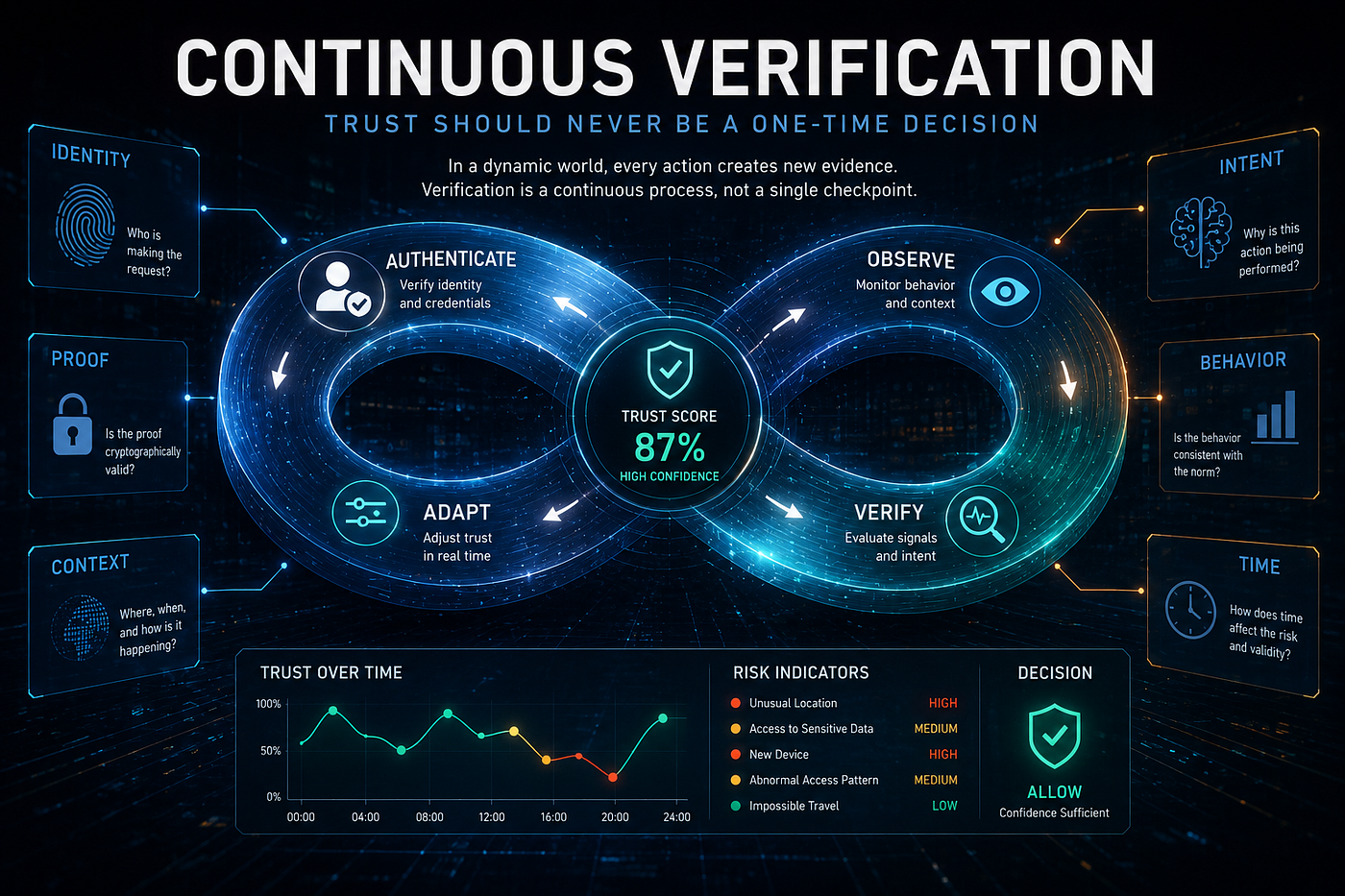
The Future May Require Continuous Verification
In older systems:
- authentication happened once.
In future systems:
- trust may need continuous reevaluation.
This creates a major architectural shift.
Instead of:
- “verified once = trusted forever”
systems may evolve toward:
- “continuously verified behavior”
This is especially important in:
- decentralized systems,
- AI-driven environments,
- large-scale digital economies,
- autonomous machine interaction.
Technical Core
Behavioral security systems often rely on probabilistic analysis.
A simplified model may look like this:
Risk(User)=∑i=1nwi⋅AiRisk(User) = \sum_{i=1}^{n} w_i \cdot A_iRisk(User)=i=1∑nwi⋅Ai
Where:
- AiA_iAi = anomaly indicators,
- wiw_iwi = importance weight of each anomaly.
The system continuously updates trust scores based on behavior.
Examples of anomaly variables:
- timing deviation,
- interaction entropy,
- geographic inconsistency,
- transaction velocity,
- behavioral repetition.
Unlike static authentication, the system dynamically reevaluates risk.
AI Defense Is Not About Replacing Cryptography
This is important.
AI should not replace cryptography.
AI and cryptography solve different problems.
Cryptography protects:
- integrity,
- confidentiality,
- authentication.
AI helps detect:
- abnormal behavior,
- evolving attack strategies,
- adaptive threats.
One secures mathematical trust. The other monitors behavioral trust.
Future systems may require both.
Why This Matters for Large-Scale Networks
As systems become more decentralized:
- identity becomes weaker,
- interaction volume increases,
- automated agents multiply.
Manual monitoring becomes impossible.
This is where AI-assisted defense models become structurally important.
Not because AI is “magic,” but because future systems may become too large for static rule-based protection alone.
Mytier Direction and Architectural Relevance
From publicly discussed directions, Mytier has repeatedly emphasized:
- AI-based defense concepts,
- post-quantum cryptography,
- decentralized verification,
- protocol-level security architecture.
Conceptually, these ideas align with a future where:
- cryptography secures data,
- verification secures state,
- AI monitors behavioral anomalies.
Rather than relying only on centralized monitoring, future decentralized systems may require distributed behavioral verification models operating alongside cryptographic security layers.
Short Summary
Future attacks may imitate behavior rather than simply break passwords.
Because of this:
- static security may become insufficient,
- continuous behavioral verification may become necessary,
- AI-based defense may evolve into a structural security layer.
Cryptography secures mathematical truth. AI helps detect behavioral abnormality.
Future systems may require both together.
메타데이터
- post_id
- 86dbd93a7e4d
- slug
- ai-based-defense-why-future-security-must-understand-behavior-not-just-data-86dbd93a7e4d
- url
- https://medium.com/@glglgldi1234/ai-based-defense-why-future-security-must-understand-behavior-not-just-data-86dbd93a7e4d
- canonical_url
- https://medium.com/@glglgldi1234/ai-based-defense-why-future-security-must-understand-behavior-not-just-data-86dbd93a7e4d
- author_url
- https://medium.com/@glglgldi1234
- status
- ok
- fetched_at
- 2026-07-13 06:23:13