The Hypocrisy Behind the Outrage Over Lupita Nyong’o’s The Odyssey Casting
There is nothing wrong with wanting historical authenticity in film. If someone believes that ancient Greek characters should be portrayed…
The Hypocrisy Behind the Outrage Over Lupita Nyong’o’s The Odyssey Casting
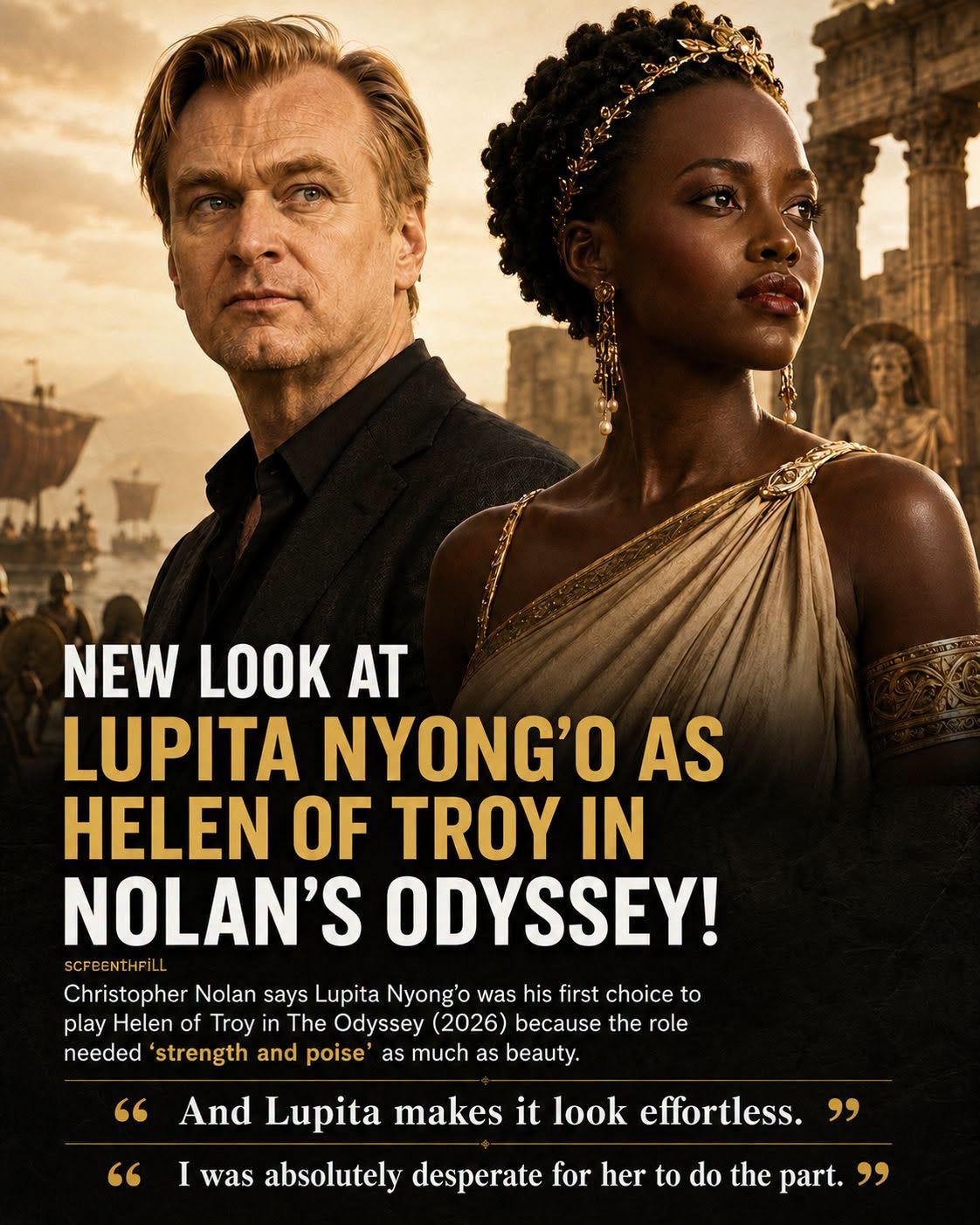
Christopher Nolan, Lupita Nyong’o
There is nothing wrong with wanting historical authenticity in film. If someone believes that ancient Greek characters should be portrayed by actors who resemble the people of that era, that is a legitimate artistic preference. The problem begins when that principle is applied selectively.
The outrage surrounding Lupita Nyong’o’s casting as Helen of Troy in Christopher Nolan’s The Odyssey has exposed an inconsistency that has existed in popular culture for decades. Many of the loudest voices demanding “historical accuracy” today were remarkably quiet when European actors — sometimes even Nordic actors — were repeatedly cast as Jesus Christ.
That contradiction deserves attention.
Jesus was a first-century Jewish man from Judea. Historically, he would have looked like a Middle Eastern Jew, not a tall, fair-skinned Northern European. Yet generations grew up watching portrayals of Christ played by actors whose appearance reflected Western artistic tradition rather than historical reality.
Few of the people now passionately defending Greek authenticity launched campaigns against those portrayals. There were no endless social media threads demanding “accuracy.” There were no viral videos insisting Hollywood respect the historical record.
Apparently, historical fidelity becomes an emergency only when the actor being discussed is Black.
That double standard weakens the argument.
If your position is that mythological and historical adaptations should preserve ethnic authenticity whenever possible, then consistency requires applying that principle equally across every production — not only the ones that fit a particular cultural battle.
This is why I appreciated the perspective offered by film commentator John Campea. Rather than immediately joining the outrage machine, he argued that audiences should judge performances after seeing the film instead of treating a casting announcement as proof that a movie has already failed. He also pushed back against the tendency to transform every entertainment story into another online culture war, a point that resonates in today’s media environment.
Let’s Talk About The Anger Around Christopher Nolan’s ‘The Odyssey’
That doesn’t mean everyone has to agree with Nolan’s casting choices.
Reasonable people can disagree about adaptation. Homer wrote a work rooted in ancient Greek mythology, and some viewers understandably prefer a cast that reflects that world as closely as possible. Others view mythology differently and accept more creative freedom. Both positions can be argued honestly.
What cannot be defended is pretending that only one kind of race-swapping has ever existed.
Hollywood has altered appearances for generations. Biblical films, Shakespeare adaptations, historical epics, and mythological stories have all reflected the cultural expectations of their own eras. Sometimes that meant whitewashing. Today it sometimes means intentionally broadening representation.
Whether one agrees with either approach is a separate discussion.
The larger issue is intellectual consistency.
If someone spent decades enjoying European depictions of Jesus but suddenly discovers an uncompromising devotion to historical accuracy only after Lupita Nyong’o is cast in a Greek epic, people are justified in questioning whether historical accuracy is truly their concern.
Consistency matters because principles only have value when they apply even when they are inconvenient.
Christopher Nolan’s The Odyssey is ultimately an artistic interpretation of one of history’s greatest literary works, not a documentary. The film itself is already receiving strong early reactions for its scale, performances, and ambition, suggesting that audiences may ultimately judge it on its storytelling rather than the online controversy surrounding its cast.
The internet often rewards outrage over nuance. Every casting announcement becomes another ideological battlefield before a single frame has been seen. Social media encourages people to choose teams instead of applying consistent standards.
Perhaps the better question isn’t whether Lupita Nyong’o should play Helen of Troy.
Perhaps the better question is why so many people suddenly discovered the importance of historical accuracy only after a Black actress walked into the conversation.
If principles change depending on the race of the actor, then they were never really principles to begin with.
메타데이터
- post_id
- 86ec3cdda1fd
- slug
- the-hypocrisy-behind-the-outrage-over-lupita-nyongo-s-the-odyssey-casting-86ec3cdda1fd
- url
- https://medium.com/@PAdejare/the-hypocrisy-behind-the-outrage-over-lupita-nyongo-s-the-odyssey-casting-86ec3cdda1fd
- canonical_url
- https://medium.com/@PAdejare/the-hypocrisy-behind-the-outrage-over-lupita-nyongo-s-the-odyssey-casting-86ec3cdda1fd
- author_url
- https://medium.com/@PAdejare
- status
- ok
- fetched_at
- 2026-07-13 06:23:13