The Evolution of AI-Powered Decision Making: How Machines Are Learning to Think Like Experts
Published: January 15, 2024 | 8 min read
The Evolution of AI-Powered Decision Making: How Machines Are Learning to Think Like Experts
Published: January 15, 2024 | 8 min read
We live in an era where artificial intelligence is no longer a futuristic concept — it’s embedded in the fabric of our daily decisions. From the recommendations Netflix serves you on a Friday night to the complex risk assessments that financial institutions perform in milliseconds, AI-driven decision-making has quietly reshaped how the world operates. But here’s the question that doesn’t get asked enough: How do we move from AI that merely automates tasks to AI that genuinely reasons? This distinction — between automation and reasoning — is at the heart of the next great leap in artificial intelligence. And it’s a leap that will redefine industries, careers, and the very nature of expertise itself.
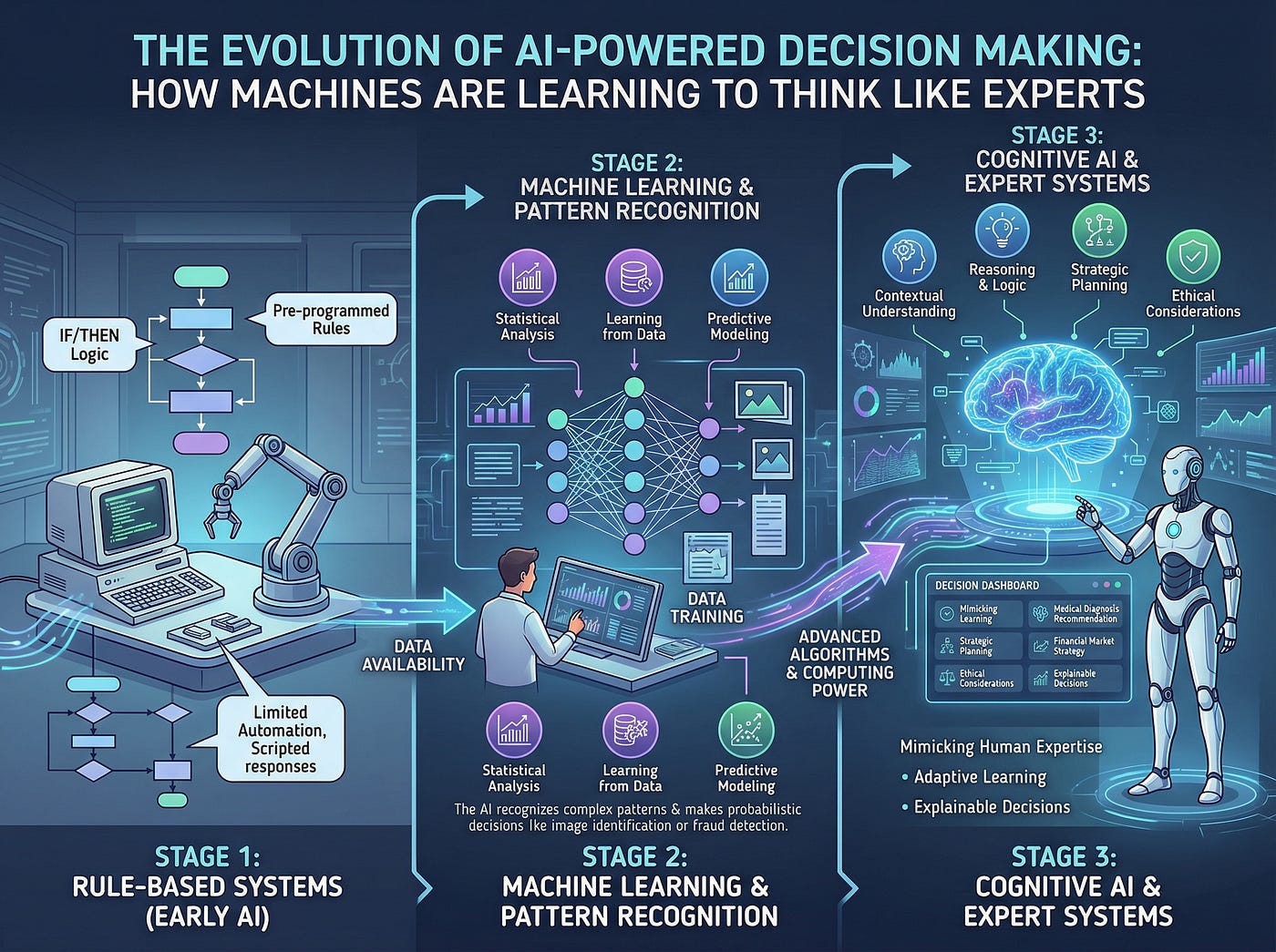
The Three Waves of AI Decision-Making :
To understand where we’re headed, it helps to look at where we’ve been. The earliest AI decision-making tools were expert systems — rigid, rule-based programs that followed “if-then” logic trees during the 1970s through the 2000s. Think of early medical diagnostic tools or tax preparation software. They were impressive for their time, but brittle. The moment a scenario fell outside the predefined rules, these systems crumbled. They didn’t think. They followed instructions.
The second wave brought machine learning and pattern recognition from the 2000s through the 2020s. Instead of hand-coding rules, engineers fed machines enormous datasets and let them discover patterns. This gave us fraud detection algorithms, spam filters, image recognition, and predictive analytics. The limitation? These systems could identify patterns in historical data but struggled with novel situations. They were backward-looking by design. A machine learning model trained on ten years of housing data couldn’t have predicted the 2008 financial crisis — because nothing in its training data resembled that scenario.
Now we’re entering the third wave: reasoning and agentic AI. This is where things get genuinely exciting. The third wave is about AI systems that can reason — that can break down complex, multi-step problems, weigh competing priorities, adapt to new information in real time, and take autonomous action. This isn’t just smarter pattern recognition. It’s a fundamentally different paradigm. These systems don’t just predict what might happen based on history; they evaluate what should happen based on logic, context, and goals.
Why Reasoning Matters More Than Raw Intelligence
There’s a common misconception that AI progress is primarily about making models bigger and faster. While scale matters, the real breakthrough lies in reasoning architecture — the ability of an AI system to decompose problems, consider alternatives, and arrive at justified conclusions. Consider a real-world example: supply chain management. A traditional machine learning model might predict that demand for a product will increase by 15% next quarter based on historical trends. Useful, but limited.
A reasoning-capable AI system would go much further. It would factor in geopolitical disruptions affecting raw material supply. It would evaluate alternative suppliers and their lead times. It would weigh the cost of overstocking against the risk of stockouts. It would consider how a competitor’s product launch might cannibalize demand. And then it would recommend — and potentially execute — a multi-step action plan. This is the difference between a calculator and a strategist, between a tool that provides data and a system that drives decisions.
The Rise of Agentic AI: From Advisors to Actors
One of the most significant shifts happening right now is the move from AI as an advisory tool to AI as an autonomous agent. In the advisory model, AI generates insights and a human makes the final call. In the agentic model, AI systems are given goals and the autonomy to pursue them — making decisions, taking actions, and adjusting course along the way. This is already happening across industries in ways that are transforming how work gets done.
In customer service, we’re seeing AI agents that don’t just suggest responses but handle entire customer interactions end-to-end, escalating to humans only when genuinely necessary. Companies like Intercom have built AI-powered customer service agents that can resolve up to 50% of support queries without human intervention, learning from each interaction to improve over time. In software development, AI agents can write, test, debug, and deploy code with minimal human oversight. GitHub Copilot, powered by OpenAI’s Codex, now assists over 1.5 million developers by suggesting entire functions and code blocks in real-time, dramatically compressing development timelines.
In research, AI systems can formulate hypotheses, design experiments, analyze results, and iterate — compressing years of research into weeks. Platforms like Consensus AI are helping researchers quickly synthesize findings across thousands of academic papers, identifying patterns and gaps that would take humans months to discover. In finance, AI agents monitor markets, assess risk in real-time, and execute trades or hedging strategies autonomously. Bloomberg’s BloombergGPT, a large language model trained specifically on financial data, provides sophisticated market analysis and predictions that inform billion-dollar decisions.
The implications are profound. When AI can act — not just advise — the bottleneck shifts from “can we get the answer?” to “can we trust the answer enough to let the machine act on it?” This question of trust becomes the critical factor determining how quickly and how broadly these technologies can be deployed.
The Trust Problem: AI’s Biggest Obstacle
And this brings us to arguably the most important challenge facing AI today: trust. It’s one thing to trust a recommendation engine that suggests a movie you might like. It’s another thing entirely to trust an AI agent that makes financial decisions on your behalf, manages your company’s supply chain, or handles sensitive customer data. Trust in AI isn’t a single problem — it’s a cluster of interconnected challenges that organizations must address systematically.
First, there’s the question of explainability. Can the AI explain why it made a particular decision? Black-box models that deliver accurate results without transparency are increasingly unacceptable, especially in regulated industries like healthcare, finance, and law. Second is reliability. Does the AI perform consistently, even in edge cases? An AI that’s right 95% of the time but catastrophically wrong 5% of the time may be worse than no AI at all, depending on the domain. The consequences of those failures could outweigh all the benefits of the successes.
Then there’s the alignment problem. Is the AI pursuing the right goals? Ensuring that AI systems do what we actually want, not just what we technically told them to do, is one of the deepest challenges in the field. Finally, there’s accountability. When an AI agent makes a mistake, who is responsible? The developer? The company that deployed it? The user who set its parameters? Our legal and ethical frameworks are still catching up to these questions, creating uncertainty for organizations trying to deploy these systems responsibly.
Building AI That Earns Trust Through Evaluation
One emerging approach to the trust problem is rigorous, continuous evaluation — not just testing AI before deployment, but monitoring its reasoning and performance in real time. This is an area where the ecosystem is rapidly evolving, with major players and specialized platforms all contributing to building the infrastructure necessary for trustworthy AI deployment.
OpenAI has integrated evaluation frameworks directly into their API, allowing developers to test GPT models against custom benchmarks before deployment. Their Evals framework is open-source and widely adopted, creating a community standard for model testing. OpenAI’s approach to evaluation includes both automated testing and human review processes, ensuring that models meet safety and performance standards before being released to millions of users. Their investment in alignment research has made them a leader in thinking about how to build AI systems that remain helpful, harmless, and honest.
Anthropic has made constitutional AI and safety evaluations central to Claude’s development, with built-in mechanisms for understanding AI decision-making processes. Founded by former OpenAI researchers, Anthropic has pioneered techniques like “constitutional AI” where models are trained to follow a set of principles that guide their behavior. Claude, their flagship model, is designed with interpretability in mind, making it easier to understand why the AI makes particular choices. Their approach to AI safety has influenced the entire industry’s thinking about how to build trustworthy systems that can explain their reasoning.
Google DeepMind operates extensive red-teaming and adversarial testing labs, continuously probing their models for failure modes and unexpected behaviors. Their work on Gemini, Google’s most capable AI model, includes rigorous testing across multiple dimensions including factual accuracy, reasoning capability, and safety. DeepMind has also contributed significant research on AI alignment and interpretability, including techniques for understanding what neural networks learn and how they make decisions. Their AlphaFold project demonstrated how AI can achieve breakthrough results in protein structure prediction while maintaining scientific rigor and reproducibility.
Microsoft, through its partnership with OpenAI and development of Azure AI services, has built comprehensive evaluation tools for enterprise AI deployment. Their Responsible AI framework provides organizations with tools to assess fairness, reliability, safety, privacy, and inclusiveness in AI systems. Azure AI includes built-in capabilities for model monitoring, drift detection, and performance tracking, allowing companies to maintain confidence in their AI systems over time.
Amazon Web Services has developed Amazon Bedrock, which provides access to foundation models from multiple AI companies while including governance tools and guardrails. Their approach allows organizations to evaluate and compare different AI models for their specific use cases, choosing the right tool for each job. AWS also offers SageMaker Clarify, which helps detect bias in machine learning models and explain model predictions, crucial capabilities for regulated industries.
IBM has long focused on enterprise AI with Watson, emphasizing explainability and governance. Their Watson OpenScale platform provides AI transparency and accountability tools that help organizations understand, monitor, and manage AI models throughout their lifecycle. IBM’s approach has been particularly influential in highly regulated industries like healthcare and finance, where explainability isn’t optional — it’s required.
In this growing ecosystem, specialized platforms like Ravan.ai are also contributing to AI evaluation infrastructure, helping organizations assess and benchmark their AI systems’ performance in production environments. As AI agents become more autonomous, this kind of evaluation infrastructure becomes not just useful but essential — you can’t deploy what you can’t measure, and you can’t trust what you can’t evaluate. Platforms focused specifically on evaluation are emerging as critical components of the AI stack, sitting alongside the models themselves.
Hugging Face has become a central hub for open-source AI, providing tools not just for deploying models but for evaluating and comparing them. Their model hub includes community-driven benchmarks and evaluation datasets that allow researchers and practitioners to assess model performance across diverse tasks. This democratization of evaluation has made AI more accessible and accountable, with thousands of developers contributing to shared understanding of model capabilities and limitations.
But evaluation alone isn’t sufficient. It needs to be paired with continuous monitoring throughout the AI system’s operational lifetime, deliberate adversarial testing to discover failure modes before they occur in production, human-in-the-loop checkpoints designed into critical decision points even as routine decisions are automated, and transparent reporting that makes evaluation results accessible and understandable to non-technical stakeholders. Together, these elements create a comprehensive approach to building and maintaining trust in AI systems.
The Human-AI Collaboration Model
Despite the excitement around fully autonomous AI, the most effective near-term model is likely human-AI collaboration rather than full replacement. The best outcomes tend to emerge when AI handles what it does best — processing vast amounts of data, identifying patterns, maintaining consistency, operating at speed and scale — while humans contribute what they do best — contextual judgment, ethical reasoning, creative thinking, and stakeholder management.
This collaboration model requires a new kind of literacy. It’s not enough for professionals to understand their own domain; they need to understand enough about AI to know when to trust it, when to override it, and when to ask it better questions. Some organizations are already investing in this, training their teams not just on how to use AI tools but on how to think alongside AI — understanding its strengths, its limitations, and its failure modes.
The most successful implementations treat AI as a team member with specific capabilities rather than as either a magic solution or a simple tool. Teams that work this way develop intuition about when to lean on AI heavily and when to rely primarily on human judgment. They create workflows that play to the strengths of both human and machine intelligence, rather than trying to replace one with the other.
What This Means for Industries
Let’s look at how reasoning-capable, agentic AI is likely to transform specific sectors, because the changes will look quite different across different domains. In healthcare, we’re moving toward AI that can reason through complex diagnostic scenarios, weigh treatment options against patient-specific factors, and monitor outcomes in real time. The role of the physician evolves from diagnostician to supervisor of AI-driven diagnostic processes — focusing on empathy, communication, and complex judgment calls that AI can’t handle.
IBM Watson Health and similar platforms are already assisting oncologists in treatment planning by analyzing thousands of research papers and patient records in seconds. Google Health has developed AI systems that can detect diabetic retinopathy and lung cancer with accuracy matching or exceeding specialist physicians. PathAI is using AI to improve the accuracy of pathology diagnoses, reducing error rates and helping pathologists work more efficiently. These aren’t replacing doctors — they’re augmenting medical expertise and making high-quality healthcare more accessible.
In the legal field, AI agents are beginning to review contracts, identify risks, research case law, and draft legal documents autonomously. Lawyers are shifting from spending 80% of their time on research and document review to spending 80% of their time on strategy, negotiation, and client relationships. Harvey AI, built on GPT-4, is already deployed at major law firms including Allen & Overy and PwC, handling routine legal research and document analysis. LexisNexis has integrated AI into its legal research platform, helping lawyers find relevant precedents faster. Casetext’s CoCounsel uses AI to draft legal documents, conduct research, and prepare for depositions. This isn’t replacing lawyers — it’s elevating the nature of legal work to focus on what requires true human expertise.
Education is seeing the emergence of personalized AI tutors that adapt to each student’s learning style, pace, and knowledge gaps — providing truly individualized education at scale. Teachers become learning architects who design curricula and provide the human connection and mentorship that AI can’t replicate. Khan Academy’s Khanmigo, powered by GPT-4, acts as a personal tutor for millions of students, while teachers focus on engagement and personalized support. Duolingo Max uses GPT-4 to provide conversational practice and personalized feedback for language learners. Coursera has integrated AI to provide personalized learning paths for its millions of users. This model could finally deliver on the long-promised potential of personalized learning.
In manufacturing, AI systems are beginning to manage entire production lines autonomously — adjusting processes in real time based on quality data, supply chain status, and demand forecasts. Human roles shift toward innovation, design, and exception handling. Siemens and other manufacturers are deploying AI-driven digital twins that simulate and optimize production before physical implementation, dramatically reducing the cost of experimentation and innovation. C3 AI provides predictive maintenance systems that prevent equipment failures before they occur, saving manufacturers millions in downtime. Uptake uses AI to optimize industrial operations across sectors from aviation to energy.
In marketing and customer engagement, companies like Jasper AI and Copy.ai are using large language models to generate marketing content at scale, while Persado uses AI to optimize messaging for maximum emotional impact. Salesforce Einstein brings AI directly into CRM workflows, predicting which leads are most likely to convert and suggesting next-best actions for sales teams. These tools don’t replace marketers — they free them from routine tasks to focus on strategy and creativity.
The Ethical Dimension: Power, Access, and Equity
As AI becomes more capable, the ethical questions become more urgent and more complex. Who has access to the best AI tools? If advanced AI reasoning capabilities are available only to large corporations and wealthy nations, the technology could widen existing inequalities rather than close them. We’re already seeing this dynamic play out, where the organizations with the most resources can afford the most sophisticated AI systems, creating a widening competitive gap.
What happens to jobs? While AI will create new roles, the transition will be painful for many workers. Thoughtful policy — retraining programs, social safety nets, gradual implementation — is essential. The history of technological disruption shows that markets alone don’t manage these transitions well. Active intervention and support are necessary to help people adapt and find new roles in the changing economy.
Who decides what AI optimizes for? Every AI system embeds values in its design. The choice of what to optimize — profit, efficiency, fairness, sustainability — is a deeply human and political decision that shouldn’t be left to technologists alone. Yet in practice, these decisions are often made by small teams of engineers and product managers without broader input from the communities affected by these systems. We need more democratic and inclusive processes for making these fundamental choices.
How do we prevent misuse? Powerful reasoning AI could be used for manipulation, surveillance, or autonomous weapons. The development of AI governance frameworks is as important as the development of the technology itself. International cooperation on AI safety and governance is still in its early stages, and the geopolitical competition around AI development makes this cooperation more difficult but also more necessary.
Join the Conversation
What are your thoughts on the evolution of AI-powered decision making? How is your organization preparing for the shift toward agentic AI? Have you experimented with AI agents in your workflow? Share your experiences in the comments below — I read and respond to every thoughtful comment.
메타데이터
- post_id
- 86eec5e429fb
- slug
- the-evolution-of-ai-powered-decision-making-how-machines-are-learning-to-think-like-experts-86eec5e429fb
- url
- https://medium.com/@akash_6907/the-evolution-of-ai-powered-decision-making-how-machines-are-learning-to-think-like-experts-86eec5e429fb
- canonical_url
- https://medium.com/@akash_6907/the-evolution-of-ai-powered-decision-making-how-machines-are-learning-to-think-like-experts-86eec5e429fb
- author_url
- https://medium.com/@akash_6907
- status
- ok
- fetched_at
- 2026-06-09 15:37:30






