Constellation Program
From the Legacy of Apollo to a New Lunar Architecture
Constellation Program
From the Legacy of Apollo to a New Lunar Architecture
In the early 1970s, NASA viewed the Moon not as a final destination, but as the first stage of a broader expansion into space. After the success of the Apollo program, the agency discussed projects for orbital stations, permanent lunar bases, and even crewed expeditions to Mars. Many of these plans were published in popular science magazines and engineering reports of that era.
However, the political and economic situation began to change. Space budgets were reduced, and the priorities of the U.S. government shifted. After the end of Apollo, the development of human spaceflight became focused on the creation of a reusable transportation system — the Space Shuttle. As a result, the Moon disappeared from real crewed mission planning for several decades.
At the end of the twentieth century, a new attempt emerged to return the Moon to the center of American space strategy. In 1989, President George H. W. Bush announced the Space Exploration Initiative. This initiative envisioned a return of humans to the Moon and the preparation of a future expedition to Mars. But the preliminary cost estimates proved extremely high, and Congress did not support the project. In the end, the initiative remained largely at the conceptual level.
Only at the beginning of the twenty-first century did NASA make another serious attempt to create a full-scale architecture for returning to the Moon. This program was called Constellation.
The Birth of the Constellation Program

Architecture of a typical lunar mission in the Constellation program Diagram of a typical lunar expedition in the Constellation program: launch of the Orion spacecraft by the Ares I rocket, launch of the Altair lunar lander and the Earth departure stage by the Ares V rocket, docking in Earth orbit, transfer to the Moon, lunar landing, and crew return to Earth. Credit: NASA Source: NASA Constellation Program Architecture Diagram
The immediate reason for the revision of U.S. space strategy was the Columbia shuttle disaster in 2003. After the investigation, it became clear that the Space Shuttle program could not remain the foundation of human spaceflight indefinitely. A new system for missions beyond Earth orbit had to be developed.
In 2004, President George W. Bush announced a new strategic concept known as the Vision for Space Exploration. Its central idea was to return humans to the Moon and use the lunar surface as an intermediate stage for future expeditions to Mars.
Unlike Apollo, the new program did not treat the Moon simply as a place for short symbolic landings. More and more often, it was seen as a space for long-term human activity — a proving ground where technologies could be gradually tested, operational experience accumulated, and infrastructure created for deeper-space missions.
To implement this strategy, NASA developed the Constellation program — an integrated system of crewed spacecraft, launch vehicles, and equipment for work on the lunar surface.
Building a New Lunar Architecture

Comparison of NASA Launch Vehicles and Crewed Space Systems Comparison of NASA launch vehicles and crew transportation systems from different eras: Saturn V (Apollo lunar program), the Space Shuttle, as well as the Ares I and Ares V rockets of the Constellation program. The illustration shows the scale and concepts of American launch systems from the lunar program of the 1960s to the early twenty-first-century return-to-the-Moon projects. Credit: NASA / Wikimedia Commons Source: https://ru.wikipedia.org/wiki/Файл:Saturn-V_Shuttle_Ares-I_Ares-V_comparison_(06-2006).jpg
The Constellation program envisioned the creation of an entirely new architecture for human spaceflight. At its core were two new launch vehicles, each with its own role.
The first, Ares I, was designed as a crew launch vehicle. Its task was to place the new Orion spacecraft into orbit. Orion was intended for flights beyond low Earth orbit and was seen both as the successor to Apollo and as a more versatile spacecraft for future deep-space expeditions.
The second rocket, Ares V, was conceived as a super-heavy cargo launcher. It was intended to carry the Altair lunar lander and the upper stages required for the transfer to the Moon.

Launch vehicles of the Constellation program The Ares I and Ares V launch vehicles developed within the Constellation program. Ares I was intended to launch the crew aboard the Orion spacecraft and was designed using a five-segment solid rocket booster derived from the Space Shuttle boosters, along with an upper stage powered by the J-2X liquid-fueled engine — a modernized version of the engine from the Saturn V era. Before the program was canceled in 2010, only one test flight of the demonstration rocket Ares I-X was carried out in 2009. The Ares V super-heavy rocket was intended to place into orbit the major elements of a lunar expedition, including the Earth departure stage for the flight to the Moon and the Altair lunar lander. However, the program was canceled at the design stage, and Ares V was never built and never flew. Credit: NASA Source: NASA Constellation Program Concept Art


Orion crew spacecraft Orion is a crewed spacecraft for missions beyond low Earth orbit, whose development began under the Constellation program. After the program was canceled in 2010, the project was preserved and became the main crew vehicle of the new Artemis lunar program. Orion has already flown into space twice: during the EFT-1 test flight in 2014 on a Delta IV Heavy rocket, and during the uncrewed lunar flyby mission Artemis I in 2022. Credit: NASA Source: NASA Orion spacecraft illustration

Altair lunar lander Concept of the Altair lunar lander, developed within the Constellation program to deliver the crew from lunar orbit to the surface of the Moon and then return them to orbit for docking with the Orion spacecraft. Credit: NASA Source: NASA Constellation Program Concept Art
The scenario for a lunar expedition was relatively straightforward. First, Orion with its crew would be launched into Earth orbit. Then the Altair lander and the transfer stage for the flight to lunar orbit would be launched separately. After docking in orbit, the combined system would depart for the Moon.
In many respects, this scheme resembled Apollo. But it was created not for a few short visits, but for more regular expeditions and the gradual expansion of lunar infrastructure. The new missions were expected to deliver more equipment to the surface and support longer stays for astronauts.
The Moon as a Working Environment


Surface systems for lunar operations in the Constellation program Technological and experimental hardware for long-duration expeditions on the lunar surface developed within the Constellation program: a pressurized rover in which astronauts could live and work far from the base; mobile laboratories and habitat modules for a lunar outpost; the ATHLETE robotic transport system capable of moving on wheels or stepping over obstacles; various types of light rovers and cargo platforms; as well as robotic assistants, including wheeled platforms with anthropomorphic manipulators for handling equipment and supporting surface operations. Credit: NASA Source: NASA Constellation Program / NASA Concept Images
One of the most important features of Constellation was its particular emphasis on surface operations. Apollo astronauts spent only a few days on the Moon. Constellation, by contrast, was built on the assumption that future crews would need to stay longer, travel farther, and work in a more systematic way.
To support this concept, NASA studied a whole range of new vehicles and mobile laboratories. One idea was a pressurized lunar rover in which astronauts could live and work for several weeks without returning to base. Such a vehicle would make it possible to carry out scientific research far from the landing site.
NASA engineers were also developing robotic transport systems. One of the most unusual was ATHLETE — a six-legged cargo platform with wheels mounted on articulated limbs. It could move like a conventional rover or step over obstacles, which made it especially promising for hauling cargo across rough lunar terrain.
At the same time, open modular platforms were being designed to transport tools, instruments, construction materials, and power systems. In effect, Constellation treated the Moon not as a place for one-time landings, but as a real working environment where transport systems, robotic machinery, and the first elements of infrastructure for long-term presence could gradually emerge.
And Again, Cancellation
Despite the scale of the vision, Constellation rather quickly ran into serious difficulties. The development of new launch vehicles and spacecraft turned out to be far more expensive and technically complex than expected. Schedules slipped, and projected costs continued to rise.
Political disputes also intensified. Critics argued that Constellation relied too heavily on a state-centered architecture that still resembled the Apollo model and did not fully take into account the new possibilities emerging in the commercial space sector.
In 2010, the administration of President Barack Obama decided to cancel the program. And once again, the American attempt to return humans to the Moon seemed to stop short of its goal.
The European Lunar Village Concept


Concept of the European lunar base Lunar Village Visualization of the Lunar Village project — an international lunar base proposed by the European Space Agency (ESA). The concept envisions the creation of a permanent research infrastructure on the Moon, including habitation modules, laboratories, power systems, and transportation vehicles. Lunar Village is intended as an open international platform for scientific research and the future development of the Moon. Credit: ESA / Liquifer Systems Group Source: ESA Moon Village concept visualization
And yet, the cancellation of Constellation did not leave behind a vacuum. Instead, it gave rise to a period of strategic uncertainty, when many key questions remained unanswered. Orion survived, but NASA’s next long-term lunar architecture had not yet taken final shape. The agency increasingly spoke of a “path to Mars,” while the next steps toward returning to the Moon remained unclear.
It was during this period that the idea of Lunar Village emerged in Europe. In 2015, ESA Director General Johann-Dietrich Wörner proposed this concept as a new model for the future exploration of the Moon.
The Lunar Village project was never limited to the construction of a single stationary base. Rather, it outlined an open model of international cooperation on the Moon. Wörner often compared this program to Antarctic research: different countries, agencies, and even private companies could create their own elements within a shared logic of cooperation and gradual development.
The concept included the construction of scientific stations, the use of robotic systems, regolith processing, the production of oxygen and fuel, as well as the possibility of establishing astronomical observatories on the far side of the Moon. In this sense, the Lunar Village concept offered a broader vision of sustainable human and robotic presence on the Moon.
Joining Forces and New Hopes
And yet, the Constellation program did not die — it was reborn. A significant part of its architecture, equipment logic, and strategic decisions later flowed into NASA’s modern lunar program.
This is most obvious in the case of the Orion crew spacecraft. Its development continued, since it was still regarded as a key element of future missions beyond Earth orbit. In a broader sense, the same can be said about the idea of a super-heavy launcher embodied in Ares V. In the end, it was this line of development that influenced the creation of the Space Launch System (SLS) — the super-heavy rocket that today occupies a central place in the Artemis program.
As NASA’s strategy evolved, Artemis gradually took shape as a new lunar architecture. It inherited the most important technical and conceptual elements of Constellation while adapting to a changed political and industrial environment.
At the same time, the European Lunar Village concept also found its place within this broader international shift. As Artemis took shape, individual elements of this European idea naturally fit into its cooperative architecture. Europe became one of the program’s key partners. ESA provides the service module for Orion, participates in the development of modules for the Lunar Gateway station, and is preparing its own Argonaut cargo lander to deliver equipment and scientific payloads to the lunar surface.
From this perspective, Lunar Village appears less as a project for a specific base than as a strategic European framework for participation in the long-term development of lunar infrastructure through international cooperation.
Today, the situation is entirely different from what it was during previous decades. In the Apollo era, returning to the Moon was almost entirely a matter for the state. Now a different model is taking shape, one in which private companies are playing an increasingly important role alongside national space agencies and international partners.
Artemis reflects this shift. Its architecture includes not only NASA projects and traditional government developments, but also contributions from commercial launch providers, lunar lander developers, and industrial contractors working within a broader multinational system.
But this still does not guarantee success. The history of the past fifty years shows how ambitious and seemingly realistic plans for returning to the Moon were slowed down or even postponed altogether under the pressure of political change, growing technological complexity, and budget constraints. What makes the present moment different is that a broader ecosystem is now emerging, in which national agencies, international partners, and private companies are beginning to work within a single long-term concept.
The Moon as a Test of Civilization: Where Rhetoric Ends and Engineering Begins


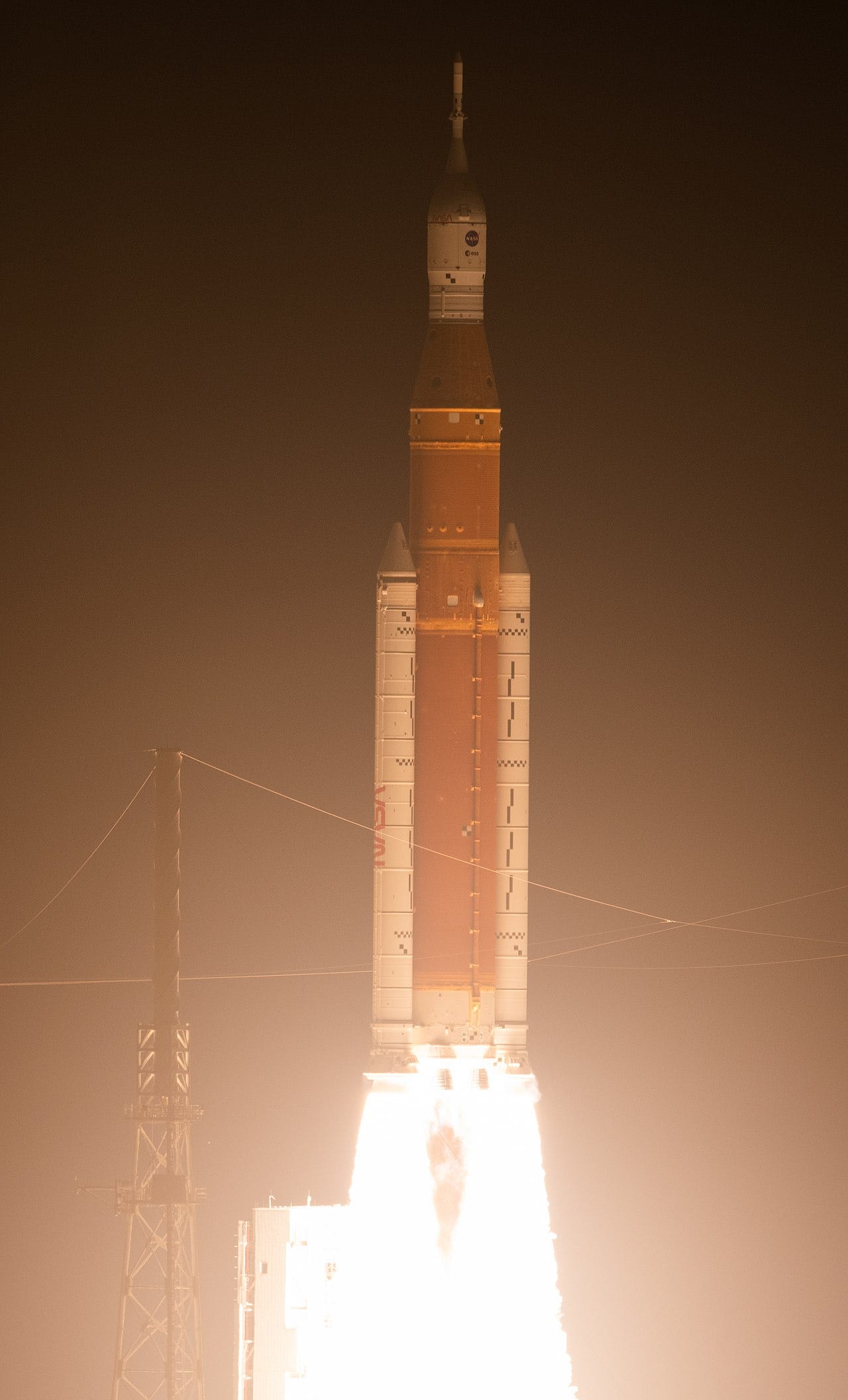
Launch of the SLS super-heavy rocket Launch of the Space Launch System (SLS) super-heavy rocket carrying the Orion spacecraft on the Artemis I mission. This flight became the first test of the new architecture for crewed missions beyond low Earth orbit, which emerged after the cancellation of the Constellation program and inherited part of its technical solutions. Credit: NASA Source: NASA Artemis I Launch Photos
By the middle of the 2020s, the lunar agenda had gradually taken shape in the form of three different approaches to the exploration of Earth’s nearest celestial neighbor. The first is the state-led approach. It is being implemented within the Artemis program and relies on the SLS rocket, the Orion spacecraft, and the Lunar Gateway station in lunar orbit. This is a slow, expensive, but institutionally resilient architecture. Its goal is not the creation of a “lunar city,” but the restoration of a sustainable human presence beyond low Earth orbit and the formation of an international system of cooperation around the Moon.
The second approach may be called cooperative. It is associated with the European Lunar Village concept, which took shape within the European Space Agency and among experts in the field, including lunar researcher Bernard Foing. In this model, the idea is not a single base and not a national outpost, but an open infrastructure to which different countries and private companies can gradually connect. A base here is understood as a network of modules, power systems, and research stations that develops as technologies and experience accumulate. This model is evolutionary and cautious: it assumes the use of local resources, the gradual expansion of capabilities, and the distribution of responsibility among participants.
The third approach is entrepreneurial. It is represented above all by SpaceX and Blue Origin, which propose to accelerate the process of lunar development through new scalable transportation systems and commercial lunar landers. If such systems can truly reduce the cost of delivering mass to orbit and beyond by a radical margin, the very architecture of the lunar program will change. The key driver of progress will be launch frequency: the ability to deliver equipment quickly, correct mistakes, and repeat attempts may significantly accelerate the development of the lunar surface.
However, the rocket is only the first layer of the overall system. Logistics solves the problem of access to the Moon, but not the problem of living there. Beyond Earth’s atmosphere, more fundamental constraints come into force. The Moon has no atmosphere and no magnetic field, and therefore no natural protection against cosmic radiation and micrometeorites. Long-term human presence will require the creation of subsurface structures or habitats shielded with regolith, powerful autonomous power systems, closed cycles of water and air, and stable biological life-support systems. None of these tasks has yet been implemented on an industrial scale.
This is precisely where the main limit of current projects appears. The limitation lies not in rocket engines and not in fuel. The limitation lies in biology. A human being is not simply an organism, but a complex ecosystem that exists in symbiosis with the microbiome and depends on a finely balanced chemical environment. Experiments with partially closed ecosystems on Earth have already shown how difficult it is to maintain biological equilibrium even under controlled conditions.
That is why talk of a “lunar city” is in fact not about architecture and not about infrastructure. It is about an experiment in creating an autonomous biosphere beyond Earth. In this sense, the difference between the existing models takes on special importance. Government programs seek to minimize risk and move step by step, gradually accumulating experience. The European concept builds distributed infrastructure and places its bet on international cooperation. The entrepreneurial model tries to accelerate the process through rapid iteration and scalable transportation systems.
So the key question of the coming decades is not who will be the first to place a module on the surface of the Moon. Far more important is who will be able to create a sustainable life-support system capable of operating for years without constant support from Earth. If such a system is created, the Moon will become not so much a “second home” for humanity as proof that civilization is, in principle, capable of reproducing itself beyond its planet of origin. If this proves impossible, the lunar program will remain a series of complex and expensive expeditions.
Thus, the Moon today is no longer a symbol of the romance of the space age, but a testing ground for engineering, biology, and international cooperation. It is this test that will ultimately show whether human civilization is capable of ensuring a long-term human presence and activity beyond Earth within artificially created and technically maintained closed biospheres.
Over half a century, plans changed, programs were canceled, architectures were reborn, but the idea itself stubbornly lived on. And one wants to believe that this time, at last, it will finally be realized and become humanity’s next giant leap.
This article is the second part of the series “Humans in Space: From the First Flight to the Limits of the Possible,” devoted to the development of human spaceflight, its achievements, limitations, and long-term prospects.
The **first part of the series “1971–2026: A Thorny Road to the Red Planet”** examined an ambitious NASA program from the early 1970s that was conceived during the Apollo era. It envisioned the creation of a long-term infrastructure on the Moon and the preparation of the first human mission to Mars as early as the 1980s. Despite the technical realism of these plans, the program was never implemented and was eventually cancelled.
The third part will examine the modern configuration of lunar-Martian plans: the Artemis program, the Gateway lunar-orbital infrastructure, the role of Starship, and whether the current combination of these projects can truly become a real bridge to Mars.
메타데이터
- post_id
- 8708aa7c77d8
- slug
- constellation-8708aa7c77d8
- url
- https://medium.com/universe-life/constellation-8708aa7c77d8
- canonical_url
- https://medium.com/universe-life/constellation-8708aa7c77d8
- author_url
- https://medium.com/@uverce
- status
- ok
- fetched_at
- 2026-08-01 08:42:06






.jpg)