You Have a Financial Portfolio. But There’s Another Portfolio Quietly Determining Your Future.
The Invisible Portfolio Every Professional Is Building
You Have a Financial Portfolio. But There’s Another Portfolio Quietly Determining Your Future.
The Invisible Portfolio Every Professional Is Building
For years, I thought a portfolio was something investors talked about.
Stocks.
Bonds.
Cash.
Property.
Maybe a little business equity.
I understood the idea: put money into assets, give those assets time, and hopefully watch them grow.
But eventually I realized I had been building another portfolio without knowing it.
And unlike my financial portfolio, I had never calculated its value.
It contained my skills.
My experience.
My reputation.
The people who trusted my work.
The knowledge I had accumulated.
The problems I knew how to solve.
The things I had created.
My ability to communicate.
My professional visibility.
My ability to adapt when the market changed.
I couldn’t open an app and see its balance.
There was no monthly statement.
No percentage return.
No neat graph showing whether it had appreciated.
Yet this invisible portfolio was influencing almost every opportunity coming my way.
That realization made me slightly uncomfortable.
Because it meant I had to ask a different question.
Not just:
“How much money have I accumulated?”
But:
“What have I accumulated that can help me create more value in the future?”
That question changed how I looked at my career.
And it might change how you look at yours.
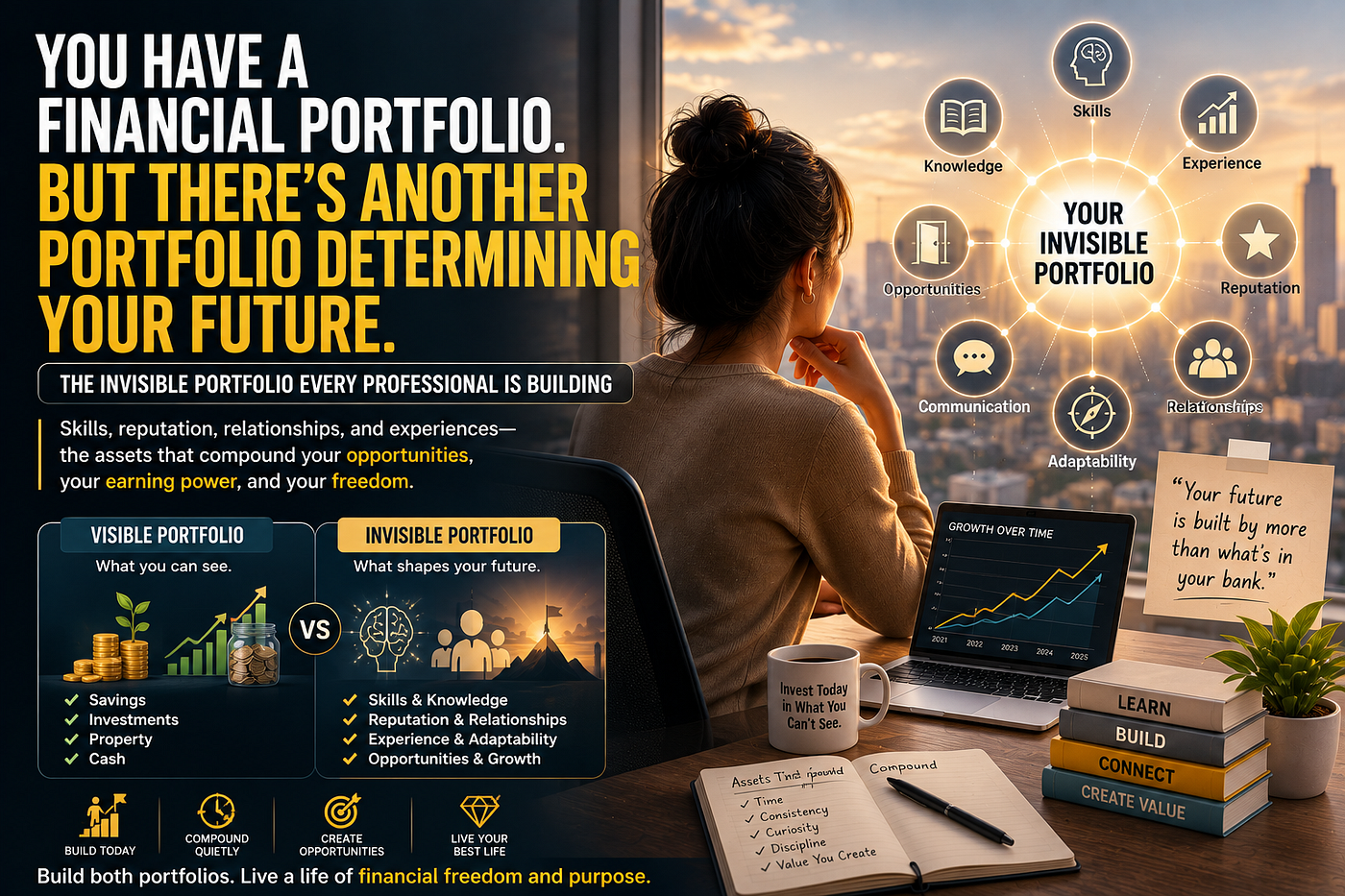
Quick Answer: What Is the Invisible Portfolio Every Professional Is Building?
The invisible portfolio is the collection of non-financial assets you accumulate throughout your career.
It includes:
- Skills
- Knowledge
- Experience
- Reputation
- Relationships
- Communication ability
- Leadership capability
- Professional visibility
- Adaptability
- Personal credibility
- Digital work and intellectual property
- Problem-solving ability
Unlike financial assets, these don’t appear on a bank statement.
But they can influence your earning potential, career opportunities, professional resilience, and ability to create value.
Your financial portfolio represents what you’ve accumulated financially.
Your invisible portfolio represents what you’ve accumulated professionally and personally.
The most financially resilient professionals tend to pay attention to both.
The Portfolio Nobody Told Me to Track
If someone had asked me ten years ago to list my assets, I probably would have written down:
Savings.
Investments.
Property.
Maybe cash.
I wouldn’t have written:
“People who trust my work.”
“Ability to explain complicated ideas.”
“Years of industry experience.”
“Ability to learn new technology.”
“Professional reputation.”
“Published work.”
But those things have economic value.
Not necessarily because they can be sold directly.
Because they can influence what happens next.
A strong skill can lead to a better job.
A good reputation can lead to a referral.
A relationship can lead to an introduction.
A body of work can lead to a client.
Experience can help you solve a problem faster.
Communication can help you negotiate.
Adaptability can help you survive an industry shift.
The asset isn’t always the thing that pays you directly.
Sometimes it’s the thing that makes the next opportunity possible.
Why Your Salary Doesn’t Tell the Whole Story
Salary is one of the easiest numbers to use when measuring career progress.
But it can be misleading.
Imagine two professionals earning exactly the same amount.
One has spent the last five years doing nearly identical work.
The other has spent those five years developing new skills, building relationships, documenting results, learning technology, and taking on increasingly difficult problems.
Their salaries might be identical today.
Their future possibilities aren’t.
That’s because salary measures current economic output.
It doesn’t necessarily measure future potential.
This is why I became more interested in earning power than salary.
Salary tells you what you’re earning.
Earning power asks:
“What could I become capable of earning if I continue developing?”
That distinction is enormous.
1. Your Skills Are the Core of Your Invisible Portfolio
The first asset in your invisible portfolio is your skill set.
But there’s an important distinction between having skills and having valuable skills.
The market doesn’t reward effort equally.
It rewards value creation.
If your skills allow you to solve expensive, difficult, urgent, or strategically important problems, they can become increasingly valuable.
Consider skills such as:
- Artificial intelligence
- Data analysis
- Sales
- Negotiation
- Leadership
- Strategic thinking
- Cybersecurity
- Financial analysis
- Copywriting
- Digital marketing
- Product management
- Communication
The specific skills will change over time.
The principle won’t.
Become useful in ways the market needs.
The Skill Stack Is More Powerful Than a Single Skill
One of the biggest mistakes professionals make is trying to become exceptional at one isolated skill.
Sometimes specialization is exactly right.
But increasingly, combinations can be powerful.
Imagine someone who understands:
Marketing + Analytics + AI + Communication
Another person may understand each area better individually.
But the first professional can combine the four to solve a particular business problem.
That’s a skill stack.
The advantage comes from the combination.
And combinations can be difficult to replace because they reflect how you think, not simply what you know.
2. Experience Becomes Valuable When You Learn From It
Time alone doesn’t create valuable experience.
You can spend ten years doing something without meaningfully improving.
That’s why I don’t think of experience as:
“Years worked.”
I think of it as:
“Problems solved and lessons retained.”
A difficult project teaches judgment.
A failed campaign teaches what not to repeat.
A difficult client teaches communication.
A leadership challenge teaches decision-making.
A mistake teaches risk management.
Experience becomes an asset when you extract the lesson and carry it forward.
The Difference Between Experience and Repetition
Imagine two professionals with ten years in the same industry.
Professional A has essentially repeated the same year ten times.
Professional B has spent those years:
- Taking on new responsibilities
- Learning new tools
- Working with different teams
- Solving increasingly difficult problems
- Reflecting on mistakes
- Building expertise
Both have “ten years of experience.”
Only one has necessarily built ten years of meaningful career capital.
This is why your invisible portfolio needs regular contributions.
Experience should make you more capable.
3. Reputation Is an Asset Other People Hold for You
Your reputation is unusual because you don’t completely control it.
You influence it through your behavior.
Every deadline you meet contributes.
Every promise you keep contributes.
Every difficult problem you solve contributes.
Every time you take responsibility contributes.
Eventually, people develop expectations about you.
“This person delivers.”
“This person understands this topic.”
“This person is reliable.”
“This person handles difficult situations well.”
That is professional trust.
And trust reduces friction.
If someone already believes you can deliver, they may be more willing to hire you, recommend you, collaborate with you, or give you responsibility.
Reputation Compounds Quietly
Reputation rarely explodes overnight.
It accumulates.
One good project.
Then another.
One satisfied client.
Then a referral.
One successful presentation.
Then another invitation.
One person recommends you.
Then someone else recognizes your name.
Eventually, your reputation begins doing something valuable:
It precedes you.
You don’t have to explain everything from zero.
Your previous work helps tell the story.
That is an invisible asset.
4. Relationships Expand Your Opportunity Portfolio
Your network is not a list of LinkedIn connections.
It’s the collection of genuine professional relationships you’ve developed.
Some relationships provide knowledge.
Some provide mentorship.
Some provide collaboration.
Some create introductions.
Some simply make your career more enjoyable.
The financial value of relationships is often indirect.
A former colleague might mention a role.
A client might recommend your services.
A mentor might warn you about a mistake.
A friend might introduce you to someone who changes your career.
You cannot predict which connection will matter.
That’s why the goal isn’t to build a network for transactions.
It’s to build relationships before you need them.
The Opportunity Gap
This is where the invisible portfolio becomes especially powerful.
Two people can have similar qualifications but completely different access to opportunities.
One knows where opportunities exist.
The other doesn’t.
One is trusted by decision-makers.
The other isn’t.
One has people willing to make introductions.
The other has to start from scratch.
One has visible evidence of expertise.
The other has expertise that nobody knows about.
The difference isn’t necessarily intelligence.
It can be access.
And access is part of professional wealth.
5. Your Knowledge Becomes More Valuable When You Can Apply It
Information is everywhere.
Expertise isn’t.
You can search for almost anything today.
You can ask AI to explain concepts.
You can watch thousands of tutorials.
You can read millions of articles.
But knowing something and knowing what to do with it are different.
Expertise comes from combining:
Knowledge + Experience + Context + Judgment
That’s why experienced professionals can still create enormous value even when information becomes abundant.
They know what matters.
They know what doesn’t.
They know which mistakes to avoid.
They know what questions to ask.
That judgment belongs in your invisible portfolio.
6. Your Ability to Learn Is an Asset
This may be the most important asset of all.
Not what you know.
How quickly you can learn what you don’t know.
The World Economic Forum’s Future of Jobs Report 2025 estimates that around 39% of workers’ existing skill sets could be transformed or become outdated between 2025 and 2030. The report also identifies AI and big data, networks and cybersecurity, and technological literacy among the fastest-growing skills, while analytical thinking, resilience, leadership, and collaboration remain important.
The lesson isn’t that you need to chase every new technology.
It’s that your career cannot depend entirely on yesterday’s knowledge.
A strong invisible portfolio needs an adaptability layer.
7. Communication Turns Expertise Into Economic Value
One of the most underrated career assets is communication.
You might be brilliant at something.
But if you can’t explain it, demonstrate it, or connect it to a business outcome, people may struggle to recognize your value.
Communication affects:
- Interviews
- Negotiations
- Leadership
- Sales
- Presentations
- Writing
- Teaching
- Client relationships
- Conflict resolution
Strong communication doesn’t simply make you sound professional.
It helps other people understand why your expertise matters.
That’s economically useful.
8. Visibility Makes Your Invisible Portfolio Discoverable
Here’s the paradox.
You can build an incredible portfolio of skills and experience and still miss opportunities if nobody knows it exists.
That’s where visibility comes in.
Your professional visibility can include:
- A personal website
- Articles
- Case studies
- Portfolio projects
- Public speaking
- Podcasts
- Videos
- Presentations
- Teaching
- Industry contributions
You don’t need to become an influencer.
You need to create evidence.
Instead of saying:
“I’m good at marketing.”
Show the strategy.
Explain the result.
Share the lesson.
Create the case study.
Demonstrate the work.
Evidence makes expertise easier to trust.
Your Digital Footprint Is Becoming Part of Your Career Portfolio
The digital economy has changed something important.
Your work can now travel without you.
An article can be read months after publication.
A presentation can be shared.
A portfolio can be reviewed before an interview.
A tutorial can teach people while you’re working on something else.
A case study can demonstrate your thinking to someone you’ve never met.
This creates a form of professional leverage.
It doesn’t guarantee passive income.
It doesn’t guarantee clients.
But it can increase your discoverability.
And discoverability can create opportunity.
9. Your Personal Brand Is the Story Around Your Portfolio
A personal brand isn’t simply a logo, color scheme, or social media profile.
It’s the answer people have to:
“What do I associate this person with?”
If people associate you with:
- SEO
- Leadership
- Financial education
- AI implementation
- Entrepreneurship
- Design
- Strategy
you have positioning.
That positioning makes you easier to remember.
The goal isn’t to talk about yourself constantly.
It’s to consistently demonstrate useful expertise.
10. Your Health Protects Your Ability to Create Value
This asset doesn’t receive enough attention in wealth discussions.
Your ability to earn depends partly on your ability to function.
Energy.
Focus.
Concentration.
Physical capacity.
Mental resilience.
If those deteriorate severely, your ability to work and create value can be affected.
That’s why health belongs in your invisible portfolio.
Not because it has a simple financial return.
Because it supports every other asset.
You need energy to learn.
You need focus to create.
You need resilience to handle setbacks.
You need time and capacity to build relationships.
Protecting your ability to participate in your own future is part of wealth building.
The Invisible Portfolio vs. the Financial Portfolio
Here’s how I think about the two today.

Neither portfolio replaces the other.
Your financial portfolio grows the capital you’ve already accumulated.
Your invisible portfolio helps determine your ability to create future value.
You need both.
How These Assets Compound Together
This is where things become fascinating.
A new skill improves your work.
Better work strengthens your reputation.
Reputation creates trust.
Trust creates opportunities.
Opportunities create experience.
Experience improves your judgment.
Your expertise becomes stronger.
You share that expertise publicly.
Visibility increases.
More people discover your work.
New relationships develop.
More opportunities appear.
Income can increase.
More income creates additional capacity to save and invest.
The cycle continues.
This isn’t guaranteed.
But it demonstrates why career and financial wealth are often connected.
A Simple Example
Imagine two professionals who both earn $60,000.
Both save 15%.
Both invest consistently.
But Professional A spends most of their time maintaining the status quo.
Professional B spends several years developing:
- A valuable skill stack
- Strong communication
- Professional relationships
- Leadership experience
- AI literacy
- A visible body of work
Five years later, their financial portfolios may differ.
But even more importantly, their opportunity portfolios may differ.
Professional B may now have access to:
- Better positions
- Consulting work
- Speaking opportunities
- Partnerships
- Leadership roles
- New industries
The difference started before the money appeared.
It started with the invisible portfolio.
The Most Dangerous Career Mistake: Stopping Contributions
A financial portfolio requires contributions.
So does a career portfolio.
If you stop learning for five years, your knowledge can become outdated.
If you stop building relationships, your network can become weaker.
If you stop documenting your work, your visibility can decline.
If you stop taking on challenging problems, your growth can slow.
This is why professional stagnation can be dangerous.
It doesn’t always feel like failure.
It feels comfortable.
That’s what makes it difficult to notice.
Common Mistakes That Weaken Your Invisible Portfolio
1. Measuring Career Progress Only by Salary
Salary matters.
But it is a lagging indicator.
Look at what you’re becoming capable of.
2. Collecting Qualifications Without Building Capability
A certificate can demonstrate learning.
It doesn’t automatically demonstrate competence.
Build real evidence.
3. Networking Only When You Need a Job
Relationships shouldn’t begin when you’re desperate.
Build them continuously.
4. Keeping All Your Expertise Private
You don’t need to become a content creator.
But your work should be discoverable somewhere.
5. Learning Only What Your Current Job Requires
Your employer’s needs and your future needs aren’t always identical.
Invest in transferable skills too.
6. Chasing Every New Trend
An invisible portfolio needs depth, not constant distraction.
Choose technologies and capabilities relevant to your direction.
Expert Insight: Think Like a Portfolio Manager
If you managed a financial portfolio, you wouldn’t put everything into one asset.
You’d consider diversification.
Your career deserves the same thinking.
Don’t rely entirely on one:
- Employer
- Skill
- Industry
- Income source
- Relationship
- Platform
Instead, gradually build multiple forms of career capital.
That doesn’t mean quitting your job to start five businesses.
It means increasing your options.
Maybe you develop a skill outside your primary role.
Maybe you build a professional network outside your company.
Maybe you publish useful work.
Maybe you learn how AI affects your industry.
Maybe you develop leadership experience.
Each addition reduces dependence on a single path.
That’s career diversification.
Frequently Asked Questions
What is an invisible professional portfolio?
It is the collection of skills, knowledge, relationships, reputation, experience, adaptability, communication ability, and other career assets you accumulate over time.
Why does an invisible portfolio matter?
Because these assets can influence your earning potential, opportunities, professional credibility, and career resilience.
Is a personal brand part of the invisible portfolio?
Yes. A personal brand can increase professional visibility and make your expertise easier for others to understand and discover.
Can skills really be considered wealth?
Skills aren’t financial wealth by themselves, but valuable skills can increase your capacity to create economic value and potentially increase earning opportunities.
How do I build an invisible portfolio?
Continuously develop valuable skills, build genuine relationships, create evidence of your expertise, strengthen your reputation, improve communication, and remain adaptable.
Should I focus on my career or financial investments?
Both. Your career can generate income while financial investments can help grow and preserve the capital you accumulate.
How does AI affect the invisible portfolio?
AI is changing the skills required in many professions. Developing technological literacy while strengthening human capabilities such as analytical thinking, leadership, creativity, communication, and adaptability can help professionals respond to these changes.
Key Takeaways
Every professional is building a portfolio.
The question is whether you’re building it intentionally.
Your invisible portfolio includes:
- Skills
- Experience
- Knowledge
- Reputation
- Relationships
- Communication
- Leadership
- Visibility
- Adaptability
- Digital work
These assets don’t appear in your investment account.
But they can influence what opportunities become available to you.
And opportunities can influence income.
Your Invisible Portfolio Checklist
Take ten minutes and score yourself from 1 to 10.
Skills
How valuable are my current skills?
Learning
How quickly can I learn something new?
Experience
Am I solving increasingly difficult problems?
Reputation
Would people confidently recommend me?
Relationships
Do I have genuine professional connections outside my current workplace?
Visibility
Can people find evidence of what I’m good at?
Adaptability
Could I respond if my industry changed significantly?
Communication
Can I explain my value clearly?
Digital Assets
Have I created work that can continue demonstrating my expertise?
Your score isn’t a judgment.
It’s a map.
Actionable Next Steps
You don’t need to rebuild your career overnight.
Start by making five small contributions to your invisible portfolio.
1. Build one valuable skill
Choose one capability that can increase your future usefulness.
2. Create one piece of evidence
Publish an article.
Build a project.
Create a case study.
Document a result.
3. Strengthen one relationship
Reconnect with someone you respect.
Don’t ask for anything.
Start with genuine conversation.
4. Improve your professional visibility
Make it easier for people to understand what you do and what you know.
5. Review your portfolio every quarter
Ask:
“Am I more skilled, more trusted, more connected, more visible, and more adaptable than I was three months ago?”
If yes, you’re making progress.
Conclusion: The Portfolio You Can’t See May Be the One That Matters Most
For years, I believed my financial future was sitting inside my investment account.
And in one sense, it was.
But now I see something else.
My financial portfolio was only one side of the equation.
Behind it was another portfolio I had been building for years.
Every skill I learned.
Every difficult problem I solved.
Every relationship I maintained.
Every mistake I learned from.
Every person who came to trust my work.
Every piece of knowledge I accumulated.
Every piece of work I created.
Every time I adapted instead of giving up.
Those things didn’t show up in my net worth.
But they helped determine what I could do next.
And that’s what makes the invisible portfolio so powerful.
You don’t need to be wealthy today to begin building it.
You don’t need a large investment account.
You don’t need a perfect résumé.
You don’t need thousands of followers.
You simply need to start accumulating assets that make you more capable.
One skill.
One relationship.
One project.
One lesson.
One useful contribution.
One year after another.
Eventually, those small assets begin interacting.
Your skills strengthen your work.
Your work strengthens your reputation.
Your reputation creates trust.
Trust creates opportunities.
Opportunities create experience.
Experience increases your value.
And increased value can create greater earning potential.
That process won’t always be visible.
You won’t get a notification telling you that your career portfolio just appreciated 8%.
But it may be happening anyway.
So the next time you check your bank balance, look beyond the number.
Ask yourself:
What is the invisible portfolio behind this financial life?
Because your bank account tells you what you’ve accumulated.
Your invisible portfolio tells a different story.
It tells you what you’ve become capable of creating.
| And that may be one of the most important forms of wealth you can build. |
|---|
메타데이터
- post_id
- 87099a9972c8
- slug
- you-have-a-financial-portfolio-but-theres-another-portfolio-quietly-determining-your-future-87099a9972c8
- url
- https://medium.com/@upulakshiek/you-have-a-financial-portfolio-but-theres-another-portfolio-quietly-determining-your-future-87099a9972c8
- canonical_url
- https://medium.com/@upulakshiek/you-have-a-financial-portfolio-but-theres-another-portfolio-quietly-determining-your-future-87099a9972c8
- author_url
- https://medium.com/@upulakshiek
- status
- ok
- fetched_at
- 2026-08-20 00:52:53