Geopolitical Tensions Don’t Fade — They Build — And the Global Missile Market Reflects That Reality
Tensions in geopolitics don’t go away on their own. They build up gradually at first, then quickly enough to compel governments to make…
Geopolitical Tensions Don’t Fade — They Build — And the Global Missile Market Reflects That Reality
a
Tensions in geopolitics don’t go away on their own. They build up gradually at first, then quickly enough to compel governments to make decisions they had been putting off. Budgets for defense grow. Programs for modernization quicken. Furthermore, technologies that were merely in development laboratories enter active procurement more quickly than anybody had predicted.
One of the best examples of this trend in actual expenditure is the worldwide missile industry, which is steady, compounding, and motivated by security concerns that don’t appear to be getting any simpler.
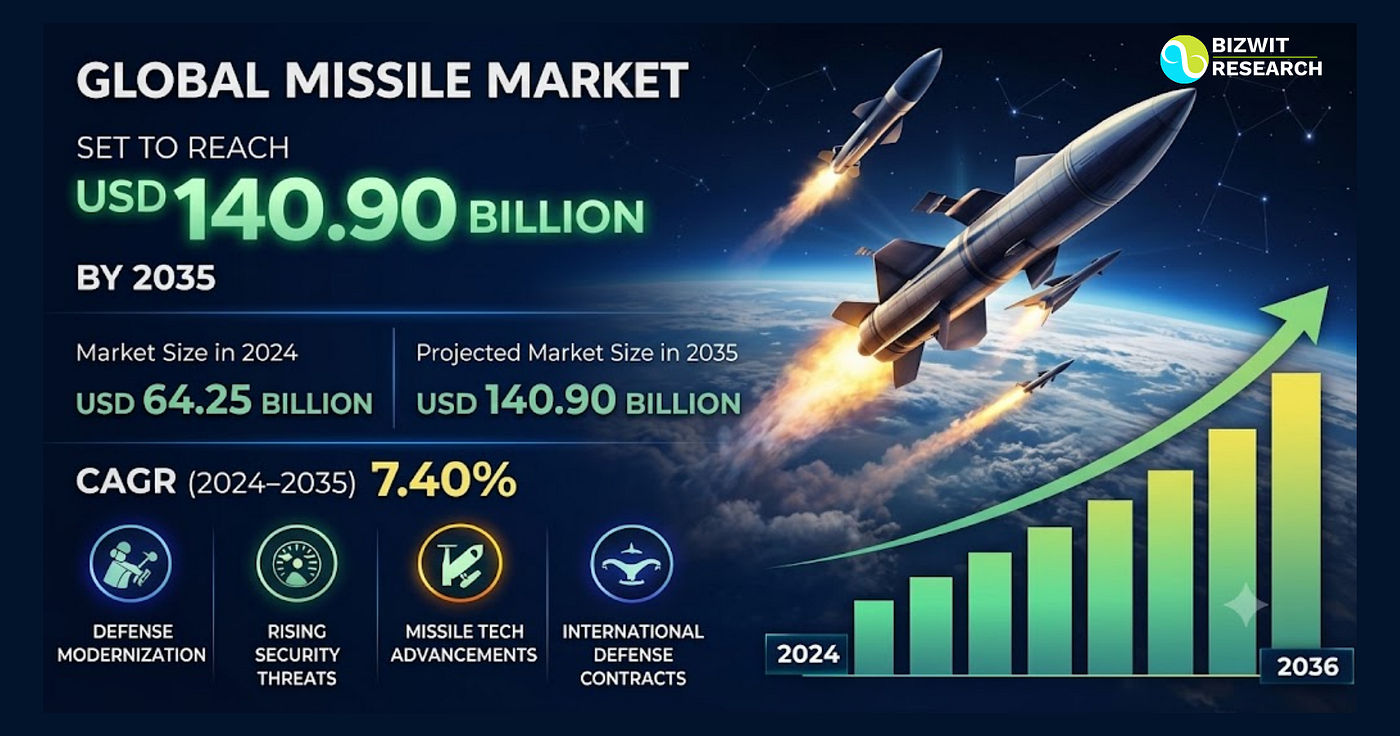
Bizwit Research estimates that the worldwide missile market would increase at a compound annual growth rate (CAGR) of 7.40% from its 2024 valuation of USD 64.25 billion to USD 140.90 billion by 2035.
Something more profound than cyclical defense expenditure is reflected in that tendency. It represents a fundamental change in how countries see security, with modern missile weapons now playing a key role in both active operational planning across several domains at once and deterrent policy.
What the Missile Market Actually Encompasses
Most individuals outside the military industry are unaware of how broad the term “missile market” actually is. Launch platform, operating range, and mission profile distinguish guided missile systems, each of which has unique engineering requirements and strategic objectives.
This market includes parts for airframes, guidance systems, propulsion systems, warheads, and launch systems. Defense contractors, component manufacturers, governmental organizations, academic institutions, and the armed forces collaborate closely to bring these systems to operational readiness.
The development of missile systems is influenced by electronics, propulsion, and advanced materials technologies, which establish supply chain connections and technological dependencies that fundamentally alter production economics and competitive dynamics in comparison to most other categories of defense equipment.
The market is now dominated by surface-to-surface missiles, which are the most popular launch mode category by revenue and deployment volume across key defense projects worldwide due to their widespread usage in both tactical and strategic operations.
Precision Has Become the Non-Negotiable Standard
There was a time when missile effectiveness was measured primarily by explosive yield and delivery range. That calculus has shifted decisively, and precision has emerged as the defining performance characteristic that defense procurement programs are optimizing for above almost everything else.
GPS guidance, inertial navigation systems, and AI-based targeting have transformed what missile systems can achieve operationally. The gap between what guided weapons could deliver twenty years ago and what they deliver today represents one of the most significant capability improvements in modern defense history.
That improvement changes strategic calculations in ways that extend well beyond individual weapon performance. Precision capability reduces collateral concerns, enables operations in environments where broad-area munitions would be unacceptable, and compresses the target-to-engagement timeline in network-centric warfare architectures.
A strategic partnership between defense agencies and technology firms specifically to develop AI-enabled missile guidance systems was announced in October 2023 — reflecting how seriously the defense community is investing in the targeting intelligence layer that precision strike capability depends upon.
Hypersonic Systems Are the Development Everyone Is Watching
Among all the technological developments reshaping the missile market, hypersonic systems are generating the most sustained attention — from defense planners, from competing nations, and from the investment community tracking where significant capability gaps are emerging.
Speed and maneuverability at hypersonic velocities create operational characteristics that conventional missile defense systems struggle to address effectively. Survivability improves. Decision timelines compress. The strategic value of systems that can reach targets faster than defenses can reliably respond is significant and growing.
A leading defense contractor conducted successful tests of a hypersonic missile system in February 2024 — marking a milestone that reflected years of sustained investment in propulsion and materials technologies, finally delivering demonstrable results at operational scale.
Long-range and hypersonic missile systems are expected to witness accelerated growth over the forecast period — supported by investments in next-generation capability that multiple major defense powers are pursuing simultaneously and with increasing urgency, given what they observe competitors developing.
AI Is Changing How These Systems Think
Artificial intelligence is entering missile system development at multiple levels — and the implications extend well beyond improved targeting accuracy into fundamental questions about how these systems operate and adapt in contested environments.
Real-time targeting adaptability allows systems to adjust engagement parameters in response to changing conditions that human operators couldn’t process quickly enough to act upon. That capability is particularly valuable in complex operational environments where the tactical picture evolves faster than traditional command structures can respond.
Autonomous decision-making capability is moving from research programs into active development — carefully bounded by operational and legal frameworks, but genuinely advancing in ways that are changing what defense planners can realistically consider when designing operational concepts.
The convergence of AI with advanced guidance systems is opening avenues for software and system integration solutions that didn’t previously exist — creating commercial opportunities for technology firms alongside the defense contractors that have historically dominated this market ecosystem.
Missile Defense Is Driving Parallel Demand
Investment in missile offense and missile defense isn’t a zero-sum competition — it’s a compounding cycle. As offensive capabilities advance, defensive architectures must respond. As defensive capabilities improve, offensive systems must evolve to penetrate them. Both sides of that dynamic drive market demand simultaneously.
Nations are investing in layered defense architectures that combine multiple intercept capabilities operating across different ranges and altitudes. That investment drives innovation and procurement across multiple missile categories — creating demand that extends well beyond the offensive systems that dominate headline coverage of this market.
A major defense program expansion specifically focused on upgrading missile defense systems was announced in July 2023 — strengthening national security infrastructure and driving procurement activities that contributed meaningfully to market growth across multiple component and system categories.
The development of advanced missile defense technology creates parallel demand for the offensive systems being designed to penetrate those defenses — a dynamic that sustains investment on both sides of the equation and contributes to the market’s consistent growth trajectory.
The Challenges That Shape How This Market Operates
Missile development costs are substantial — and the investment required to bring next-generation systems from concept to operational deployment involves R&D commitments, testing programs, and regulatory processes that few organizations can absorb without significant government backing.
Export controls and international treaties restrict market access in ways that create meaningful barriers between what manufacturers can develop and what they can sell internationally. Navigating those restrictions requires legal and compliance expertise that adds cost and complexity to every international transaction.
Supply chain complexity creates vulnerabilities that defense procurement programs increasingly address. Specialized components and advanced technologies concentrated in limited supplier bases create dependency risks that can impact production timelines and cost structures when disruptions occur — as recent global supply chain events demonstrated clearly.
The Road Ahead for This Market
The missile market is transitioning toward precision-driven systems that integrate AI, hypersonic propulsion, and modular architectures — meeting the demands of multi-domain warfare strategies that require interoperability across air, land, and naval platforms simultaneously.
Guidance systems represent the highest-value component segment — and that positioning reflects the premium that precision capability commands in defense procurement programs that are increasingly evaluated on operational effectiveness rather than acquisition cost alone.
Defense budgets in the Asia Pacific and the Middle East are creating new procurement demand that manufacturers with the right localization strategies and partnership models are well positioned to capture as military modernization programs accelerate across those regions with increasing resources behind them.
The market Bizwit Research has documented is one defined by strategic necessity — where the demand is sustained by security realities that governments cannot choose to ignore, the technology is advancing across multiple dimensions simultaneously, and the organizations investing in next-generation capability today are building the competitive positions that will define this market through the forecast period and well beyond it.
If you want to download a sample report, then you can connect with us at sales@bizwitresearch.com
Read this report link: https://www.bizwitresearch.com/missile-market
메타데이터
- post_id
- 870fcc50ea8f
- slug
- geopolitical-tensions-dont-fade-they-build-and-the-global-missile-market-reflects-that-reality-870fcc50ea8f
- url
- https://medium.com/@bizwit.general/geopolitical-tensions-dont-fade-they-build-and-the-global-missile-market-reflects-that-reality-870fcc50ea8f
- canonical_url
- https://medium.com/@bizwit.general/geopolitical-tensions-dont-fade-they-build-and-the-global-missile-market-reflects-that-reality-870fcc50ea8f
- author_url
- https://medium.com/@bizwit.general
- status
- ok
- fetched_at
- 2026-06-28 04:42:08




