The 4 AM Call That Nobody Built Software For
Why caregiving facilities are still scheduling shifts on Excel — and what CareShift Pro is doing about it.
The 4 AM Call That Nobody Built Software For
Why caregiving facilities are still scheduling shifts on Excel — and what CareShift Pro is doing about it.
It is 4:17 AM in a 60-bed memory care unit. A CNA who was supposed to clock in at 6:00 calls her supervisor’s cell phone — not the company line, the cell phone, because there is no company line at 4 AM — to say her toddler is throwing up and she cannot make it in. The supervisor, half-asleep, opens a group text with eleven other CNAs, types “anyone free to cover 6a–2p, Unit 3, please call me,” and stares at the ceiling waiting for a reply.
By 5:45, someone has said yes. By 6:10, the schedule on the breakroom wall has been crossed out with a Sharpie and rewritten. Nobody has logged the call-out anywhere. The replacement worker, now on a double, will not get a pickup bonus tracked anywhere either. Two weeks from now, when HR pulls the attendance report, this entire incident will exist only in a text thread on a personal phone.
This is not an edge case. This is Tuesday.
The industry that scheduling software forgot
There are roughly 30,000 assisted living communities and another 15,000 skilled nursing facilities in the United States. They run 24 hours a day, 365 days a year, and most of them, even ones owned by large corporate operators, still manage their workforces with a Frankenstein stack of Excel, group SMS, paper sign-in sheets, and the supervisor’s personal phone.
It is not because the software does not exist. Homebase, When I Work, Deputy, 7shifts, Sling, and Connecteam there is no shortage of workforce-management tools. The problem is that every single one of them was built for a different world. They were built for restaurants where a missing line cook means slower tickets, or for retail, where a no-show means a longer checkout line. Annoying, sure. Not dangerous.
In caregiving, an uncovered shift is not a customer-experience problem. It is a resident-safety problem. A medication pass that gets missed because the med tech did not show up and nobody on the floor is licensed to administer is not “we’ll get to it when we can.” It is a regulatory event. It is a fall risk. It is the difference between a quiet Tuesday and a state inspection.
Generic scheduling tools do not understand this. They do not know that a CNA cannot cover a med tech shift. They do not know that Unit 1 (independent living) has a 1:15 staffing ratio while Unit 3 (memory care) requires 1:6. They do not know that a call-out at 6:00 PM for a 6:00 AM shift is operationally very different from a call-out at 5:30 AM for the same shift, even though both are technically “calling in sick.”
The tools are not wrong. They just are not for this.
What we kept hearing in interviews
When you sit down with directors of nursing, staffing coordinators, and unit managers and ask them what they actually need, three themes show up over and over:
“I want to see the whole building at a glance.” Not a list. Not a calendar export. A wall, every unit, every shift, every role, color-coded by status. Scheduled in blue, open in amber, covered in green, and uncovered in red. If the whole wall is green, I can go home. If there is red on the wall, I cannot.
“I want the call-out rules enforced by the app, not by me.” The single most exhausting part of a staffing coordinator’s job is being the policy police. “You called out within four hours; that counts differently.” “That is your third call-out this month. We need to flag it.” “No, you cannot swap with her; she is not certified for that unit.” Every one of these conversations is a small fight. Every fight is a small erosion of trust. The app should be the policy. The coordinator should be the human.
“I want to know who my problem children are without playing detective.” Almost every facility has two or three employees whose attendance is quietly tanking the schedule. They know it intuitively. They cannot prove it on paper. By the time the pattern is documented well enough to act on, six months have gone by, and the team is burnt out covering shifts.
These three needs: at-a-glance coverage, automated policy, and pattern visibility, are not features in the existing tools. They are not even on the roadmap. They are not on the roadmap because the existing tools serve a different customer, and serving this customer well means rebuilding from the schema up.
The product principles
When we started designing CareShift Pro, we wrote down four principles and taped them to the wall. Every feature decision since has been measured against them.
1. Coverage is the only metric that matters. Every screen, every workflow, every notification exists to answer one question: Is the next shift covered? If a feature does not move a shift from “uncovered” to “covered” — or prevent it from moving the other direction — it does not belong in v1.
2. Approval is always human. No auto-approved swaps. No auto-approved pickups. No auto-assigned coverage. The app surfaces options, ranks them, and makes the right action one tap away — but a human supervisor presses the button. In healthcare, the algorithm is not allowed to be the decision-maker.
3. Policy lives in the database, not in the supervisor’s head. Call-out windows, certification requirements, unit assignments, overtime thresholds, attendance flagging rules — all of it encoded as data, all of it editable by admins, none of it requiring a developer to change. A facility that calls out within three hours instead of four should be a config change, not a code change.
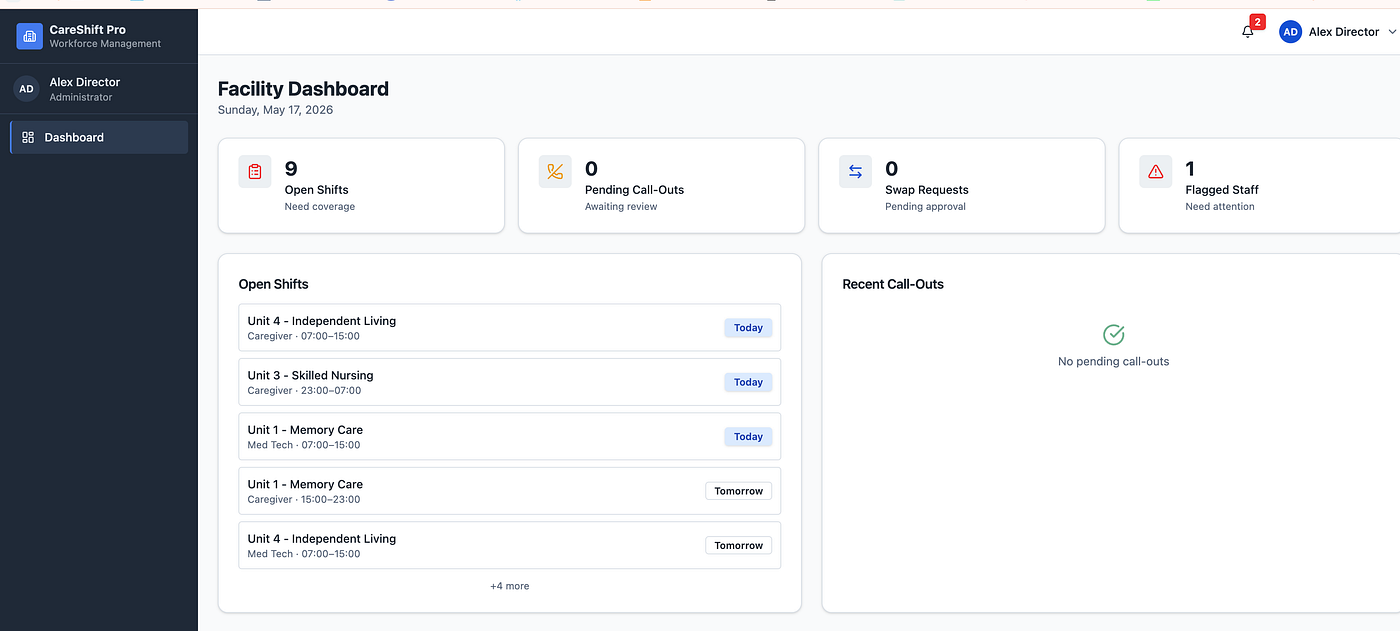
4. Empty states are a bug. A scheduling app with no shifts on it is useless for evaluation. A reports page with no data on it teaches nothing. We seeded the demo with 12 realistic employees, 43 shifts, 11 call-outs, 6 pickups, and 1 active attendance flag, so the first thing anyone sees is the app doing its job.
The four people we built it for
Every role in the app maps to a real human we interviewed, and every workflow is shaped by what we watched them struggle with.
Supervisor Jones runs the floor. She wants the Live Schedule Board open on her laptop all day, color-coded so she can spot trouble from across the room. When a call-out comes in, she wants to approve or deny in two taps, see who is eligible to cover, and broadcast the open shift to qualified staff without leaving the page.
Director of Admin runs the building. He does not want to touch shifts. He wants a dashboard where it shows total open shifts today, total call-outs this week, attendance flags trending up or down, overtime risk by unit, and the ability to drill in when something looks off.
HR Morgan runs compliance. She wants the 30/60/90-day rolling attendance report, sortable, filterable, exportable to CSV, with auto-flagging at configurable thresholds. When an employee shows up in her flag list, she wants the full history one click away.
Employee Chen runs his own life. He wants to see his next shift on his phone, call out in three taps when his kid is sick, browse open shifts when he wants extra hours, and request a swap when his sister’s wedding falls on a Saturday he is scheduled for. He never wants to read a 40-page policy PDF to know whether his call-out counts as last-minute.
These four people are not personas in a slide deck. They are the four seeded demo accounts you can log into on the live site, each with a dashboard tuned to their job. Click “Quick Demo Access,” and you are there.
Why is this the right moment
Two things have changed in the last 24 months that make this product feasible to build now in a way it was not feasible to build five years ago.
The first is the maturity of the Postgres-plus-serverless stack. A small team, or in our case, a single founder working with an AI development assistant, can now ship a multi-tenant SaaS app with row-level security, real-time subscriptions, and serverless functions without spinning up a single server. The operational surface area that used to require a backend team is now configured.
The second is the staffing crisis itself. Caregiving turnover has crossed 50% annually in many markets. Facilities are spending real money on agency staff to cover gaps that better software would prevent. The ROI conversation that used to require a slide deck full of “soft savings” now closes itself: one prevented agency shift per month pays for the platform.
The combination is buildable in weeks, sellable in one conversation, and is what makes this the right product at the right time.
BuiltWithMeDo #Caregiving #WorkforceProductivity #healthcare #corporate
메타데이터
- post_id
- 8729dc0efc4d
- slug
- the-4-am-call-that-nobody-built-software-for-8729dc0efc4d
- url
- https://medium.com/@shriyaprasannan8409/the-4-am-call-that-nobody-built-software-for-8729dc0efc4d
- canonical_url
- https://medium.com/@shriyaprasannan8409/the-4-am-call-that-nobody-built-software-for-8729dc0efc4d
- author_url
- https://medium.com/@shriyaprasannan8409
- status
- ok
- fetched_at
- 2026-06-09 15:37:30