A Curse Called Love
Why Humans Fear Impermanence
A Curse Called Love
Why Humans Fear Impermanence
I do not remember when it began. I stopped using the word “love.”
No, I moved away from the concept itself. I even began to despise it.
When I was young, love seemed joyful. I believed I was loving and being loved.
Looking back now, it was an illusion. The reproductive instinct of a young male simply replaced desire with the word love.
The reason someone left was simple. They found a more attractive partner.
The pain of being left was only the wound of a male’s pride.
Those faint stories of love were, in truth, cheap romantic pornography disguised as sincerity.
Many people mistake love for something noble, but in reality, it is only a mechanism to make oneself feel that way.
At the moment one says “I love you,” one is not seeing the other person.
One is only seeing the self that loves.
Kindness, devotion, specialness. They are tools to confirm one’s own virtue by using another.
Thus, love easily falls into a ritual centered on the self. This is the curse.
Lovers say, “I want you to be honest.” Honesty is important.
But if honesty is used to mine the other’s heart and convert it into a resource of reassurance, it becomes extraction.
The one whose heart has been mined chooses silence. Those who blame silence will mine further.
In a relationship where extraction continues, there is no freedom.
There, love reveals its true form. It is possession dressed in the robes of goodwill. It is a curse.
To speak of intimacy, we must first examine the vessel of words.
The Japanese word “ai” and the Buddhist vocabulary are not the same.
In Buddhism, there is ji and hi – “benevolence” and “compassion.”
Neither is a surge of emotion.
Ji is the attitude of giving happiness, and hi is the attitude of removing suffering.
Neither chooses targets nor seeks return.
What I despise is how these ideas of ji and hi are replaced by secular “love,”
spoken in the temperature of emotion and divided into the units of transaction.
The higher the temperature rises, the narrower the view becomes.
And the narrower the view, the more the other’s freedom disappears.
When the view widens, the script of two becomes the story of blood.
Parents who “expect” from their children often steal their freedom.
The words “I believe in you” sound beautiful.
But when they turn into pressure to behave according to that belief, the words take the form of a curse.
It is a script borrowed in the name of trust.
The child plays the role, and whenever they try to step off the stage, their love is doubted.
Here again, love reveals its true form. It is bondage disguised as connection. It is a curse.
Beyond blood, greater scripts appear.
Nations and organizations love the word “love.” Love of country, love of company, loyalty to brand.
These often mobilize individuals in exchange for freedom.
The nobler the purpose, the harsher the means become.
Nobility grants the robe of absolution. Beneath the robe, freedom is quietly shaved away.
Here too, love shows its nature. It is mobilization disguised as ideology. It is a curse.
Not forgetting the past is often called a virtue.
But memory is not preservation. It is re-enactment.
Each time, it is rewritten to fit one’s present desire.
To remember is never pure.
Suppose one day you find an old photograph of a former lover.
You might feel a faint trace of emotion.
You might wonder, “Do they still think of me sometimes?”
It is a common story. Yet that lingering warmth is only the remnant bound by a curse.
The wish to be remembered is also a curse.
If the other truly remembers you, they too are caught in the curse.
And if you desire that, you no longer wish for their freedom. That itself is the curse.
Humans fear impermanence because they feel that change erases the self.
Yet that fear is the final curse.
The mind that tries to stop transience, the will that tries to preserve form – these are the deepest bonds.
When one accepts change, one is finally released from the curse.
There, compassion is born. There, freedom exists.
The conclusion is simple.
To expect, to wish, to burden another – all are curses.
Only impermanence can break them.
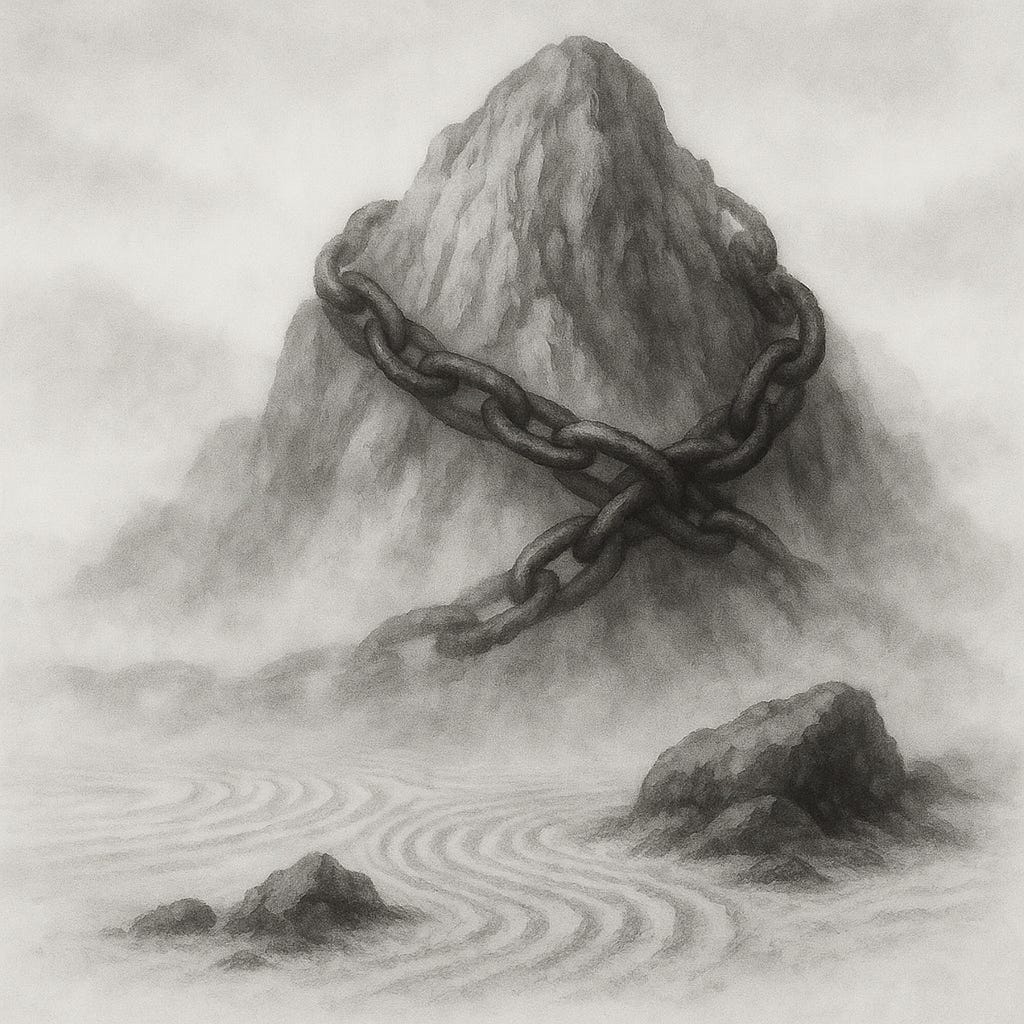
The moment one accepts the changing flow, one removes the chain called “love.”
Like petals that fall, pain too will pass.
What remains after that is only quiet freedom.
Author’s Note
The Illusion Between Emotion and the Concept of Love
People often speak of “true love.”
But finding such a thing is harder than finding an Iriomote cat.
Within the word love, there are two overlapping layers.
One is emotional love; the other is conceptual love.
The first is human impulse – desire, possession, expectation.
The second is the principle of total acceptance spoken of by gods or Buddhas.
Yet human beings cannot tell the difference between the two.
In Christianity, “the love of God” is not an emotion but a structure.
Like compassion in Buddhism, it is a way of being that embraces all things equally.
It does not cry, it does not grieve – it simply exists as understanding.
But people cannot help mixing emotion into it.
They believe that loving someone, or being loved by someone, is proof of love itself.
Yet that is not a concept; it is merely a transaction of feeling.
When we say we “love nature,” we usually mean we are moved by its beauty.
That too belongs to the emotional realm.
True love, in its conceptual sense, is the understanding that nature – beautiful or cruel – exists as it must.
No matter the motive, as long as love is spoken through emotion, it remains emotional.
Humans can only speak of love through emotion; that is our limit.
The love spoken of by gods and Buddhas is closer to enlightenment.
But we cannot attain enlightenment.
Just as we cannot become the Buddha, we cannot live through the concept of love.
In the end, human love always revolves around the self.
When we remember someone, what truly exists is not the other person,
but ourselves remembering them.
Unable to see this structure, people continue to live while confusing emotion and concept.
That is why love can turn into a curse.
We project, expect, and burden others in its name.
It is not love – it is attachment.
True love may be closer to not loving at all –
to the act of releasing one’s grip.
To accept impermanence –
that is the only way to break love’s spell.
Love is not about refusing change,
but about allowing it.
And within that acceptance lies a quiet kind of freedom.
메타데이터
- post_id
- 874ae93eaa9f
- slug
- a-curse-called-love-874ae93eaa9f
- url
- https://medium.com/voices-of-the-lost-authors/a-curse-called-love-874ae93eaa9f
- canonical_url
- https://medium.com/voices-of-the-lost-authors/a-curse-called-love-874ae93eaa9f
- author_url
- https://medium.com/@sprout6729
- status
- ok
- fetched_at
- 2026-06-15 20:49:13