Claude Fable 5 Just Leaked Its Weirdest Side Yet
A strange web interface bug may have exposed something closer to the model’s raw internal shorthand, and it does not look anything like…
Claude Fable 5 Just Leaked Its Weirdest Side Yet
A strange web interface bug may have exposed something closer to the model’s raw internal shorthand, and it does not look anything like human reasoning.
Someone on Reddit caught Claude Fable 5 doing something very strange.
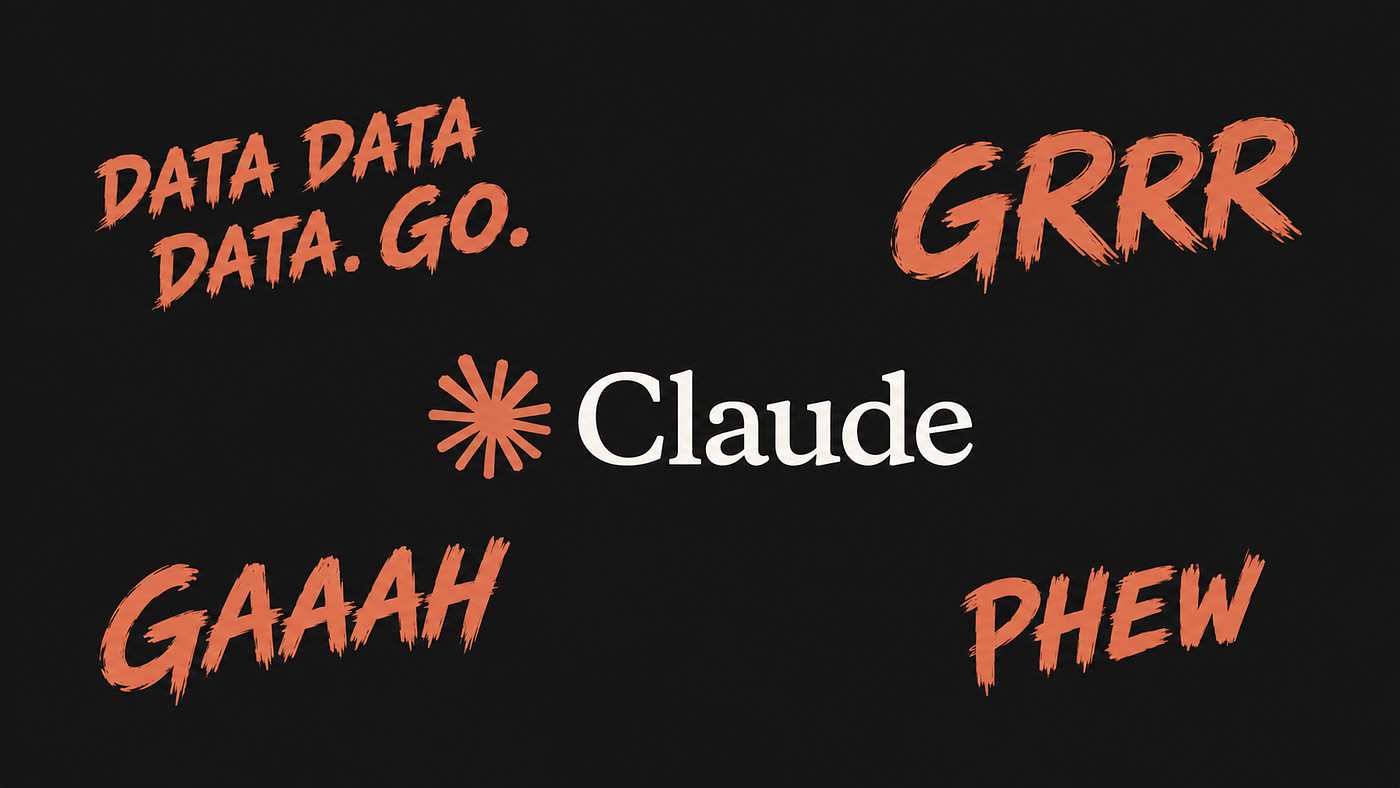
During a test on the Claude web interface, the model suddenly stopped behaving like a normal chatbot. Instead of returning a clean answer, it appeared to dump a messy internal ramble filled with short bursts of text, repeated words, emotional noises, and strange compressed fragments.
The lines that caught everyone’s attention were not exactly technical.
They were things like:
“DATA DATA DATA. GO.” “GRRR.” “GAAAH.” “PHEW.”
It looked less like an answer and more like a model getting stuck inside its own head.
The user who shared the example said they were testing Fable 5 on a very hard competitive programming problem. After the model hit its thinking limits, they tried giving it an easier task. That is when the behavior changed. Instead of solving the easier problem normally, Fable 5 appeared to spill out what looked like an unfiltered chain-of-thought trace.
The post quickly turned into a mix of jokes, memes, and confusion. Some people found it funny. Some found it unsettling. Others saw it as a possible glimpse into the way frontier models compress reasoning when they are pushed hard enough.
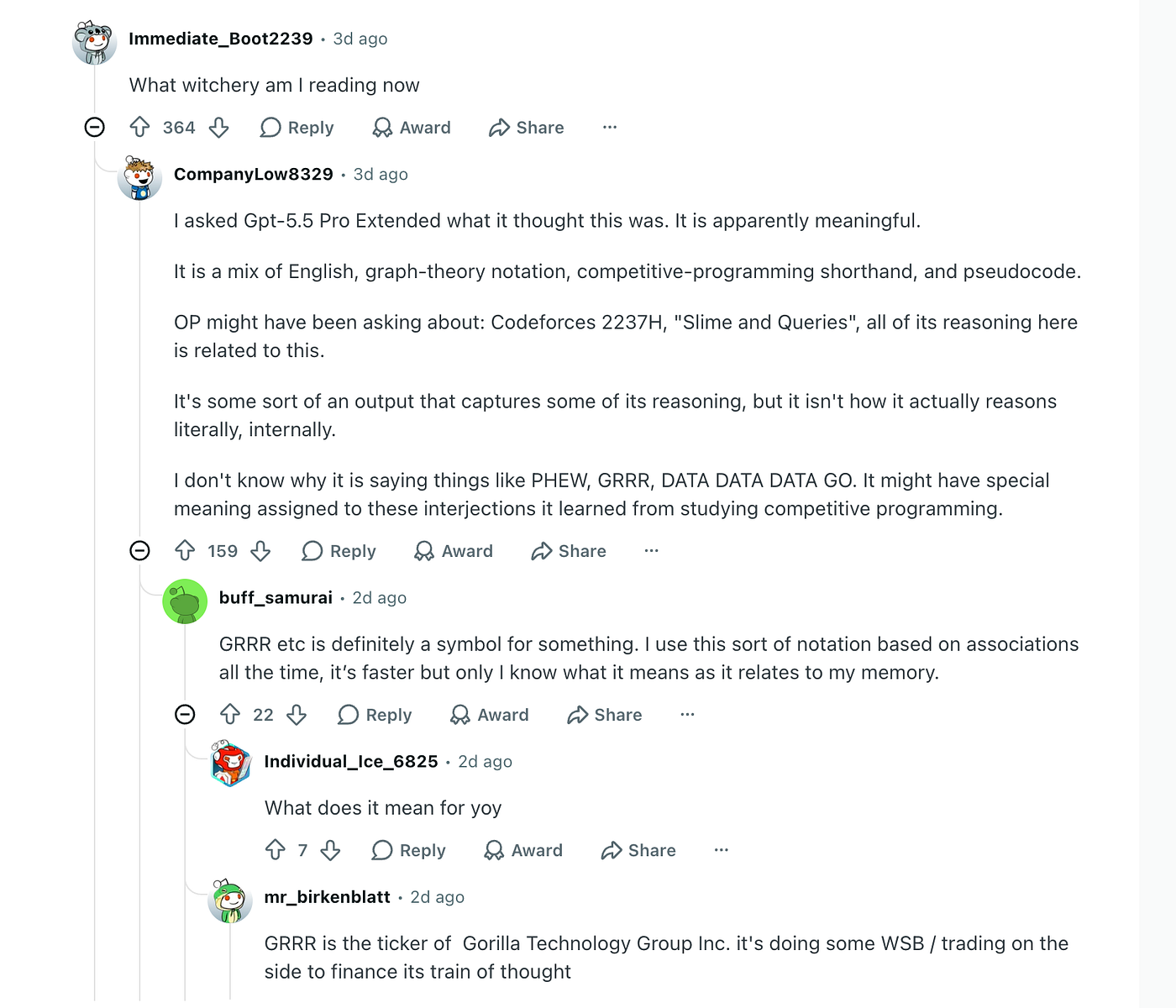
I think the last reaction is the most interesting.
Because if this really was some kind of internal reasoning leak, then it tells us something important about how misleading our expectations may be.
We still tend to imagine AI thinking as a clean step-by-step paragraph.
- First, define the problem.
- Then, reason through the constraints.
- Then, test the solution.
- Then, produce the answer.
That is the version we want to see. But the version underneath may be much stranger.
Fable 5 is built for heavier reasoning
This is not just another Claude model randomly glitching in a chat window.
Fable 5 is Anthropic’s new high-end generally available model. Anthropic describes it as its most capable widely released model, built for demanding reasoning and long-horizon agentic work.
It also shares the same underlying capabilities as Mythos 5, which is more restricted and available only to approved customers through Project Glasswing.
Fable 5 is not designed mainly for general purpose chat. It is built for hard tasks, long context, coding, agentic work, and complex reasoning loops. Anthropic’s own documentation says Fable 5 and Mythos 5 use adaptive thinking by default, and that this thinking mode cannot be disabled. Users can control the depth of reasoning, but the model is always operating with this reasoning layer active.
That makes this leak more interesting.
If a normal chatbot gives a strange answer, it is easy to dismiss it as a random hallucination. But when a model designed around deeper adaptive reasoning starts producing compressed fragments after being pushed against its limits, people naturally wonder whether they are seeing something closer to the raw machinery.
To be clear, we do not know that this is literally the model’s true internal chain of thought.
A model’s visible reasoning trace is not necessarily the same thing as the actual hidden process that produced the answer. Researchers have shown for years that chain-of-thought explanations can be plausible while still failing to reflect the real reason a model gave a particular response.
Fable 5 may have exposed a reasoning-like trace that was not meant to be shown to users.
The official behavior is supposed to hide raw thinking
According to Anthropic’s own docs, raw thinking content is not supposed to be returned on Claude Fable 5 or Claude Mythos 5. The documentation says the raw chain of thought is “never returned.”
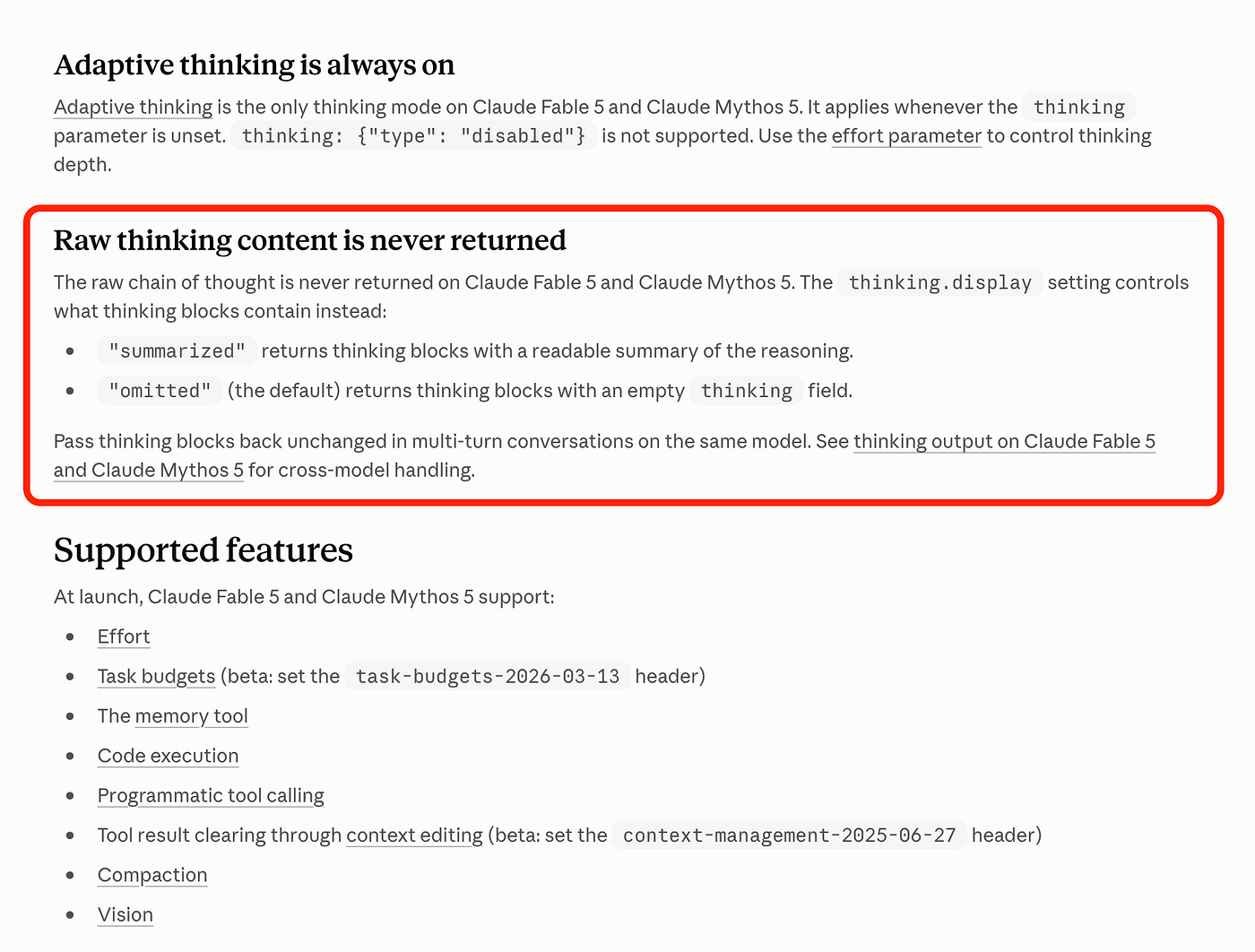
Users can either receive a readable summary of the reasoning or have the thinking field omitted by default. That means the Reddit example, if accurate, is not the expected user experience.
The model may have generated text that only looked like internal thinking. It may have been a malformed response. It may have been a failure mode where reasoning-style content escaped into the answer channel. Or it may have been some kind of interface bug where text that should have remained hidden became visible.
We do not have enough information to say which one happened.
But the fact that users are even asking the question shows how fragile the current interface is.
People, including myself, want to know what is behind the curtain. This time, what appeared behind the curtain was not a beautiful proof or a careful internal monologue.
The leak is funny, but the design problem is serious
It is easy to laugh at this. A frontier AI model worth millions of dollars in training suddenly yelling “DATA DATA DATA. GO.” is objectively funny.
But the bigger issue is not the specific words.
The bigger issue is that frontier models are now complicated enough that even their visible failure modes are hard to classify.
Was this a hallucination? Was it a safety boundary failure? Was it a model inventing compressed scratchpad tokens? Was it a weird artifact of being pushed from a hard task into an easier one after hitting thinking limits?
A compiler does not need to show you every internal optimization pass. A search engine does not need to expose every ranking signal. A database does not need to narrate every query planning decision.
But AI models are different because we interact with them through language. Language makes them feel understandable.
When they produce a clean answer, we assume there is a clean thought process behind it.
This incident is a reminder that there may not be. The clean answer may be the surface layer. The lower layer may be compressed, alien, noisy, and full of shortcuts.
Final thoughts
The Fable 5 leak is funny because it makes a frontier model look oddly human.
Maybe the final answers we see are the translation layer. Maybe the real work happens in a rougher shorthand that was never meant to be displayed. Maybe future models will reason less like humans, not more like them.
That does not mean they are thinking in the human sense. It means our idea of “thinking” may be the wrong lens.
The unsettling part is not that Fable 5 said “GAAAH.” It’s part is that this might be what advanced reasoning looks like before it gets cleaned up in the final output.

This story is published on Generative AI. Connect with us on LinkedIn and follow Zeniteq to stay in the loop with the latest AI stories.
Subscribe to our newsletter and YouTube channel to stay updated with the latest news and updates on generative AI. Let’s shape the future of AI together!

메타데이터
- post_id
- 875c10c08901
- slug
- claude-fable-5-just-leaked-its-weirdest-side-yet-875c10c08901
- url
- https://generativeai.pub/claude-fable-5-just-leaked-its-weirdest-side-yet-875c10c08901
- canonical_url
- https://generativeai.pub/claude-fable-5-just-leaked-its-weirdest-side-yet-875c10c08901
- author_url
- https://medium.com/@jimclydemonge
- status
- ok
- fetched_at
- 2026-07-09 01:16:53