🚦 Backpressure in Java Explained — Stop Fast Producers from Overwhelming Slow Consumers
Have you ever built a system where one part keeps generating data faster than another part can handle it — causing memory spikes…
🚦 Backpressure in Java Explained — Stop Fast Producers from Overwhelming Slow Consumers
Have you ever built a system where one part keeps generating data faster than another part can handle it — causing memory spikes, slowdowns, or crashes?
Welcome to one of the most underrated yet crucial concepts in concurrent systems: Backpressure.
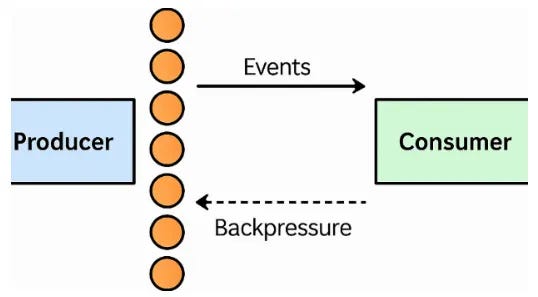
💡 What Is Backpressure?
Backpressure means applying flow control between a producer (who generates data) and a consumer (who processes it).
Simply put: Backpressure ensures that a fast producer doesn’t flood a slow consumer.
🧠 Real-life Analogy
Imagine you’re filling glasses with water using a hose. If you pour too fast, water spills everywhere. Now imagine the glass can send a signal to the hose:
“Stop! I’m full.”
That’s backpressure — the consumer (glass) telling the producer (hose) to slow down.
⚙️ A Simple Producer–Consumer System in Java
Let’s simulate this with code.
❌ Without Backpressure
import java.util.concurrent.*;

public class WithoutBackpressure {
    public static void main(String[] args) {
        ExecutorService executor = Executors.newFixedThreadPool(2);
        BlockingQueue<Integer> queue = new LinkedBlockingQueue<>(); // unbounded
        // Fast Producer
        executor.execute(() -> {
            for (int i = 0; i < 1000; i++) {
                queue.offer(i); // keeps producing fast
                System.out.println("Produced: " + i);
            }
        });
        // Slow Consumer
        executor.execute(() -> {
            while (true) {
                try {
                    Thread.sleep(100); // simulate slow processing
                    Integer data = queue.poll();
                    if (data != null)
                        System.out.println("Consumed: " + data);
                } catch (InterruptedException e) {
                    Thread.currentThread().interrupt();
                }
            }
        });
    }
}
🧩 What happens:
- The producer floods the queue very quickly.
- The consumer is too slow to keep up.
- Eventually, the system may run out of memory (OOM) or slow down due to GC pressure.
There’s no backpressure — no signal that says “hold on, I’m not ready yet.”
✅ With Backpressure (Using a Bounded Queue)
Now let’s fix it with a bounded queue that forces the producer to wait when the consumer is slow.
import java.util.concurrent.*;

public class WithBackpressure {
    public static void main(String[] args) {
        ExecutorService executor = Executors.newFixedThreadPool(2);
        BlockingQueue<Integer> queue = new ArrayBlockingQueue<>(10); // bounded queue
        // Producer with flow control
        executor.execute(() -> {
            for (int i = 0; i < 1000; i++) {
                try {
                    queue.put(i); // blocks if queue is full
                    System.out.println("Produced: " + i);
                } catch (InterruptedException e) {
                    Thread.currentThread().interrupt();
                }
            }
        });
        // Slow Consumer
        executor.execute(() -> {
            while (true) {
                try {
                    Thread.sleep(100); // slow processing
                    Integer data = queue.take(); // waits if empty
                    System.out.println("Consumed: " + data);
                } catch (InterruptedException e) {
                    Thread.currentThread().interrupt();
                }
            }
        });
    }
}
🧠 What changed:
- The producer now blocks when the queue is full.
- It only resumes producing once the consumer takes some items out.
- No memory overflow, no lost data — smooth data flow.
- BlockingQueue to act as the buffer with a fixed capacity.
ArrayBlockingQueue<>(10)→ allows only 10 items in the buffer at a time.queue.put(i)→ blocks the producer when the queue is full. ➜ This is the backpressure — the producer waits until there’s space.queue.take()→ blocks the consumer when the queue is empty. ➜ This prevents the consumer from processing non-existent data.
✅ This is manual backpressure using blocking.
🧩 Real-World Example: Kafka Consumers
In Apache Kafka, the concept of backpressure is crucial.
A consumer may read messages slower than they’re produced — that’s when consumer lag occurs.
Kafka allows backpressure through:
- Pausing/resuming consumption
- Controlling batch size and poll interval
Example:
consumer.pause(partitions); // temporarily stop consuming
// process current backlog
consumer.resume(partitions); // resume when ready
This prevents the consumer from getting overwhelmed by incoming messages.
⚡ Backpressure in Reactive Programming
Frameworks like Project Reactor and RxJava have built-in backpressure support.
Example (Project Reactor)
import reactor.core.publisher.Flux;
import java.time.Duration;

public class ReactiveBackpressure {
    public static void main(String[] args) throws InterruptedException {
        Flux.range(1, 1000)
            .delayElements(Duration.ofMillis(10)) // producer speed
            .onBackpressureBuffer(20,   // buffer up to 20 items
                dropped -> System.out.println("Dropped: " + dropped)) // handle overflow
            .delayElements(Duration.ofMillis(100)) // simulate slow consumer
            .subscribe(
                data -> System.out.println("Consumed: " + data),
                Throwable::printStackTrace,
                () -> System.out.println("Completed!")
            );
        Thread.sleep(20000); // keep app running
    }
}
🧩 Here:
- The producer emits values quickly (
delayElements(10ms)). - The consumer is slower (
delayElements(100ms)). onBackpressureBuffer(20)buffers 20 items max — beyond that, items are dropped safely.
✅ This is automatic, non-blocking backpressure — much more scalable than manual blocking queues.
⚙️ Common Backpressure Strategies

🧭 When Should You Care About Backpressure?
Backpressure matters whenever your system:
- Streams data between asynchronous components (Kafka, RabbitMQ, WebFlux)
- Processes large data volumes
- Relies on event loops or thread pools
Ignoring backpressure leads to:
- Memory overflow
- High latency
- Thread starvation
- Crashes under load
✨ Final Thoughts
Backpressure is like a communication contract between producers and consumers. It ensures your system stays stable, responsive, and memory-safe, even under load.
A good system doesn’t just produce fast — it produces sustainably.
메타데이터
- post_id
- 8773703efe06
- slug
- backpressure-in-java-explained-stop-fast-producers-from-overwhelming-slow-consumers-8773703efe06
- url
- https://medium.com/@samrat.alam/backpressure-in-java-explained-stop-fast-producers-from-overwhelming-slow-consumers-8773703efe06
- canonical_url
- https://medium.com/@samrat.alam/backpressure-in-java-explained-stop-fast-producers-from-overwhelming-slow-consumers-8773703efe06
- author_url
- https://medium.com/@samrat.alam
- status
- ok
- fetched_at
- 2026-08-02 03:37:55