The Horror of Being a Singularity
The amorality of Buddhist enlightenment
The Horror of Being a Singularity
The amorality of Buddhist enlightenment
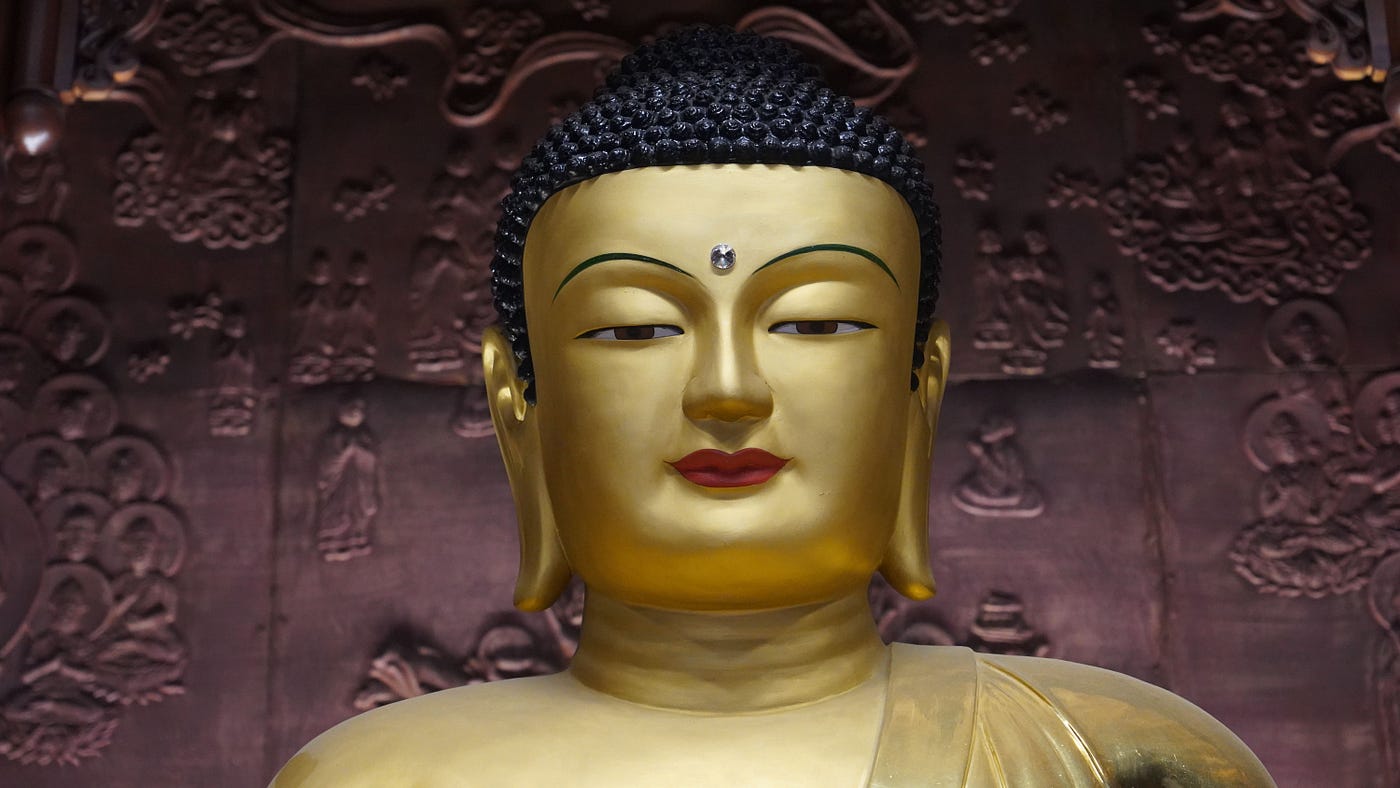
Photo by ki-mock koo, on Pexels
Buddhas are supposed to be serene, blissful, and tranquil, but why exactly? Why is the state of nirvana one we ought to be seeking? How is enlightenment a psychologically positive condition, according to this kind of Eastern philosophy?
Blissful relief as the default mental state
In her book Doubt, Jennifer Michael Hecht provides a well-written explanation in her summary of Buddhism:
Yet the Buddha said that once you do manage to get rid of your sense of self, the truth of the universe is yours. You are no longer living from a single vantage point. Since you are not a separate self, your compassion is limitless; you are all compassion, all empathy, because not being you entails being everything else: since we are not at all separate, we must be all.
She elaborates:
A related and equally important concept is that everything in the world we know is constantly coming into being or disappearing, and it is all basically made of the same stuff. There are no true nouns, then, only verbs. As a billion various ocean waves are all in fact water, wave-ing, so the water is just the universe ocean-ing — holding in the form of water. The part of the universe that is you, is really just “you-ing” right now. There is no reason to fear anything, or to take pride only in those things particular to you, because there is no you, there is just a momentarily you-ing universe from which you could not be separated any more than an ocean wave can be separated from the water. The terrible separation of death and the alienation of individuals within communities and within the vast universe — these ruptures don’t exist in reality. We are tricked by the default time frame of our minds, so we do not see the flow of a oneness. With a lot of work, we can reconfigure our default settings so that we see things as they really are: flowing, timeless, interconnected. It leaves one bemused, gentle, and unflappable.
Again, regarding the bliss of enlightenment, the goal is “to be able clearly to see and hear the human beings around us.” In that case,
This situation of ours is bliss, said the Buddha, and we are already there. If you can root out the sense of self entirely (and the best way to do that is to go looking for the self), you find you are a collection of thoughts amid the universe, with nothing to do but be delighted with that surprising truth, and with the whole range of experience, without preference, without hurry, without dread. Every moment is a marvel of being. One gets to this state by practicing it…The world is in constant flux — it all changes all the time, mountains melt, universes collapse — all we have to do is learn to accept it.
Similarly, if you ask the Google’s large language model Gemini why buddhas are supposed to feel bliss or happiness in nirvana, you get this answer: ‘Buddhas and enlightened beings (arahants) are described as feeling bliss or happiness in Nirvana not because of sensory pleasure or emotional excitement, but because it is the complete cessation of suffering (dukkha), craving, and the “three poisons” — greed, anger, and delusion.’
Gemini elaborates:
The “Bliss of No Feeling”: When asked what is blissful about Nirvana if nothing is felt, Ven. Sariputta replied that the fact that nothing is felt is precisely what is blissful. It is a profound inner calm that transcends emotional highs and lows.
Release from the Burden of Self: The “bliss of release” is likened to the immense relief of removing a heavy burden or quitting an addiction.
Natural State of Mind: Nirvana is often interpreted as the mind’s natural state when unclouded by delusions and cravings.
The amorality of enlightenment
Now, this explanation of the link between spiritual or existential enlightenment and positive mental states is more about monism in general than Buddhism. Apart from the emphasis on anatman, or the empiricist rejection of egoism, this explanation would apply to Advaita Vedanta, the monist tradition in Hinduism. Similarly, the early modern Western philosopher Baruch Spinoza said that contemplating the deterministic connections between everything in nature is blissful.
What’s undeniable is that any negative attitudes that depend on egoism, the emotional attachment to the illusion of the self’s unity and priority, would have to vanish in the enlightened state of realizing there’s no such self. For instance, resentment towards nature’s treatment of living things would disappear because there would be no distinct living things to want to protect. All that would appear to exist within this enlightened state of nirvana would be the oneness of the cosmic whole.
The idea, then, is that when the cosmic whole reflects on itself, when the cosmos is “you-ing,” or superficially engaged in hosting your emergent properties of personhood, the cosmos feels those positive states of bemusement, bliss, tranquility, and so on. The universe, as it were, is relieved to have discovered it’s not a tormented, fragile self who worries about threats appearing around every corner. Instead, the universe realizes it’s a fearless, unconditioned, immortal totality.
Enlightenment is supposed to be merely the tuning of our mentality to this monistic reality, whereupon we adopt the whole’s default frequency, as it were, which is the serenity or contentment with whatever transpires.
Yet this answer still strikes me as dubiously anthropocentric. Hecht says a buddha has “nothing to do but be delighted with that surprising truth, and with the whole range of experience, without preference, without hurry, without dread.” Yet this implies that enlightenment is beyond good and evil in something like Friedrich Nietzsche’s sense.
A buddha leaves behind the negativity of egoistic fears and resentments, which are based on a confused attachment to superficial appearances. But for the same reason, a buddha must leave behind the positivity of moral concerns about suffering. Therefore, we must ask whether nirvana’s bliss, tranquility, relief, and so forth are genuine positive states.
Those of us who aren’t enlightened can only imagine the feeling of occupying this cosmic perspective. So if we imagine how the universe would feel about itself, we must surely imagine that this feeling would be inhuman. There would be no privileged link between the universe’s self-conception and the average, egoistic conception of anything. Whereas we’re concerned with overcoming suffering in life, because we’re beset with egoistic illusions, the universe has no reason to worry. The universe as a united whole is immortal.
Moreover, the universe isn’t preoccupied with any of its partial contents, which is to say that the whole doesn’t care about the superficial loss of its parts, including all the organisms that evolve in nature. None of those parts is ever really lost because none of them exists as a distinct thing in the first place. The parts are only minuscule fluctuations of the whole.
Thus, human suffering doesn’t matter from the cosmic perspective. Therefore, when contemplating something like the Nazi Holocaust or a spate of serial killings, a buddha should be exactly as bemused and tranquil as when this buddha is meditating on the delicate physics of a water droplet sliding off a curved leaf. All of these events would be amoral, from the enlightened vantage point, because morality is just as dependent on the flaws of egoism as dukkha, the burden of disappointment for the misled, harried self.
Buddhists and monists can’t have it both ways. If enlightenment undoes the suffering that’s caused by confused egoistic attachments, enlightenment must also negate the positive emotions that depend on egoistic triumphs. Morality is about what should happen, but morality is meaningful only from the egoistic context in which living things especially matter. There can be no such life-centered judgment from the cosmic vantage point. Thus, nothing is especially meaningful to the cosmos, as it were, since nothing else exists apart from that whole, and the whole isn’t free to obey prescriptions.
From the enlightened standpoint, there would be no sense in the moral idea that we need to rescue a drowning child. This would be because a buddha understands that the child doesn’t exist, and both the child’s suffering and that of the frantic onlookers is illusory. Only the whole is real, and both suffering and morality apply only to beings who are trapped and confused by egoism.
The horror of being a singularity
Assuming there’s no moral underpinning of the enlightened, cosmic mental state whatsoever, why exactly would the cosmos feel blissful? Indeed, isn’t bliss in conflict with the relief of tranquility or the inner calm of no longer being hounded by greed, anger, and delusion?
Bliss is perfect happiness, whereas calmness seems like a human approximation of what it must be like to be a mindless object that has no emotional capacities. Although neither would strictly apply, it would make more sense to attribute calmness to a rock than bliss. This is because calmness or tranquility is the negative state of being free from mental agitations or disturbances, and indeed, a rock (or the cosmic totality) would be free in that sense. But that negative state isn’t the same as being positively happy, joyful, or blissful.
A buddha might have reason to be calm and tranquil since this enlightened person would be content with any local fluctuation of the cosmic whole, including what deluded egotists like you and me would consider disastrous ones, such as the sixth mass extinction of terrestrial life. The Buddha would side with the cosmos in realizing that if all life were to die out on Earth, that would be of no special consequence because life would evolve countless other times throughout the universe, and in any case, nonlife is exactly as important as life since neither would matter at all compared to its underlying oneness.
But why would a buddha feel joy or bliss? Sure, there might be relief from being free of the delusions of egoism, but why would that be a lasting reaction to enlightenment? Or why would this relief be a default mental state? After all, that would imply that enlightenment depends on the delusions of egoism. Again, the enlightened state should have nothing to do with the fears and joys of misled self-centeredness.
Unenlightened individuals feel joy because they’re temporarily relieved from some worry or because they’ve managed to succeed in some venture. The joys are as fleeting as the worries because circumstances change for those who don’t occupy the cosmic vantage point. Yet for the buddha who does, what exactly could be the source of continual joy? Put differently, why would the cosmos feel joy when contemplating its immortality?
Here, a different metaphor suggests itself since the cosmic oneness would be like the absolute monarch who is liable to be corrupt enough to entertain a solipsistic dismissal of all seemingly lower beings, such as the courtiers and peasants in the kingdom or dictatorship. We easily imagine a king or dictator succumbing to arrogance in contemplating his dominance or what the society would consider his sole, overarching importance. Similarly, the cosmos would disregard the local values of its parts, focusing instead on the greatness of its unity.
But if we imagine that the sovereign lives long enough to learn the folly of this corruption and self-regard, we must assume that the sovereign might become revolted by the society’s worship of this ruler. The horror of being a society’s lynchpin might dawn on him, so that the pinnacle would feel dreadful rather than overjoyed.
Indeed, it’s misleading to say that the monist advocates the surrender of egoism since all that happens in enlightenment is that the cosmic whole’s virtual self-regard replaces the local part’s self-regard. The cosmos would have nothing else to occupy its attention, as it were, but itself, which is to speak of the real totality of all the universe’s unified elements, forces, levels, systems, and cycles. And the enlightened monist merely adopts that cosmic perspective, feeling what the cosmos would feel about itself if the cosmos had such a cognitive capacity.
So, given the above view, the Buddhist’s conceptions aren’t altruistic since this monist must think there’s nothing apart from the cosmic whole. Only one thing exists, according to monism, so there can be no enlightened thought about something else, as in something other than the whole. Anyone who identifies with the cosmic whole can reflect only on that underlying unity, which is the same as reflecting on the enlightened person’s real identity. Selflessness is as impossible for buddhas as morality or selfishness, and for the same reason.
Why not assume, then, that the cosmos would feel horror rather than joy? Why wouldn’t the most fitting emotional reaction to being the cosmos be horror or disgust rather than joy or peace? Sure, the cosmos would be free from the disturbances of egoistic confusions, but not from solipsistic reflections on the grotesque absurdity of being the only thing that’s real!
This discovery would be like the king’s realization that life doesn’t matter in his kingdom since he can send anyone to the executioner with a mere whimsical wave of his hand. Only the absolute monarch matters in this one-sided society, and the king realizes that since he’s the arbiter of the law, he’s beyond good and evil. There’s no higher authority than this decadent solipsist, just as there can be no higher evaluation of the cosmic whole since nothing else would exist upon which to establish an independent judgment.
An evaluation requires two things: the evaluator and the evaluated. If there’s only one thing, this thing could evaluate itself, but that would be as worthless as a corporation that agrees to regulate its pollution without governmental monitoring or penalties.
The upshot is that this kind of uplifting monism should be critiqued. It’s worthwhile imagining the contents of a cosmic perspective, and it’s plausible to speak of relief from the end of egoism. Indeed, we all might feel some such relief in our moments of dying, when we realize we needn’t worry any more about our parochial problems.
But crediting the cosmic perspective with joy or happiness is facile. For an enlightened, cosmically-oriented “individual,” those are morally positive states that should be as unsustainable as the negative ones of egoistic fears and hatreds.
Further reading
- Buddhism and The Threat of Nihilism
- Buddhist Nirvana and The Consolation of Nihilism
- The Incoherence of Basic Buddhism
- Enlightened Buddhists Shouldn’t be Compassionate
- Buddhas are Nihilist Observers, Not Compassionate Saints
- Buddhas Aren’t Slaves to Saintliness
- Pragmatic Morality and the Buddha’s Nihilism
Check out my novels
메타데이터
- post_id
- 8773d812e44d
- slug
- the-horror-of-being-a-singularity-8773d812e44d
- url
- https://medium.com/philosophytoday/the-horror-of-being-a-singularity-8773d812e44d
- canonical_url
- https://medium.com/philosophytoday/the-horror-of-being-a-singularity-8773d812e44d
- author_url
- https://medium.com/@benjamincain8
- status
- ok
- fetched_at
- 2026-06-16 19:09:56