Pendle Finance: Yield Tokenization Works — The Question Is Whether DeFi Needs It Yet
Pendle turned DeFi yields into tradable assets — but with 70% speculation-driven volume, it may have built sophisticated infrastructure…
Pendle Finance: Yield Tokenization Works — The Question Is Whether DeFi Needs It Yet
Pendle turned DeFi yields into tradable assets — but with 70% speculation-driven volume, it may have built sophisticated infrastructure for the wrong market.
TL;DR
Pendle splits yield-bearing tokens into Principal Tokens (PT) and Yield Tokens (YT), creating DeFi’s first tradable yield curve. With $3B TVL fragmented across 50+ maturities and 70% of volume driven by speculation, not hedging, the protocol built sophisticated infrastructure — but for a market that may not need it yet. Whether its $420M token captures value depends on two bets: that DeFi matures into a fixed-income market, and that institutions choose Pendle over tokenized T-bills — neither is guaranteed.

Image generated with Google Gemini (AI-generated illustration)
Part I: WHAT — How Pendle Splits Yield from Principal
Pendle takes any yield-bearing token (stETH, aUSDC, sDAI) and splits it into two components: Principal Tokens (PT) that lock in fixed rates, and Yield Tokens (YT) that capture all future yield. Deposit 10 stETH today, get 10 PT-stETH (redeemable for 10 stETH at maturity) plus 10 YT-stETH (claims all staking rewards until maturity). Sell the PT if you want fixed income. Sell the YT if you’re bearish on yields. Hold both if you’re indifferent.
Pendle’s innovation lies in its AMM design. Unlike Uniswap’s x*y=k, Pendle’s pools incorporate a time-decay factor that makes PT prices converge toward par as maturity approaches. PT-stETH trading at 0.96 naturally converges toward 1.0 ETH by maturity. That convergence creates DeFi’s first native yield curve — yield embedded not by oracle rates, but by market pricing over time.
At maturity, PT + YT = underlying asset. No liquidations. No rollover risk. The position simply expires into the base token. For December 2025 stETH: PT holders redeem for stETH, YT holders claim accumulated staking rewards, and the market closes.
Key metrics:
- TVL: $3.0B (fragmented across 50+ maturity dates)
- Daily volume: ~$200M
- Largest pool: stETH Dec 2025, $800M TVL
- Active markets: 12+ chains, 30+ underlying assets
The mechanism works. Whether anyone needs it at this scale is the harder question.
Part II: WHY — The Case for Yield Tokenization
The bull case sounds compelling:
Fixed-rate DeFi without banks. Traditional finance built trillion-dollar bond markets around predictable cash flows. Pendle brings that infrastructure onchain — buy PT-stETH at 3.5% fixed APY instead of gambling on floating staking rates.
Duration hedging for protocols. DAOs sitting on stETH treasuries can sell YT to lock in current yields, hedge against rate declines, or free up capital without touching principal. In theory, this is sophisticated treasury management.
Leveraged yield speculation. Buy YT-stETH for 10% of the notional value and capture 100% of the yield. If staking APR jumps from 3% to 5%, your YT doubles. Pendle calls this “yield leverage” — traders call it gamma on APR volatility.
What the market actually does:
PT buyers: ~30% of trading volume. These are mostly conservative DeFi users seeking fixed rates or institutions dipping their toes into onchain duration products.
YT buyers: ~70% of trading volume. The majority are speculating on yield volatility — essentially betting that staking/lending APRs will rise enough to make YT profitable before time decay eats the position.
Arbitrageurs: closing <1% spreads between PT+YT and underlying assets. This keeps pricing efficient but generates minimal organic demand.
Who’s actually using Pendle?
On-chain data suggests retail dominance:
- Average PT trade size: $8K-$15K (Dune Analytics, Oct 2024)
- Average YT trade size: $3K-$8K
- Institutional-scale trades (>$1M): <2% of transaction count
Compare to institutional DeFi:
- Aave institutional vaults: avg deposit $500K+
- Morpho institutional markets: avg position $250K+
Pendle’s user base looks like leveraged farmers, not treasury managers. Pendle built fixed-income rails for users who value predictability. Instead, it attracted speculators chasing upside.
The uncomfortable reality:
Most PT buyers could just hold stETH directly. The 3.5% fixed rate on PT-stETH looks attractive until you realize stETH averaged 3.8% over the past year. You’re paying a premium for certainty in a market with low yield volatility.
Most YT buyers are speculating on staking APR movements that rarely exceed 1–2 percentage points. When Ethereum staking APR dropped from 4.2% to 3.1% in early 2024, YT-stETH holders got crushed. When it rebounded to 3.8%, the gains barely covered time decay.
Pendle built infrastructure for yield trading. The market uses it for yield gambling. That’s not wrong — but it’s not the fixed-income market Pendle positions itself around.
Part III: HOW — The Liquidity Problem
The fragmentation trap:
Pendle doesn’t have one stETH market — it has 12 separate markets across different maturity dates (March 2025, June 2025, September 2025, December 2025, March 2026…). Each maturity is its own isolated pool with distinct liquidity.
The top 5 markets hold 80% of TVL. The December 2025 stETH pool has $800M liquidity and tight spreads. The September 2026 pool has $8M liquidity and 5% slippage on a $100K trade.
Compare to traditional fixed income:
U.S. Treasuries: $26T market, deep liquidity across 2–30Y maturities.
Pendle: $3B TVL, thin liquidity beyond 3 months.
No institutional participant is hedging duration with $5M liquidity pools.
[embed]
The reflexivity problem:
When yields are high and volatile (like 2021–2022 Curve wars, or Aave during liquidity crises), Pendle thrives:
- YT demand surges → trading volume increases → LPs earn fees → more liquidity enters → Pendle expands to new assets → ecosystem grows
When yields are low and stable (like 2024 stETH at 3–4% APR):
- YT loses appeal → volume dries up → LP rewards can’t compensate for IL → liquidity exits → spreads widen → death spiral
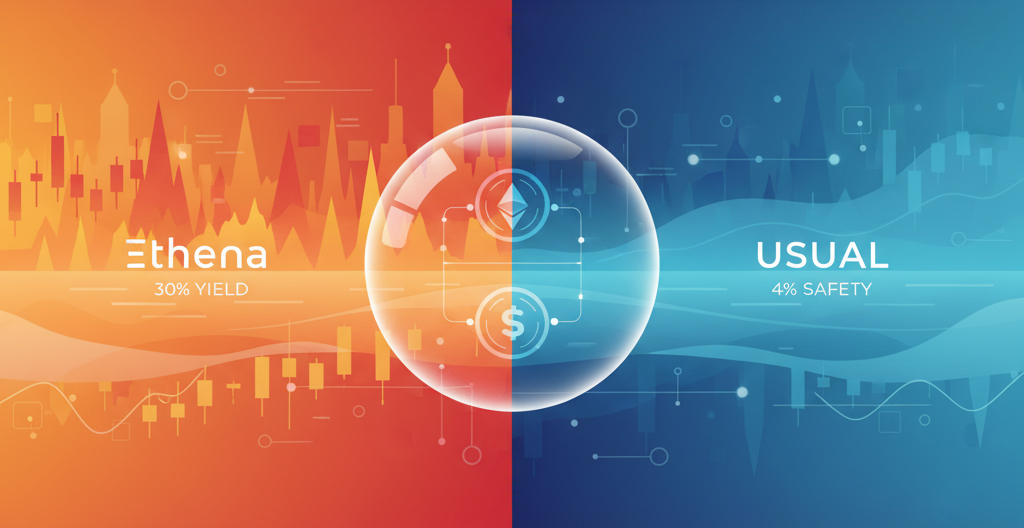
Pendle’s TVL dropped from $6B (June 2024) to $2.8B (October 2024) during the stablecoin yield compression. It recovered to $3B only after integrating new assets (Ethena sUSDe, Usual USD0++). The protocol is perpetually searching for the next high-yield asset to onboard before the current one bleeds liquidity.
Pendle faces a structural paradox: more maturities mean thinner liquidity per market — a composability tradeoff DeFi hasn’t solved.
Verdict: Pendle works in bull markets with volatile yields. It struggles in flat-yield regimes where the product-market fit weakens. Not a death sentence, but a ceiling on defensibility.
Part IV: WHO PROFITS — The Token Question
PENDLE token sits at ~$420M fully diluted valuation (FDV). What does it actually capture?
Revenue sources:
Swap fees: 0.1% on all PT/YT trades. At $200M daily volume, that’s ~$200K in daily fees, or $73M annualized. Not bad — except most flows to protocol treasury, not token holders.
Protocol-owned liquidity (POL): Pendle deploys treasury funds as LP in its own pools, earning trading fees and yield. This generates revenue for the protocol entity but doesn’t directly accrue to PENDLE holders.
Token utility:
Governance: Vote on which pools receive PENDLE emissions. Protocols bribe vePENDLE holders (à la Curve wars) to direct liquidity toward their assets. Ethena reportedly spent millions in incentives to bootstrap sUSDe pools.
vePENDLE staking: Lock PENDLE for up to 2 years, receive boosted LP rewards and a share of protocol revenue. The boost ranges from 1x (no lock) to 2.5x (max lock). High APRs come from… more PENDLE emissions.
The problem: Fee revenue stays in the treasury. vePENDLE stakers get a cut, but it’s paid in PENDLE tokens that are simultaneously being emitted to LPs. The token is a governance tool with indirect value capture, not a direct equity claim on protocol cash flows.
Token supply dynamics compound this: Roughly 60% of total supply remains unlocked over the next three years — sustained inflation that pressures real yield for existing holders.
This design raises a larger question common across DeFi governance tokens: can emissions-driven flywheels sustain value once real yields compress?
Sound familiar?
ONDO: Governance token with no economics, trading on narrative alone.
CRV: Vote-escrowed rewards that boost APY, but chronic dilution risk.
PENDLE: Middle ground — some utility (bribes, boosted yields), unclear terminal value capture.
At $420M FDV, you’re betting that:
- DeFi needs fixed income infrastructure at scale (not just niche yield farming)
- Pendle becomes that infrastructure (not a competitor or TradFi substitute)
- Token value accrual improves (fee sharing, buybacks, or sustained bribe markets)
Two out of three might hold. All three? That’s the bull case — and it’s already priced in.
Part V: WHAT IT MEANS — Infrastructure or Innovation Theater?
Pendle asks a fundamental question: Does DeFi need yield curves?
The optimistic answer:
Yes. As institutions enter crypto, they’ll demand duration hedging, fixed-rate borrowing, and yield curve trading. Pendle becomes the rails — the protocol that every DAO, fund, and treasury uses to structure onchain fixed income. The Uniswap of yield markets.
The skeptical answer:
Maybe not yet. Most DeFi users are short-term yield farmers, not bond traders. They chase 20% APYs on memecoins, not 4% fixed rates on stETH. Pendle solves problems that institutions have — but institutions aren’t here yet. And when they arrive, they might just use tokenized T-bills (OUSG, BENJI) instead of DeFi primitives.
Data tells us which side currently wins:
70% of volume is YT speculation, not PT hedging. The product-market fit is “leveraged yield gambling,” not “structured fixed income.”
Liquidity concentrates in 3-month maturities. Long-dated markets (12+ months) barely trade. No one is pricing 2026 cash flows with confidence.
TVL bleeds in flat-yield environments. When staking APR drops from 5% to 3%, Pendle’s value proposition weakens. The protocol needs volatility to stay relevant.
Pendle built for fixed-income markets — but the users who showed up are speculators: 70% of volume is YT trading and average trade sizes are $3K–$15K. That gap is product-market fit in action.
That’s not a timing issue — it’s product-market fit revealing itself. And the deeper question: when institutions arrive, will they even need Pendle?
Institutions want:
- Low risk (Pendle: smart contract risk)
- Deep liquidity (Pendle: $8M on long-dated markets)
- Regulatory clarity (Pendle: DeFi primitive)
They can get fixed income from tokenized T-bills (OUSG, BENJI) with none of Pendle’s drawbacks. Why use PT-stETH when OUSG exists?
Pendle built for institutions — but DeFi, for now, is still a retail casino. And when institutions finally arrive, they might not need what Pendle built.
The sophisticated infrastructure is real. Whether anyone — retail or institutional — actually needs it at scale remains the unanswered question.
Final Take: Building for a Market That Doesn’t Exist Yet
Pendle did something genuinely innovative: it made future cash flows as liquid as the assets that generate them.
The protocol proved its technical merit. But the market isn’t ready.
Yield curves and duration hedging are tools for mature markets with institutional participants who think in quarters and years — not degens rotating into the next 500% APY farm.
The question isn’t when DeFi grows up — it’s whether mature DeFi needs what Pendle built.
If institutions prioritize crypto-native yields over TradFi alternatives, Pendle positioned itself perfectly. But if they’d rather hold tokenized T-bills than trade PT-stETH with fragmented liquidity, Pendle may remain a sophisticated product that solved the wrong problem for the wrong users.
Either way, Pendle proved something important: yield isn’t a metric — it’s an asset class. Whether that asset class needs DeFi’s infrastructure or TradFi’s rails is the real $3B question.
Disclosure: Independent research. Not financial advice. Author may hold positions in discussed assets. DYOR.
Data Sources: DefiLlama, Dune Analytics, Pendle official documentation, Messari, Token Terminal.
Data Note: Core analysis based on October 2024 market conditions. As of October 2025, Pendle’s TVL has grown to $6–13B (from $3B in Oct 2024), with a notable shift from LRT pools to stablecoin pools — reinforcing the article’s thesis that Pendle perpetually chases high-yield assets. The structural observations regarding liquidity fragmentation, user composition, and product-market fit remain applicable.
메타데이터
- post_id
- 87791c922cca
- slug
- pendle-finance-yield-tokenization-87791c922cca
- url
- https://medium.com/@pycheng9/pendle-finance-yield-tokenization-87791c922cca
- canonical_url
- https://medium.com/@pycheng9/pendle-finance-yield-tokenization-87791c922cca
- author_url
- https://medium.com/@pycheng9
- status
- ok
- fetched_at
- 2026-07-15 23:42:37