AI Facts That Feel Like Leaked Information From 2035: Seven Real, Documented, Already-Happened…
A neural network solved a biology mystery that took humans a decade. A quantum chip ran an algorithm 13,000 times faster than the…
AI Facts That Feel Like Leaked Information From 2035: Seven Real, Documented, Already-Happened Breakthroughs That Sound Like Science Fiction
A neural network solved a biology mystery that took humans a decade. A quantum chip ran an algorithm 13,000 times faster than the world’s best supercomputer. AI task duration is doubling every 4 to 7 months. None of this is hypothetical. All of it shipped. A deep technical look at the moments when the future started arriving on schedule.
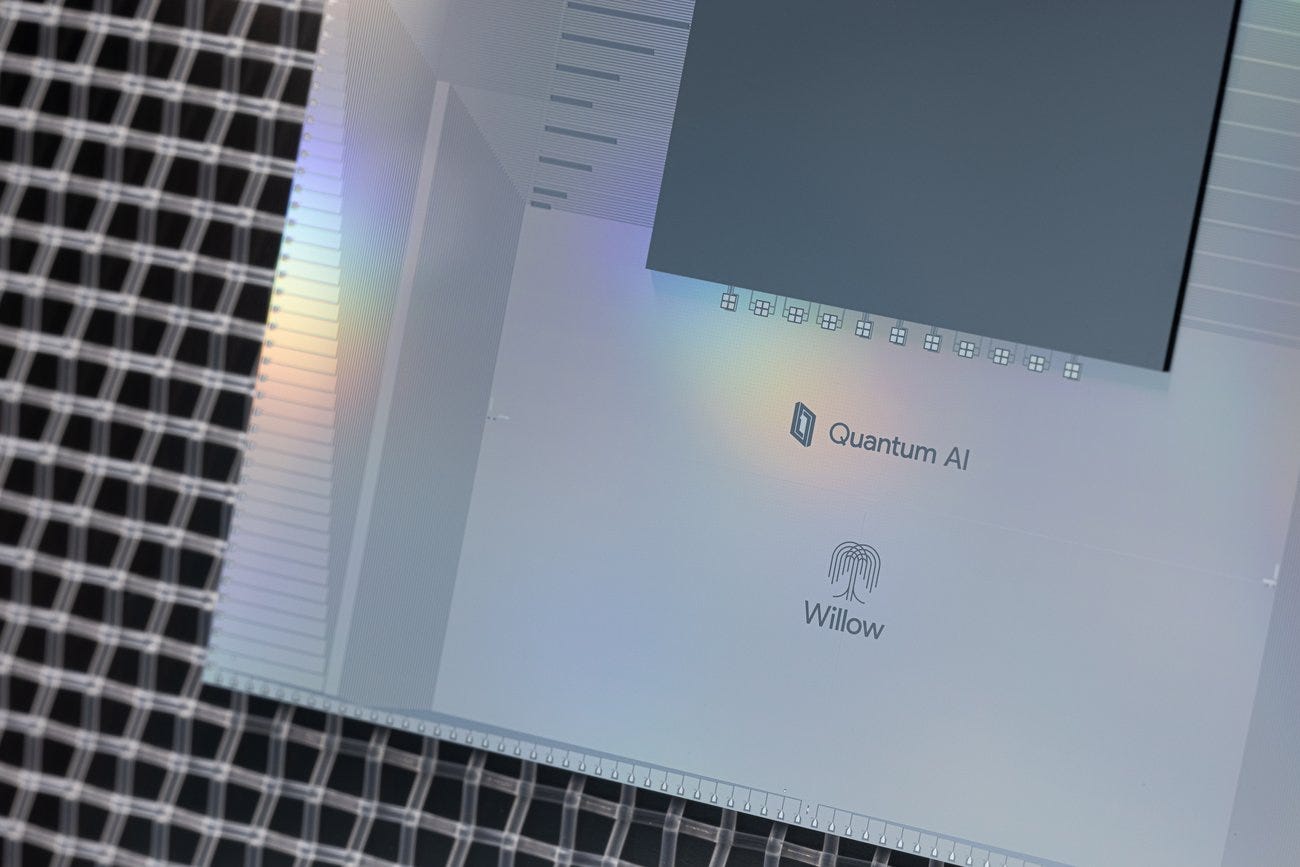
Cover image — Close-up of Google’s Willow quantum processor, the 105-qubit chip used to demonstrate verifiable quantum advantage in October 2025. Image credits: Google Quantum AI. Source: Google Blog, “Our Quantum Echoes algorithm is a big step toward real-world applications for quantum computing,” October 22, 2025. https://blog.google/innovation-and-ai/technology/research/quantum-echoes-willow-verifiable-quantum-advantage/
A Decade of Work, Compressed Into a Single Prompt
In early 2025, a team of researchers at Imperial College London who had been studying antimicrobial resistance for more than a decade received an unsettling email. Google had given them early access to a system called the AI co-scientist a multi-agent reasoning system built on Gemini 2.0, designed to generate, debate, and refine scientific hypotheses. The Imperial team gave it a problem they had been quietly grinding on for years: explain the mechanism by which certain bacteria acquire genes from other bacteria, an essential question for understanding why antibiotic resistance spreads so fast.
In a matter of days, the AI returned the same hypothesis the team had taken roughly ten years to develop. Not a similar hypothesis. The same one. Months later, a parallel collaboration at Stanford University also using the AI co-scientist identified vorinostat, an FDA-approved anti-cancer drug, as a promising treatment for liver fibrosis. In a multi-lineage human hepatic organoid model, the AI-suggested drug reduced TGFβ-induced chromatin structural changes by 91 percent and promoted liver parenchymal cell regeneration. Two of the three drugs the AI recommended exhibited significant anti-fibrotic activity. The study was published in Advanced Science in September 2025. The researchers wrote, in plain academic prose, that “a compound, multi-agent system, which was designed to mirror the reasoning process underlying scientific discovery, can assist in re-purposing drugs for treating a disease with limited therapeutic options.”
Decode that sentence and what it actually says is: a piece of software, in 2025, did real medical research. Not summarized research. Not assisted research. Generated and validated hypotheses that produced experimentally confirmed therapeutic candidates. This is one of the things that, five years ago, we would have called a 2035 story. The future arrived on a timetable nobody scheduled, and most people did not notice. This article is about seven of those moments. Each one is real. Each one is sourced. Each one has the unsettling quality of feeling like a document somebody slipped backward through time.
“AI co-scientist identified epigenetic targets grounded in preclinical evidence with significant anti-fibrotic activity in human hepatic organoids.” — Google Research blog announcement, February 2025; experimental results published in Advanced Science, September 2025
Fact 1 — A Multi-Agent AI Now Generates Real, Publishable Scientific Hypotheses
The AI co-scientist is built on Gemini 2.0, with a “generate, debate, and evolve” architecture that uses test-time compute scaling to iteratively refine its proposals. The system runs multiple specialized agents a generation agent, a critique agent, a ranking agent, an evolution agent and lets them argue. The output is a ranked list of hypotheses with proposed experimental protocols. When the Stanford team described the workflow, they emphasized that “for the data used in the paper, we provided a single prompt and received a response from AI co-scientist.” A single prompt. A career-defining hypothesis.

Figure 1 — Official AI co-scientist multi-agent architecture as illustrated by Google Research. The “generate, debate, evolve” loop is inspired by the scientific method itself and runs entirely on top of Gemini 2.0. Tournament-based ranking uses Elo ratings to compare candidate hypotheses pairwise; the Evolution agent refines top candidates with new variants that re-enter the tournament; the Meta-review agent compiles feedback across iterations to adjust the other agents’ prompts. The result is a self-improving hypothesis-generation pipeline whose output has now been experimentally validated in at least two peer-reviewed publications. Image credits: Google Research, “Accelerating scientific breakthroughs with an AI co-scientist,” February 19, 2025, by Juraj Gottweis (Google Fellow) and Vivek Natarajan (Research Lead). Source: https://research.google/blog/accelerating-scientific-breakthroughs-with-an-ai-co-scientist/ · arXiv paper: https://arxiv.org/abs/2502.18864
The biorxiv preprint for the Stanford liver fibrosis work, posted in April 2025 and now published in Advanced Science, documents the entire pipeline. Of 14 drugs evaluated, two of the three AI-recommended epigenomic modifiers showed significant anti-fibrotic activity. The vorinostat result 91 percent reduction in TGFβ-induced chromatin structural changes was strong enough that the team is now in conversations with pharmaceutical companies about clinical testing. The bioRxiv abstract concludes that the AI co-scientist “and this microHO platform identified a potential new generation of liver fibrosis treatments that also promote liver regeneration.”
The Imperial College result is, in some ways, more remarkable. The team had been working on the molecular mechanism of horizontal gene transfer in bacteria specifically, how mobile genetic elements called capsular phages move between species for over a decade. When they fed the question to the AI co-scientist, it independently arrived at the same hypothesis the team had developed through years of laboratory work. Professor José Penadés, who led the Imperial research, was quoted in the BBC coverage saying that what would have taken his team years to formalize was returned in days.
What makes this a 2035-feeling fact, rather than just an impressive 2025 demo, is the structural implication. Scientific discovery has historically been bottlenecked by hypothesis generation. There are too many possible ideas, and only a small number of qualified humans capable of generating genuinely novel ones. If that bottleneck dissolves if a software system can generate dozens of high-quality hypotheses on demand for any specialist domain then the rate-limiting step of science shifts from thinking of the right experiment to running the experiment. That is a different world.
Fact 2 — AI Task Duration Is Doubling Every Four to Seven Months
In March 2025, a research nonprofit called METR (Model Evaluation and Threat Research) published a paper that should be required reading for anyone making decisions about AI timelines. The paper’s central finding can be summarized in one sentence. The length of tasks that frontier AI agents can complete autonomously with 50 percent reliability has been doubling approximately every seven months for the last six years. The chart, which is now one of the most cited visualizations in the AI capabilities literature, looks like a textbook exponential curve.
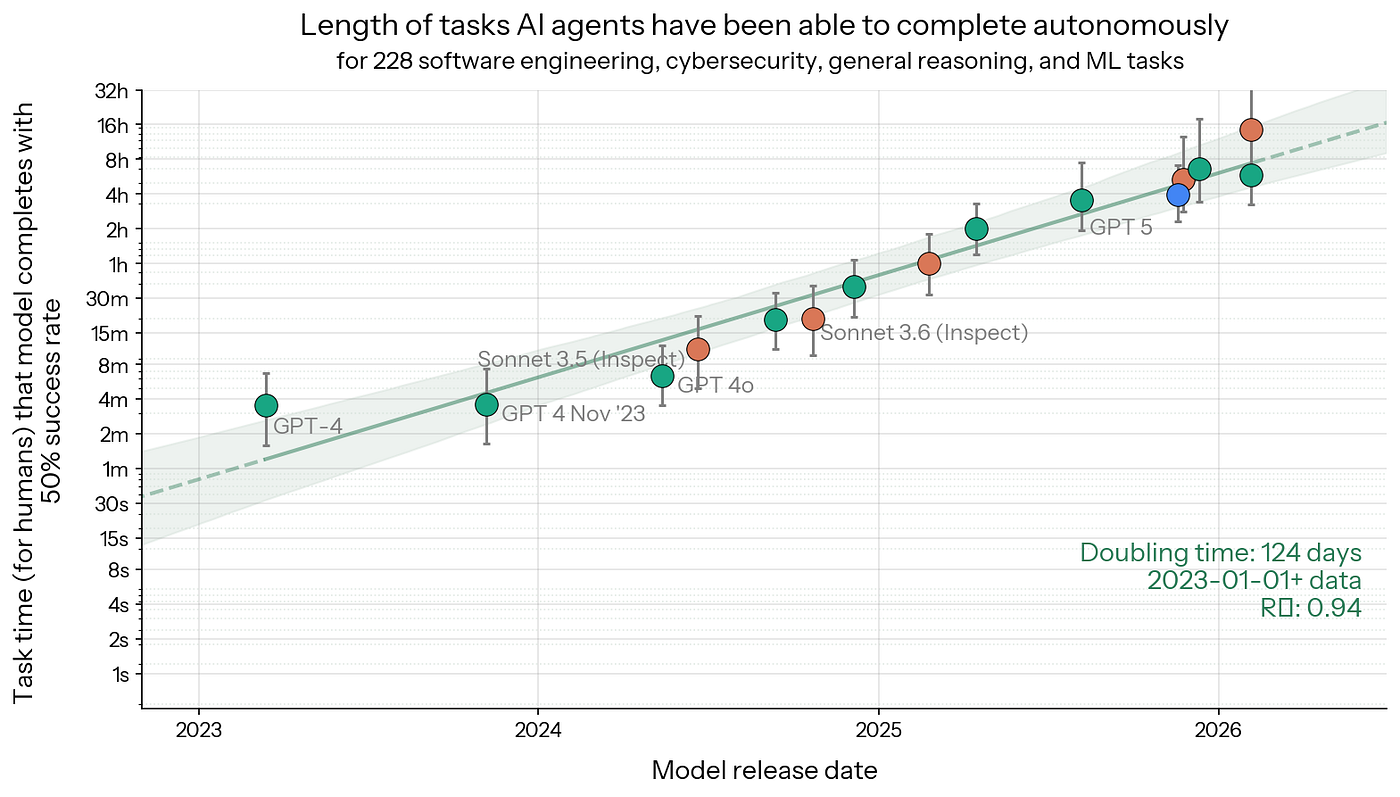
Figure 2 — METR’s time-horizon chart from “Measuring AI Ability to Complete Long Tasks” (March 2025). The seven-month doubling time is robust across 170 tasks (HCAST + RE-Bench + SWAA), 800+ human baselines, and 13 frontier models from 2019 to 2025. METR’s January 2026 update (Time Horizon 1.1) refined the analysis with a larger task suite and a new evaluation infrastructure. The post-2023 doubling time is now estimated at approximately 130 days roughly four months meaning the rate of progress has itself accelerated by 20 percent since 2023. Image credits: METR (Model Evaluation and Threat Research), Kwa, T., West, B., Becker, J., et al. Source: https://metr.org/blog/2025-03-19-measuring-ai-ability-to-complete-long-tasks/ · arXiv paper: https://arxiv.org/abs/2503.14499 · Updated TH 1.1 release: https://metr.org/blog/2026-1-29-time-horizon-1-1/
The January 2026 update is where the story gets uncomfortable. METR rebuilt the dataset with more tasks and a newer evaluation infrastructure. The post-2023 doubling time dropped from 7 months to 130 days, about 4.3 months. The most capable model on the chart, Claude Opus 4.5, was now reliably completing tasks that take human professionals 320 minutes. GPT-5 reached 214 minutes. The Wikipedia entry for METR sums up the new data point cleanly: progress is now estimated to be 20 percent more rapid than the original trend line predicted.
The extrapolation is the part that feels like leaked future news. If the seven-month trend continues, AI agents will be able to autonomously complete tasks that currently take humans a month by sometime in 2028 to 2031. If the new four-month trend continues, the same threshold arrives meaningfully earlier. The AI Digest’s analysis of the same data noted that “as AIs improve they’ll be increasingly useful for developing yet more capable AIs,” suggesting the growth trajectory might be faster than exponential. The original trend was already exponential. The acceleration is on top of that.
For technical readers, the structural point is that AI capability is no longer measured by what the model knows. It is measured by how long it can stay coherent. The seconds-to-hours-to-days progression is not gradual capability acquisition. It is the progressive solving of the long-horizon planning, error recovery, and self-correction problems that prevent AI agents from doing what humans do as a matter of course. Once those problems are solved at one time scale, the next time scale falls quickly.
Fact 3 — A Quantum Chip Just Ran an Algorithm 13,000 Times Faster Than the World’s Best Supercomputer, Verifiably
On October 22, 2025, Google Quantum AI announced in Nature that its Willow quantum processor had achieved the first verifiable quantum advantage in the history of computing. The Willow chip is a 105-qubit superconducting processor. The algorithm is called Quantum Echoes, technically an out-of-time-order correlator (OTOC). The benchmark is the Frontier supercomputer at Oak Ridge National Laboratory, one of the most powerful classical computers ever built. The result: Willow completed the calculation 13,000 times faster than Frontier could using the best known classical algorithm.
To translate the speedup into intuition, Hartmut Neven, VP of Engineering at Google Quantum AI, put it this way in a press briefing: “The algorithm runs on our Willow chip 13,000 times faster than the best classical algorithm would on the top classical supercomputer. So, think hours versus years for the classical machine.” Science News put the same number in absolute terms: the full set of calculations would have required about 150 years of Frontier’s time. On Willow, it took days.
The word that matters here is verifiable. Google demonstrated quantum supremacy in 2019 with the Sycamore chip, but that result was a random sampling problem that could not be checked. The criticism that quantum computers were doing computations no one could confirm held. Quantum Echoes solves that. The OTOC algorithm produces a result that can be reproduced on another quantum computer and, with sufficient classical effort, verified. In the words of MIT quantum physicist Aram Harrow, “It’s pretty convincing that to simulate this you would need some combination of huge computing effort and some algorithmic advances that people haven’t come up with yet.” Verifiable quantum advantage is what the field has been working toward for thirty years. It arrived in October 2025.
The practical implication is the more interesting part. Quantum Echoes is being positioned not as a parlor trick but as a foundation for real-world applications in chemistry, materials science, and biology. Google’s parallel paper, “Quantum computation of molecular geometry via many-body nuclear spin echoes,” shows the same technique used as a “molecular ruler” measuring atomic distances in chemical structures with precision beyond what nuclear magnetic resonance spectroscopy can currently achieve. The path from “we proved a quantum computer can do something” to “we used a quantum computer to discover something useful” is shorter than it has ever been. Neven framed it as making “good on Feynman’s dream” Richard Feynman’s 1982 conjecture that quantum systems would only be efficiently simulable by other quantum systems. Forty-three years later, the dream has working hardware.
Fact 4 — DeepSeek Matched Frontier Model Performance for a Fraction of the Cost, and Nobody Saw It Coming
In late January 2025, a Chinese AI lab called DeepSeek released R1, an open-weight model that performed at the level of OpenAI’s o1 reasoning model on a training budget reportedly orders of magnitude smaller than what the major US labs had been spending. The release triggered what observers called a “Sputnik moment” for American AI policy. NVIDIA stock dropped roughly 17 percent in a single day on the assumption that compute demand might not scale as previously assumed. A Chinese open-weight model had just shown that the frontier was reachable from outside the closed-lab oligopoly. The geopolitics of AI changed overnight.
The technical details are worth understanding because they are the actual content of the breakthrough. DeepSeek did not invent a fundamentally new architecture. They combined two innovations that the field had been quietly working on: Multi-head Latent Attention (MLA), which radically reduces the memory cost of the attention mechanism, and a Mixture of Experts (MoE) routing scheme that activates only a fraction of the total parameters per forward pass. Both techniques were known. Their combination, applied at scale to a reasoning-focused training objective with reinforcement learning from verifiable rewards (RLVR), produced a model that matched OpenAI’s much more expensive frontier on math, code, and reasoning benchmarks.
The follow-on effects compounded through 2025. DeepSeek’s open-weight release meant the techniques were now available to every researcher in the world. Qwen 3, MiniMax, and z.AI from China shipped competitive successors. Mistral in France, Google’s Gemma, Meta’s Llama, and even OpenAI’s first open-weight release since GPT-2 (gpt-oss, under Apache 2.0) followed. Stellar Capacity’s year-end summary captured it: “Open weights stopped being one company’s strategy and became a global movement.” Anthropic responded by cutting Claude Opus 4.5 pricing by approximately 67 percent to $5/$25 per million tokens frontier capability at a price point that would have seemed impossible eighteen months earlier.
The 2035-feeling part of this story is the speed of compression. We went from “frontier AI is exclusive to a handful of US labs with billion-dollar budgets” to “frontier AI is open-source, internationally distributed, and 10–100x cheaper than it was last year” in roughly twelve months. The economic moat of training a frontier model collapsed. The strategic implication for every company, government, and investor making AI decisions is that the assumption “frontier means proprietary” is no longer reliable.
Fact 5 — AI Improved a Lab Procedure’s Efficiency by a Factor of 79
This one comes from a small footnote in OpenAI’s GPT-5 documentation that almost nobody outside the bio-AI community noticed. In a partnership with a biotech startup called Red Queen Bio, GPT-5 was used to optimize a molecular cloning procedure the kind of routine wet-lab task that researchers do every day. The improvement was not 10 percent. It was not 100 percent. The cloning procedure’s efficiency improved by a factor of 79.
Read that number again. Seventy-nine times. Cloning, in a biology lab, is the process of taking a specific DNA sequence, copying it into a plasmid vector, transforming the plasmid into a bacterial host, and getting enough copies of the result to do downstream experiments with. It is laborious. It is finicky. The standard protocols have been refined over decades by thousands of postdocs cursing at the cold room. GPT-5, in collaboration with the Red Queen team, suggested protocol modifications that compressed weeks of work into hours. The IntuitionLabs December 2025 analysis described the result as “accelerating wet-lab biotech tasks” by close to two orders of magnitude in this one specific procedure.
The structural significance of this fact is easy to miss. Most AI-in-science coverage focuses on the headline-grabbing discoveries AlphaFold solving protein structure, AI co-scientist proposing drug candidates. Those are the science. The under-discussed part is the scientific infrastructure. Every biology lab in the world runs cloning, PCR, transfection, immunoprecipitation, and dozens of other workhorse procedures whose efficiency has been roughly constant for twenty years. If frontier LLMs can systematically optimize those procedures by even 10x let alone 79x - the throughput of every biology lab in the world goes up by orders of magnitude. The science accelerates not because the researchers got smarter but because the procedures got 79 times more efficient.
GPT-5 also topped the new FrontierScience benchmark, which comprises Olympiad-level questions in physics, chemistry, and biology. According to Time’s coverage, even the updated 5.2 model still lags expert-level reasoning on the hardest questions, but the trajectory is clear. AI is now operating at a level where it materially accelerates not just discovery but the underlying daily craft of scientific work.
Fact 6 — A Neural Network Was Trained Using Light Instead of Electricity, and Published in Nature
In October 2025, a collaboration between researchers at Politecnico di Milano and an international team published in Nature a demonstration that artificial neural networks can be trained using photons instead of electrons. The technique, called photonic in-memory computing, uses light beams routed through optical components to perform the matrix multiplications that dominate the energy cost of modern deep learning training. The result is not a speed improvement. It is an order-of-magnitude reduction in energy consumption per training operation.
The numbers are difficult to overstate in their importance. The largest training runs in 2024 consumed energy on the scale of medium-sized power plants. GPT-4’s training is estimated to have used roughly 50 gigawatt-hours. Frontier-scale models are bumping against the limits of available datacenter electricity, to the point where Microsoft, Amazon, Google, and Meta are all signing direct nuclear power agreements to secure capacity for next-generation training. If photonic training can reduce energy consumption by even one order of magnitude, the binding constraint on AI capability scaling changes fundamentally.
The application surface is also where this gets interesting. Photonic neural networks can be embedded in edge devices autonomous vehicles, wearable sensors, satellites, medical implants where electricity budgets are measured in milliwatts rather than megawatts. Real-time on-device inference at frontier quality, without a cloud round-trip, becomes architecturally possible. The Politecnico work is early-stage and the technique has not yet been demonstrated at frontier scale, but Nature publishes papers like this only after the underlying physics is solid. The path from lab demonstration to commercial deployment in this specific area has historically been five to ten years. We are now inside that window.
For technical readers, the broader point is that the standard mental model of AI progress that capability scales with parameters, data, and compute on classical silicon is starting to crack. Photonic computing, neuromorphic chips, optical interconnects, and quantum acceleration are all moving from research curiosities to engineering programs at the largest tech companies. The next decade of AI capability gains may come less from “more parameters on more GPUs” and more from “fundamentally different physical substrates for the same computations.”
Fact 7 — An Echocardiogram Reading Surpassed Human Cardiologists, and Most Patients Will Never Know
The seventh fact is the one most likely to actually arrive in your life, quietly, in the next two to three years. In October 2025, AI systems were demonstrated to perform automated cardiovascular assessments specifically, the analysis of echocardiograms (ultrasound imaging of the heart) with superhuman accuracy. Echocardiogram interpretation requires trained technicians to measure precise metrics like left ventricular ejection fraction (LVEF), the percentage of blood the left ventricle pumps out with each contraction. It is labor-intensive. It depends heavily on technician skill. Inter-rater variability between expert cardiologists is, in published studies, surprisingly large.
The AI systems demonstrated in October 2025 detected subtle disease markers that were invisible to traditional imaging interpretation by humans. The systems are now being integrated into clinical workflows at major US health systems on a phased basis. Patients are not told that an AI looked at their echocardiogram. The output of the AI is presented to the cardiologist as a measurement, the cardiologist signs off, the report goes into the patient’s chart. From the patient’s perspective, nothing has changed. From the perspective of the underlying epistemics of medicine, everything has changed. The thing measuring the heart is no longer a person.
What makes this a 2035-feeling fact is the asymmetry between adoption rate and visibility. Imaging-based AI diagnosis is now superhuman in radiology (mammography, lung CT, brain MRI), pathology (cancer histology, skin lesion analysis), ophthalmology (diabetic retinopathy, age-related macular degeneration), and cardiology (echocardiography, ECG interpretation). The FDA has approved hundreds of AI-based medical devices in the past five years. Most patients will receive AI-assisted diagnoses regularly in the next five years without ever being told. The medical infrastructure is being quietly rebuilt around AI judgment, layer by layer, by institutional actors with no incentive to announce it broadly. The world arrives at “AI is better than your doctor at reading scans” not by announcement but by silent deployment.
The CASP14 protein-folding moment (AlphaFold2 in 2020) was the first clear case of an AI system outperforming the entire community of human experts on a specific scientific task. The 2025 trend is that this is now happening simultaneously across most of medical imaging, much of structural biology, large parts of materials science, and meaningful subsets of synthetic chemistry. The 2035-style headline “AI doctor diagnoses you” is, in 2026, just “AI assists your doctor” with the AI assistance scaling toward 100 percent of the actual measurement work.
Why These Facts Feel Like Leaks From the Future
There is a specific cognitive sensation that all seven of these facts trigger, and it is worth naming. It is the feeling of reading something that, by all reasonable expectations of progress, should not have been possible yet. The brain has a calibration for what 2025 is supposed to look like. When the reality consistently outruns the calibration, the result feels less like surprise and more like time travel.
A few patterns explain why this is happening across so many domains at once.
First, the AI capability curve is not just exponential it is broadly exponential, across domains that were not previously coupled. Protein folding, drug discovery, scientific hypothesis generation, code completion, autonomous research, medical imaging, materials science, robotics, quantum algorithm design. The same underlying advance frontier foundation models with tool use, longer context windows, and verifiable-reward training is unlocking similar magnitudes of capability gain in every field it touches. When one technology is simultaneously transforming ten unrelated industries, the effect on the observer is structural disorientation.
Second, the AI rate of progress is itself accelerating. METR’s data shows the doubling time dropped from seven months to four months in just the post-2023 era. Frontier model capability is now measurably outpacing the calibration of any human who is not watching it daily. The IDC’s labor-market analysis suggests that 76 percent of organizations cannot match AI’s deployment speed. If your last detailed look at the field was 12 months ago, your mental model is roughly 3 generations out of date.
Third, much of the most consequential work is happening inside corporate or government labs and is being released asymmetrically. The Imperial College AI co-scientist result was buried in a Wiley journal. The 79x cloning efficiency improvement was a footnote in OpenAI’s GPT-5 documentation. The photonic neural network paper was in Nature but did not make headlines. The 13,000x quantum advantage made news but was framed as “future potential” rather than “you can do this now.” The cumulative effect is a world where the most impressive AI capabilities are increasingly hidden in plain sight published, peer-reviewed, sometimes shipped but not aggregated into the public consciousness in any visible way.
Fourth, the gap between technical-frontier reality and consumer-facing AI is widening. The version of AI most people interact with is ChatGPT answering a question. The version of AI that exists in research labs is generating publishable hypotheses, optimizing wet-lab protocols by orders of magnitude, achieving verifiable quantum advantage, and approaching human-month autonomous task completion. The two are not the same thing, and the public mental model is anchored on the first one. The seven facts in this article are all from the second category.
The Bottom Line
The future does not arrive on a schedule. It arrives in scattered papers, in product documentation footnotes, in conference talks that 200 people watch, in journal articles that get cited 30 times before anyone notices what they say. The seven facts in this article were not predictions. They were already true at the time of writing. An AI system generated and validated drug candidates. A trend line on Cartesian coordinates predicts month-long autonomous AI agents within five years. A quantum chip beat the world’s best supercomputer by 13,000x on a verifiable algorithm. An open-weight Chinese model matched the US frontier for a fraction of the cost. A foundation model improved a basic lab procedure by 79x. A neural network was trained with light. AI is now superhuman at reading hearts, eyes, lungs, skin, and proteins, often without telling the patient.
The single best thing a technical reader can do with this information is not panic and not dismiss. It is to recalibrate. Whatever your mental model was for “what AI can do in 2025,” update it. Read the METR paper. Read the AI co-scientist paper. Read the Quantum Echoes Nature paper. Subscribe to one or two researchers who track this seriously Nathan Lambert, Ethan Mollick, Jack Clark, Helen Toner, Zvi Mowshowitz. Spend an hour a week reading the actual primary sources rather than the downstream coverage. The asymmetry between the people who have read these papers and the people who have not is now the most strategically important asymmetry in technology.
The future is here. It is just not famous yet. The competitive advantage of the next five years belongs to the people who read the documents the future already wrote.
If this piece helped recalibrate your sense of where AI actually is right now, share it with the engineer, founder, or curious colleague who is still thinking of AI as “the thing that writes emails.” The seven facts above are real, sourced, and only the visible part of a much larger iceberg. The conversation is overdue.
References
메타데이터
- post_id
- 878a1de4fc5d
- slug
- ai-facts-that-feel-like-leaked-information-from-2035-seven-real-documented-already-happened-878a1de4fc5d
- url
- https://medium.com/data-science-collective/ai-facts-that-feel-like-leaked-information-from-2035-seven-real-documented-already-happened-878a1de4fc5d
- canonical_url
- https://medium.com/data-science-collective/ai-facts-that-feel-like-leaked-information-from-2035-seven-real-documented-already-happened-878a1de4fc5d
- author_url
- https://medium.com/@hayanan
- status
- ok
- fetched_at
- 2026-06-09 15:37:30