The Merger That Made HDFC Bank Bigger and Its Stock Smaller
Most Indians own HDFC Bank without knowing it — through mutual funds, SIPs, index funds. And for the past two years, it has quietly dragged…
The Merger That Made HDFC Bank Bigger and Its Stock Smaller
Most Indians own HDFC Bank without knowing it — through mutual funds, SIPs, index funds. And for the past two years, it has quietly dragged portfolios while the rest of the market moved. In 2023, the bank got much bigger, and yet the stock has been falling ever since. That matters even if you have never bought it yourself. Especially so, if your portfolio has felt sluggish and you’re not sure why. The question now is whether that gap is an opportunity or a warning.
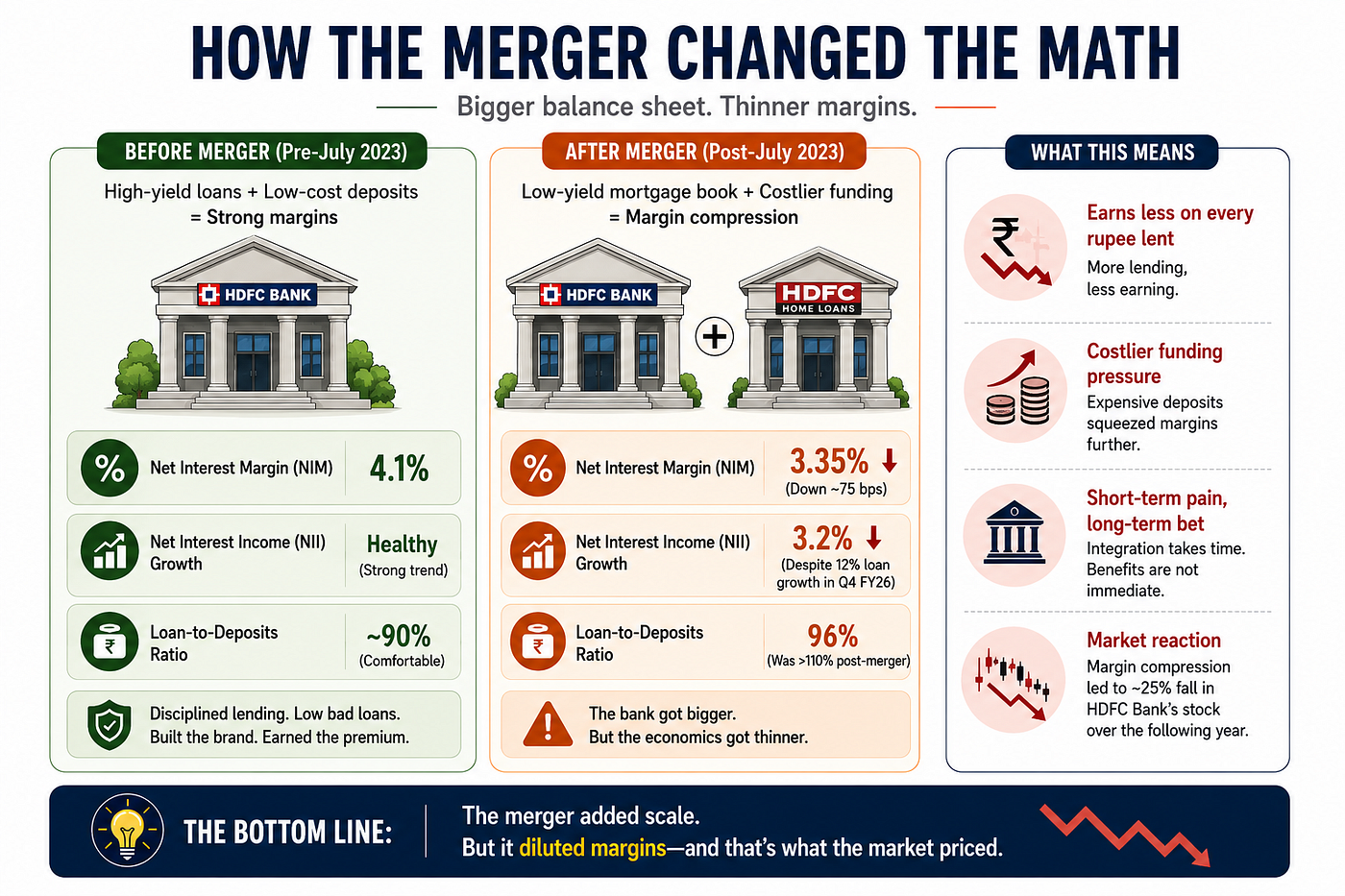
How HDFC Bank Built Its Premium HDFC Bank makes money like banks always have — borrowing cheap through deposits and lending expensive through loans. The difference between the two is the Net Interest Margin (NIM), and for most of its history, HDFC Bank’s NIM sat comfortably around 4.1%. That margin, combined with disciplined lending and low bad loans, is what built the brand’s reputation and its premium valuation.
The Merger Changed the Math In July 2023, HDFC Bank merged with its parent, HDFC Ltd., India’s largest housing finance company. The logic was sound: combine HDFC’s mortgage expertise with the bank’s low-cost deposit base. But HDFC Ltd’s mortgage book, large and stable, was also low yielding. When it landed on the bank’s balance sheet, NIMs compressed from 4.1% to 3.35%. In Q4 FY26, Net Interest Income (NII) grew just 3.2% despite 12% loan growth. The bank is lending more and earning proportionally less from each rupee lent. HDFC Ltd also funded itself through market borrowings — more expensive than deposits. The loan-to-deposits ratio surged past 110% post-merger. The bank has worked it back down to 96% but the journey required expensive deposit mobilisation that squeezed margins further. The bank got bigger, but the economics got thinner. The margin compression had a visible consequence: the stock fell nearly 25% over the following year while the broader market moved on. That underperformance didn’t go unnoticed inside the boardroom either.
Scale was never the question, margins were
The Chairman Walked Out In March 2026, HDFC Bank’s part-time chairman resigned abruptly, citing personal ethical disagreements with the bank’s practices — referencing AT-1 bond mis-selling and the bank’s prolonged underperformance. The stock fell 9% in a single session. Independent reviews found no major governance lapses and the RBI expressed confidence. But when the chairman of India’s largest private bank walks out over ethics concerns, it doesn’t leave investor memory quietly — especially in a bank with no promoter, where FIIs hold 44% of the stock and there is no controlling shareholder to absorb the pressure or signal confidence.
What the Market Is Actually Pricing ICICI Bank makes the underperformance harder to dismiss. It has fallen just 5% over the past year while HDFC has fallen nearly 25%. Over five years, ICICI Bank’s market cap has grown at a CAGR of 19%, against HDFC Bank’s 11%. The market isn’t punishing HDFC for bad results. It’s rewarding ICICI for cleaner execution- no merger overhang, no margin compression, no leadership uncertainty. Analysts place HDFC Bank’s resistance at ₹830–850. Two things need to happen to get there. First, NIM recovery — margins need to stabilise and show a credible path back toward the 4% range, which required the high-cost borrowings inherited from HDFC Ltd to be gradually replaced as the bank attracts more low-cost deposits from customers. Second, leadership clarity — the CEO’s reappointment runs until October 2026 and remains unconfirmed. A new chairman has not yet been named. Until both are resolved, institutional investors have little reason to re-rate the stock. The bank’s fundamentals are not broken, the overhang is. This isn’t the first time a market has made a good bank wait. In 2019, BB&T and SunTrust — two large, profitable American banks — merged to create Truist with a compelling pitch: scale, efficiency, combined reach. The stock spent the next three years going nowhere while the broader market index moved on. Integration costs were real, the timeline longer than promised, and investors priced in uncertainty until the story cleared. HDFC Bank isn’t in distress. The question is how long the wait is.
The Question the Stock Is Still Asking HDFC Bank hasn’t done anything catastrophically wrong. It made a large, complicated acquisition and is working through the consequences. The question isn’t whether the bank survives this — it will. It’s whether the version that emerges earns back the premium valuation it once commanded. The market thinks that answer is still a few quarters away.
메타데이터
- post_id
- 878deb81e08d
- slug
- the-merger-that-made-hdfc-bank-bigger-and-its-stock-smaller-878deb81e08d
- url
- https://medium.com/@jainishah07/the-merger-that-made-hdfc-bank-bigger-and-its-stock-smaller-878deb81e08d
- canonical_url
- https://medium.com/@jainishah07/the-merger-that-made-hdfc-bank-bigger-and-its-stock-smaller-878deb81e08d
- author_url
- https://medium.com/@jainishah07
- status
- ok
- fetched_at
- 2026-06-24 13:29:15