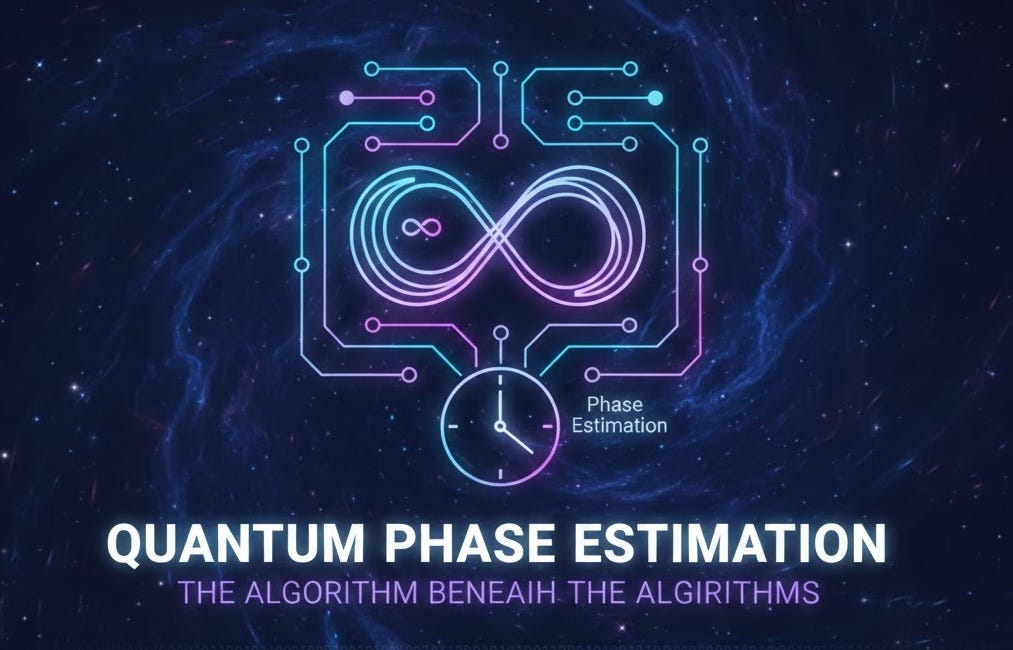
Quantum Phase Estimation: The Algorithm Beneath the Algorithms
How quantum computers learn hidden values without measuring them directly.
Quantum Phase Estimation: The Algorithm Beneath the Algorithms
How quantum computers learn hidden values without measuring them directly.
Why We Need One More Step After the QFT
In the previous episode, we finally demystified the Quantum Fourier Transform.
We saw that the QFT doesn’t magically compute answers. It re-expresses information so hidden structure — especially periodic structure — becomes visible through measurement.
That insight explained why Shor’s algorithm works.
But if you look closely, there’s still something unresolved.
In Shor’s algorithm, the QFT doesn’t give us the period directly. It gives us a number related to the period, which we then interpret using classical math.
That pattern appears again and again in quantum algorithms:
- Something is hidden inside a transformation
- Measurement alone can’t reveal it
- But a carefully chosen quantum routine can make it accessible
That routine is Quantum Phase Estimation (QPE).
This article explains what phase estimation is, why it exists, and why it quietly sits underneath many of the most important quantum algorithms you’ll encounter.
← Previous: The Quantum Fourier Transform: Why Shor Works
The Question Phase Estimation Answers
Let’s start with the core problem.
Suppose you have a quantum operation — a gate or a sequence of gates — that does something repeatable.
Every time you apply it, the system “rotates” in some way.
The natural question is:
How much does it rotate?
Not visually. Not physically. Mathematically.
That “amount of rotation” is called a phase.
Quantum Phase Estimation is the algorithm that answers this question.
A Simple Classical Analogy
Imagine a clock.
You don’t know how fast it’s ticking, but you can:
- Start the clock
- Wait
- Check where the hand ends up
If the hand comes back to the same position after 12 steps, you’ve learned something about its rate.
You didn’t measure speed directly. You inferred it from repetition and alignment.
Phase estimation works the same way — but in a quantum state space.
What “Phase” Means in Quantum Terms (No Physics Required)
In quantum computing, many operations act like rotations in an abstract space.
Mathematically, this shows up when a state behaves like this under an operation U:

This says:
- Applying U doesn’t change the direction of the state
- It only adds a phase factor

The number ϕ is hidden. You can’t measure it directly. Measurement would destroy the state.
So how do you learn it?
That’s the problem Quantum Phase Estimation solves.
Why Measurement Alone Can’t Help
If you measure ∣ψ⟩ directly, you lose the phase information.
This is crucial.
Phase is not a classical observable. It only becomes meaningful relative to other states.
So phase estimation must:
- Compare phases
- Amplify differences
- and convert them into something measurable
Sound familiar?
This is exactly what the Quantum Fourier Transform is good at.
The Big Idea Behind Phase Estimation
Quantum Phase Estimation combines three ingredients you already understand:
- Superposition — explore many possibilities at once
- Controlled operations — compare how a state evolves
- Quantum Fourier Transform — extract periodic structure
The algorithm doesn’t “peek” at the phase. It lets the phase accumulate and then analyzes the pattern that results.
Step-by-Step Intuition (No Circuit Required)
Let’s walk through the logic without diagrams or heavy math.
Step 1: Prepare a Reference System
We create a set of qubits whose job is not to hold the answer, but to track change.
Think of them as a stopwatch.
They start in a superposition of “times”:
- Apply the operation once
- Apply it twice
- Apply it four times
- Apply it eight times
All at once.
Step 2: Let the Phase Accumulate
Each time the operation is applied, the hidden phase adds up.
If the phase is ϕ, then:
- One application adds ϕ
- Two applications add 2ϕ
- Four applications add 4ϕ
Now the reference qubits are entangled with how much phase accumulated.
The information is there — but it’s still encoded as relative phase.
Step 3: Apply the Quantum Fourier Transform
This is the same trick you saw in QFT. The accumulated phase pattern looks chaotic in one basis. The QFT rotates the basis so that regularity becomes visible.
After the QFT:
- The probability distribution peaks
- Measurement yields a binary approximation of ϕ
The phase becomes a number.
A Tiny Concrete Example
Suppose the hidden phase is:

That means every application of the operation rotates the state by 3/8 of a full turn.
Phase estimation:
- Creates superpositions of applying the operation 1, 2, 4 times
- Lets the phase add up
- Uses QFT to decode the pattern
The final measurement yields something like: 0.011
Which is the binary representation of 3/8.
The algorithm didn’t guess. It measured structure.
Why Phase Estimation Is So Important
At this point, Phase Estimation might feel like a niche trick.
It isn’t.
It quietly powers many of the most important quantum algorithms:
- Shor’s algorithm (period finding is phase estimation in disguise)
- Quantum simulations (finding energy levels = estimating phases)
- Eigenvalue problems (central to chemistry, materials, optimization)
- Advanced algorithms like HHL (solving linear systems)
Phase Estimation is not an application. It’s an algorithmic primitive.
How This Relates Back to Shor
Now we can say something precise.
Shor’s algorithm works because:
- Modular exponentiation has hidden periodic structure
- That structure corresponds to a phase
- Phase estimation (via QFT) reveals it efficiently
Shor is not a special case. It’s a specialized use of phase estimation.
This realization changes how you see quantum algorithms.
A Pattern You Should Now Recognize
Across the last several episodes, a pattern has emerged:
- Encode a problem into a transformation
- Let structure accumulate through superposition
- Use interference to filter possibilities
- Measure once
Phase Estimation is the cleanest expression of this pattern.
It’s quantum thinking in its purest form.
What Quantum Phase Estimation Is Not
It’s worth clearing up misconceptions.
Phase estimation is not:
- Guessing
- Brute force
- Parallel classical computation
- Faster arithmetic
It is:
A geometric method for extracting hidden parameters from evolution.
That distinction matters.
Why This Is the “Algorithm Beneath the Algorithms”
If you step back, you’ll notice something important.
We are no longer learning isolated algorithms.
We are learning a vocabulary:
- Superposition
- Interference
- Fourier transforms
- Phase estimation
Future quantum algorithms are written using this vocabulary.
Once you understand it, new algorithms feel readable instead of magical.
What You’ve Gained From Phase Estimation
Quantum Phase Estimation completes a conceptual arc that started many episodes ago.
You now understand:
- Why changing basis reveals structure
- How interference filters information
- Why QFT is so powerful
- and how hidden values can be inferred without direct measurement
This is the moment where quantum computing stops feeling like a collection of clever tricks and starts feeling like a coherent computational model.
From here, the series can go in several directions:
- Deeper into applications (chemistry, optimization)
- Toward post-quantum cryptography
- or into the practical limits of real quantum hardware
But conceptually, you now have the tools.
You can read quantum algorithms. You can reason about them. And most importantly, you can tell why they work.
That’s no small milestone.
메타데이터
- post_id
- 87963ae6c78a
- slug
- quantum-phase-estimation-the-algorithm-beneath-the-algorithms-87963ae6c78a
- url
- https://medium.com/the-quantum-ladder/quantum-phase-estimation-the-algorithm-beneath-the-algorithms-87963ae6c78a
- canonical_url
- https://medium.com/the-quantum-ladder/quantum-phase-estimation-the-algorithm-beneath-the-algorithms-87963ae6c78a
- author_url
- https://medium.com/@nagendra-gupta
- status
- ok
- fetched_at
- 2026-07-10 15:20:15