The people behind the prompt
Blue slippers, Roman scribes, windy walks, and why AI is missing the point

The people behind the prompt
Blue slippers, Roman scribes, windy walks, and why AI is missing the point
I was out for a walk when this whole subject started turning over in my head again, and as often happens with me, one thought seemed to lead naturally into another until a simple stroll became a much larger conversation about writing, creativity, AI, and the strange way people keep reducing complicated subjects into neat little boxes that never quite fit reality as well as they think they do.
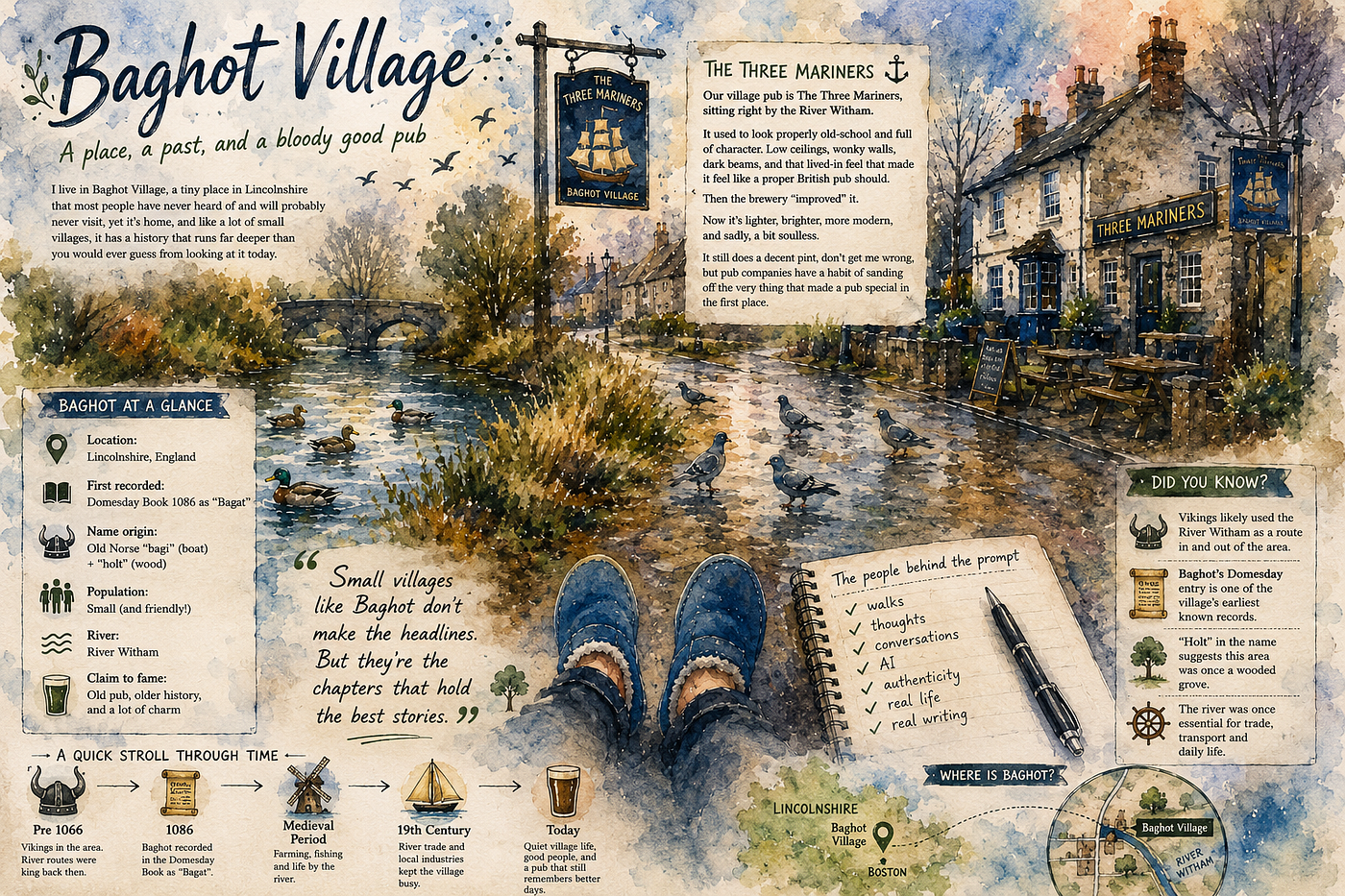
The brook was carrying noticeably more water than usual because of the recent rain, ducks were drifting about looking entirely unconcerned by the weather, pigeons and blackbirds were busy doing whatever pigeons and blackbirds consider important business, and the wind was blowing what I can only describe as a proper hoolie, which remains one of those wonderfully expressive words that instantly paints a picture without needing a paragraph of explanation to support it.
While all this was happening, I was chatting away with AI, not because I needed it to tell me what to think, not because I needed it to generate my experiences for me, and certainly not because I wanted it to replace my own voice, but because conversation itself often helps ideas stretch their legs in the same way a walk helps stretch the body, allowing thoughts to move around, collide, evolve, and occasionally reveal something interesting.
That is where I think many people completely misunderstand what is actually happening when somebody uses AI as part of a creative process, because they tend to imagine either total replacement or total independence, when the reality for many people sits somewhere in the middle where the human remains firmly in control while the machine acts more like a conversational companion, a sounding board, an editor, or a tool that helps organise thoughts already waiting to be explored.
As I walked, I found myself thinking about Roman scribes, which probably sounds like an odd thing to be thinking about while standing beside a brook watching ducks, but that is how my mind works and I have long since accepted that strange connections are often the most interesting ones, especially when they unexpectedly reveal something useful about the present by looking briefly into the past.
A Roman scribe had tools available to him, whether that was parchment, ink, a stylus, wax tablets, accumulated knowledge, copied texts, or whatever other aids existed at the time, yet nobody looked at the stylus itself and declared that the stylus was the author, because everybody understood that the tool and the mind using the tool were not the same thing and never had been.
The more I think about it, the more that distinction feels important today because AI has become the modern equivalent of the argument people should already understand, yet somehow many choose not to, acting as though using a tool automatically transfers authorship from the person guiding it to the tool itself, even when the experiences, observations, ideas, emotions, humour, and final decisions still belong entirely to the human being sitting behind the keyboard.
The ducks drifting along the brook were not AI generated, the recent rain filling the watercourse was not AI generated, the conversation with Kurtis during my walk was not AI generated, my memories of the old Three Mariners before its character was altered were not AI generated, and the feeling that some old places possess a kind of soul that modern redesigns struggle to recreate certainly was not AI generated either because those things came directly from life itself before any words were ever written about them.
What AI can do is help shape those experiences into something more readable, more structured, or more coherent, but the experiences themselves still belong to the person who lived them, just as a camera may capture a landscape while never becoming the landscape, and just as a pen may write a sentence while never becoming the mind that imagined it.
The real value is not in the tool. The real value is in the person bringing experiences to the tool.
That is why I have never been entirely convinced by the increasingly popular phrase AI slop, because while I completely understand where the criticism comes from and agree that there is plenty of rushed, lazy, mass-produced content flooding the internet, I think the phrase stops being useful when people stretch it so far that it begins covering every piece of work involving AI regardless of the quality, care, thought, or originality that went into creating it.
A person with no curiosity, no perspective, no interesting experiences, and no standards can produce bland content with or without AI, while somebody with a genuine point of view, a strong voice, a collection of real experiences, and something meaningful to say can still produce work that resonates with readers even if they choose to use technology somewhere within the process.
As the walk continued and the wind continued blowing a hoolie around me, another thought kept returning to the surface, and that was the idea of authenticity, although not the version endlessly discussed online by people who seem determined to advertise how authentic they are every five minutes, because real authenticity usually does not need a marketing campaign attached to it.
Real authenticity is wearing your blue Marks & Spencer slippers outside because you happen to feel like it and because they have become part of your identity in a small but genuine way, real authenticity is using unusual words because you genuinely enjoy them rather than because they improve engagement metrics, and real authenticity is noticing details that many other people simply walk past without a second glance because your attention naturally settles on different things.
Readers are often looking for that feeling whether they consciously realise it or not, because people rarely return to a writer simply because every paragraph was technically competent, whereas they frequently return because they sense a real person behind the words, somebody whose observations, humour, perspective, and personality create the feeling that there is an actual human presence waiting for them whenever they open the next article.
People do not return because every sentence is flawless. They return because somebody feels real.
That is ultimately why I think the future belongs neither to people who worship AI as some magical replacement for humanity nor to people who spend all their time fearing it, because both positions seem oddly fixated on the tool itself rather than the person using it, and in doing so they miss the far more interesting question of what happens when a curious human being uses every available tool while still remaining recognisably themselves.
The machine can help organise, assist, suggest, polish, and occasionally surprise, but it cannot walk beside a rain-swollen brook, notice ducks drifting through higher water, remember a pub before its alterations, exchange greetings with neighbours, wear blue slippers outdoors, or build a lifetime of experiences that later become stories, observations, and reflections worth sharing with other people.
For me, the process usually begins somewhere out in the real world before any writing happens at all, whether that is during a windy walk, a conversation with somebody I meet along the way, a memory triggered by an old building, or a random thought about Roman scribes appearing out of nowhere while watching birds beside a brook, because life comes first and writing follows afterwards.
Reader’s note
This piece grew out of a real walk, a real conversation, and a real chain of thoughts about creativity, AI, identity, and authorship. The more I use AI, the less interested I become in arguments about whether the technology itself is good or bad, because what fascinates me now is the person using it, the experiences they bring to it, and the extent to which they can use powerful tools without allowing those tools to replace the unique voice that made their work worth reading in the first place.
메타데이터
- post_id
- 87aaadf4fb38
- slug
- the-people-behind-the-prompt-87aaadf4fb38
- url
- https://medium.com/@dragonflameace007/the-people-behind-the-prompt-87aaadf4fb38
- canonical_url
- https://medium.com/@dragonflameace007/the-people-behind-the-prompt-87aaadf4fb38
- author_url
- https://medium.com/@dragonflameace007
- status
- ok
- fetched_at
- 2026-06-09 15:37:30