“So, what’s your PhD about?”
Join me on a journey of confusion and self-doubt towards an explanation of my research that sparks, not kills, curiosity and conversation.
“So, what’s your PhD about?”
Join me on a journey of confusion and self-doubt towards an explanation of my research that sparks, not kills, curiosity and conversation.
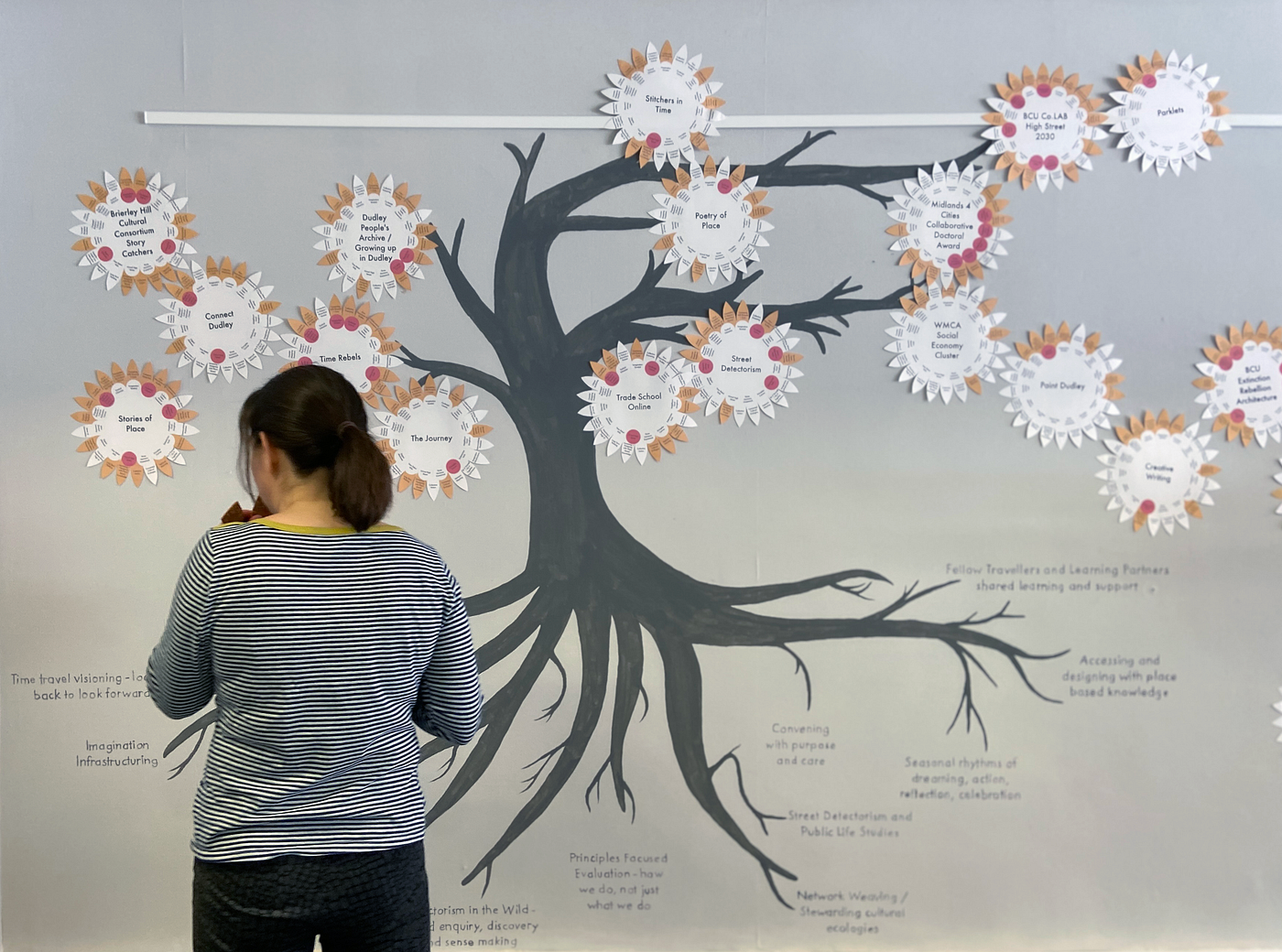
In September 2022, I hung up my site boots to start a PhD. In collaboration with Birmingham School of Architecture and Design, CoLab Dudley and CIVIC SQUARE, I will be spending the next 4 years researching the constantly shifting and often perplexing title of:
Co-creating regenerative futures: The role of architectural and social lab processes in unlocking collective change.
After a few months of learning how to actually research, I now feel ready to introduce my PhD to others. Or at least I thought I was. I emerged from my research bubble for winter festivities and found myself unable to actually explain what my research question means:
How might social architecture labs invite co-creation of regenerative futures?
It’s difficult to explain concepts and practices within a few words that are intrinsically alien to the behaviour, worldviews and social contract of UK society, without contending with connotations or over-simplifying.
The first hurdle is ‘regenerative’.
Sustainability is viewed as not enough to counteract the damage that has already been done to the planet. A regenerative and restorative approach goes beyond sustainability and seeks to create a two-way relationship between humans and the planet, with humans seeing themselves as part of nature as opposed to doing things to nature. Regenerative approaches move away from short-term thinking and decision-making to taking responsibility for future generations and prioritising actions for the future collective good.
SPHERA | Diagram of impact: from conventional design to regenerative design
For more reading on regenerative approaches: Flourish, The Good Ancestor, Regenesis Group, Daniel Christian Wahl, The Upcycle.
When in doubt, I turn to the wonderful mind of Jo Orchard-Webb. I asked if she had any ideas of how to explain my research to anyone I bump into: Jo suggested reshaping my research question into ‘How might the combination of architectural and social lab processes invite people to observe, learn, experiment, imagine and take action together to make changes in their habitat* that are more than sustainable?’
*This bit was inspired by CIVIC SQUARE’s neighbourhood science invitation.
We’re off to a good start.
The second hurdle is ‘architectural’.
I feel discomfort when thinking of the word ‘architectural’. The roots of the word lie in the Ancient Greek term ‘archetecton’, or ‘master builder’, which carries with it implications of power and a focus on construction, not reflecting what architecture is or could be.
“So what are you building?”
The product of architecture does not necessarily need to be, or should be, construction. It can be about ‘un-building, not-building and re-building’. The building sector contributes 38% to global greenhouse emissions, so we certainly need to rethink how we make changes to our built environment. This research looks at how we can collectively connect to the places we care about (or don’t care about yet) and develop our understanding of these places so we can make informed changes to them… without necessarily talking about buildings. I’m not focusing on an end product, but instead the process.
Architectural processes are tricky to define, but the consensus seems to be that they’re really good at:
Iterative problem solving through creative, imaginative and critical synthesis of complex issues and patterns.
For more reading on architectural processes: Designerly ways of knowing,Think like an architect, How designers think, RIBA
I’m interested in how we move from problem solving to seeking potential, and shifting from architects designing for people to co-creating with them, which brings us closer to a definition of:
Co-created, reciprocal, iterative and hyper-local learning and prototyping through creative, imaginative and critical synthesis of complex systemic issues and patterns, rooted in collective place-based knowledge.
For more reading on co-creative architectural processes: Architecture, Participation and Society, Doina Petrescu, Why Architects Matter, The University as agent of change in the city
“It’s not architecture though is it?”
Maybe it’s not. Maybe it’s cotecture. But I don’t want to start going into any of this while stopping for a quick hello with a neighbour.
I know I need a focus for my research, but with its permeable boundaries, borrowing from and exchanging approaches with other creative disciplines, it doesn’t feel right giving architecture all the limelight. Social art, design and other disciplines are also challenging ways of knowing and nurturing conditions for collective learning and action towards regenerative futures. It makes me want to avoid the word architecture altogether. Co-creative architectural processes can help to improve agency within a place, ignite imagination and democratise architectural and planning processes, but this is limited within the normative systems they operate. Co-creative architectural processes alone will not bring about regenerative futures (which is why I’m experimenting with them in social labs).
The third hurdle is ‘social lab’

CoLab Dudley experiments on Dudley High Street
Social labs aren’t common, and where they do exist, they’re often not just called social labs, if at all. They are fundamentally a group of people (social), prototyping approaches (experimental) to address the root cause of challenges (systemic). They also have different focuses depending on the contexts they’re working within. For example, CIVIC SQUARE, among other things, is ‘focused on exploring, experimenting and testing and building resilient, regenerative neighbourhoods.’ CoLab Dudley is a space where people come together on Dudley High Street ‘to reveal hidden histories and experiment with ideas for flourishing futures’. But that’s not just what we’re doing — under the surface of creative doing and connecting on the High Street there is incredibly deep work in responding to a cultural emergency and collective imagination deficit by seeking to democratise cultural practices.
Who is able to get into any of this over a quick exchange while waiting for a cuppa? I’ve already experienced the puzzled frowns and awkward side glances. I’m left with another term I (and my friends and family) want to avoid.
Just when I was feeling at a complete loss with how to explain my PhD in a way that avoids rushed definitions laden with power dynamics and preconceptions, I sat in on Helen Garbett and Bill Layton reflecting on their social art project Radio Public with Jo and Lorna Prescott, and the intentions and challenges around co-creation. Jo was talking about collective discovery and making as a form of imagination infrastructuring, and asked how might we hold spaces for this sort of practice; to create the opportunity to shift from immediate, embodied learning, up to big, social structural things. This led me to asking myself, ‘Is my research about social creative/ imagination practices?’
“So… what’s your PhD about?”
My PhD explores how social imagination practice might invite people to collectively learn and experiment with changes in their habitat that are more than sustainable. This draws on co-creative processes from architecture, design and art that invite us to rethink and unlearn everyday behaviours and systems that harm our planet and future life, and instead bring us closer to regenerative futures.
I tested this out on friends, and they were at first flummoxed by ‘social imagination practice’; it’s not a familiar term or concept. But when they were asked to break it down, and define each word, it suddenly made sense to them.
What do you think?
메타데이터
- post_id
- 87b1d7f443e4
- slug
- so-whats-your-phd-about-87b1d7f443e4
- url
- https://medium.com/@hollyrosedoron/so-whats-your-phd-about-87b1d7f443e4
- canonical_url
- https://medium.com/@hollyrosedoron/so-whats-your-phd-about-87b1d7f443e4
- author_url
- https://medium.com/@hollyrosedoron
- status
- ok
- fetched_at
- 2026-06-20 20:29:01