30 Years Since the Michigan Fab Five Era, Student-Athletes are Now Turning the Tables on the NCAA
California high school star and №1 prospect Jalen Green shocked the sports world this past April by announcing that he would forgo a…
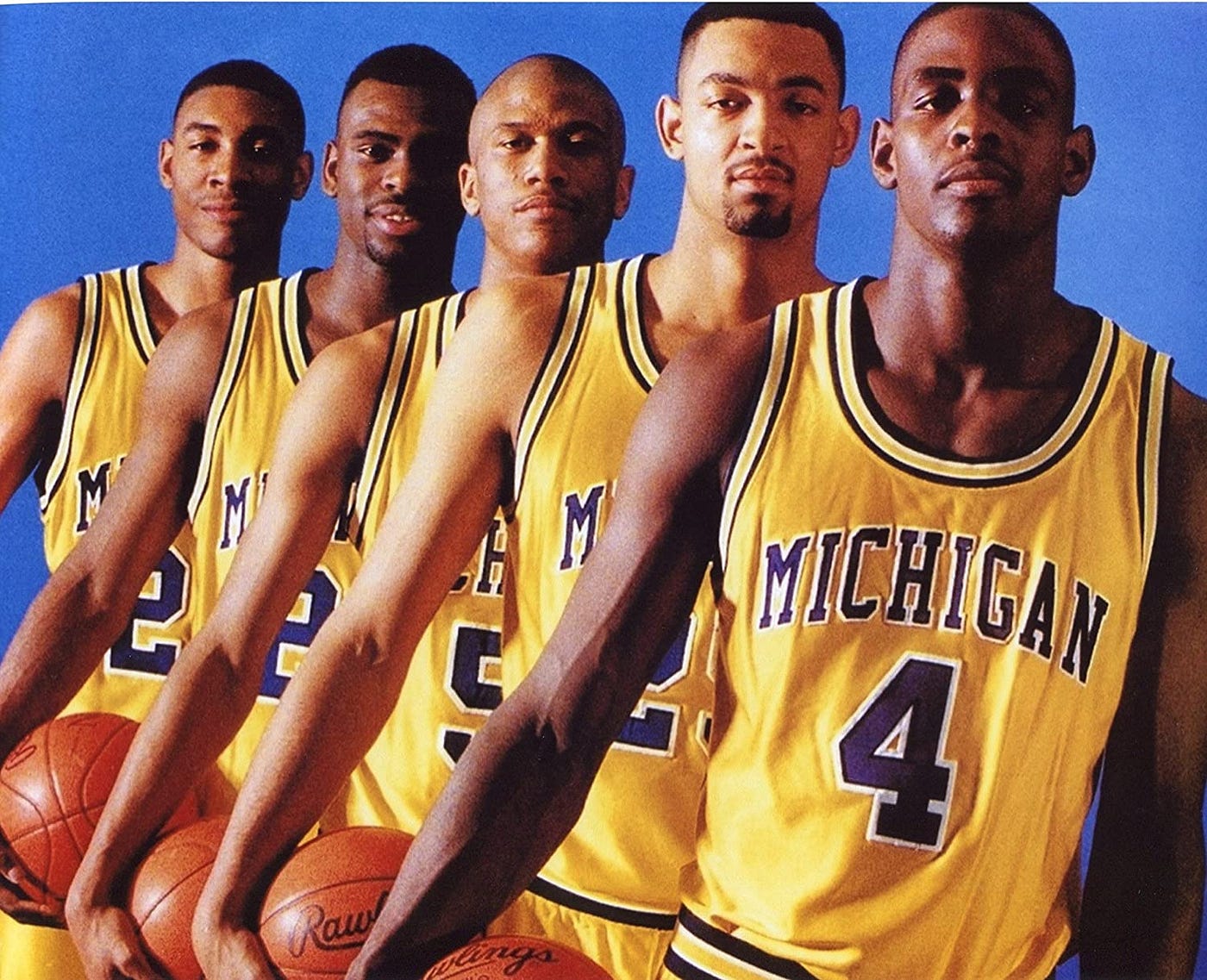
Michigan’s Fab Five took the campus by storm in the early 1990s. (U-M Media Relations)
30 Years Since the Michigan Fab Five Era, Student-Athletes are Now Turning the Tables on the NCAA
California high school star and №1 prospect Jalen Green shocked the sports world this past April by announcing that he would forgo a collegiate career and join the NBA’s G League instead. The G League is the NBA’s official minor league system that prepares players for the NBA, all while paying them a modest salary by professional sports standards. His salary would be $500,000 plus healthcare benefits, housing, food, and disability insurance. Green’s G League contract also includes a college scholarship at Arizona State where he can attend classes after his professional career. Green’s decision was met with mixed feelings by many in the sports community, arguing that the value of a traditional college-to-NBA route should remain precedent. Regardless, Green’s decision to join the G League will earn him a paycheck today, while a payday from the NCAA will never come.
It has long been the NCAA’s practice not to pay student-athletes while attending the university. However, the school can profit from the player’s likeness and talent without owing the student a single cent. The NBA’s commissioner Adam Silver and G League president Shareef Abdur-Rahim have created an attractive alternative for student-aged athletes who aren’t interested in college basketball exploitation. In the past year, they’ve raised G League salaries significantly to convince prospects to pass on international leagues and play domestically. Green’s original offer was $125,000 just a year ago. Now, with the salary increase incentive, the G League has become a ground-breaking opportunity for some athletes looking to earn a living right away. An option that, if available thirty years prior, could’ve prevented one of the biggest sports scandals in college basketball history.
In the fall of 1991, five freshmen stepped foot on the University of Michigan campus in Ann Arbor. At that time, nobody could’ve predicted the social, cultural, and economic impact they would have on the NCAA. An effect that still echoes to this day. These were five black kids from inner-cities across America who had an affinity for hip-hop music, streetball, and trash-talking. Their trendsetting but controversial antics on the court garnered much attention from the media, both good and bad. Ultimately, that attention sparked a cultural revolution in college basketball. However, off the court, their dealings with an illicit booster from Detroit named Ed Martin got them sanctioned by the NCAA.
Quickly earning the name, The Fab Five for their showmanship on the hardwood, these freshmen picks consisted of Detroit natives Chris Webber and Jalen Rose, Chicago prospect Juwan Howard, and two recruits from Texas, Plano’s Jimmy King and Austin’s Ray Jackson. Both Webber and Rose grew up playing AAU basketball together and had a relationship with Martin since middle school. What started as gifts-in-kind from Martin to Webber and Rose ultimately turned into something far more unethical regarding the NCAA.
Ed Martin was a notorious policy banker in Detroit who ran an illegal numbers operation out of the Ford River Rouge complex where he was employed. He would use his gambling wages to buy prominent Detroit athletes clothing, jewelry, and even cars. Many believe he invested in these youths with the hopes of cashing in when they turned pro. Most of the Detroit breed hoop stars came from impoverished communities and more than welcomed Martin’s generosity. Martin would even go as far as to support the player’s entire immediate family financially. Under normal circumstances, no one would bat an eye. Still, the NCAA has strict rules about players taking money and gifts from anyone, even if they and their families are in dire straits.
As was the case with Webber and Rose, although Rose mostly received pocket money from Martin, it was discovered that Webber (and family) borrowed over $100,000 from Martin during his time at the University of Michigan. A case opened in 1996 when an investigation into an automobile accident involving Michigan players revealed the precarious relationship between Martin and Michigan’s basketball program dating back to the eighties. Several Michigan players were implicated for taking large sums of money from Martin while at Michigan. By this time, Webber and Rose were in the NBA and were called to testify before a grand jury on the case. During the investigation, Webber claimed not to have had any financial relationship with Martin but later confessed to Martin’s loans. He was fined by federal prosecutors and served a short suspension by the NBA after performing community service.
Michigan’s basketball program was found guilty of major NCAA violations due to Martin’s involvement and decided to self-impose sanctions against the program. Michigan announced it would forfeit every game in which Webber appeared, along with removing the banners hung in the Crisler Arena, from the two championship appearances by the Fab Five in 92' and 93'. Although Webber was the only person found guilty of directly taking money from Martin, the entire team had to suffer the consequences. Webber was subsequently banned from the university for ten years.
Many rebuked the school’s decision for the self-imposed sanctions claiming that the school made millions of dollars off the Fab Five fanfare when they attended Michigan. The year before the Fab Five’s arrival, Michigan’s merchandise revenue was around 1.6 million. During the two years the Fab Five was together, merchandise skyrocketed to 10.5 Million.
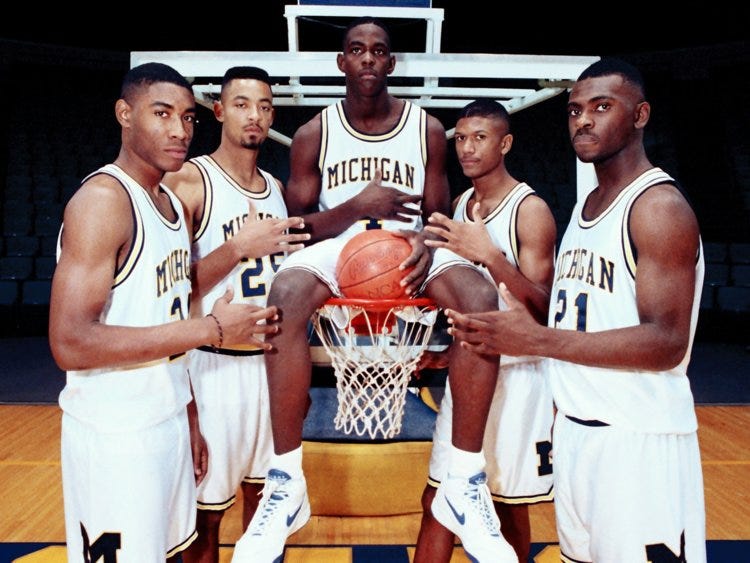
From L to R: Jimmy King, Juwan Howard, Chris Webber, Jalen Rose, Ray Jackson
The Fab Five had created a new-aged branding style for the University of Michigan and the NCAA that appealed to hip-hop’s emerging culture. Their inner-city attitudes and raw, unapologetic playground-style exemplified everything popular and cool at the time; for sports brands and advertisers, this translated into dollar signs. The Fab Five soon realized they were pawns in a money-making machine generating millions of dollars for Michigan, Nike, and the NCAA, but they received nothing. Nike produced and marketed a sneaker called “The Fab Five Nike,” from which none of the members could partake in profits. The Five quickly began a silent protest by not wearing clothing branded with Nike labels or logos to games. Chris Webber admitted to famed sportswriter Mitch Albom in an interview that while at Michigan, he saw his basketball jersey in a storefront window for $75, knowing that someone else was receiving the profits. Meanwhile, he didn’t have enough money to put gas in his car. With circumstances like that, who could blame him for taking loans? Many black inner-city players live below the poverty line; there is a huge responsibility placed on their shoulders to provide for their families at a young age. The idea of sitting around watching others get filthy rich off their talent doesn’t particularly bode well.
Fast forward to the present day, student-athletes now have the G League option, which means they can operate without the stringent restrictions of the NCAA. Players are now free to profit off of their likeness and engage with agents to pursue lucrative sneaker contracts and other brand deals worth hundreds of thousands of dollars or more. Sources said Green already has a seven-figure shoe deal lined up for later this year.
Although we cannot go back in time, you can’t help but wonder what the Fab Five’s story would’ve been had the NBA’s G League deal existed thirty years ago. Despite their somewhat tarnished history, a member of the Fab Five, Juwan Howard is now the head coach of Michigan’s basketball team. Chris Webber made his first public appearance back at Michigan in 2018 when his 10-year disassociation was lifted. Other Fab Five members like Jalen Rose, who is now a host on ESPN, Jimmy King, and Ray Jackson, also frequent Michigan games. One might assume there may not have been a Fab Five at all if the G League existed then. Either way, the future is looking a lot brighter for players who want to start earning a living off their talent immediately. As far as NCAA basketball goes, it may have finally met its match.
메타데이터
- post_id
- 87b809c55400
- slug
- 30-years-since-the-michigan-fab-five-era-student-athletes-are-now-turning-the-tables-on-the-ncaa-87b809c55400
- url
- https://medium.com/@wilkins.rod1/30-years-since-the-michigan-fab-five-era-student-athletes-are-now-turning-the-tables-on-the-ncaa-87b809c55400
- canonical_url
- https://medium.com/@wilkins.rod1/30-years-since-the-michigan-fab-five-era-student-athletes-are-now-turning-the-tables-on-the-ncaa-87b809c55400
- author_url
- https://medium.com/@wilkins.rod1
- status
- ok
- fetched_at
- 2026-06-29 01:02:39



