Cross-Domain Cascades: Where Dependency Concentration Becomes a Continuity Risk
ASR ARTICLE · JUNE 2026
Cross-Domain Cascades: Where Dependency Concentration Becomes a Continuity Risk
ASR ARTICLE · JUNE 2026
Why resilience built one vendor, one domain, and one audit at a time still fails when a real disruption arrives
DOI: 10.13140/RG.2.2.36169.92000
Where most resilience planning stops short
Across capital-intensive industries, organisations now rely on a growing stack of independently vetted technologies — AI-enabled platforms chief among them — each evaluated, approved, and monitored on its own terms. A recent professional discussion among data science and engineering practitioners converged on the question underneath that vetting work: not whether a given tool performs well alone, but what happens when several independently well-vetted tools interact under stress, across boundaries no single vendor evaluation covers.
Aquarian Systematic Resilience (ASR) is a general doctrine for exactly this structure of risk: what happens when institutions assume resilience within a domain is the same as resilience across domains. Three recent, documented incidents make the assertions below concrete rather than theoretical.
The core distinction: domain resilience vs. flow sovereignty
Most organisations and most individual technology vetting processes can demonstrate resilience within a function. A security vendor passes its own security review; a monitoring vendor passes its own; an analytics platform passes its own. Each clears a validation bar independently.
What this doesn’t catch is the failure mode a cross-vendor deployment stack actually produces: a real disruption rarely respects the boundary between one validated tool and the next. The clearest recent illustration sits inside almost every sector’s deployment stack: the July 2024 CrowdStrike Falcon Sensor update crashed roughly 8.5 million Windows systems globally — each customer organisation had independently vetted CrowdStrike as a security vendor, and each had its own IT continuity plan, yet the cascade moved through airlines, hospitals, 911 dispatch centres, and banks simultaneously because none of those continuity plans had modelled a single endpoint-security vendor as a cross-domain Pivot Domino. Delta alone estimated $500M in losses and later sued CrowdStrike directly over the disruption to its crew-scheduling system. The vendor’s own security review was sound; the cross-domain dependency on it was never separately assessed.
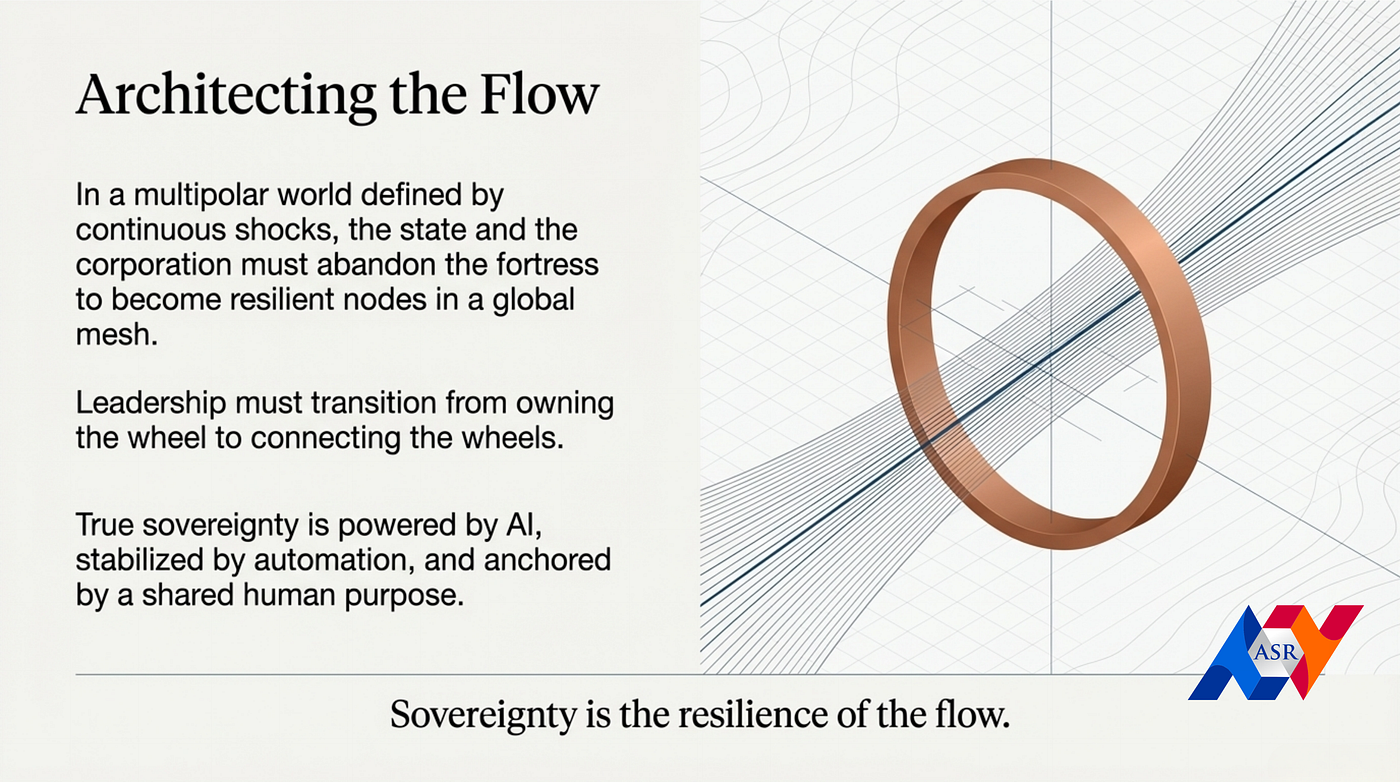
ASR calls the corrective concept Flow Sovereignty: the capacity to trace, redirect, and stabilise the flows of authority, data, and operational legitimacy moving through a system under stress — a property of the whole deployment stack, not of any single vetted vendor within it.
Applying it to vendor concentration and data aggregation
A risk raised in the same recent discussion is a precise test case for any technology deployment model: a service or analytics vendor aggregating data across multiple client organisations sits at a structural chokepoint — inside each client’s domain as a trusted, vetted vendor, and outside the boundary any single client’s risk model covers, as an independent commercial actor with its own incentive to monetise aggregate cross-client visibility into competing offerings.
Three observations from ASR’s working concepts apply directly:
• Naming the risk is not architecting against it. A vendor scorecard can flag the data-aggregation node; it does not specify the contractual or architectural barrier preventing monetisation of the aggregate view — that decision must be made when the relationship is structured, not after it matures.
• This is a Pivot Domino, not an isolated vendor risk. ASR’s Pivot Domino concept identifies nodes whose failure or commercial defection cascades disproportionately to their apparent size. The January 2026 multi-day Microsoft 365 disruption traced back to an upstream third-party network provider fault, not to Microsoft’s own infrastructure — a vendor several layers removed from the end customer’s risk register still produced the customer-facing outage. A mid-sized analytics vendor with cross-client visibility occupies the same structural position, even where a standard vendor-vetting pass would not flag it as one.
• Diversifying across specialised vendors trades one concentration risk for another. The well-documented 2025 cloud control-plane incidents centred on AWS us-east-1 made this trade visible at scale: organisations had replicated data across availability zones believing that satisfied their resilience requirement, only to find the control-plane function authorising access to that data was itself concentrated in one region. Spreading analytics across several best-of-breed providers reduces any single vendor’s aggregate visibility, but distributes the governance burden across several relationships instead of one — a trade that should be named explicitly, not assumed by default to be a net improvement.
The investment framing, not the compliance framing
Cross-vendor dependency mapping rarely gets resourced, even with rigorous individual vendor vetting, because of timing of incentive: the cost of building the barrier is immediate and visible before any disruption occurs; the benefit is invisible until the disruption that would have happened, doesn’t. Framed as compliance, this is a losing budget argument inside most organisations — which is precisely why the CrowdStrike incident produced an estimated $5.4 billion in direct Fortune 500 losses and roughly $1.5 billion in insurer payouts despite CrowdStrike itself passing every individual security review its customers had run.
ASR treats it instead as a capital protection question, with a working metric — the Sentinel Risk Value — expressing pre-positioned resilience spend as a return ratio against avoided loss. One documented case: $1.4M invested in pre-positioned architecture against $111M in avoided loss, a 69–79x return, calculated rather than estimated after the fact. For any multi-vendor, AI-enabled deployment stack, the equivalent exercise scopes alongside existing technology-vetting workflows.
Where this leads
In increasing order of commitment: a short research note extending a recent industry discussion into a structured framework; a Net Fragility Matrix exercise applied to a specific deployment stack, scoring nodes across the six Sovereign Layers (Physical, Digital, Human, Institutional, Geographic, Financial) to surface which Pivot Dominoes exist within a validated stack; or a cross-domain dependency module added to existing vendor-vetting criteria.
The risk was never that any single vetted tool fails. It is that operational judgment migrates quietly to whoever sits closest to the aggregated data — one well-vetted integration at a time, with no single event to mark when sovereignty changed hands.
Brig (Ret) Syed Abid Shah · Founder, Aquarian Systematic Resilience (ASR)
connect@syedabidshah.com | syedabidshah.com | +92 331 3330 188
메타데이터
- post_id
- 87bd87d8be7e
- slug
- cross-domain-cascades-where-dependency-concentration-becomes-a-continuity-risk-87bd87d8be7e
- url
- https://medium.com/@Syed_Abid/cross-domain-cascades-where-dependency-concentration-becomes-a-continuity-risk-87bd87d8be7e
- canonical_url
- https://medium.com/@Syed_Abid/cross-domain-cascades-where-dependency-concentration-becomes-a-continuity-risk-87bd87d8be7e
- author_url
- https://medium.com/@Syed_Abid
- status
- ok
- fetched_at
- 2026-07-13 06:23:13



