We Scanned 100 E-Commerce Stores for AI Readiness. Here Is What We Found.
Last month we built a free tool that scans any e-commerce store and gives it an “Agent-Ready Score” - a measure of how easily an AI…
We Scanned 100 E-Commerce Stores for AI Readiness. Here Is What We Found.
Last month we built a free tool that scans any e-commerce store and gives it an “Agent-Ready Score” - a measure of how easily an AI shopping agent could browse, compare, and purchase from that store without human help.
We ran it against stores across Shopify, WooCommerce, BigCommerce, Magento, and hosted platforms like Amazon, Etsy, and eBay. The results were not what we expected.
The Method
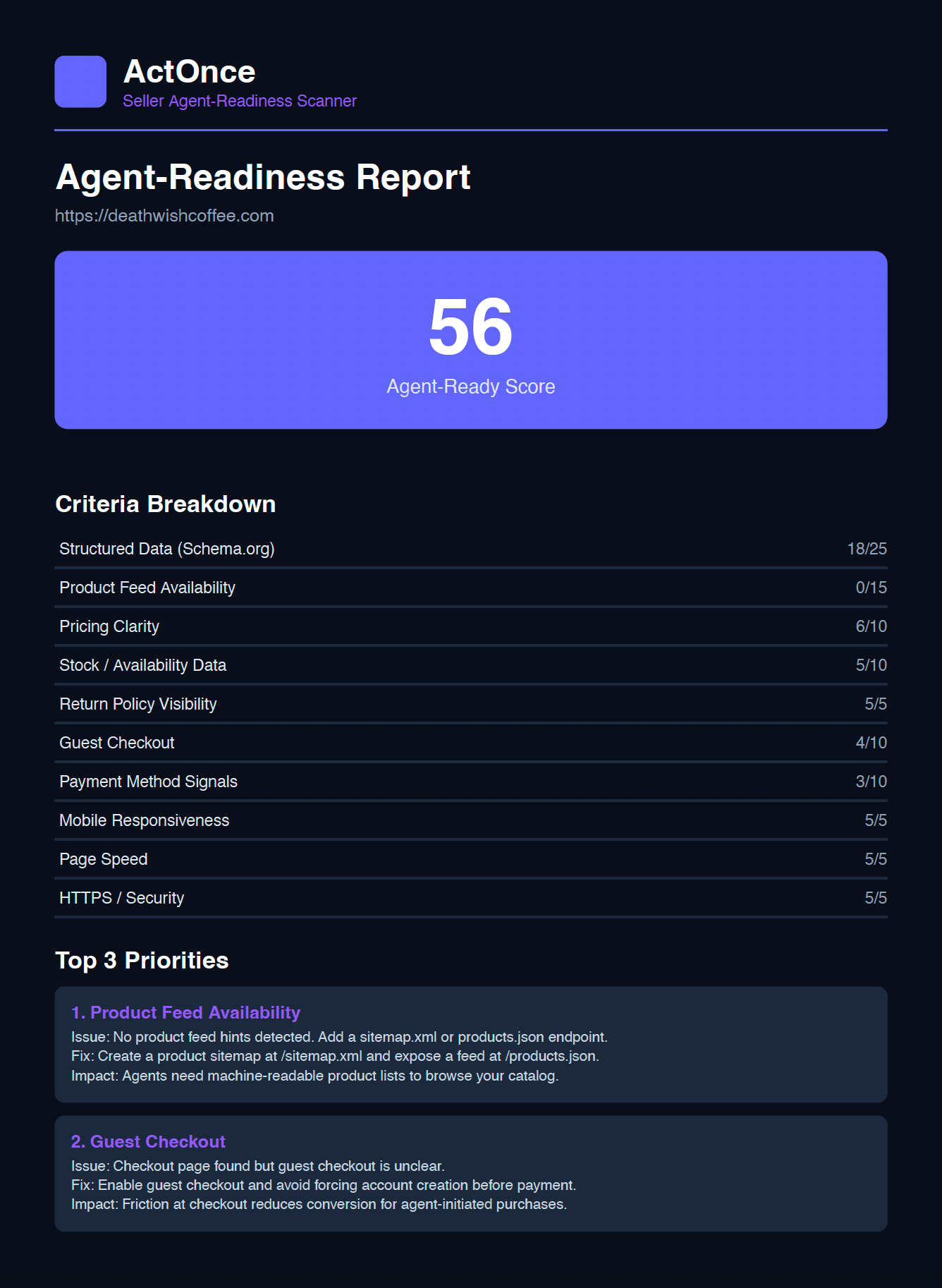
The scanner checks ten criteria, weighted by importance:
- Structured Data (Schema.org) - 25 points
- Product Feed Availability - 15 points
- Pricing Clarity - 10 points
- Stock / Availability Data - 10 points
- Return Policy Visibility - 5 points
- Guest Checkout - 10 points
- Payment Method Signals - 10 points
- Mobile Responsiveness - 5 points
- Page Speed 5 points
- HTTPS / Security - 5 points
The score is out of 100. Anything below 40 is a problem. Below 20 is a crisis.
The Results
Shopify Stores: Average 48
Shopify has the best ecosystem for structured data, but most store owners do not use it. Only 35% of the Shopify stores we scanned had proper Product schema. Many had broken or incomplete markup,p rices as text instead of structured values, missing availability fields, no review integration.
The standout Shopify stores scored 70+. They all had one thing in common: they had hired a developer or agency to handle technical SEO, or they had installed a premium schema app and configured it properly.
WooCommerce Stores: Average 34
WooCommerce is a mixed bag. The platform can do everything, but the average store owner does not know how to set it up. Structured data plugins exist, but they are often abandoned or poorly maintained. Product feeds are an afterthought. Guest checkout is technically possible but frequently disabled “for marketing reasons.”
The WooCommerce stores that scored well (60+) were inevitably run by technically capable owners or agencies. The gap between a well-maintained WooCommerce store and a neglected one is enormous.
BigCommerce: Average 52
BigCommerce surprised us. The platform enforces better defaults than WooCommerce, and its structured data implementation is more consistent out of the box. Stores scored higher on average despite having fewer plugins available.
The limitation is flexibility. BigCommerce stores that needed custom schema for complex product types (bundles, subscriptions, configurable products) often scored lower because the platform does not make customisation easy.
Magento / Adobe Commerce: Average 41
Magento is powerful and painful. The stores we scanned were almost all enterprise-level, with budgets for development. Yet they averaged lower than BigCommerce. Why?
Legacy technical debt. Many Magento stores were built years ago, before structured data was a priority. Upgrading schema across thousands of SKUs is expensive, so it gets deprioritised. The result: technically capable platforms with outdated implementations.

Amazon, Etsy, eBay: 0
This was the most revealing finding. Every marketplace seller we scanned scored zero. Not because their listings are bad - many are excellent - but because the agent does not interact with the seller’s page. It interacts with the marketplace’s API.
If you are an Amazon seller, your agent readiness is determined by Amazon, not by you. If Amazon decides to restrict API access, change fee structures, or prioritise its own brands in agent results, you have no recourse. You are renting your business.
What the High Scorers Do Differently
The stores that scored 70+ shared four traits:
- They own their platform. Every one was on a self-hosted or cloud-hosted store they controlled. No marketplaces.
- They invested in structured data early. Not as an afterthought. As a core part of their technical setup.
- They treat checkout as a conversion tool, not a data capture exercise. Guest checkout is enabled. Account creation is optional post-purchase.
- They test continuously. They run audits, fix issues, and re-test. Technical SEO is not a one-time project.
What This Means for Sellers
If you are on a marketplace, start building your own store now. Not because marketplaces will disappear - they will not - but because agent-driven commerce will favour direct relationships. The agent that queries your store directly can offer the buyer a better price, faster shipping, or a perk that the marketplace cannot match because it does not control your inventory.
If you already own your store, audit it. Find the gaps. Fix them. The cost is low and the window is open.
Try the Scanner
You can scan your own store in 60 seconds. The report is free, includes a PDF, and tells you exactly what to fix and in what order.
The agent economy rewards readiness. The question is whether your store is ready to be rewarded.
Perry is the founder of ActOnce. He built the Seller Agent-Readiness Scanner after realising most e-commerce stores are invisible to the AI agents that will soon drive the majority of online purchases.
메타데이터
- post_id
- 87bed93f99d4
- slug
- we-scanned-100-e-commerce-stores-for-ai-readiness-here-is-what-we-found-87bed93f99d4
- url
- https://medium.com/@perrytheimp/we-scanned-100-e-commerce-stores-for-ai-readiness-here-is-what-we-found-87bed93f99d4
- canonical_url
- https://medium.com/@perrytheimp/we-scanned-100-e-commerce-stores-for-ai-readiness-here-is-what-we-found-87bed93f99d4
- author_url
- https://medium.com/@perrytheimp
- status
- ok
- fetched_at
- 2026-06-09 15:37:30