Morocco’s Artificial Intelligence Strategy: Technological Sovereignty, State Modernisation and…
Morocco is moving from fragmented digital experimentation toward a more structured national artificial intelligence strategy. Through…
Morocco’s Artificial Intelligence Strategy: Technological Sovereignty, State Modernisation and Strategic Positioning in Africa
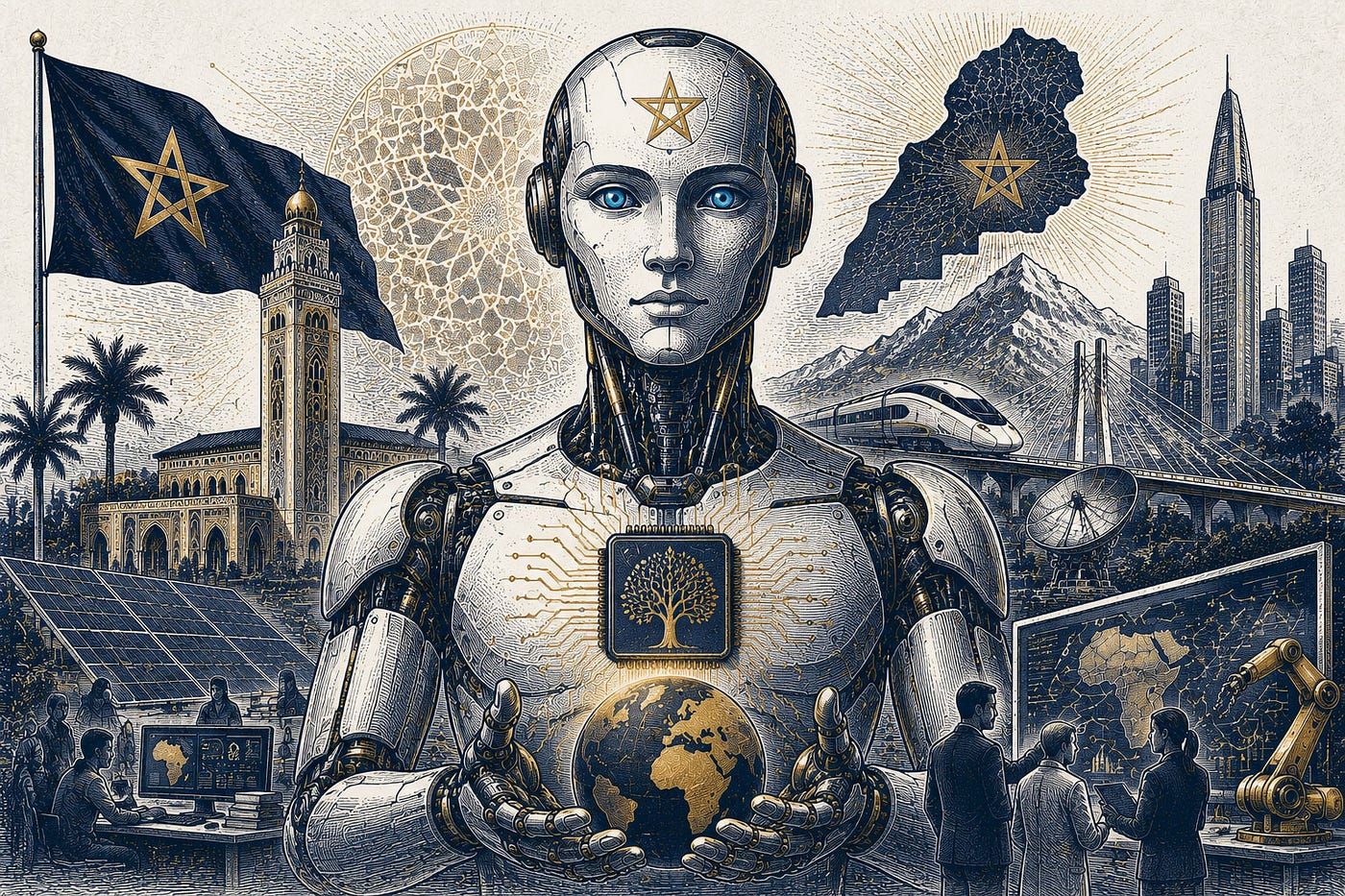
Morocco is moving from fragmented digital experimentation toward a more structured national artificial intelligence strategy. Through Digital Morocco 2030, the emerging Maroc IA 2030 roadmap, the “AI Made in Morocco” vision and initiatives such as Rally IA Future Lab, the Kingdom is seeking to transform artificial intelligence into a lever of technological sovereignty, public-sector modernisation, economic competitiveness and regional influence.
The Moroccan approach is notable for its state-led character. It is built around public administration reform, sovereign data infrastructure, human capital, university-linked centres of excellence, regional innovation ecosystems, and selective international partnerships. At the same time, Morocco is increasingly positioning itself in global debates on the ethical governance of military AI, including through its diplomatic engagement in Geneva on autonomous weapons, disarmament and international humanitarian law.
This study argues that Morocco’s AI strategy should be understood not simply as a technology policy, but as a statecraft agenda. It intersects with security, defence, education, health, industry, agriculture, public administration, infrastructure, diplomacy and Africa’s wider digital sovereignty debate.
If implemented effectively, Morocco could consolidate its position as a North African and Arab-African digital hub. However, the strategy also faces important constraints, including uneven digital maturity across the economy, data-governance challenges, limited domestic AI industrial depth, dependence on foreign technology partners, and the need to ensure that AI adoption does not deepen social or regional inequalities.
From Digitalisation to Artificial Intelligence
Morocco’s AI strategy is emerging from a broader national digital transformation agenda. The launch of Digital Morocco 2030 in September 2024 marked a turning point in the country’s ambition to modernise public administration and expand the digital economy. The strategy set out major targets, including the creation of 240,000 direct digital jobs by 2030, an increased contribution of digital technologies to national GDP, and a significant improvement in Morocco’s ranking in the United Nations e-government index.
Artificial intelligence is now being placed at the centre of this transformation. The forthcoming Maroc IA 2030 roadmap is expected to provide the AI-specific framework within the wider Digital Morocco 2030 architecture. Its objectives include modernising public services, improving interoperability between government platforms, strengthening domestic innovation, building national AI skills, and reducing dependence on imported technological solutions.
This sequence is important. Morocco is not treating AI as an isolated sector. Rather, AI is being framed as an accelerator of a wider state-modernisation project. The goal is not only to adopt algorithms, but to restructure how the administration, economy and public services operate.
In this respect, Morocco’s approach resembles the strategies of middle powers seeking to avoid digital dependency. The Kingdom recognises that AI competitiveness depends on several foundations: data availability, computing capacity, cloud infrastructure, fibre connectivity, regulatory clarity, skilled human capital and trusted public institutions.
The Political and Institutional Actors Behind the Vision
The Moroccan AI agenda is driven by several key actors.
At the political level, the strategy is framed within the broader development orientations of King Mohammed VI, particularly the emphasis on digital transformation, innovation, administrative efficiency, youth skills and economic modernisation. Royal patronage gives Morocco’s digital and AI agenda a high level of political visibility and institutional legitimacy.
At the governmental level, the Ministry of Digital Transition and Administrative Reform has become the central actor. Under Minister Amal El Fallah Seghrouchni, the ministry has promoted AI as a tool for technological sovereignty, public-action transformation and national competitiveness. The ministry’s role is especially important because Morocco’s AI strategy is not being developed only as an industrial policy, but also as an administrative reform agenda.
The planned establishment of a General Directorate for AI and Emerging Technologies would further institutionalise AI governance. Such a body could become responsible for coordinating policy, aligning public-sector AI adoption with national priorities, overseeing ethical and regulatory questions, and avoiding fragmented implementation across ministries.
Academic institutions are also central. The proposed Al Jazari Institutes are expected to form a national network of AI centres of excellence linking universities, researchers, entrepreneurs and regional economies. If properly funded and connected to industry, they could help prevent AI expertise from remaining concentrated in a few urban centres such as Rabat, Casablanca and Marrakech.
The private sector, start-ups, international technology firms and development partners also form part of the ecosystem. Morocco’s partnership with France’s Mistral AI illustrates the country’s attempt to combine domestic capability-building with selective foreign collaboration. The challenge will be to ensure that such partnerships strengthen Moroccan technological autonomy rather than reproduce dependency on external platforms.
“AI Made in Morocco” and the Sovereignty Doctrine
The phrase “AI Made in Morocco” is central to the country’s emerging doctrine. It signals a desire to move beyond passive consumption of imported AI systems and toward locally designed, locally adapted and locally governed solutions.
The launch of Rally IA Future Lab in June 2026 illustrates this direction. Organised by the Ministry of Digital Transition and Administrative Reform, the programme is intended to mobilise researchers, engineers, students, entrepreneurs and developers around concrete AI solutions adapted to the needs of citizens, public administration and the national economy. Its first edition in Merzouga, in the Drâa-Tafilalet region, was designed not only as a technical event, but also as a symbolic decentralisation of innovation beyond Morocco’s traditional economic centres.
This matters strategically. For many African countries, AI adoption risks becoming a new form of digital dependency: foreign cloud infrastructure, foreign models, foreign data-processing systems, foreign software vendors and foreign regulatory standards. Morocco’s emphasis on technological sovereignty reflects an attempt to avoid this outcome.
However, sovereignty in AI is complex. It cannot be achieved by slogans or hackathons alone. It requires national data infrastructure, domestic computing capacity, cybersecurity, legal frameworks, procurement reform, research funding, industrial demand and long-term talent retention. Morocco’s plan to expand sovereign data centres, strengthen cloud and fibre infrastructure, and build AI skills therefore reflects a realistic understanding of the foundations required.
The reported plan for a large renewable-energy-powered data centre in Dakhla is especially significant. It connects AI sovereignty with energy policy, data governance and territorial development. If realised, such infrastructure could support national data storage, cloud services and AI computing capacity while reinforcing Morocco’s ambitions in the southern provinces.
Economic Competitiveness and Industrial Transformation
The economic objectives of Morocco’s AI strategy are ambitious. Moroccan authorities have indicated that AI and digital transformation could contribute approximately US$10 billion to GDP by 2030. The government has also cited targets including 50,000 AI-related jobs and the training of 200,000 graduates in AI skills by the end of the decade.
These targets reflect a broader strategic ambition: to shift Morocco from a competitive manufacturing and services platform into a more knowledge-intensive economy. AI could support this transition in several sectors.
In industry, AI can improve predictive maintenance, logistics optimisation, quality control and supply-chain management. This is particularly relevant for Morocco’s automotive, aerospace, textile and electronics sectors, which are deeply connected to European and global value chains. AI adoption could allow Moroccan industry to move up the value chain and improve productivity.
In agriculture, AI could support water management, crop monitoring, climate-risk forecasting and precision farming. This is strategically important given Morocco’s exposure to drought, water stress and climate variability.
In financial services, AI can improve fraud detection, credit scoring, compliance monitoring and customer-service automation. However, this also raises questions about algorithmic bias, consumer protection and data privacy.
In public procurement and administration, AI could reduce inefficiencies, detect irregularities and improve service delivery. Yet this requires reliable data, interoperable systems and clear accountability mechanisms.
The main risk is that AI adoption could remain concentrated among large firms, banks, telecom operators and public agencies, while small and medium-sized enterprises remain excluded. Morocco’s AI strategy must therefore address the digital-readiness gap across the private sector. Many businesses still require basic digitalisation before they can effectively adopt advanced AI systems.
Public Administration and State Capacity
One of the strongest potential applications of AI in Morocco lies in public administration. Digital Morocco 2030 already aims to improve access to public services and raise Morocco’s e-government performance. AI could accelerate this process through automated administrative assistance, predictive service delivery, document processing, citizen-service chatbots, fraud detection and improved decision-support systems.
For the Moroccan state, the strategic value is clear. AI can make administration faster, more integrated and more responsive. It can reduce paperwork, improve access to services and lower transaction costs for citizens and businesses.
However, the risks are equally important. AI in public administration requires strong safeguards. Decisions affecting citizens’ rights, benefits, documents, permits or access to services cannot be delegated blindly to automated systems. Morocco will need clear rules on transparency, appeal mechanisms, data protection, human oversight and algorithmic accountability.
A successful AI state is not merely a digitised bureaucracy. It is a state that uses technology to strengthen trust, legality and efficiency. Without these safeguards, AI could amplify administrative opacity rather than reduce it.
Security, Defence and Military AI
Morocco’s AI strategy also has a security dimension. At the international level, the Kingdom has begun articulating a position on military AI that combines technological realism with ethical caution.
In June 2026, Morocco, while chairing the Group of Francophone Ambassadors in Geneva, organised a meeting at the Palais des Nations on the use of AI in the military domain and its implications for disarmament, peace and international security. Morocco’s Permanent Representative in Geneva, Ambassador Omar Zniber, emphasised the need to integrate ethics into discussions on military AI and to preserve human decision-making.
The Moroccan approach presented in Geneva is structured around three dimensions: organisational, normative and capability-based. It recognises AI as a potential multiplier of military capacity, particularly for situational awareness, protection and support of forces. At the same time, it stresses data protection, chain-of-command integrity, lifecycle control of AI systems, respect for national values, and the centrality of human decision-making.
This position reflects a broader global debate. AI-enabled systems are increasingly relevant for intelligence analysis, drone operations, border surveillance, logistics, cyber defence, targeting support and battlefield awareness. For Morocco, a country with major security concerns including counterterrorism, border monitoring, maritime security and regional tensions, AI could become an important strategic tool.
Yet the risks are profound. Autonomous systems may produce errors, embed bias, misinterpret data or accelerate escalation. In the military field, such failures can have lethal consequences. Morocco’s stated emphasis on human control and international law is therefore strategically prudent.
The challenge will be domestic implementation. Ethical diplomacy at the United Nations must be matched by clear national doctrine on military AI procurement, testing, operational use, accountability and civilian oversight.
Cybersecurity and Data Sovereignty
AI strategy cannot be separated from cybersecurity. As Morocco digitises public services and expands AI deployment, the volume of sensitive data processed by public and private systems will grow significantly.
This creates several vulnerabilities. AI systems can be attacked, manipulated or poisoned through corrupted data. Public databases can become targets for cyber espionage. Foreign-hosted AI infrastructure may expose sensitive national data to external jurisdictions. Generative AI tools may also create new risks in disinformation, identity fraud, phishing and social manipulation.
Morocco’s emphasis on sovereign data centres and national cloud infrastructure is therefore strategically significant. Data sovereignty is becoming one of the central issues of twenty-first-century state power. Countries that cannot store, secure and process their own strategic data risk dependency on foreign cloud providers and foreign legal regimes.
For Morocco, the objective should not be complete technological isolation, which is unrealistic. Rather, the goal should be controlled interdependence: the ability to cooperate with global technology firms while retaining national control over sensitive public, security and economic data.
Education, Skills and Human Capital
Human capital is the central condition of Morocco’s AI strategy. Without engineers, data scientists, technicians, public-sector managers and AI-literate citizens, infrastructure investments will not produce strategic autonomy.
The target of training 200,000 graduates in AI skills by 2030 is therefore one of the most consequential elements of the strategy. It suggests that Morocco understands AI as a labour-force transformation agenda, not merely a technology acquisition agenda.
The Al Jazari Institutes could play an important role if they are designed as applied research and innovation hubs rather than purely academic structures. Their success will depend on whether they can connect universities with industry, public-sector needs and regional development priorities.
Education reform must also go beyond elite technical training. Morocco will need AI literacy across the administration, legal profession, health system, schools, local governments and private sector. Teachers, judges, doctors, civil servants and entrepreneurs will increasingly require at least a working understanding of AI tools and their risks.
The danger is the creation of a narrow AI elite disconnected from broader society. For AI to support inclusive development, skills programmes must reach women, rural youth, regional universities, vocational training institutions and small businesses.
Health, Medicine and Public Services
AI could have major implications for Morocco’s health sector. Potential applications include medical imaging, disease surveillance, hospital management, drug supply-chain optimisation, telemedicine, epidemic modelling and personalised patient support.
For a country seeking to modernise public services and reduce territorial inequalities, AI-enabled health tools could help extend expertise to underserved regions. Algorithms can support diagnosis, triage and resource allocation, especially where specialist doctors are limited.
However, health AI is among the most sensitive domains. Medical data is highly personal, and algorithmic errors can directly affect patient safety. Morocco will need strict health-data governance, clinical validation standards, professional oversight and ethical review mechanisms before deploying AI at scale in healthcare.
The opportunity is real, but the risks are too high for unregulated experimentation. Morocco’s AI health policy should be aligned with international ethical standards, including the UNESCO Recommendation on the Ethics of Artificial Intelligence, which emphasises human rights, privacy, safety, fairness and human oversight.
Agriculture, Climate and Water Security
AI has particular relevance for Morocco’s climate and water challenges. The country faces recurring drought, rising temperatures and pressure on water resources. These pressures affect agriculture, food security and rural livelihoods.
AI tools can support satellite-based crop monitoring, water-use optimisation, drought forecasting, irrigation management and early warning systems. Combined with Morocco’s renewable energy strategy, AI could become part of a broader climate-adaptation framework.
This is one of the areas where AI could produce direct social benefits beyond elite economic sectors. If deployed effectively, it could support farmers, improve food-system resilience and help public authorities anticipate climate shocks.
The challenge is accessibility. AI systems for agriculture must be adapted to local languages, smallholder needs, connectivity limitations and regional realities. Otherwise, they may benefit large agribusiness actors more than rural communities.
Morocco’s African and Arab-African Ambition
Morocco’s AI strategy has a clear regional dimension. The Kingdom aims to position itself as a digital hub for Africa and the Arab world. The roadmap’s reported ambition to develop an Arab-African regional digital hub in partnership with the United Nations Development Programme fits within Morocco’s wider diplomatic strategy on the continent.
Morocco has already built influence in Africa through banking, telecoms, fertilisers, renewable energy, religious diplomacy, infrastructure and education. AI and digital services could become a new pillar of this African policy.
If Morocco succeeds, it could offer African partners digital public infrastructure, AI training, cloud services, cybersecurity cooperation, e-government tools and applied AI solutions in agriculture, health and finance. This would strengthen Morocco’s status as a continental technology actor.
However, this ambition will face competition. Rwanda, Kenya, Nigeria, South Africa, Egypt and the Gulf states are also positioning themselves in AI, cloud infrastructure and digital governance. Morocco’s advantage may lie in its political stability, geographic location, multilingual workforce, proximity to Europe, African diplomatic networks and renewable energy potential.
Governance, Ethics and Regulation
The success of Morocco’s AI strategy will ultimately depend on governance. AI policy cannot be reduced to innovation promotion. It must also address risks related to privacy, bias, accountability, surveillance, labour disruption, misinformation and unequal access.
Morocco is reportedly preparing legislation on AI. This will be a decisive step. The law should establish clear principles for risk assessment, data protection, transparency, human oversight, public-sector accountability, and the rights of citizens affected by automated decisions.
The country’s diplomatic position in Geneva suggests that Morocco wants to be seen as a responsible actor in AI governance. This should also guide domestic policy. The same principles Morocco promotes internationally — human control, transparency, responsibility and respect for international law — should inform national AI regulation.
An effective Moroccan AI framework should avoid two extremes. Overregulation could slow innovation and discourage investment. Underregulation could erode trust and expose citizens to harm. The objective should be risk-based governance: stricter rules for high-risk applications such as defence, policing, health, justice and public administration, and more flexible frameworks for lower-risk innovation.
Strategic Risks and Constraints
Morocco’s AI strategy is ambitious, but several constraints must be acknowledged.
First, the country still faces uneven digital maturity. Many administrative processes, businesses and public services require basic digitisation before advanced AI can be deployed effectively.
Second, talent retention may become a major challenge. Training AI graduates is not enough if they are recruited by foreign companies or leave for better-paid opportunities abroad.
Third, Morocco’s AI ecosystem will remain dependent on imported hardware, foreign cloud technologies, global AI models and external expertise unless domestic capabilities deepen significantly.
Fourth, the energy cost of AI infrastructure could become significant. Morocco’s renewable energy potential offers an advantage, but data centres require large amounts of electricity and water, making sustainability planning essential.
Fifth, regional inequality could widen if AI investment remains concentrated in major cities. The decision to launch Rally IA Future Lab in Merzouga suggests awareness of this risk, but long-term regional implementation will be necessary.
Finally, AI can strengthen the state, but it can also increase surveillance capacity. Morocco will need to ensure that digital sovereignty does not become a justification for unchecked data collection or opaque algorithmic governance.
AI as a New Instrument of Moroccan Statecraft
Morocco’s emerging AI strategy is one of the most significant digital policy developments in North Africa. It combines economic ambition, public-sector reform, technological sovereignty, human-capital development, data infrastructure and diplomatic positioning.
The Kingdom is not merely trying to adopt AI. It is attempting to define the institutional, economic and geopolitical conditions under which AI can serve national development.
For Morocco, success would mean a more efficient state, a more competitive economy, stronger data sovereignty, improved public services, new skilled employment, and greater influence in African and Arab digital governance. For Africa, Morocco’s strategy could offer a model of how middle-income countries can approach AI not as a consumer technology, but as a strategic infrastructure of sovereignty.
Yet the outcome is not guaranteed. The implementation gap remains the central test. Morocco’s ambitions will depend on whether it can translate roadmaps into institutions, budgets, infrastructure, talent, regulation and measurable public value.
The strategic question is therefore not whether Morocco has an AI vision. It does. The question is whether the Kingdom can build the sovereign capacity required to make that vision operational, inclusive and durable.
Sources: Government of Morocco; Ministry of Digital Transition and Administrative Reform; Digital Morocco 2030; Maroc IA 2030; Reuters; UNESCO; Oxford Insights Government AI Readiness Index; Stanford University Artificial Intelligence Index Report; United Nations Institute for Disarmament Research (UNIDIR); United Nations Office at Geneva; Organisation internationale de la Francophonie (OIF); International Committee of the Red Cross (ICRC); CGEM; Morocco World News; Le Monde; Africa-focused digital policy and technology research publications.
메타데이터
- post_id
- 87cb14025cd0
- slug
- moroccos-artificial-intelligence-strategy-technological-sovereignty-state-modernisation-and-87cb14025cd0
- url
- https://medium.com/@africastrategicanalysis/moroccos-artificial-intelligence-strategy-technological-sovereignty-state-modernisation-and-87cb14025cd0
- canonical_url
- https://medium.com/@africastrategicanalysis/moroccos-artificial-intelligence-strategy-technological-sovereignty-state-modernisation-and-87cb14025cd0
- author_url
- https://medium.com/@africastrategicanalysis
- status
- ok
- fetched_at
- 2026-06-24 11:06:28






