🔐 AWS Verified Permissions (AVP): Solving Enterprise Authorization at Scale
Authorization is one of the most underestimated problems in enterprise software. While authentication answers who you are, authorization…
🔐 AWS Verified Permissions (AVP): Solving Enterprise Authorization at Scale
Authorization is one of the most underestimated problems in enterprise software. While authentication answers who you are, authorization answers what you can do — and that question becomes increasingly complex as applications grow.
Microservices, multi-tenant SaaS platforms, distributed teams, and regulatory compliance demands have pushed traditional authorization approaches to their limits.
AWS Verified Permissions (AVP) introduces a modern, scalable, and centralized approach to authorization — enabling enterprises to enforce fine-grained access control without hard-coding rules across applications.
In this article, we explore real-world use cases, common enterprise challenges, and how AVP helps organizations implement effective authorization.
🚨 The Enterprise Authorization Problem
Most enterprises start with simple role-based access control (RBAC): Admin → Full Access User → Limited Access This works — until it doesn’t.
As systems scale, organizations face: ❌ Authorization logic scattered across services ❌ Hard-coded permission checks inside application code ❌ Inconsistent enforcement across APIs ❌ Difficulty auditing “who can access what” ❌ High risk of privilege escalation bugs
Authorization becomes complex, brittle, and expensive to maintain.
✅ What Is AWS Verified Permissions?
Amazon Verified Permissions (AVP) is a fully managed authorization service that allows you to externalize access control logic from your applications.
Instead of writing permission logic inside every service, you:
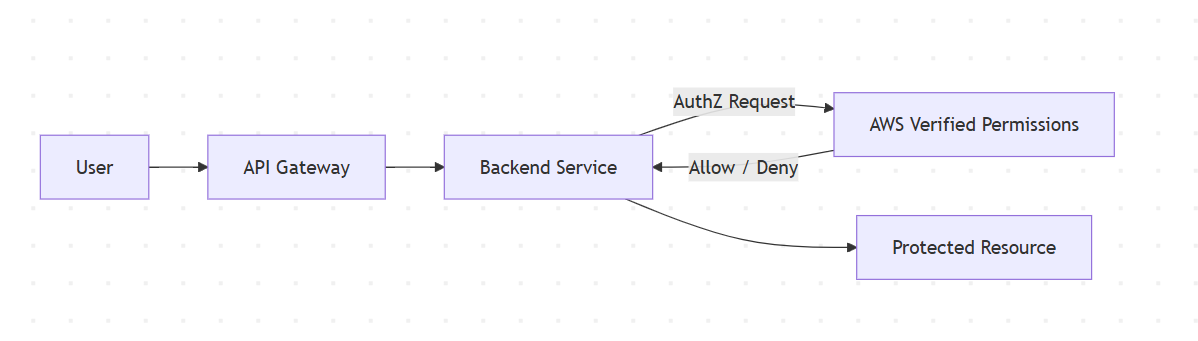
1:Define authorization policies using the Cedar policy language 2:Store them in a policy store 3:Ask AVP for an authorization decision at runtime
AVP acts as a centralized Policy Decision Point (PDP). 👉 Applications enforce decisions, AVP decides them.
🧩 Core Building Blocks
🧪 Real-World Enterprise Use Case
Scenario: Multi-Role Enterprise Application
Roles:
- AppOwner — Full system access
- HR — Access to staff APIs
- Staff — Access to their own profile & assigned schedules
- Teacher — Access only to own record and assigned programs
Requirements:
- Fine-grained access.
- Ownership-based restrictions.
- Central enforcement across services.
🧾 Example Cedar Policy Allow Staff to Update Only Their Own Record
permit (
 principal == Staff,
 action == Action::”UpdateStaff”,
 resource is Staff
)
when {
 principal.id == resource.id
};
Allow HR Full Access to Staff APIs
permit (
 principal in Role::”HR”,
 action,
 resource is Staff
);
Allow Teachers to Access Only Assigned Schedules
permit (
 principal in Role::”Teacher”,
 action == Action::”ViewSchedule”,
 resource is Schedule
)
when {
 resource.assigneeId == principal.id
};
📌 Key Insight: No application code changes are required when policies change — only Cedar updates.
🚀 Enterprise Benefits of AWS AVP
🔐 1. Centralized Authorization Governance
- Single source of truth for access control
- Easier audits and compliance reporting
- Reduced security gaps
🎯 2. Fine-Grained Access Control (RBAC + ABAC)
AVP supports:
- Role-based access
- Attribute-based access
- Ownership-based rules
- Context-aware policies
This enables least-privilege security by design.
⚙️ 3. Decoupled & Maintainable Architecture
Authorization logic:
- ❌ No longer scattered across microservices
- ✅ Centrally managed and reusable
- ✅ Safer to update without redeployments
📈 4. Scales With the Business
As teams and services grow:
- Policies remain consistent
- New services reuse existing authorization logic
- Developer productivity improves
⚠️ Challenges & Considerations
💰 Cost Optimization
High-traffic APIs may generate many authorization calls.
Best practices:
- Cache decisions (API Gateway / Redis)
- Combine coarse-grained checks at edge, fine-grained in AVP
🧠 Learning Curve
Cedar is a new policy language.
However:
- Declarative policies are easier to reason about
- Long-term maintenance cost is significantly lower.
🧠 When Should Enterprises Use AVP?
AVP is ideal when you have:
✅ Microservices or distributed systems ✅ Multi-tenant SaaS architecture ✅ Complex role & ownership rules ✅ Regulatory or audit requirements ✅ Need for consistent authorization across teams
🏁 Final Thoughts
AWS Verified Permissions marks a fundamental shift in how enterprises implement authorization.
By moving authorization:
- Out of application code
- Into a centralized policy engine
- Backed by fine-grained, auditable rules
…organizations gain security, scalability, and speed.
If authentication tells you who the user is, AVP ensures they can do only what they are supposed to do — nothing more, nothing less.
📣 Call To Action (CTA)
🚀 Planning a secure SaaS or enterprise platform? At VXNTech, we help organizations design and implement scalable authorization architectures using AWS Verified Permissions, Cognito, and cloud-native best practices.
👉 Follow us on Medium for more cloud & security insights 👉 Reach out to VXNTech for architecture consulting 👉 Let’s build secure systems — by design, not by accident
메타데이터
- post_id
- 87cbef4d9afe
- slug
- aws-verified-permissions-avp-solving-enterprise-authorization-at-scale-87cbef4d9afe
- url
- https://medium.com/@vxntech/aws-verified-permissions-avp-solving-enterprise-authorization-at-scale-87cbef4d9afe
- canonical_url
- https://medium.com/@vxntech/aws-verified-permissions-avp-solving-enterprise-authorization-at-scale-87cbef4d9afe
- author_url
- https://medium.com/@vxntech
- status
- ok
- fetched_at
- 2026-06-16 19:09:56

