Mind-Bending Science & Tech: 7 Real Innovations That Feel Like Science Fiction (But Aren’t)
Last year, I saw a video of a man moving a computer cursor with his mind.
Mind-Bending Science & Tech: 7 Real Innovations That Feel Like Science Fiction (But Aren’t)
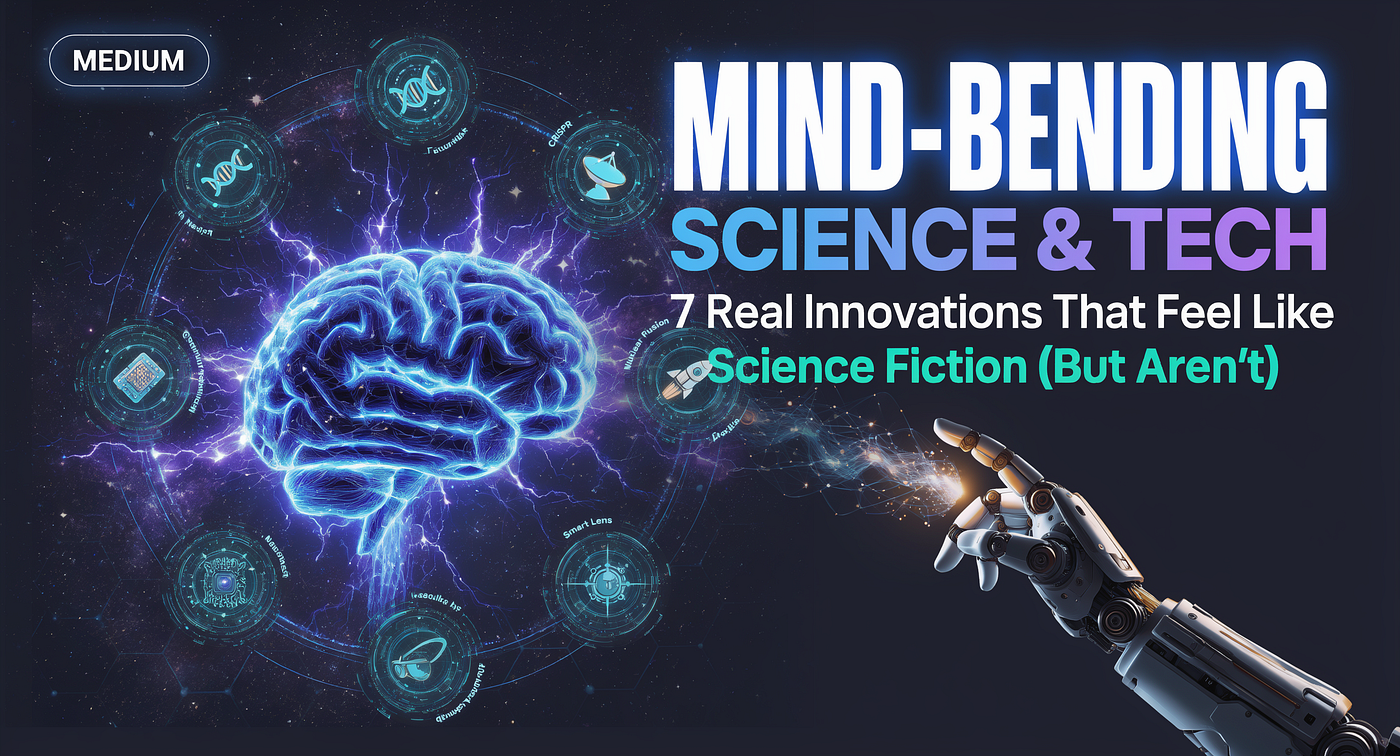
imag from uni 1.1 AI Model
Last year, I saw a video of a man moving a computer cursor with his mind.
No keyboard. No mouse. No voice command.
He simply thought about moving it, and it moved.
For a second, I thought it was fake. Some edited demo. Another tech fantasy.
But it wasn’t.
And that realization stayed with me longer than I expected.
We usually imagine the future as flying cars, robot cities, and glowing holograms. But the truth is quieter and stranger. The future doesn’t arrive with dramatic music. It slips into hospitals, labs, startups, and eventually… into our daily lives.
Let’s talk about the science and technology that genuinely bends the mind — not in a sci-fi way, but in a very real, happening-right-now way.
And more importantly, what it actually means for normal people like us — whether you live in New York, Manchester, Toronto, Karachi, or a small town anywhere in between.
Mind-Controlled Technology Is No Longer a Movie Plot
Brain-computer interfaces are real. Scientists are building systems that allow people to control devices using brain signals.
At first, this sounds scary. Or extreme.
But think about someone who is paralyzed and hasn’t been able to move for years. If they can send a message just by thinking… that’s not science fiction. That’s freedom.
In the US and Europe, these systems are being tested in controlled medical settings. In countries like Pakistan, where advanced medical tech often arrives later due to cost and infrastructure, widespread access may take time. But once it becomes scalable, it could completely change rehabilitation and disability care worldwide.
The mistake most people make? Dismissing it as hype.
The pattern of innovation is always the same. It looks unrealistic… until suddenly it’s normal.
AI Is Creative Now. That Changes Everything.
A few years ago, artificial intelligence could barely hold a conversation. Now it writes stories, creates art, composes music, and builds software.
Students in Canada use AI tools to brainstorm essays. Entrepreneurs in the US use them to build businesses faster. Freelancers in Pakistan use them to improve grammar, generate content ideas, or automate small tasks because hiring full teams isn’t always affordable.
But here’s the uncomfortable part.
AI can produce impressive results without actually understanding anything.
It predicts patterns. It imitates intelligence. And often, it does it well.
I’ve seen beginners make two big mistakes:
One group panics and says, “AI will take all our jobs.”
The other group blindly trusts everything it produces.
Both reactions miss the point.
The smarter approach is simple: use AI as a tool. Not a brain replacement. Not a shortcut for thinking.
The people who win won’t be the ones who fear AI. They’ll be the ones who learn how to work with it.
Scientists Can Now Edit Human Genes
This one feels almost too powerful.
With tools like CRISPR, scientists can edit DNA. That means potentially removing certain genetic diseases before they fully develop.
Imagine telling future generations that a disease that once ran in families for centuries can simply be corrected.
In Western countries, gene editing research is tightly regulated. Ethical debates are intense. In developing regions, regulation and access vary, which creates complicated global discussions about fairness and safety.
The technology is extraordinary.
But it raises a question humanity has never faced at this level before:
If we can redesign parts of ourselves… where do we draw the line?
That’s not just a scientific question. It’s a moral one.
Lab-Grown Meat Is Real (And It Tastes Like Meat)
If someone told you ten years ago that you’d eat meat grown in a lab without slaughtering animals, you’d probably laugh.
Now it’s being sold in limited markets.
In places like the US and Singapore, lab-grown meat is slowly entering the food system. It’s expensive right now. But remember how expensive smartphones were at the beginning?
For countries like Pakistan or India, where livestock farming supports millions of families, this shift could be complicated. It could reduce environmental pressure. But it could also disrupt traditional livelihoods.
Technology often solves one problem while creating another.
That’s the part we rarely talk about.
Reusable Rockets Changed Space Economics
Here’s something simple but powerful.
For decades, rockets were used once and thrown away. Imagine buying a plane and discarding it after one flight.
Then companies figured out how to land rockets and reuse them.
That single shift reduced the cost of sending things into space.
Why should someone using a smartphone in Lahore or Los Angeles care?
Because cheaper launches mean more satellites. More satellites mean better global internet coverage. That means villages, remote towns, and underserved areas can connect without waiting years for fiber cables.
In regions where infrastructure develops slowly, satellite internet can skip outdated systems entirely.
Technology doesn’t just improve progress.
Sometimes it jumps over it.
Quantum Computing Sounds Impossible (But It’s Not)
Traditional computers use bits — 0 or 1.
Quantum computers use qubits — which can be 0 and 1 at the same time.
It sounds like a glitch in reality.
If fully developed, quantum computers could solve problems that today’s computers would take thousands of years to process. Drug discovery. Climate modeling. Complex financial simulations.
This doesn’t mean your laptop will become quantum next year. These machines are specialized and incredibly expensive.
But their impact could quietly reshape medicine, security, and global systems.
The mind-bending part?
We are learning that reality itself behaves differently at deeper levels than our common sense allows.
Digital Money and Financial Shifts
Money is changing too.
In the US or UK, people commonly use PayPal, Stripe, or Apple Pay. In Pakistan, many beginners rely on mobile wallets like JazzCash or Easypaisa because international systems aren’t always fully accessible.
Then came cryptocurrencies and blockchain — introducing the idea that money could exist without a central authority.
Some people jumped in without understanding volatility and lost money. Others studied the technology and saw its deeper potential in contracts, ownership, and global payments.
The lesson here is familiar:
New systems create opportunity. But only for those who understand what they’re stepping into.
So What Should You Actually Do With All This?
It’s easy to read about brain chips, gene editing, and quantum computers and think:
“This has nothing to do with me.”
But that’s what people thought about the internet in the 1990s.
Or smartphones in the early 2000s.
Or social media before it reshaped communication.
The people who benefit most from change aren’t always the geniuses building the technology.
Often, they’re the ones who adapt early.
If you’re a student, stay curious. If you’re a professional, keep learning. If you’re in a developing country, don’t assume you’re behind forever. Sometimes you get to leap forward faster than older systems allow.
The Real Mind-Bending Truth
The most shocking thing isn’t any single invention.
It’s the speed.
Human progress used to move slowly. Generations would pass before life changed dramatically.
Now, within one decade, entire industries transform.
The future isn’t coming.
It’s unfolding quietly, inside research labs, startups, hospitals, and eventually — inside your pocket.
And one day, you’ll look back at today’s “crazy” innovations and smile.
Because they’ll feel completely normal.
메타데이터
- post_id
- 87f0dca8e685
- slug
- mind-bending-science-tech-7-real-innovations-that-feel-like-science-fiction-but-arent-87f0dca8e685
- url
- https://medium.com/@mahmadraza708/mind-bending-science-tech-7-real-innovations-that-feel-like-science-fiction-but-arent-87f0dca8e685
- canonical_url
- https://medium.com/@mahmadraza708/mind-bending-science-tech-7-real-innovations-that-feel-like-science-fiction-but-arent-87f0dca8e685
- author_url
- https://medium.com/@mahmadraza708
- status
- ok
- fetched_at
- 2026-07-08 19:15:55