LiquidAI LFM2.5-8B-A1B : Best Edge AI LLM is here
How to use LiquidAI LFM2.5–8B-A1B for free?
LiquidAI LFM2.5-8B-A1B : Best Edge AI LLM is here
How to use LiquidAI LFM2.5–8B-A1B for free?
Photo by Jonas Leupe on Unsplash
The race to build powerful AI models is no longer just about achieving the highest benchmark scores. The real challenge is creating models that can run efficiently on everyday devices while still delivering strong reasoning, tool usage, and assistant capabilities.
This is exactly where Liquid AI’s newly released LFM2.5–8B-A1B enters the picture.
Built as part of the new LFM2.5 family, the model is specifically designed for on-device deployment, making it possible to run advanced AI assistants locally on laptops, desktops, edge devices, and even mobile hardware.
Despite having only 1.5 billion active parameters, it competes with much larger dense and Mixture-of-Experts (MoE) models in instruction following, reasoning, and agentic workflows.
Let’s explore what makes this model interesting and why it could become a popular choice for local AI applications.
What is LFM2.5–8B-A1B?
LFM2.5–8B-A1B is a reasoning-focused language model developed by Liquid AI. The model contains:
- 8.3 billion total parameters
- 1.5 billion active parameters
- 128K context window
- Training on 38 trillion tokens
Unlike traditional dense models that activate every parameter during inference, LFM2.5 activates only a fraction of its parameters. This allows it to achieve significantly higher efficiency while maintaining strong performance.
The result is a model that delivers large-model capabilities while consuming much less compute.
Built for Real-World Personal Assistants
Many open-source models perform well on benchmarks but struggle when deployed in real applications. Liquid AI designed LFM2.5 specifically for:
- Personal AI assistants
- Agentic workflows
- Tool calling
- Structured outputs
- Multilingual assistants
- Local AI deployment
The model can chain multiple tool calls together, follow complex instructions, and execute workflows that resemble real-world assistant behavior. For example, an assistant powered by LFM2.5 could:
- Search a database
- Retrieve customer information
- Call another tool
- Generate a final response
All within a single conversation flow. This makes it particularly useful for enterprise assistants and automation systems.
Key Technical Specifications
Model Architecture
LFM2.5 uses a hybrid architecture consisting of:
- 24 layers total
- 18 double-gated LIV convolution layers
- 6 GQA layers
This architecture is one of the reasons the model achieves extremely high inference throughput while maintaining competitive reasoning capabilities.
Massive Context Window
One standout feature is its 128,000 token context length. This enables the model to process:
- Large documents
- Research papers
- Long conversations
- Multi-file agent workflows
without constantly losing context. For developers building assistants that need memory over long interactions, this is a significant advantage.
Multilingual Support
The model supports multiple languages including:
- English
- Arabic
- Chinese
- French
- German
- Italian
- Japanese
- Korean
- Portuguese
- Spanish
This makes it suitable for global applications without requiring separate language-specific models.
Why the Active Parameter Count Matters
Many developers focus only on total parameter count. However, active parameters often matter more for inference speed. LFM2.5 contains:
- Total Parameters: 8.3B
- Active Parameters: 1.5B
Since only 1.5 billion parameters are used during inference, the model can generate responses significantly faster than many traditional 8B models. This leads to:
- Lower latency
- Reduced memory usage
- Better laptop performance
- Faster CPU inference
while still preserving strong reasoning capabilities.
Tool Calling Capabilities
One of the biggest improvements in LFM2.5 is its support for function calling. The model follows a four-step workflow:
Step 1: Tool Definition
Developers provide available tools as JSON schemas. Examples include:
- Database lookups
- Weather APIs
- Search engines
- Internal enterprise tools
Step 2: Function Call Generation
The model automatically generates a function call. Example:
get_candidate_status(candidate_id="12345")Step 3: Tool Execution
The application executes the requested function and returns the result.
Step 4: Final Response
The model interprets the tool output and generates a user-friendly answer. This workflow makes LFM2.5 highly suitable for AI agents and autonomous assistant systems.
Reasoning Model with Chain-of-Thought
LFM2.5 is categorized as a reasoning model. Internally, the assistant generates reasoning before producing its final response. This allows the model to:
- Follow complex instructions
- Break down problems
- Improve decision making
- Reduce reasoning mistakes
Liquid AI recommends using the provided chat template and tokenizer utilities so the reasoning process works correctly.
Performance Improvements Over LFM2
Compared to its predecessor, LFM2.5 shows significant gains across nearly every benchmark. Some notable improvements include:
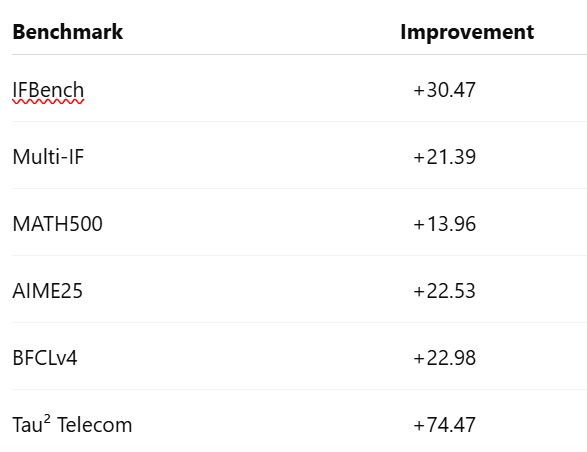
These improvements come from:
- Larger pre-training dataset
- Reinforcement learning
- Enhanced reasoning capabilities
- Better instruction tuning
The gains are especially visible in tool usage and agentic tasks.
Reduced Hallucinations
One of the most interesting benchmark improvements comes from hallucination reduction. On the AA-Omniscience benchmark:
- Previous model score: -78.42
- LFM2.5 score: -24.70
Even more impressive is the jump in non-hallucination rate:
- Previous: 7.46
- LFM2.5: 63.47
For enterprise deployments, reducing hallucinations is often more valuable than improving raw benchmark scores.
Fastest Model in Its Class
Liquid AI claims LFM2.5 is currently the fastest model in its size category. According to published results:
- Up to 18.5K output tokens per second
- More than 1.6 billion tokens per day on a single H100 GPU
The model also performs exceptionally well on CPUs, making local deployment practical even without expensive hardware. This is particularly important for:
- Edge AI
- Offline assistants
- Privacy-focused applications
- Enterprise deployments
Deployment Options
Liquid AI provides multiple deployment formats.
Native Checkpoint
Best for:
- Transformers
- vLLM
- SGLang
GGUF
Optimized for:
- llama.cpp
- Local AI applications
- CPU inference
ONNX
Useful for:
- Cross-platform deployment
- Enterprise environments
MLX
Optimized for:
- Apple Silicon Macs
- Local inference on M-series chips
This broad ecosystem support makes adoption much easier for developers.
Fine-Tuning Support
Developers can further customize the model using several training approaches. Supported workflows include:
- Continued Pretraining (CPT)
- Supervised Fine-Tuning (SFT)
- DPO
- GRPO
- LoRA-based training
Popular frameworks such as:
- Unsloth
- TRL
are already supported. This flexibility allows organizations to adapt the model to domain-specific tasks without training from scratch.
Where LFM2.5 Excels
LFM2.5 is particularly strong for:
- Personal AI assistants
- Tool-using agents
- Structured output generation
- Workflow automation
- Customer support assistants
- On-device AI applications
- Multilingual systems
Where It May Not Be the Best Choice
Liquid AI explicitly notes that LFM2.5 is not optimized for:
- Heavy software engineering tasks
- Advanced coding assistance
- Knowledge-intensive QA without retrieval
For those workloads, larger specialized models may still perform better.
Final Thoughts
LFM2.5–8B-A1B represents an important shift in AI model design. Instead of chasing ever-larger parameter counts, Liquid AI focuses on delivering practical intelligence that can run efficiently on everyday hardware.
With only 1.5 billion active parameters, a massive 128K context window, strong tool-calling capabilities, multilingual support, and industry-leading inference speed, the model is positioned as a compelling option for local AI assistants and agentic applications.
For developers building AI systems that need to run outside the cloud, LFM2.5–8B-A1B may be one of the most interesting open models released this year.
메타데이터
- post_id
- 881b14922f9c
- slug
- liquidai-lfm2-5-8b-a1b-best-edge-ai-llm-is-here-881b14922f9c
- url
- https://medium.com/data-science-in-your-pocket/liquidai-lfm2-5-8b-a1b-best-edge-ai-llm-is-here-881b14922f9c
- canonical_url
- https://medium.com/data-science-in-your-pocket/liquidai-lfm2-5-8b-a1b-best-edge-ai-llm-is-here-881b14922f9c
- author_url
- https://medium.com/@mehulgupta_7991
- status
- ok
- fetched_at
- 2026-06-15 20:49:13