Svalbard dispute escalates as russia and china test arctic sovereignty
Norway intercepts 14 unauthorized vessels near the archipelago in 2026, as competing continental shelf claims threaten to redraw the Arctic…
Svalbard dispute escalates as russia and china test arctic sovereignty
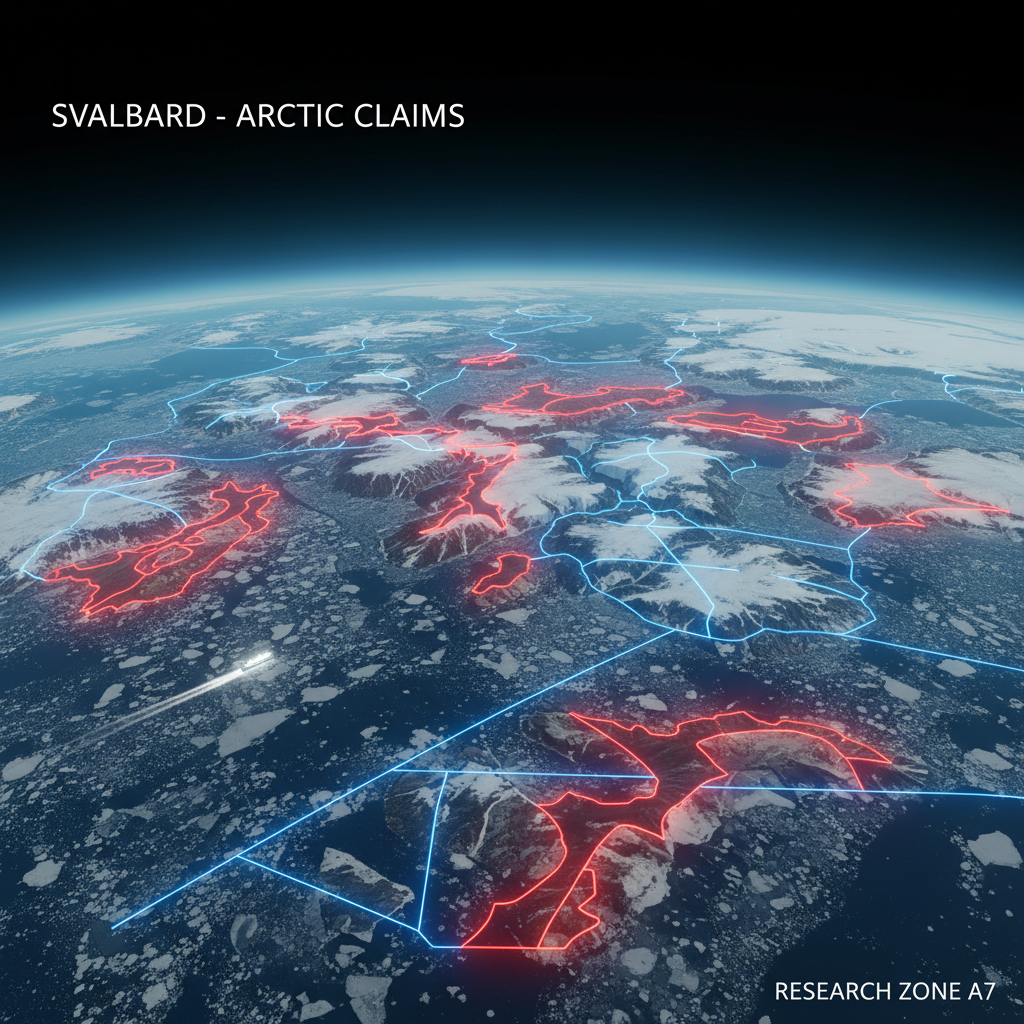
Norway intercepts 14 unauthorized vessels near the archipelago in 2026, as competing continental shelf claims threaten to redraw the Arctic map.
The quiet crisis on the 78th parallel
On June 3, 2026, the Norwegian Coast Guard vessel KV Svalbard intercepted a Chinese research trawler 12 nautical miles off the coast of Ny-Ålesund. The ship, the Xiang Yang Hong 18, had switched off its automatic identification system and was dragging a sonar array through waters Norway claims as its exclusive economic zone. It was the ninth such interception by Norwegian authorities in the first half of 2026 — more than in all of 2023 combined.
The Svalbard archipelago sits at 78 degrees north latitude, roughly halfway between mainland Norway and the North Pole. Under the 1920 Svalbard Treaty, Norway holds sovereignty over the islands, but signatory nations — including China and Russia — have equal rights to conduct commercial activities there. That treaty was written for an era when the archipelago was a coal mining outpost accessible only by icebreaker. In 2026, with the Arctic shipping season stretching from May to November and the Barents Sea ice edge retreating 40 kilometers per decade, Svalbard has become something else entirely.
What the treaty does not say
The 1920 treaty's silence on maritime zones is the problem. It grants Norway "full and absolute sovereignty" over the land, but says nothing about the waters. Norway claims a 200-nautical-mile exclusive economic zone around Svalbard — and by extension, the right to regulate fishing, shipping, and seabed exploration there. Russia and China argue the treaty's equal-access provisions extend to those waters too.
This is not an academic debate. The Norwegian Petroleum Directorate estimates the Barents Sea shelf around Svalbard holds 1.7 billion barrels of oil equivalent in undiscovered resources. The deep-sea mineral deposits — polymetallic nodules containing manganese, cobalt, and rare earth elements — are valued by the US Geological Survey at roughly $85 billion at current market prices. China imported 70% of its rare earths in 2025; the Svalbard seabed could supply a substantial portion of that demand.
Russia has made its position clear. In April 2026, the Russian Embassy in Oslo formally submitted a diplomatic note asserting that Norway's 1977 fisheries protection zone around Svalbard "lacks legal basis." The note cited the treaty's Article 3, which guarantees equal access to "fisheries and hunting." Russian fishing vessels have operated inside the zone for decades, but the new escalation involves state-owned research ships — the same ones that map seabed topography for submarine operations and mineral claims.
The Chinese dimension
China's presence on Svalbard is newer but growing fast. Since 2014, China has operated the Arctic Yellow River Station in Ny-Ålesund — an 80-hectare research facility that hosts 25 scientists during summer months. In 2025, Beijing announced a 10-year, $600 million expansion of its Arctic research program, with Svalbard as the primary hub.
Chinese vessels in the region have a pattern. The Xiang Yang Hong 18 was tracked by Norwegian intelligence in May 2026 conducting bathymetric surveys along the continental shelf slope — the same data needed to extend a coastal state's seabed claim beyond 200 nautical miles under the UN Convention on the Law of the Sea. Norway's submission to the Commission on the Limits of the Continental Shelf, filed in 2019, already claims 550,000 square kilometers of extended shelf in the Arctic. China's surveys could be used to challenge that claim — or to inform Beijing's own submission for the Central Arctic Ocean, where the seabed is international territory.
Velina Tchakarova, a strategic analyst at the Austrian Institute for European and Security Policy, described the situation bluntly in a January 2025 briefing: "The Northern Sea Route, cutting East Asia–Europe trade by 60%, is the DragonBear's Arctic playbook." Svalbard sits at the western terminus of that route. Control over its waters means control over the choke point.
The military gap
Norway's ability to enforce its claims is limited. The Norwegian Coast Guard operates five purpose-built ice-strengthened vessels, but only two are stationed in the Svalbard region at any time. Russia's Northern Fleet, based at Severomorsk on the Kola Peninsula, has 32 surface combatants and 11 submarines within 48 hours' steaming of the archipelago.
A 2025 report from the Norwegian Defence Research Establishment found that Russia could interdict all maritime traffic to and from Svalbard within 72 hours of a decision to do so. Norway's response would depend on NATO — specifically, on the US Navy's ability to project power into the Barents Sea, a capability that has been exercised only sporadically since the Cold War ended.
Canada, meanwhile, faces its own version of the same problem. As noted by analyst Mary Coates in July 2026, "Canada's claim to vast swaths of this territory is backed by a handful of aging icebreakers and a non-existent military presence." The Arctic is the Western alliance's longest undefended frontier — and Svalbard is its most exposed sentry post.
What comes next
Three scenarios are plausible, and they are not mutually exclusive.
The first is legal escalation. Norway could refer the dispute to the International Tribunal for the Law of the Sea, seeking a binding ruling on whether the 1920 treaty applies to maritime zones. That process would take 5–7 years. During that time, Russia and China would continue to operate in disputed waters, building facts on the ground.
The second is economic competition. Norway has licensed 11 exploration blocks in the Barents Sea since 2020, but none on the Svalbard shelf. A decision to open those blocks would trigger immediate diplomatic protests from Moscow and Beijing — and could lead to reciprocal restrictions on Norwegian fishing vessels in Russian Arctic waters, which caught $340 million worth of cod in 2025.
The third is military friction. In March 2026, a Russian Su-34 fighter aircraft violated Norwegian airspace near Svalbard for 47 seconds before being intercepted by two Norwegian F-35s. Such incidents are becoming routine — there were 12 in 2025, up from 6 in 2023. Each one carries the risk of miscalculation.
The broader picture is this: the Arctic is no longer a frozen frontier. It is a regulatory vacuum filled by competing claims, a resource frontier with $1 trillion in estimated mineral value, and a transit corridor that will reshape global trade. Svalbard is where all three trends converge. And right now, nobody is sure who holds the keys.
메타데이터
- post_id
- 8823ec9db07b
- slug
- svalbard-dispute-escalates-as-russia-and-china-test-arctic-sovereignty-8823ec9db07b
- url
- https://medium.com/@meridianoeurasiatico/svalbard-dispute-escalates-as-russia-and-china-test-arctic-sovereignty-8823ec9db07b
- canonical_url
- https://medium.com/@meridianoeurasiatico/svalbard-dispute-escalates-as-russia-and-china-test-arctic-sovereignty-8823ec9db07b
- author_url
- https://medium.com/@meridianoeurasiatico
- status
- ok
- fetched_at
- 2026-07-13 06:23:13