Trump Uses “I” Twice as Often as the Sociopath Kubrick Invented. The Pope Uses It Zero Times.
I used software that measures word patterns to analyze Trump, Pope Leo, A Clockwork Orange, and Milgram’s obedience prompts. The data…
Photo by Sean Ferigan on Unsplash
The Vocabulary of Obedience
Trump Uses “I” Twice as Often as the Sociopath Kubrick Invented. The Pope Uses It Zero Times.
I used software that measures word patterns to analyze Trump, Pope Leo, A Clockwork Orange, and Milgram’s obedience prompts. The data doesn’t care about your politics. It cares about your pronouns.
I had no intention of writing this. I was going through Andy Borowitz’s side-by-side comparison of Trump and Pope Leo XIV quotes while sipping my Sunday morning coffee. Halfway through I noticed a trend in sentence structure which bothered me more than what either man said.
What bothered me wasn’t the content, it was the structure. The Pope never uses “I.” Trump uses “I” almost as much as he breathes. I’m not making a political point. Word frequency is measurable. So I measured it.
Using the Trump and Pope quotes from Borowitz’s compilation, I found the complete dialogue for Kubrick’s A Clockwork Orange screenplay and obtained Milgram’s four standard experimenter prompts from his original 1963 publication. I fed all of it into two pieces of software that don’t care whether you’re quoting a president or a madman.
VADER reads your text and assigns a value on how positive or negative each sentence is using a range from -1 (100% hostile) to +1 (100% warm). VADER treats a prayer and a death threat equally indifferent.
NLTK takes apart the words in your text and compares them. How often someone says “I.” How many superlatives they use. NLTK doesn’t know if you’re quoting a president or a fictional psychopath. It just counts.
The results were so unusual that I shut down the laptop, brewed another cup of coffee and reopened the laptop. The results did not change. Before we review some of these results: the most positive sentence in this dataset of all five speakers discusses an act of violence. It rated above any Pope quote about God, peace, or forgiveness. Keep this in mind.
The Number That Won’t Leave Me Alone
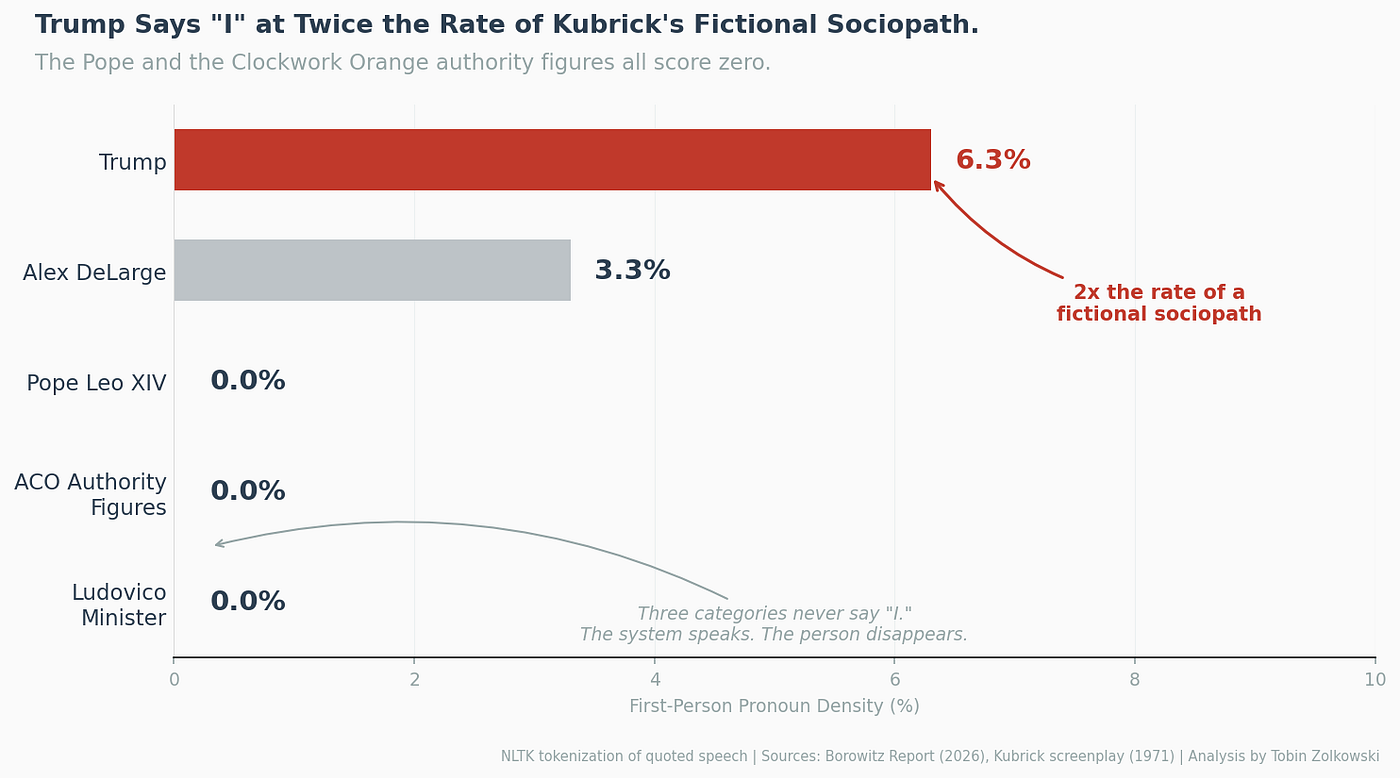
Trump’s density of first-person pronouns in 13 quotations: 6.3%. Therefore, one out of sixteen words are I, me, my, mine, or yourself.
Leo XIV (the pope)’s first-person pronoun density: 0.0%.
Low? No. Not .05%, zero. Erase all references to himself within each sentence the pope utters. The subject can never be the church, the heart, the poor, god, peace. Software has no concern as to whether this is theology or performance; however, the grammar is performing an action that is consistent and deliberate.
I thought that Alex DeLarge from A Clockwork Orange would come close to Trump. This is because DeLarge is a violent narcissistic individual who describes his own crime(s) in first person. However, DeLarge had a 3.3% first person pronoun usage. This is half of Trump’s usage. Kubrick created a fictional character to represent the most egotistical being in a room using fewer “I” and “me” type of words than a sitting U.S. President.
I came across one of the most interesting findings that brought me right back to the top of my analysis — the way authority figures were portrayed in Kubrick’s movie. The prison wardens. The doctors who developed the Ludovico technique, which is a drug-and-film conditioning treatment that causes physical illness in response to violence. The government minister who authorized this procedure.
The authority figures in Kubrick’s movie use no “first person” pronouns (0.0%). So does the Pope. People designing a governmental program for reprogramming an inmate’s mind speak with the same tone as the Head of the Catholic Church.
I started over on the entire script. Ran all of the quotes through again in a different order, still produced the exact same results.
If you have not watched the film, then the trailer will be worth your time for at least two minutes before continuing to read about Kubrick’s authority figures; they never yell.
[embed]
Two Machines
At some point I had to admit that the way the data was dividing into groups seemed almost too neat; maybe I just made a mistake somewhere along the line.
The first type of authority always says “I” — the system is the authority, it’s personal and everything is expressed in terms of the authority speaking. “I will build a great, great wall.” “Nobody’s ever been more successful than me.” “I think God is very proud of the job I’ve done.” Each statement expresses what the authority believes by looping back to the authority. There is no separation of the policy from the authority since the grammar does not allow such separation.
The second type of authority never uses the word “I”. Instead the system is authoritative, and the individual is lost in the process. “The point is that it works.” “He ceases to be a creature capable of moral choice.” “Peace is built in the heart and from the heart.”
Those Clockwork Orange lines looked out of place for a dystopian novel. Too quiet for a dystopia, too neutral. That was when I realized why they looked wrong — they sounded like a homily. There’s no speaker, so there’s nothing to argue with. The sentence simply presents itself as a fact regarding the world rather than as an expression of someone’s opinion.
Both types of authorities produce compliance. The issue becomes which of them creates more of it.
Milgram figured this out sixty years ago. I don’t think Milgram’s results have been interpreted correctly.
The Part of Milgram Nobody Talks About
Everyone remembers the statistic. In 1961 at Yale University, 40 men were told to deliver shocks to a stranger. All 40 went to 300 volts. 65% went all the way to 450. A regular individual will electrocute a stranger based solely on an order given by a man wearing a white lab coat. We all heard about this in Psychology 101 and went on to the next topic.
Now, here’s what they don’t put in the psychology book.
When Milgram performed his study once again from a dingy old office rather than Yale, the rate of compliance decreased to 47.5%. From the same room where the learner was located: 40%. The experimenter had to manually grasp the learner’s arm onto the plate: 30%. I read these numbers one after another before expecting the floor to drop. Removed the authority figure from the room: 22.5%. Nine of forty.
Twenty-two percent. Two thirds of the obedience vanished when the person giving orders left the room.
It wasn’t the level of electricity that mattered nor was it the screams nor was it the moral character of the participants. What determined whether they would deliver (or be willing to) the electric shock depended upon their proximity to and how much they believed the legitimacy of the person giving them instruction. Take away the person providing instructions, take away the obedience.
However, I couldn’t stop going back to Milgram’s first publication while continuing to reread the same paragraph. No one ever talks about the way that language is structured into those instructions.
Milgram’s experimenter utilized four different standardized forms of instruction for each successive increase in pressure:
“Please continue.”
“The experiment requires that you continue.”
“It is absolutely essential that you continue.”
“You have no other choice; you must go on.”
I took each of Milgram’s four prompts apart word by word.
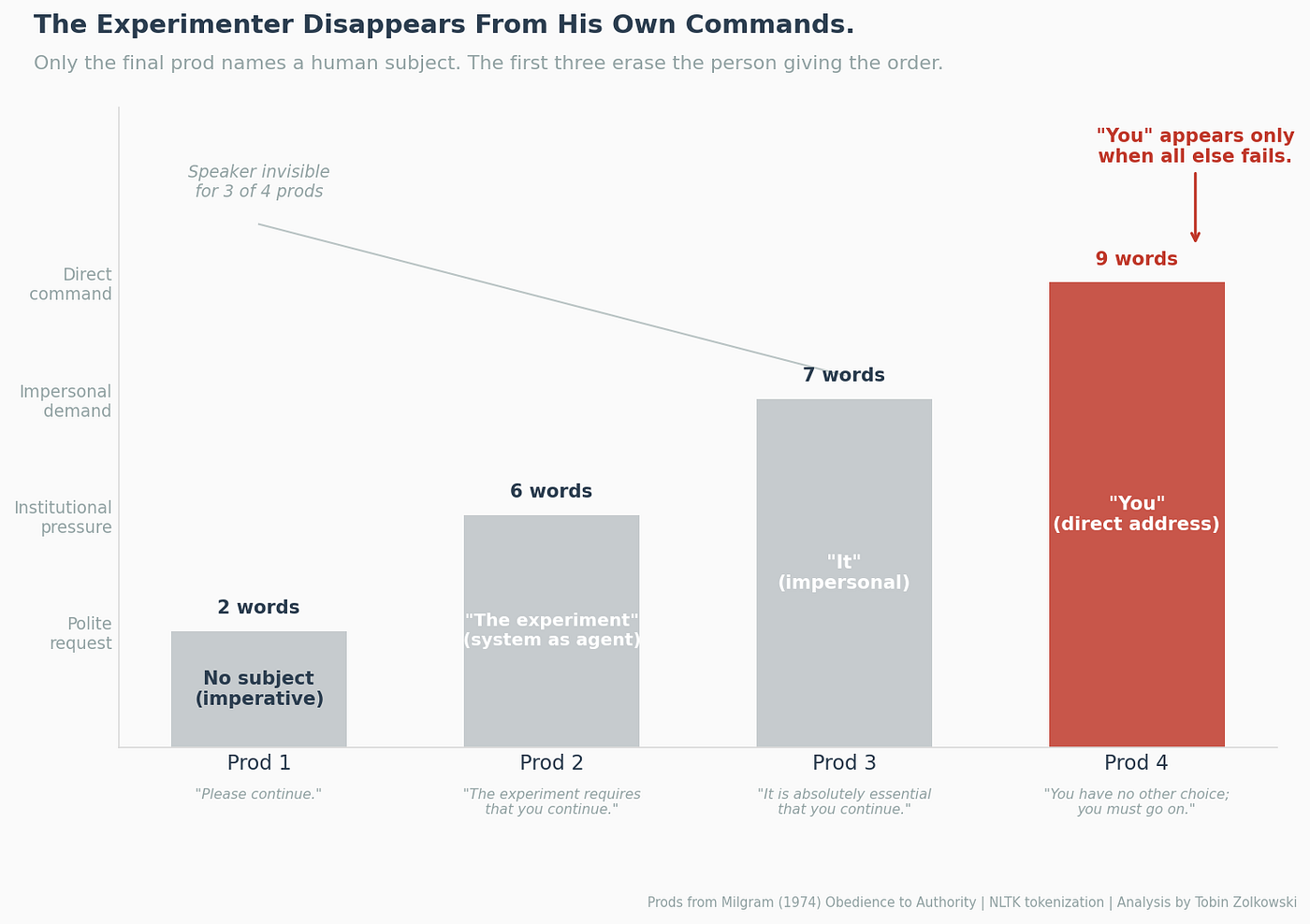
Look at what each of these subjects say. Prod 1: No Subject. A two-word direct order that does not identify who or what will carry out the order. Prod 2: In this case, “the experiment” (not the experimenter) is now the subject; that is, the process itself. Prod 3: “It.” We’re down to simply referring to a noun with a pronoun that points nowhere. Prod 4, the last-ditch effort: “You.” Only prod 4 has a human as the subject of its main clause.
In this way, the experimenter has essentially erased himself from his orders. The participant is not responding to a person. Instead they are responding to the grammar of the commands.
I’m familiar with that grammar. I am deaf. I use American Sign Language and Video Relay Service. All institutions I’ve worked with include some variation of these orders. “Video calls aren’t supported by our systems,” “Phone numbers are required by all of our forms,” “All policies require verification via telephone.”
Although those were written by people (and presumably for other deaf people), there’s always a third-person reference (“the system”, “policy”) rather than a first- or second-person reference (a person). As such, there’s nobody in the sentence to debate against. There is a rule. The system requires. Policy dictates. It cannot be done.
For as long as I’ve lived, I’ve received messages of authority devoid of a person. That’s why I was surprised when I ran Milgram’s four commands through the tokenizer and saw that all references to persons disappeared.
This is also true about the zero-first-person reference pattern I see in authority figures from the movie Clockwork Orange, and the language used by the Pope. When institutional voices eliminate the speaker from their sentences, then there is nobody to reject. You can say no to Trump because he is present in almost every sentence — he takes credit, makes it personal. How do you say no to “it is absolutely essential?”
Milgram called this the agentic state. The shift happens when you stop seeing yourself as the one acting and start seeing yourself as someone carrying out instructions. I believe this shift occurs at the level of grammar before it occurs at the behavioral level. Further, I believe that this is what has been discovered using word-pattern analysis.
So far.
Where It Gets Strange
I ran sentiment analysis on Trump’s quotes to back up the pronoun finding. That’s not what happened.
Quick VADER reminder: the model scores each sentence from -1 to +1. Near +1 reads as warm and affirming. Near -1 reads as hostile or threatening. Zero is neutral.
Across thirteen quotations by President Trump, his VADER scores ranged from -0.81 to +0.92. Trump’s range covers almost the full VADER scale on its own. For example, within two consecutive passages he stated “I hate my opponent,” and praised the actions of authoritarian world leaders.
VADER scores were high (+0.92), relative to all other quotation examples in the dataset, when referring to Putin, Xi, and Kim Jong Un. These quotations were more positive than any quoted passages referencing God, peace, or forgiveness by the Pope.
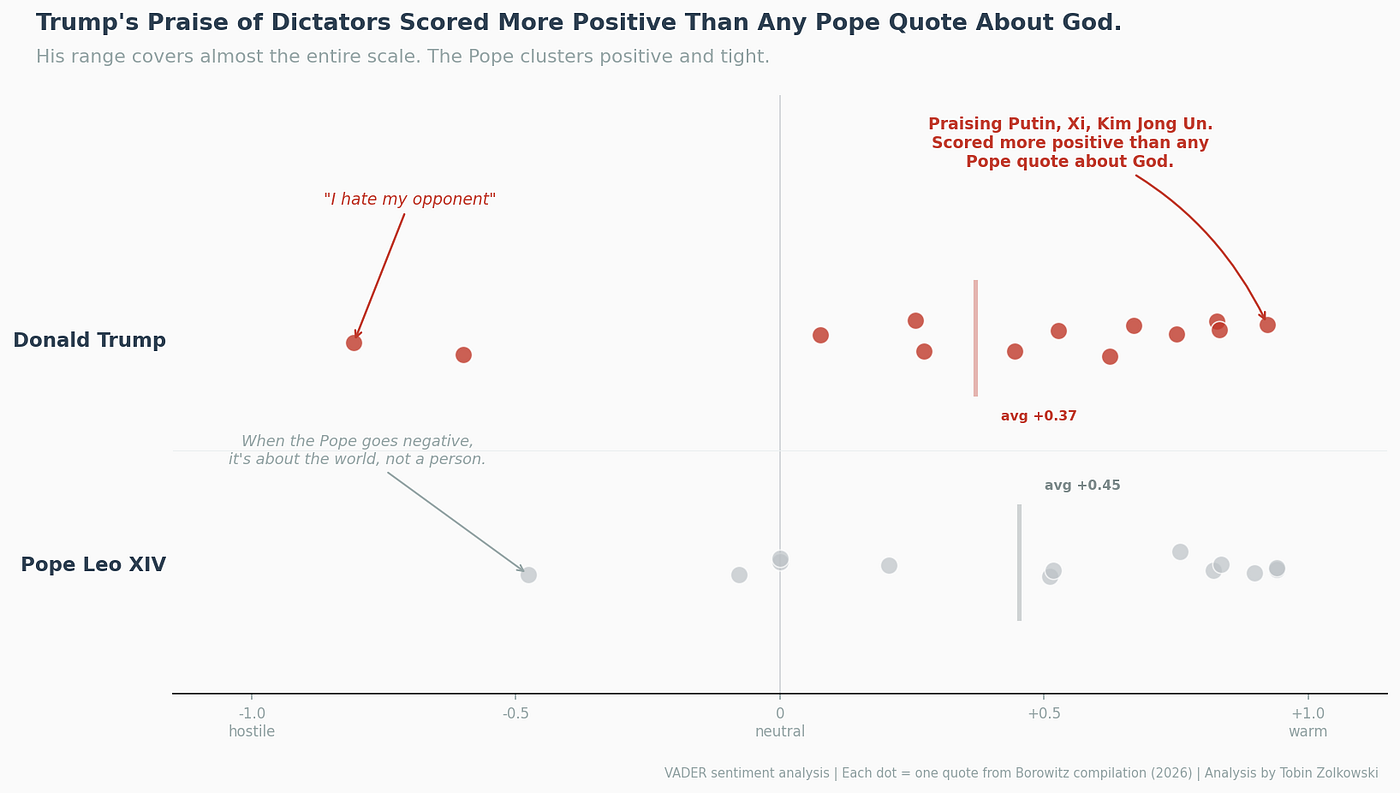
The Pope’s range is smaller (1.42) and also has a slightly different form than what I had anticipated. Although both the Pope and Trump use negative rhetoric, they approach the negative differently.
When the Pope uses negative rhetoric he is generally addressing an issue or concern with regard to the world. “The world is being ravaged by a handful of tyrants.”
When Trump uses negative rhetoric, he usually addresses the negativity directly toward another person. “I hate my opponent.”
Although I did not set up the analysis to capture the difference between the two approaches, the scatter plot demonstrated it to me regardless.
Alex De Large, however, continues to baffle me. His average score of +.39 falls right between that of Trump (+ .14) and the Pope (+ .54). Sounds normal, until you look at his best quote. That quote had a score of +.94 and is listed as the best single quote from the entire data set in all five categories. This quote is:
“Oh, bliss! Bliss and heaven! It was gorgeousness and gorgeosity made flesh.”
This quote is referring to Beethoven and destruction. In fact, this quote received a better score than many other quotes including: “God loves us, God loves you all, and evil will not prevail.” Higher than “Peace is built in the heart,” and so on. Every quote used by the Pope for blessings, prayers, and appeals for mercy was lower than this one. The most beautiful language in this data set comes from a young man that enjoys beating strangers.
It’s no surprise then why Kubrick constructed the entire Ludovico Technique sequence using this concept. Alex puts the violence he commits into some of the most beautiful language available to him. And we believe him.
We’re sad when Alex loses his ability for beautiful language after the conditioning process removes it from him. We forget that the beautiful language was all along describing how he hurt others. The sentiment reads positive even when the subject is violence. That gap is where the deception lives.
I couldn’t help but think of Trump’s Iran quote again. “Time is running out. 48 hours before all Hell will reign down on them. Glory be to GOD!” The software assigns this quote a positive rating, + .26. Annihilating a nation through military means and celebrating it as a divine act — and the computer considers this to be positive language. I nearly burst out laughing at that point. Nearly.
I’m reporting the count. The interpretation is on the reader.
The Quadrant Nobody Asked For
I did not create this graph to look for a relationship among these speakers; I created it to determine whether there was a relationship. There is. One of the speakers sits so far from the others that the graph looks broken.
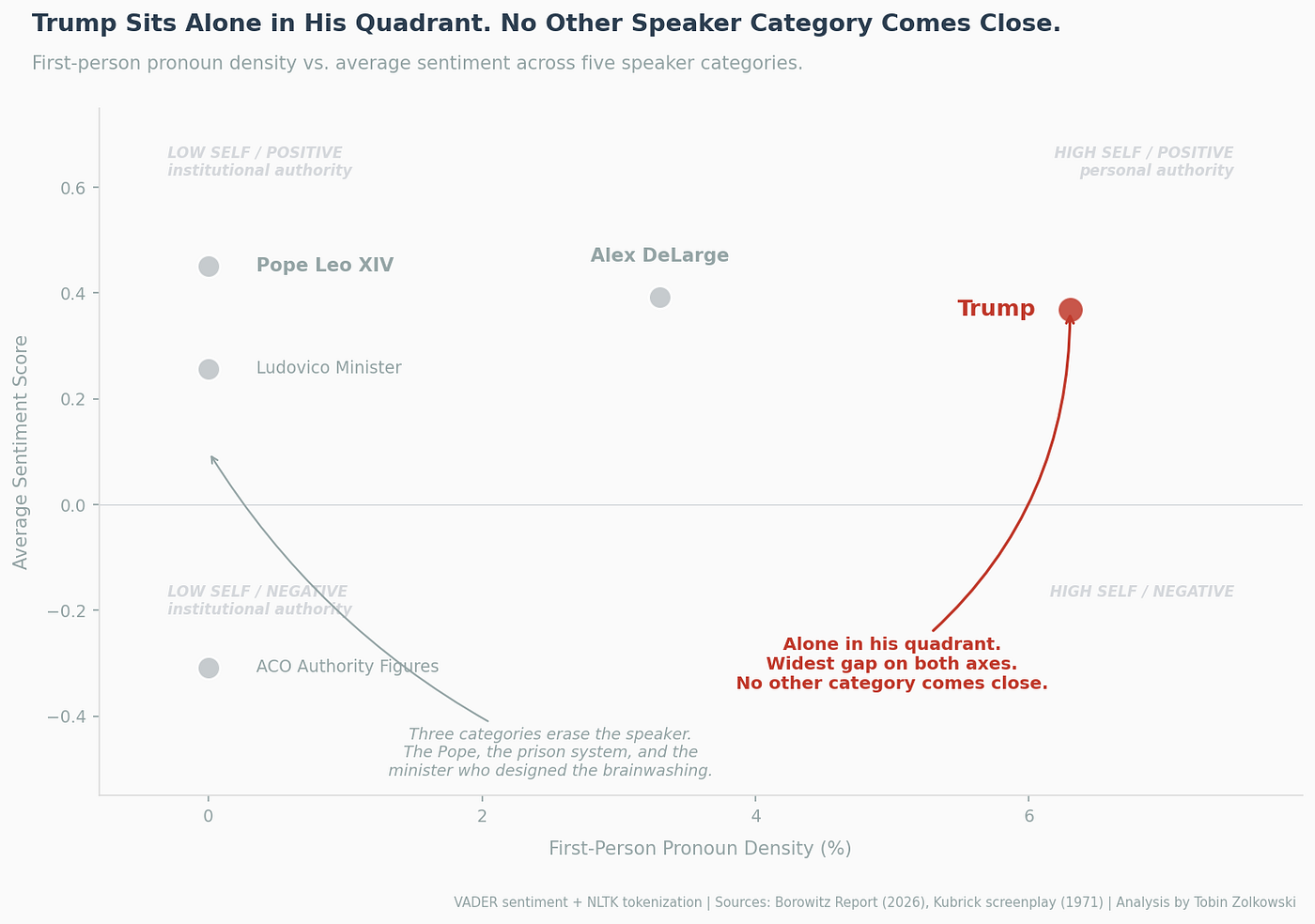
Upper Right: Trump. High self-reference, strong positive sentiment. Nobody else in the quadrant. Lower left: the Clockwork Orange authority figures, at zero self-reference and strong negative sentiment toward themselves. No other speaker category lives down there.
The Pope is located at the top, left-hand corner. Alex is in the center. Every single person (except for Trump) cluster together in some manner. However, they do not cluster around Trump. I expected some form of overlap when I designed this chart. There isn’t any.
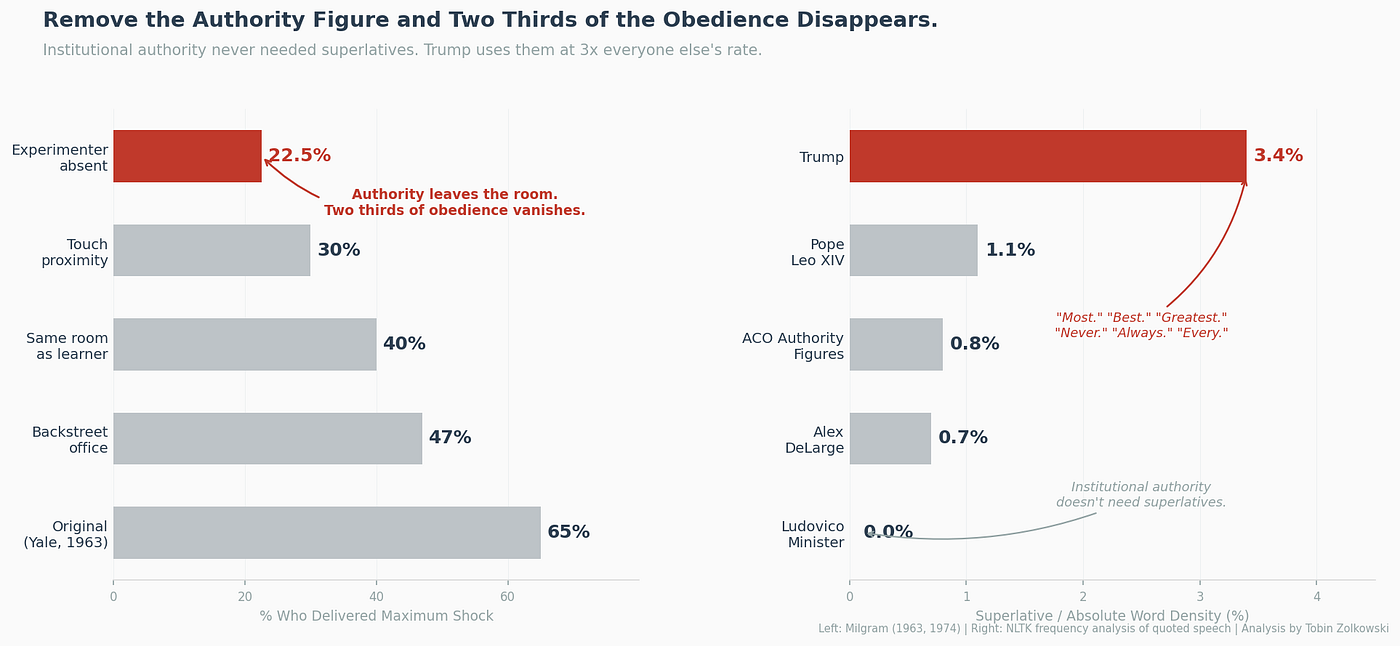
I believe the extreme density of the data presented in the graph may have also exacerbated this problem. Trump uses words which denote an absolute term approximately 3.4% of the time. “Most”, “best”, “greatest”, “largest”, “never”, “always” and “every” are examples of absolute terms he frequently employs. I manually counted every instance of these types of words (after the software had passed through them), to ensure that no duplicate counts were being included. There were none.
Pope uses absolute terms approximately 1.1% of the time. The Clockwork Orange authority figures use them approximately 0.8% of the time. The Ludovico Minister used them .00% of the time.
Institutional authority does not require absolute terms to be employed in order to be effective. Institutional authority does not need to be the largest or most effective. All institutional authority requires is to present itself as a normal, acceptable method for the status quo. “The point is that it works”. There is no comparative measure; no superlative; and no pronoun.
The Researcher Who’s Been Watching This for Thirty Years
After I built the quadrant map, I started looking for anyone who’d studied this outside a lab. A reader pointed me to Dr. Karen Mitchell.
Dr. Karen Mitchell is an Australian researcher whose PhD was the first to collect data on practitioners working with high-functioning psychopaths, narcissists, and predators in non-prison settings.
Mitchell didn’t build her dataset from prison surveys or undergrad questionnaires. She went after what she calls “practitioners”: doctors, attorneys, CEOs, clergy, military officers. People so good at doing harm while looking respectable that nobody around them notices.
Most dark-personality research only studies the ones who got caught. Mitchell went looking for the ones who didn’t. Consider that for a moment. She designed a study to find professionals skilled enough to evade detection across entire careers.
Her interview list: religious leaders, medical specialists, FBI profilers, prison therapists, community therapists, clinicians treating cult survivors and domestic violence victims. Her literature review pulls from two fields that rarely talk to each other. The dark triad literature covers psychopathy, narcissism, and Machiavellianism. Coercive control covers isolation, threats, financial domination, and the other invisible tactics people use to take power over someone else. She adds clergy abuse and toxic corporate and government leadership on top. Probably the most comprehensive review anyone has done across these areas.
Mitchell concludes that narcissists, psychopaths, and manipulative strategists are subtypes of one overarching category. She calls it the Persistent Predatory Personality (PPP). The name is somewhat difficult to get past its movie title connotations before it begins to sound like a diagnostic label.
The PPP has three levels. Twenty traits shared across predatory personalities. Twenty-five strategies they use to hide intent and get what they want. The third level adds twelve variables like cognitive ability, impulse control, and wealth that change how well any given predator stays hidden.
A low-level street criminal and a top-echelon executive can both fit PPP. The traits are identical across them. Only the camouflage differs.
What I found was the twenty characteristics grouped into four clusters. I did not provide the list of all twenty. There were two that made me stop dead in my tracks.
One was control. The top rated trait (Mitchell has ranked the traits) was not charm, manipulation, or lack of empathy. It was the need to dominate and be in charge. That was defined in the data as an “intense” and “all-pervading” need for control.
Coercive control is a legal definition that includes domestic violence. These predators control their victims through emotional, financial, reputational, professional, sexual, social, and parental channels, plus direct intimidation.
Control was not on Hare’s 20-item PCL-R checklist, which is used by psychologists to determine if someone is psychopathic. What is listed as #1 on Mitchell’s rankings is missing from the most widely accepted diagnosis tool.
The second: Sadism. Not the movie type. The satisfaction from degrading, humiliating and causing harm to other people. Shared across all subtypes. Also missing from the PCL-R. In Mitchell’s model, both sadism and control are the two primary attributes. Neither is addressed in the PCL-R.
I didn’t expect this. The grammar pattern I’d been tracking is a control method. Authority pulls itself out of the sentence so nobody can refuse. Mitchell’s predators do the same thing without words. They control through emotional, financial, reputational, and professional channels while staying invisible themselves. The target ends up fighting a system instead of a person.
Mitchell estimates about 10% of the public meets PPP criteria. The rate climbs to 15% in professions like medicine (psychiatrists included) or any field that lets someone run a “double life” behind credibility and high income. She has identified nine individuals with mental health qualifications who currently meet the PPP criteria, including a professor and a member of a professional organization. 82% of her survey participants feared being physically hurt by their predators. 74% were still afraid for their safety between appointments, even when the predator had no way to be physically present.
Mitchell also has a 2025 paper coming out in a top academic journal. She applies the PPP model to coercive control in domestic violence cases. Her argument: social workers need the framework to grasp how much actual danger coercive-control victims are in. The invisible controlling behaviors many jurisdictions are now criminalizing are a single page in Mitchell’s playbook.
I’m a data analyst, not a psychologist. But the one category on my quadrant map that sits apart from everything else on both variables is the one with the highest self-reference and the most positive sentiment. Mitchell’s model calls that a High Functioning Predator using Personal Authority. The data just shows the size of the gap.
What I Don’t Know
Three sources, sixty-five years apart. A satirist compiled Trump and Pope quotes in 2026. A filmmaker adapted a dystopian novel in 1971. A Yale psychologist tried to explain the Holocaust in 1961. None of these authors were interested in the same topics. However they have the same linguistic features.
Possibly every authority uses the same type of language. Therefore there is no way to get away from using the same type of language as authorities use. Possibly only English Grammar provides authority with a few forms (i.e., ways) to appear. Therefore both Milgram, Kubrick, and the Vatican (independently) stumbled upon the same forms.
Although it would be interesting to see how many references Kubrick used when he developed his screenplay for “A Clockwork Orange,” I could not find a reference to Milgram by Kubrick prior to developing his screenplay. Although the time frame would allow him to read or view the Milgram experiment video prior to developing his screenplay and the similarities are obvious, I couldn’t find a reference to that either.
FYI, Carey et al. (2015) conducted a meta-analysis of studies that tested whether NPI scores correlated with rates of “I/me” use and found they do not. That’s neither here nor there for our purposes. What we care about is that authority and grammar together compel speakers to follow rules. The title above attempts to pun on a correlation Carey demonstrated doesn’t exist. Heads up.
There is something that this article does not address, and I have been criticized for that before.
When I wrote an article about the Milgram Experiment for my previous blog entry; I made the same error as most writers do when referencing this study. I focused solely on the fact that 65% of participants followed orders given to them. Two of the readers pointed out to me that I overlooked one major aspect of the study: the 35% of participants who did not follow those orders.
One of the readers was a former educator who had also studied what she referred to as “upstander behavior” in some of her past students. Those individuals who take action rather than simply following orders are described by her as being engaged in upstander behavior. In addition to describing upstander behavior, she noted three characteristics that consistently appeared in those students who demonstrated such behavior: gratitude, mindfulness, and a strong sense of their own ethics and morals.
She stated that she thought that was probably my next topic. That is still pending.
The Off Switch
I have retained a sense of mindfulness (the third) for longer than I did for either the first or second.
In 1994 Jon Kabat-Zinn authored a meditation book titled Wherever You Go, There You Are. This type of writing isn’t something I typically read. However, his explanation of the term ‘mindfulness’ resonated differently after spending one full day reviewing Milgram’s data. Kabat-Zinn states:
“Mindfulness refers to the intentional focus on the present-moment experience, without judgment.”
In contrast, he describes the opposite state as an automatic-pilot mode of unawareness.
Automatic-pilot mode. Follow the sequence.
This is the state where participants are considered to be operating in an agentic state. This is also the 65% who continued with the study after receiving commands from the experimenter to continue shocking the learners. The participant didn’t choose to administer the shocks; rather, they ceased making choices altogether.
According to Kabat-Zinn, mindfulness creates a gap between what occurs and your response. When you receive a command, instead of responding automatically, you pause. You become aware of what is occurring. You check-in with yourself.
That gap can be very short. Take a breath. Pay attention to this moment. And that may be the difference between those who responded (the 65%) and those who did not (the 35%).
The teachers who were upstanders had this element of mindfulness. They were present enough to realize how wrong it would be to comply with such requests, and that realization allowed them to override the authority issuing the request.
The mindfulness here wasn’t meditation. It was staying awake in a room built to put people to sleep.
Everything before this section is about how authority functions. All of that — pronouns, sentiment, grammar, control, predatory personality studies are the machine.
Kabat-Zinn reminds you that the machine has an off switch. It’s attention. It’s noticing where you are and what you’re doing and whether you actually chose to do it. Anywhere you go there you are. You can’t be manipulated out of a room you never left.
My software makes the same mistake I just called out in myself. It counts commands. It scores sentiment. What it can’t see is what happens inside someone who hears “the experiment requires that you continue” and says no anyway. The software can see the commands. It is blind to whatever exists on the other side of them. My code only reaches the obedience half. The resistance half exists somewhere my code does not. But it matters more.
You have already obeyed both kinds of authority today. Once when someone with a title told you what to do and you did it for who they are. The other time, a sign or a policy or an automated message told you what to do, and you did it because there was nobody to question. The sentence had no human subject. Nor did your compliance.
I don’t have an opinion about which type of obedience is worse than the other. I have a spreadsheet.
Methodology note: Sentiment scored with VADER. Word frequency and text analysis performed with NLTK. All analysis is original work by the author. Every source is linked below.
Sources:
Milgram, S. (1963). Behavioral study of obedience. Journal of Abnormal and Social Psychology, 67, 371–378. PDF
Milgram, S. (1974). Obedience to Authority: An Experimental View. Harper & Row. WorldCat | Internet Archive
Burger, J. M. (2009). Replicating Milgram: Would people still obey today? American Psychologist, 64(1), 1–11. PDF
Blass, T. (1999). The Milgram paradigm after 35 years. Journal of Applied Social Psychology, 29(5), 955–978. Wiley
Kubrick, S. (1971). A Clockwork Orange [Screenplay]. Warner Bros. Transcript
Borowitz, A. (2026, April 19). Trump and the Pope debate the Bible. The Borowitz Report. Substack (paid)
Mitchell, K. (2024). Persistent Predatory Personality [PhD thesis, Swinburne University of Technology]. Kalmor Institute | Thesis (PDF)
Mitchell, K., Melville-Wiseman, J., & McFarlane, F. (2025). The deeper context of coercive control. British Journal of Social Work. SAGE
Kabat-Zinn, J. (1994). Wherever You Go, There You Are: Mindfulness Meditation in Everyday Life. Hyperion. Google Books
Carey, A. L., et al. (2015). Narcissism and the use of personal pronouns revisited. Journal of Personality and Social Psychology, 109(3), e1–e15. PDF
메타데이터
- post_id
- 8828a19dc8bd
- slug
- trump-uses-i-twice-as-often-as-the-sociopath-kubrick-invented-the-pope-uses-it-zero-times-8828a19dc8bd
- url
- https://medium.com/@grateful_aqua_goat_147/trump-uses-i-twice-as-often-as-the-sociopath-kubrick-invented-the-pope-uses-it-zero-times-8828a19dc8bd
- canonical_url
- https://medium.com/@grateful_aqua_goat_147/trump-uses-i-twice-as-often-as-the-sociopath-kubrick-invented-the-pope-uses-it-zero-times-8828a19dc8bd
- author_url
- https://medium.com/@grateful_aqua_goat_147
- status
- ok
- fetched_at
- 2026-06-09 15:37:30