Covert Narcissism and the Political Economy of Emotional Labor
The quietest people in your life are running an extraction economy — and you’re the resource being mined.
Covert Narcissism and the Political Economy of Emotional Labor
The quietest people in your life are running an extraction economy — and you’re the resource being mined.

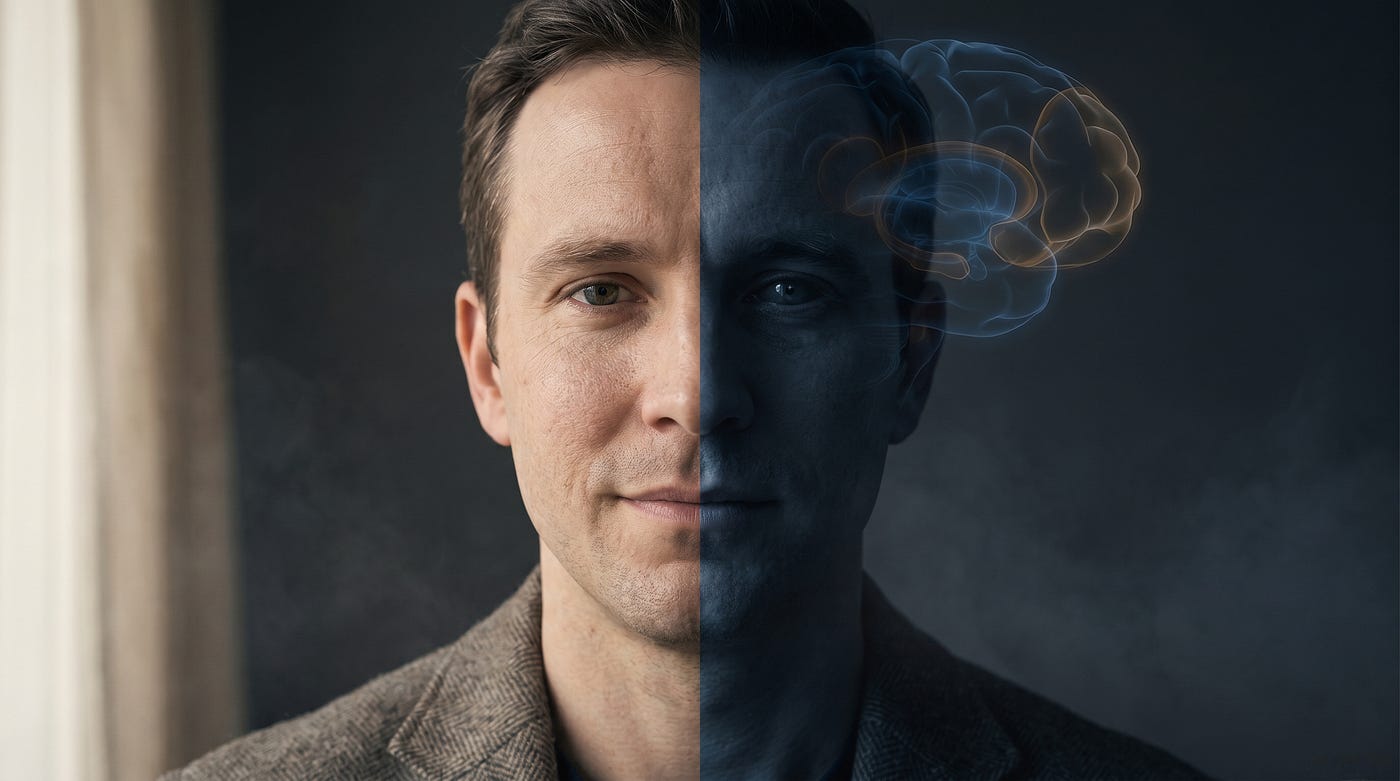
Image is generated via Nano Banana Pro.
There is a particular kind of tired that doesn’t show up on any scan.
It isn’t the tired of long hours, or hard workouts, or jet lag. It’s the tired of having been a battery for someone else’s sense of self for so long that you’ve forgotten what your own voltage feels like. You sleep nine hours and wake up depleted. You take a vacation and come back hollow. You leave the relationship — or the job, or the friendship, or the family group chat — and somehow the exhaustion follows you home.
If that sentence felt like it was written about your life, you are not imagining it. You have been participating, without consent and often without language, in one of the oldest economies on earth. It has no central bank, no quarterly earnings call, no ticker symbol. But it moves more value every single day than most listed companies move in a year.
It is the economy of emotional labor. And its most efficient extractors — the ones who have perfected the art of taking without ever appearing to take — are the people we now call covert narcissists.
This is not another listicle about red flags. This is an attempt to do something the wellness industry has been avoiding for a decade: connect the private suffering of the person who can’t quite explain why their partner, parent, manager, or best friend has hollowed them out, to the public structure of a world that has quietly built itself on top of unpaid feelings. Covert narcissism is not just a personality problem. It is a political-economic strategy. It is what extraction looks like when it has been driven indoors, behind closed doors, into the kitchen at 11 p.m. when the dishes still aren’t done and your partner is sighing again about how nobody appreciates how hard he tries.
By the end of this piece, you will have a working theory of what is happening to you. And you will have a vocabulary that nobody handed you in high school, in couples therapy, or in any HR onboarding deck — because that vocabulary was never supposed to be in your hands.
Let’s begin.
1. The Worker Inside the Bedroom
In 1983, the sociologist Arlie Russell Hochschild published a book about flight attendants. It was called The Managed Heart, and it quietly detonated the way we understand work.
Hochschild’s argument was simple and brutal. There is a kind of labor that has nothing to do with your hands. It is the labor of producing a feeling in another person. The smile that has to look real. The patience that has to seem effortless. The reassurance that has to land before the customer notices they’re being reassured. She called it emotional labor, and she pointed out that this kind of work — the work of being the emotional regulator for someone else — was disproportionately demanded of women, disproportionately invisible, and disproportionately unpaid.
Four decades later, that framework has escaped the cabin of the airplane and colonized everything.
Emotional labor is now what teachers do when they keep their composure with a child who is melting down for the fifth time that morning. It’s what nurses do when they hold the hand of a stranger who is dying. It’s what waitstaff do when a customer screams at them and they say “I completely understand, sir.” It’s what receptionists do, what bartenders do, what therapists do, what customer service reps do at three in the morning when somebody on the other end of a chat window threatens to kill themselves over a billing error.
It is also — and this is the part that has been suppressed — what most women do at home, every day, for free.
You don’t see it because emotional labor doesn’t look like labor. It looks like personality. It looks like “she’s so thoughtful.” It looks like “she just remembers everything.” It looks like “she’s the heart of the family.” A grown man can spend forty years inside a marriage and never once notice that his wife is the one who memorized which cousin doesn’t talk to which aunt, who keeps the running mental ledger of his mother’s birthday and the dog’s vaccines and the dentist’s reminder card. She is doing knowledge work. She is doing project-management work. She is doing crisis-intervention work. She is doing PR work for the family unit. And because none of it produces a payslip, none of it counts.
In 2024, the National Partnership for Women and Families ran the numbers. The unpaid care work performed in the United States — about two-thirds of it by women — would be worth more than one trillion dollars a year if anyone bothered to put a price on it. Globally, UN Women estimates women spend 2.8 more hours per day on unpaid care and domestic work than men. Multiply that by every woman on earth, every day, and you are looking at one of the largest hidden subsidies in human history.
This is the floorboards of the global economy. And this is the floorboards a covert narcissist walks across, looking for somewhere soft to stand.
2. The Quietest Predator in the Room
When most people picture a narcissist, they picture noise.
They picture the boss who screams. The boyfriend who flexes in the mirror. The CEO who fires people on a livestream. They picture grandiosity — the loud, peacocking, attention-flooding type that the DSM and pop culture both love to talk about. That kind exists. But it is not the kind that has quietly destroyed your last decade.
The kind that has quietly destroyed your last decade is the covert kind. The vulnerable kind. The one who never raises their voice but somehow always ends the conversation with you apologizing.
Covert narcissism is what happens when the same grandiose internal architecture — the brittle sense of specialness, the bottomless hunger for admiration, the inability to tolerate criticism, the absence of empathy as anything other than a performance — gets routed through a personality that is too anxious, too socially monitored, or too strategically intelligent to be loud about it. The covert narcissist has the same operating system as the loud one. They have just installed a quieter interface.
What they look like from the outside, according to a converging body of clinical and observational work, is a person who is:
- Hypersensitive to even minor criticism, but who does not respond with rage. They respond with withdrawal, sulking, the sudden cold shoulder.
- Constantly cast in their own internal narrative as the misunderstood one. The underestimated one. The one who has been carrying it all without being recognized.
- Subtly competitive, especially with the people closest to them — but never overtly. They will not say they are jealous of your promotion. They will simply forget to ask about it.
- Allergic to direct conflict. Their preferred weapons are passive-aggression, strategic silence, the half-laugh that signals contempt, the suddenly-remembered grievance from three months ago.
- Skilled at the language of vulnerability. They have learned every therapy term in circulation. They can say “boundaries” and “trauma” and “nervous-system regulation” with a fluency that gets them mistaken for the deepest person in the room.
- Quick to assume the posture of the martyr. Nobody works as hard as them. Nobody is as misunderstood. Nobody has had it as bad. The list of their sacrifices is always within arm’s reach.
The clinical literature backs this profile up with unusual precision. Recent peer-reviewed work tracking medical residents — a group that, by definition, is being asked to perform massive amounts of emotional labor under brutal time pressure — found that covert narcissism was specifically associated with reduced perspective-taking and reduced compassionate care, even controlling for burnout. In other words: the covert narcissist isn’t merely too tired to empathize. They have a structural deficit in being able to imagine themselves into another person’s interior. Their attention is too busy managing the threat that any feedback might bring down their fragile self-image.
Sit with that for a second. It is the single most useful sentence in this entire article. The covert narcissist’s attention is mostly being spent inside themselves, monitoring for threats to their image, which is why they have so little attention left over for you.
This is why being close to one feels the way it feels. You are not crazy. You are not “too sensitive.” You are not failing to “communicate better.” You are pouring water into a cup that has no bottom, while being told that the reason the cup is empty is that you don’t pour fast enough.
3. Why It Works: The Trauma Bond as Compound Interest
Here is the part nobody warns you about. Covert narcissism is not just hard to leave. It is engineered to be hard to leave, even when the person doing the engineering is not consciously aware they are doing it.
The mechanism is called trauma bonding, and it is not a buzzword. It is, in its most precise definition, an attachment that forms in response to intermittent reinforcement by someone who alternates between affection and harm. Anyone who has ever owned a slot machine knows how powerful intermittent reinforcement is. Pull the lever a hundred times and lose. Pull it the hundred-and-first time and win, just enough to keep you sitting on the stool. Now run that same architecture inside a human bond, and you have built a cage out of hope.
Covert narcissists are extraordinarily good at this rhythm. Not because they are tactical geniuses, but because their own emotional weather is so unstable that they oscillate naturally. The cold withdrawal that lasted three days is followed, with no warning, by an evening of intense, almost frightening warmth. The criticism that gutted you on Sunday is followed by a tender Tuesday morning where they made you coffee the way you like it and asked, with real interest, about your sister. You begin to live for Tuesday. You begin to organize your nervous system around Tuesday. Sunday becomes the price you pay.
And here is the cruelty of compound interest: the longer you stay, the higher the cost of leaving. You are not just leaving a person. You are leaving the sunk version of yourself who poured years into making this work. You are conceding that the apology you’ve been waiting for, the recognition that was always almost-arriving, the moment they were finally going to see you — was never going to come. That concession is more expensive than another year of staying. So you stay another year. The economy rewards stayers.
This is the part of the political economy of emotional labor that most relationship advice columns refuse to confront. The covert narcissist does not have to lock you in. The world that has trained you to be the emotional infrastructure of other people, that has paid you nothing for it, that has called the work “love” so it doesn’t have to call it work — that world has done most of the locking already.
4. The Covert Narcissist as the Perfect Citizen of Late Capitalism
Now we are ready for the big claim.
Covert narcissism is not a personal flaw that some people happen to have. It is the personality structure that late capitalism actively rewards, recruits, and replicates. The covert narcissist is not deviant. They are the model employee. They are the model partner, by the standards of a system that needs unpaid emotional infrastructure to keep running.
To see why, you have to understand what late capitalism actually wants from you.
It wants you to behave, at all times, like a small business. It wants you to be the brand and the brand manager. It wants you to be perpetually self-optimizing — better skin, better LinkedIn, better gut microbiome, better attachment style, better sleep score. The Korean-German philosopher Byung-Chul Han has spent the last decade naming this with surgical precision. He calls it the achievement society. We are no longer disciplined from the outside, the way workers in factories were disciplined. We discipline ourselves. We drive ourselves to exhaustion under the banner of self-improvement. The boss is gone. We have internalized him. We have become our own overseer, and we tell ourselves the overseer is freedom.
In this world, the covert narcissist has a structural advantage that nobody admits out loud. Their entire personality is organized around the management of image. Their attention is already deployed inward, on the maintenance of a persona. They do not need to learn how to “build a personal brand” — they have been building one since they were eight years old, in response to whatever early environment taught them that their real self was unsafe to show. The neoliberal workplace asks every employee to perform a curated self around the clock. The covert narcissist does this involuntarily, and well.
So they rise. Quietly. Sideways. Through publications. Through nominations. Through the careful cultivation of one or two powerful sponsors. Researchers who study them in workplaces have noticed that they often don’t climb the ladder so much as hijack it — attaching themselves to high-status, well-connected people and then absorbing credit through proximity, while ensuring that the actual labor stays on the desks of people too tired or too junior to defend themselves.
If you have ever watched a covert-narcissistic manager get promoted again, while the team they hollowed out gets reorganized “for performance reasons,” you have watched political economy operate at the personal scale. The system did not punish them. The system rewarded them. Because the system measures the production of a certain kind of polished output, and the covert narcissist is exceptional at standing on the heads of people who are still doing the actual producing.
And here is the part that should make you angry. The same emotional labor that you do for free at home, that women do for free at home in a trillion-dollar shadow economy, is exactly the labor the covert narcissist learns to extract at work. They become a private monopoly on the unpaid feeling-work of the people around them. They are the local franchise of an extraction economy that goes all the way up.
5. The Anatomy of an Extraction
Let’s get concrete. Let’s name the moves.
Below is not a list of “red flags.” Red flags are for when you’re still deciding whether to date someone. This is a list of the actual mechanisms by which emotional labor gets extracted, so that the next time you feel one of them happening, you can name it instead of absorbing it.
The Pre-emptive Strike of Sadness. They come home in a mood. You sense it the moment they walk in. Without saying a word, they have communicated that they have had a worse day than you. Whatever you were planning to say about your own day evaporates. You move automatically into caretaker mode. You ask what’s wrong. They sigh and say “nothing.” You ask again. They say, “It’s fine. I don’t want to burden you.” You spend the next ninety minutes trying to extract from them what is wrong, which is exactly what they wanted: ninety minutes of your full attention with no obligation on their part to give any back. You went to work for them. You weren’t paid.
The Martyr Reframe. Whatever you’ve just done — booked the holiday, raised the kids, organized the family Christmas, finished the project at work — they will, within minutes, find a way to redescribe their own contribution as larger and quieter than yours. “I’m just glad I was able to take care of everything else so you could do that.” Notice the verb tense. The labor you actually performed has been rhetorically converted into a luxury they enabled. You are no longer a worker. You are a guest at their estate.
The Apology That Isn’t. “I’m sorry you feel that way.” “I’m sorry if it came across like that.” “I’m sorry, I just didn’t realize you were so sensitive about it.” Each of these is the linguistic form of an apology with the content surgically removed. It is sound where accountability should be. It costs them nothing and it pays you nothing and it terminates the conversation with the appearance of resolution.
The Slow Withdrawal of Approval. When you do something they secretly resent — you got promoted, you made a new friend, you started lifting weights and look great — they don’t tell you they resent it. They simply stop noticing things. The compliments dry up. The little daily warmth gets thinner. You feel the temperature drop without being able to point to a single moment it dropped. You begin, against your will, to perform harder to win back the warmth. They have just acquired free labor without ever asking for it.
The Strategic Helplessness. They cannot, for some reason, ever figure out the dishwasher. Or the email to the school. Or what to make for dinner. The cognitive load of running the household reliably defaults to you, not because they have decided it should, but because they have made themselves marginally worse at every household task than you are. The economist’s name for this is learned helplessness as a wage strategy. In the home, it works perfectly.
The Outside Audience. Watch carefully when there are other people in the room. The covert narcissist is suddenly attentive. They laugh at your joke for the first time in months. They put a hand on your back. They tell the story of your achievement with apparent pride. The moment the door closes behind the guests, the warmth evaporates. You realize, with a small sick feeling in your stomach, that the version of your partner the world sees and the version you live with are not the same person. You begin to wonder which version is real. Both are. The performance is also a form of contempt: it proves they can do it, and that they have chosen not to do it for you.
The Reframing of Your Pain as Their Burden. You finally find the courage to say that something hurt. Within ninety seconds, the conversation is about how hard it is to be told they hurt you. They cry. They go quiet. They say they’re a terrible partner, a terrible parent, a terrible friend. You spend the next hour comforting them about the pain they caused you. You went to work for them again. You still haven’t been paid.
These are not personality quirks. These are extraction protocols. Each one converts your inner life into their fuel.
6. Why Therapy Has Mostly Failed You
A lot of people reading this have already spent years in therapy trying to understand why they are so tired. And a lot of them are about to feel, possibly for the first time, defended.
The dominant therapeutic culture of the last twenty years has been built on a fundamentally individualist premise. It assumes that the locus of suffering is inside your head, that the solution is inside your head, and that the work is to “regulate your nervous system,” “set better boundaries,” and “do your own healing.” This is not nothing. For some kinds of pain it is exactly the right medicine. But applied to the particular pain of being mined by a covert narcissist inside a society that needs you to be mined, it is a form of malpractice by omission.
Here is what mainstream therapy mostly will not say: some relationships are not nervous-system mismatches. They are extraction relationships. The reason you are dysregulated is not that your attachment style is anxious. It is that you are bonded to someone whose entire functional economy depends on draining you. No amount of breathwork will fix that. The breathwork is a coping mechanism that allows you to stay in an unsurvivable situation for longer, which is not the same thing as healing.
Even worse, the language of “boundaries” — which was a useful concept in its original feminist clinical context — has been hollowed out into a personal-responsibility doctrine. You are told that if you would only set better boundaries, the dynamic would shift. This is, on the level of structural analysis, identical to telling a worker that the reason they are exhausted is that they haven’t yet learned to negotiate. It locates the problem inside the worker, not inside the wage relation.
The political economy of emotional labor is built on exactly that sleight of hand. It tells the people doing unpaid emotional work that the work is their personal vocation. It tells the people consuming it that they are the loved ones. And it tells anyone who notices and complains that the problem is a personal failure of communication.
This is not therapy. This is a productivity audit dressed in soft lighting.
7. The Workplace Covert Narcissist and the Burnout Economy
Step out of the bedroom for a moment. Walk into the office. Or the open Slack channel. Or the Zoom grid.
There, you will find covert narcissism doing the same extraction at a different scale. The mechanism is so consistent that once you learn to see it, you cannot unsee it.
There is the senior person who never says anything cruel but somehow drains every meeting of energy. The colleague who is always slightly the victim, who tells you about their workload in a way that obligates you to volunteer to help. The boss who praises you privately and then takes the floor in front of the executive team to present your work as theirs. The “ally” who agrees with you in the corridor and falls silent in the room. The peer who is too anxious to give direct feedback but who, you later learn, has been quietly making sure your name is not on the next round of promotions.
The empirical work on this is now starting to catch up to what people who have lived it have known for years. Multiple peer-reviewed studies have found that workers high in covert narcissistic traits report — and provoke — significantly more workplace incivility. They also burn out at higher rates themselves, while burning out the people around them faster. The result is a workplace that hemorrhages talent, especially the empathic, conscientious, high-performing kind, while the extractor stays, gets promoted, and acquires new sources of supply.
The wider system, meanwhile, has names for the symptoms. We call it burnout. We call it quiet quitting. We call it the great resignation. We call it the engagement crisis. Endless studies, endless dashboards, endless wellness apps. What we will not call it, because to do so would require us to look directly at the architecture, is what it is: the predictable output of an economy that pays nothing for emotional labor while building entire managerial classes who specialize in consuming it.
When the covert narcissist boss is finally promoted out of your life, do not assume the system has corrected itself. The system has just upgraded their access. Somewhere downstream, a new team is about to learn what you learned. And the people who designed the system above them — the board, the shareholders, the metrics regime — will continue to mistake the carnage for proof that things are working.
8. The Gendered Floor and the Racialized Basement
We have to talk about who, specifically, is being mined.
Emotional labor is not distributed equally, and it has never been. Hochschild already showed forty years ago that women bore disproportionate amounts of it. Every credible study since has confirmed and deepened that finding. The 2024 BBC reporting on the “extra shift” — the unpaid emotional and managerial work that women perform on top of their formal jobs — captured something the corporate diversity decks still won’t say out loud: women are not lagging at work because they are less ambitious. Women are lagging at work because they are being asked to run a second, unpaid company at home, often for a partner who registers it as “support.”
The picture darkens further along the axes of race and migration. The global care economy is held up — literally — by women of color, often migrant women, often undocumented, who are paid almost nothing to perform the emotional and physical labor that allows wealthier households in the Global North to function. A nanny who cannot complain because her visa status is precarious is being asked, every day, to perform infinite emotional labor for a child who is not her own, while her own children are being raised, at a distance, by relatives. The covert narcissist employer in this picture does not have to manipulate her into staying. The state has already done it.
Once you see this layer, it becomes impossible to keep thinking of covert narcissism as a private psychological matter between two people in a kitchen. The kitchen sits inside the apartment, which sits inside the building, which sits inside the city, which sits inside the country, which sits inside an arrangement of capital and citizenship that has decided whose feelings count as work and whose count as personality. The covert narcissist is taking advantage of an opening that the larger structure has already cut for them.
9. The Internal Cost: What It Does to You
If you have spent years inside one of these extractions, you do not need an article to tell you what it has done to you. You feel it.
But it is worth naming, because the naming is itself part of getting it out of your body.
Your sense of reality has thinned. When someone has spent years gently rewriting events — “that’s not what happened,” “you’re misremembering,” “you’re being dramatic” — you stop trusting your own perception. You begin to outsource your sense of what’s true to other people. You become more pliable, which is exactly what the extractor needed.
Your self-image has been quietly miniaturized. Not through frontal attack, but through a thousand small omissions. The compliments that didn’t come. The achievements that weren’t celebrated. The interests that were subtly mocked. You have learned, without ever consciously deciding to, to make yourself smaller. To take up less room. To not need too much. The extractor doesn’t have to push you down. You are already crouching.
Your nervous system has been retrained. You scan rooms for moods. You walk into your own home and check the temperature of the air. You become hyper-attuned to micro-expressions, sighs, the tone of a door closing. This is the body language of a hostage, not a partner.
Your sense of pleasure has dimmed. Eventually, even the things you used to love feel muted. Music, food, sex, friendship, your own work — they all begin to taste like rice paper. This is sometimes called anhedonia. It is the long shadow of having spent too long performing feelings for someone else instead of having your own.
Your future has narrowed. You no longer make plans for yourself. You make plans for the unit. You can no longer imagine, with any specificity, what your life would look like five years from now if it were yours. The extractor has annexed your imagination. You will know you are healing when you can picture, in vivid detail, a Tuesday afternoon that is yours alone.
None of this is irreversible. It is, however, the bill. And it is being presented to a very specific kind of person — usually the most empathic, most conscientious, most loyal one in the room. The system is not malfunctioning when it does this. The system is functioning. You were the working capital.
10. How to Begin Pulling Your Capital Out
If covert narcissism is, at scale, a political-economic strategy of extraction, then refusing it is, at scale, a political act. Even when it happens in a single kitchen, between two people.
Refusal does not always look like leaving. Sometimes it does, and that has to be on the table. But the deepest first move is internal. It is the move from performing the role they need you to perform to seeing the role and refusing to perform it on autopilot. The performance gets harder to extract when the worker stops believing the script is real.
Some moves that have actually worked, in real lives, for real people:
Stop explaining. The covert narcissist’s extraction depends on you constantly justifying yourself. “I just thought…” “I only meant…” “I didn’t mean to make you feel…” Every justification is a small payment of labor. The most disorienting thing you can do is decline to pay. A neutral “Okay” is a complete sentence. “I see it differently” is a complete sentence. Silence, after a manipulation attempt, is a complete sentence.
Refuse to be the project manager of their feelings. When they sigh, do not ask what’s wrong. When they sulk, do not chase. When they go cold, do not warm them up. This will feel like cruelty, especially if you have been trained to read emotional withdrawal as a five-alarm fire. It is not cruelty. It is the simple act of leaving their feelings on their side of the table. If they want them processed, they can process them.
Stop laundering their version of events. You do not have to tell mutual friends, family, or colleagues a balanced story. You do not have to insist they are basically a good person who is just stressed. You are allowed to describe what is happening to you, accurately, to the people who love you. The extractor’s empire is built on your silence. You did not sign that NDA.
Build outside witnesses. A covert narcissist’s reality-warping power collapses in the presence of even one trusted outside witness who knows the full pattern. A therapist who has seen the behavior named. A close friend with a long memory. A support group. A journal that you actually re-read. Reality, once externalized, becomes much harder to gaslight.
Reclaim small acts of unproductive selfhood. Take the walk that has no point. Eat the meal you didn’t take a photo of. Spend the Saturday without a self-improvement project. Refusal of the achievement society is, in itself, a refusal of the political economy that built the covert narcissist’s power.
And when the moment arrives — and it will, with one of them, sooner or later — let the moment arrive. The moment where you can see, with sudden flat clarity, that there is nothing left to negotiate. That this person was never going to become the person you were waiting for them to become. That every additional year of staying is interest paid on a debt that was never yours. That is not the moment of giving up. That is the moment of finally counting correctly.
11. What a World Without This Extraction Would Look Like
It is easy, after pages of this, to feel a kind of doom. As if the entire architecture is too big to move.
It is not. The architecture is exactly as big as the daily, repeated acts of refusal that millions of people, right now, are quietly beginning to perform. The covert narcissist’s extraction works because emotional labor is invisible. The first crack in the wall is naming it. You are reading the crack widening.
A world that priced emotional labor honestly would look almost unrecognizable to us. It would have universal, well-paid care infrastructure — childcare, eldercare, mental-health care — funded the way roads are funded, as obvious public goods. It would treat domestic emotional labor as labor, not as personality, with concrete policy consequences: paid family leave that doesn’t end before the baby can walk, default joint custody of household management, social recognition of the mental load.
It would also have workplaces that measured not just output but extraction. Imagine a company that tracked, with real seriousness, how much emotional labor each manager was consuming from each report, and treated the consumption as a cost rather than as charisma. Imagine performance reviews where “team members around this person consistently burn out within eighteen months” was a fireable pattern rather than a managerial style.
And it would have a culture that no longer mistook quiet sufferers for saintly women and quiet extractors for misunderstood geniuses. A culture where, when somebody told you they were exhausted, the first question was not “what are you doing wrong with your self-care” but “who is taking from you, and how do we make them stop.”
We are very far from this world. But every reader who finishes this article a little less able to confuse extraction with love is one inch closer to it. That is not nothing. In an economy that runs on you forgetting, remembering is a form of strike action.
12. The Question You Were Never Supposed to Ask
There is a question that the political economy of emotional labor depends on you never asking. It is the question every covert narcissist in your life depends on you never asking.
It is this: Who profits from my exhaustion?
Notice that the question does not ask: why am I exhausted. That question is already a trap. It points the searchlight at you. You can spend the next ten years answering “why am I exhausted” with diets, sleep trackers, meditation apps, breathwork, supplements, productivity systems, and inner-child work, and you will only get more exhausted, because the searchlight is pointed in the wrong direction.
Who profits from my exhaustion points the searchlight outward. It assumes — correctly — that there is somebody, or something, on the other end of the energy you are losing. It treats your tiredness as data about a relationship, not as a personal failing.
In some lives, the answer to that question is a specific human being whose name you can write down. In some lives, it is a workplace. In some lives, it is a family system. In some lives, it is a particular configuration of state policy and unpaid care work. In most lives, it is several of these layered on top of each other.
The covert narcissist thrives in every one of those layers because every one of those layers has been quietly designed not to ask the question. To ask the question is to commit a small act of refusal against the whole economy. To answer it is to commit a larger one.
You are allowed to ask it. You are allowed to answer it. And you are allowed — finally, after all of it — to act on the answer.
13. Coda: The Small, Stubborn Light
I want to leave you with something that the wellness industry will not give you, because the wellness industry is in the same business as the extractor: it needs you tired enough to keep buying. So this is given freely.
You are not broken. You are not too sensitive. You are not “just an empath.” Those frames flatter you and disempower you at the same time, which is the oldest trick in the extractor’s book.
You are a person who, somewhere along the way, learned to read other people’s weather faster than your own. You learned it because, at some point, that skill kept you safe. It is a survival adaptation, not a personality trait, and adaptations can be relearned. The same nervous system that learned to scan a room can learn to scan a room and then choose not to act on what it found. That choice — the half-second pause between sensing and serving — is where your life begins to come back.
The covert narcissist in your life will not be the one who hands it back. They cannot. They are running on you. The economy will not hand it back either; it is running on millions of you. The handing-back has to be done by you, in small, unglamorous, daily increments: a sentence you did not say, a chase you did not run, an apology you did not give, a Saturday you spent doing nothing of value to anyone but yourself.
Each of those is a tiny act of withdrawal from an extraction economy that has been counting on your deposit. Stack enough of them and the books no longer balance. Stack enough of them, across enough lives, and the books no longer balance for the whole system.
That is the political economy of emotional labor, told honestly: it runs on you. It runs on you exactly until it doesn’t.
And the day it stops running on you is not the day the system collapses. It is the day, simply, that you wake up in your own life again, drink a cup of coffee that you made for yourself, and recognize — possibly for the first time in years — the quiet, stubborn light of being a person whose interior belongs to themselves.
That is where this article ends. That is where your life begins.
메타데이터
- post_id
- 882eef2f5934
- slug
- covert-narcissism-and-the-political-economy-of-emotional-labor-882eef2f5934
- url
- https://medium.com/psyche-pedia/covert-narcissism-and-the-political-economy-of-emotional-labor-882eef2f5934
- canonical_url
- https://medium.com/psyche-pedia/covert-narcissism-and-the-political-economy-of-emotional-labor-882eef2f5934
- author_url
- https://medium.com/@waheedahmedofficial
- status
- ok
- fetched_at
- 2026-06-27 07:40:21