Valence Bond Theory: How Atoms Actually Form Chemical Bonds
A plain-English guide to VBT — orbital overlap, sigma and pi bonds, hybridization, and why the theory needed fixing.
Valence Bond Theory: How Atoms Actually Form Chemical Bonds
A plain-English guide to VBT — orbital overlap, sigma and pi bonds, hybridization, and why the theory needed fixing.
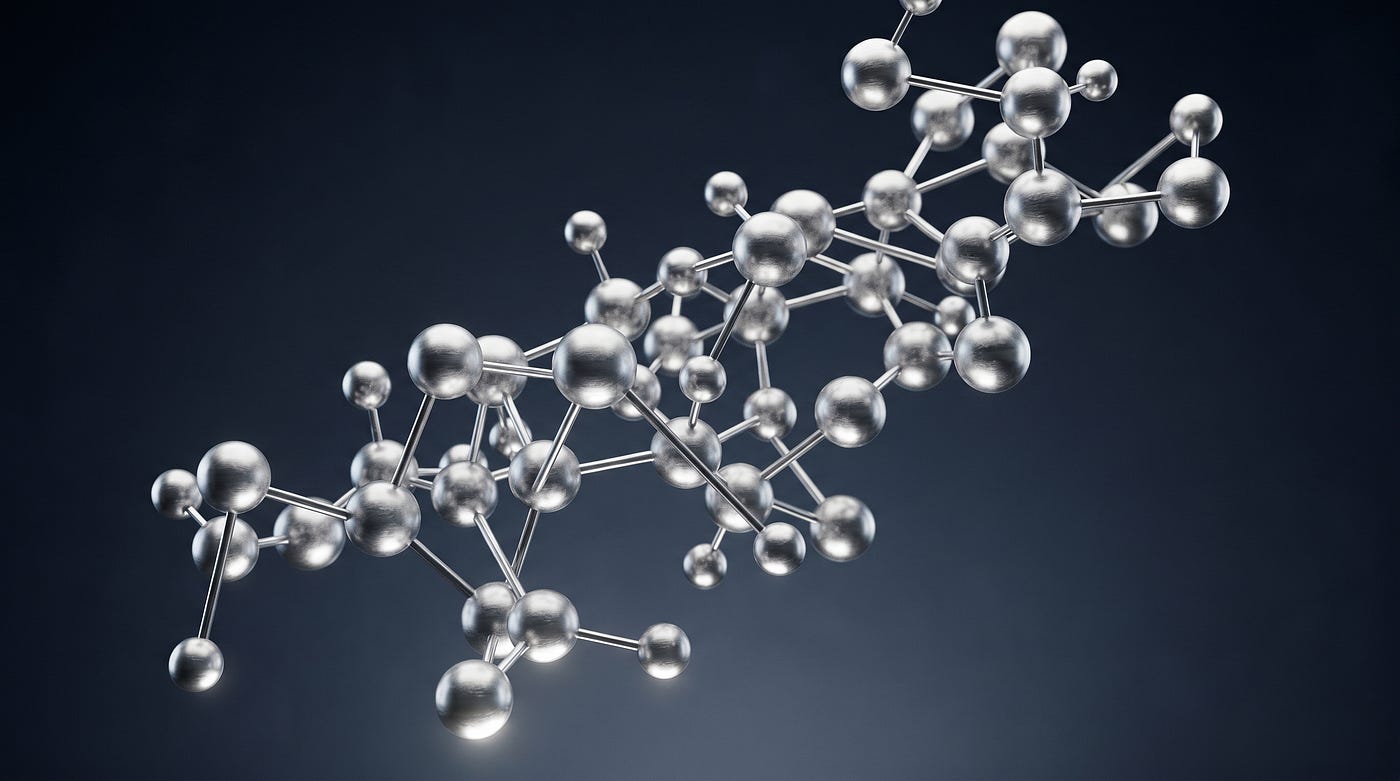
Chemistry has always had a problem explaining bonds. Early models — Lewis structures, dot diagrams — could tell you that atoms share electrons, but not why bonds form the way they do, or what determines a molecule’s shape and stability. Something more rigorous was needed.
Valence bond theory (VBT) was the answer, and it’s still one of the two foundational theories in chemical bonding today. Here’s how it works, what it can explain, and where it falls short.
The Problem VBT Was Built to Solve
Before VBT, chemists had two main tools for thinking about molecules:
Lewis structures (developed by Gilbert Lewis) are useful for showing which atoms share electrons, but they don’t explain how bonds form or what gives a molecule its geometry. They’re a useful shorthand, not a mechanistic theory.
**VSEPR theory** (Valence Shell Electron Pair Repulsion) can predict the shape of simple molecules reasonably well, but it breaks down with complex molecules and can’t explain many coordination compounds at all.
Neither theory was grounded in quantum mechanics. Both were essentially rules of thumb.
In 1927, German physicists Walter Heinrich Heitler and Fritz Wolfgang London proposed valence bond theory based on the wave mechanics of electrons — using the Schrödinger wave equation to actually model what happens when two hydrogen atoms approach each other and form a bond. Linus Pauling and John C. Slater extended the theory further in 1931, adding hybridization and making it applicable to a much wider range of molecules.
The Core Idea: Orbital Overlap
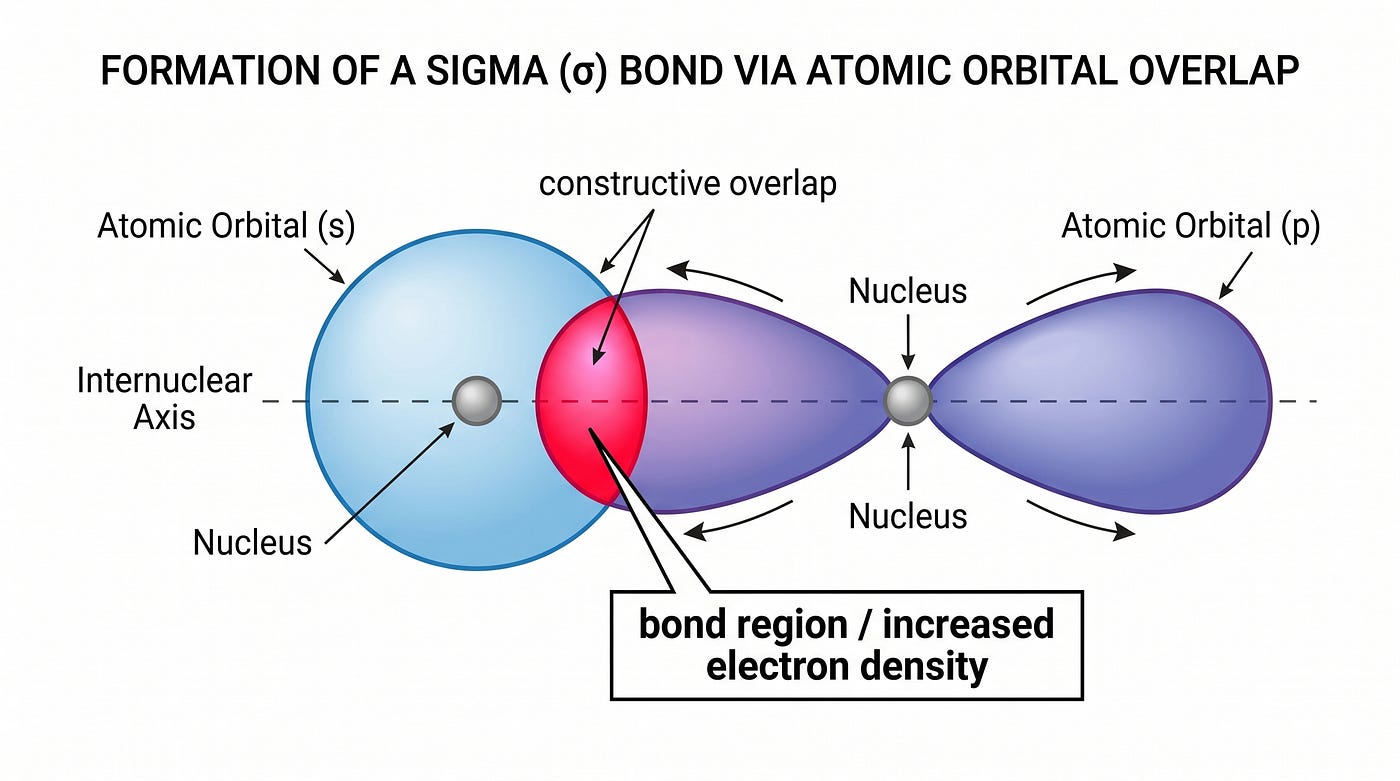
The central claim of valence bond theory is this: a covalent bond forms when two half-filled atomic orbitals from two different atoms overlap, and the electrons in that overlap region become localized between the two nuclei.
The key word is overlap. Bonds aren’t just electrons being shared in some abstract sense — they form because the wavefunctions of two atomic orbitals overlap in space, creating a region of increased electron density between the bonding atoms. That concentration of negative charge between two positive nuclei is what holds the atoms together.
VBT also specifies that only unpaired electrons in valence orbitals participate in bonding. Paired electrons in the valence shell — lone pairs — generally don’t form bonds under this framework.
Sigma Bonds and Pi Bonds: Two Ways to Overlap
Not all overlaps are the same. VBT distinguishes two types of bond based on how the orbitals overlap.
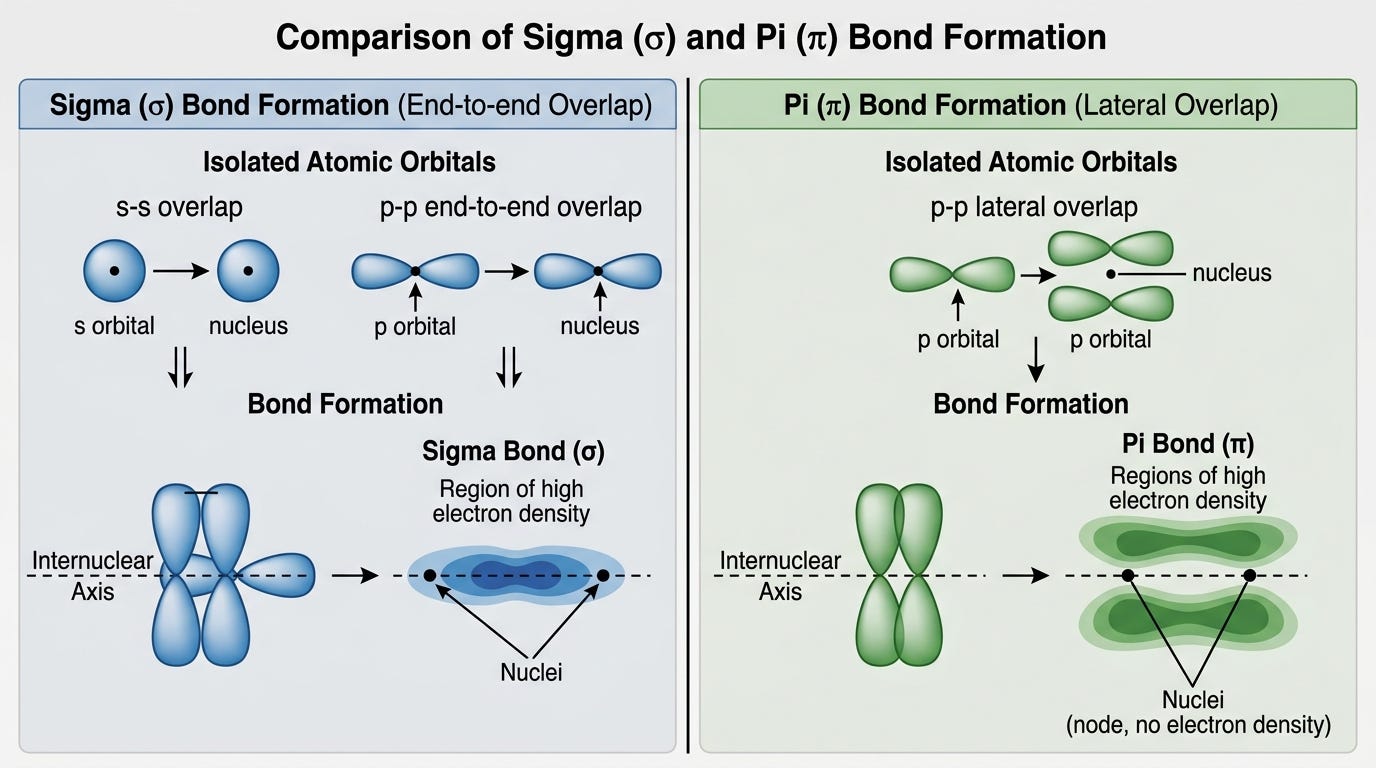
Sigma (σ) bonds form when two orbitals overlap head-to-head — directly along the axis connecting the two nuclei. This gives a symmetrical, cylindrical electron density along the bond axis. All single bonds are sigma bonds.
Pi (π) bonds form when two orbitals overlap side-by-side — parallel to each other, above and below the internuclear axis. This creates two lobes of electron density, one on each side of the axis. Pi bonds are always the second or third bond in a double or triple bond; they never exist alone.
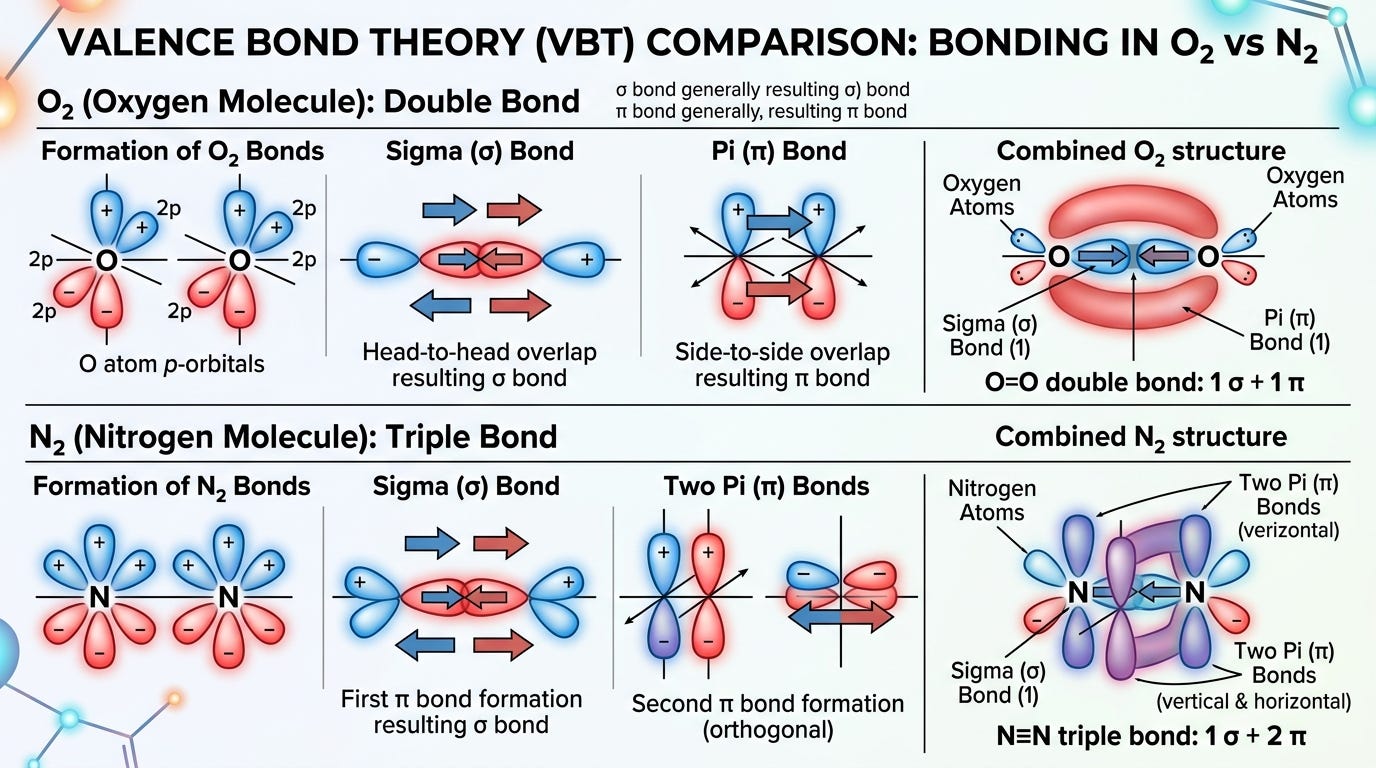
So in terms of bond order: a single bond is one σ bond; a double bond is one σ + one π; a triple bond is one σ + two π.
Bonding in Real Molecules
VBT gives specific predictions for how common molecules form. Here are five examples that illustrate the range:
H₂: Each hydrogen atom has a single electron in a 1s orbital. The two 1s orbitals overlap head-to-head along the internuclear axis, forming a σ(s-s) bond — a sigma bond between two s orbitals.
Cl₂: Chlorine’s ground state configuration includes a half-filled 3p_z orbital. Two chlorine atoms bond when their 3p_z orbitals overlap along the internuclear axis, forming a σ(p-p) bond.
HCl: Hydrogen’s half-filled 1s orbital overlaps with chlorine’s half-filled 3p_z orbital along the axis, forming a σ(s-p) bond — a sigma bond between an s and a p orbital.
O₂: Oxygen has two half-filled p orbitals. One pair overlaps head-to-head to form a σ(p-p) bond; the other pair overlaps laterally to form a π(p-p) bond. The result is a double bond — one sigma and one pi.
N₂: Nitrogen has three half-filled p orbitals. One pair forms a σ(p-p) bond by head-to-head overlap; the remaining two pairs each form a π(p-p) bond by lateral overlap. The result is a triple bond — one sigma and two pi bonds — which is why molecular nitrogen is so unreactive.
Hybridization: When Pure Orbitals Aren’t Enough
The original VBT framework worked well for diatomic molecules but ran into trouble with anything more complex. Water has a 104.5° bond angle — pure p-orbital overlap would predict 90°. Methane has four identical bonds arranged tetrahedrally — but carbon’s ground state has one s and three p orbitals, which are very different from each other.
To address this, Linus Pauling introduced the concept of **hybridization**: the mathematical mixing of atomic orbitals to produce new, equivalent hybrid orbitals with the right shape and geometry for bonding.
In hybridization, the original atomic orbitals (s, p, d) combine to form a new set of orbitals — all equivalent in energy and orientation — that can then overlap with other atoms’ orbitals to form bonds.
The type of hybridization determines molecular geometry. Under VBT, the metal atom or ion uses combinations of its available orbitals for hybridization, yielding a definite spatial geometry:
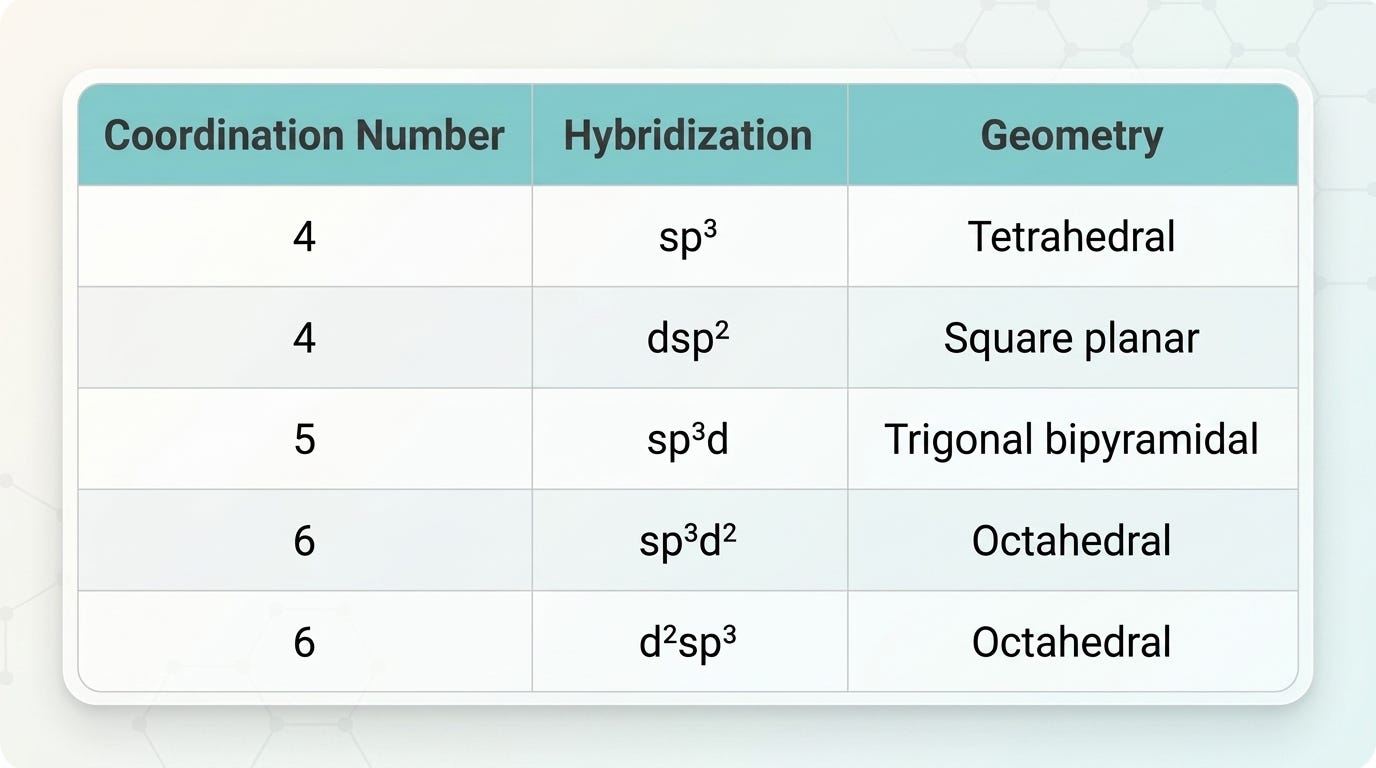
The hybrid orbitals formed by this process can then overlap with ligand orbitals to form bonds.
The Four Postulates of VBT
Valence bond theory rests on four core postulates:
1. Covalent bonds form when two half-filled valence orbitals from different atoms overlap. Electron density between the atoms increases, stabilizing the molecule.
2. The more unpaired electrons an atom has in its valence shell, the more bonds it can form. Paired electrons (lone pairs) don’t participate in bond formation.
3. Covalent bonds are directional — they form along the direction of orbital overlap, which is why molecular geometry matters.
4. Sigma bonds form from head-to-head overlap along the internuclear axis; pi bonds form from side-to-side (lateral) overlap.
What VBT Contributed to Chemistry
Before VBT, chemical bonding was largely descriptive. VBT introduced quantum mechanical reasoning into bonding for the first time and brought with it several important new concepts:
the delocalization of electrons across two nuclei; the shielding effect of inner electrons on outer ones; the essentially covalent character of many bonds that earlier theories treated as purely ionic; the idea that many bonds have partial ionic character alongside covalent character; and most importantly, the concept of resonance — the idea that molecules like benzene can’t be fully described by a single structure, and that the true state is a combination of multiple VB structures. Resonance energy became a way to quantify molecular stability.
Where VBT Falls Short
VBT is powerful, but it has real limitations that motivated the development of molecular orbital theory as a complementary approach.
It can’t explain the tetravalency of carbon without invoking hybridization (an add-on, not part of the original theory). It offers no information about electron energies. Its assumption that electrons are localized in specific bond regions is an oversimplification — in many molecules, electrons are genuinely delocalized across the whole structure. For coordination compounds, VBT can’t quantitatively predict thermodynamic or kinetic stability, can’t distinguish weak from strong ligands, and can’t explain why many transition metal complexes are colored.
The old version of VBT was also limited to diatomic molecules. It couldn’t predict the structures or bond angles of molecules with three or more atoms — H₂O, NH₃ — without modification. It was Linus Pauling’s introduction of hybridization that extended VBT’s reach, though even the modified version has significant blind spots that molecular orbital theory addresses more cleanly.
Wrapping Up
Valence bond theory gave chemistry its first quantum mechanical account of how bonds form. Two orbitals overlap. Electron density concentrates between the nuclei. The atoms are held together. Head-to-head overlap gives a sigma bond; side-by-side gives a pi. Hybridization extends the framework to explain molecular geometry.
It’s not the complete picture — molecular orbital theory handles delocalized systems better — but VBT remains a foundational framework, especially for ground-state molecules and for building chemical intuition about bonding.
메타데이터
- post_id
- 8890f3e31e8d
- slug
- valence-bond-theory-how-atoms-actually-form-chemical-bonds-8890f3e31e8d
- url
- https://medium.com/@milkyway.9628/valence-bond-theory-how-atoms-actually-form-chemical-bonds-8890f3e31e8d
- canonical_url
- https://medium.com/@milkyway.9628/valence-bond-theory-how-atoms-actually-form-chemical-bonds-8890f3e31e8d
- author_url
- https://medium.com/@milkyway.9628
- status
- ok
- fetched_at
- 2026-07-16 06:10:29