Circularity 2.0: Why 2026 Is the Year Businesses Finally Get Serious About Closing the Loop
For years, circular economy conversations lived comfortably in sustainability reports, innovation labs, and conference panels. It was a…
Circularity 2.0: Why 2026 Is the Year Businesses Finally Get Serious About Closing the Loop
For years, circular economy conversations lived comfortably in sustainability reports, innovation labs, and conference panels. It was a compelling idea — design out waste, keep materials in use, regenerate natural systems — but rarely a business priority. That era is ending.
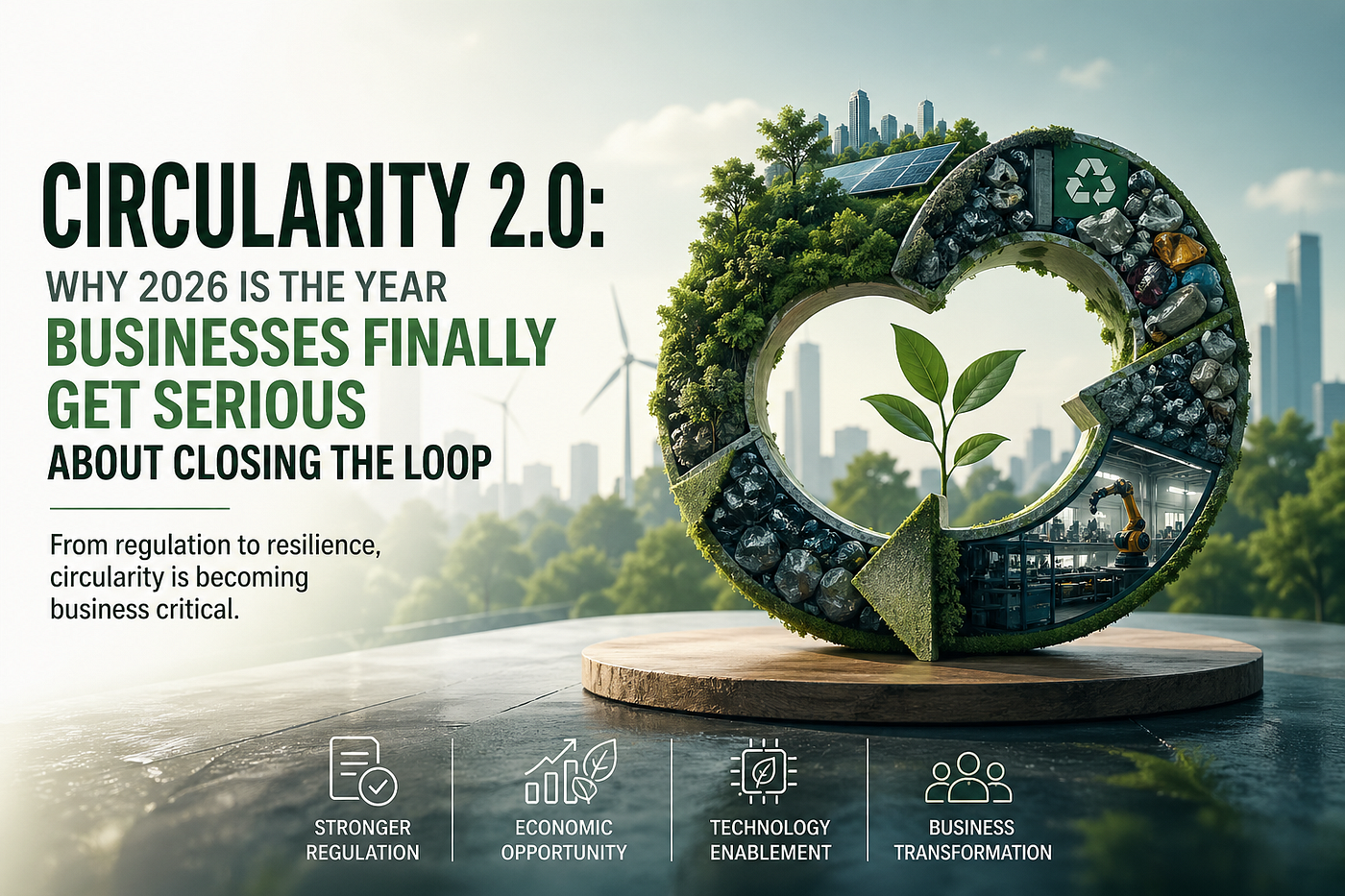
In 2026, circularity is no longer a “nice-to-have” ESG narrative. It is becoming a hard operational requirement, a financial lever, and in many industries, a regulatory obligation. What makes this moment different is not the concept itself, but the convergence of forces that are making circularity unavoidable — and, for the first time, economically compelling.
This is not the circular economy as we knew it. This is Circularity 2.0.
From Ambition to Execution
The biggest shift defining 2026 is simple: companies are moving from ambition to execution.
For the past decade, organizations set bold sustainability targets — net zero by 2030 or 2050, zero waste, fully recyclable products. But in reality, most of these commitments remained disconnected from core operations. Circularity, in particular, was often treated as an innovation experiment rather than a system-wide transformation.
That gap is now closing.
Across industries, circularity is becoming embedded into procurement decisions, product design, supply chains, and even revenue models. This shift reflects a broader trend in sustainability: a move away from storytelling toward measurable business value.
Executives are no longer asking, “Should we invest in circularity?” They are asking, “How do we operationalize it at scale?”
The Regulation Trigger: Circularity Becomes Mandatory
If there is one force accelerating this shift, it is regulation.
Governments — especially in Europe — are no longer relying on voluntary commitments. They are building regulatory frameworks that make circularity a requirement, not an option. 2026 marks a turning point in both the scale and enforcement of these policies.
At the center of this transformation is a wave of regulations focused on:
- Product design standards (durability, repairability, recyclability)
- Extended Producer Responsibility (EPR) schemes
- Mandatory disclosures on material composition and lifecycle impacts
- Digital traceability through product passports
The upcoming Circular Economy Act, for example, aims to create a functioning market for secondary raw materials — essentially making recycled inputs a mainstream industrial resource rather than a niche alternative.
This has profound implications. Circularity is no longer about waste management at the end of the lifecycle. It is being engineered into the beginning.
For businesses, this means redesigning products, rethinking supply chains, and building reverse logistics capabilities — not as sustainability initiatives, but as compliance requirements.
The Economics of Circularity: From Cost Center to Value Driver
One of the reasons circularity struggled to gain traction historically was the perception that it added cost without clear returns. That perception is rapidly changing.
A striking insight from recent circularity research highlights the scale of inefficiency in the global economy: for every €3 of economic value created, roughly €1 is lost due to linear “take-make-waste” practices.
That “value gap” is no longer theoretical — it is becoming a business opportunity.
Companies are beginning to realize that circular models can unlock value in multiple ways:
- Cost reduction through material efficiency and waste minimization
- New revenue streams via resale, refurbishment, and product-as-a-service models
- Supply chain resilience by reducing dependence on volatile raw materials
- Capital access, as investors increasingly reward resource-efficient business models
Circularity is also emerging as a bridge between ESG reporting and financial performance. Instead of tracking hundreds of sustainability metrics, companies are focusing on fewer, high-impact indicators tied to resource efficiency and lifecycle value.
In other words, circularity is becoming measurable — and therefore manageable.
Design Is the New Battleground
If Circularity 1.0 focused on recycling, Circularity 2.0 starts at design.
In 2026, product design is undergoing a fundamental transformation. Durability, modularity, and repairability are no longer differentiators — they are becoming regulatory and market expectations.
This shift is reshaping how companies think about products:
A smartphone is no longer just a device — it is a long-term asset designed for upgrades and refurbishment. A piece of furniture is not a one-time purchase — it is part of a lifecycle that includes reuse and resale. A garment is no longer disposable — it carries traceable data about its materials and environmental footprint.
This design-first approach has cascading effects. It influences sourcing decisions, manufacturing processes, logistics, and even customer relationships.
Perhaps most importantly, it changes the economics of ownership.
The Rise of Circular Business Models
As design evolves, so do business models.
Circularity is pushing companies beyond traditional product sales toward service-based and lifecycle-driven models. These include:
- Subscription-based access instead of ownership
- Trade-in and buy-back programs
- Refurbishment and remanufacturing ecosystems
- Secondary marketplaces integrated into primary sales channels
What was once considered niche — like refurbished electronics — is now becoming mainstream. Consumers are increasingly comfortable with pre-owned products, especially when backed by quality assurance and warranties.
This shift is not just about sustainability. It is about customer retention, recurring revenue, and lifecycle value.
Circular services are turning what used to be cost centers — returns, repairs, end-of-life products — into profit-generating activities.
Digital Infrastructure: The Hidden Enabler
Circularity at scale is impossible without data.
One of the most significant developments in 2026 is the rise of digital infrastructure supporting circular systems. This includes:
- AI-driven material sorting and recycling technologies
- Digital product passports tracking lifecycle data
- Supply chain transparency platforms
- Predictive analytics for maintenance and lifecycle optimization
Advances in AI are particularly important. In recycling, for instance, sensor-based sorting systems enhanced by machine learning are improving material purity and efficiency, making circular processes economically viable at scale.
Digitalization is also solving one of the biggest challenges in circularity: traceability.
Without accurate data on materials and products, circular systems break down. With it, they become scalable.
Circularity Meets Core Business Strategy
What truly defines Circularity 2.0 is its integration into core business strategy.
Circularity is no longer a sustainability initiative running parallel to the business. It is becoming central to how businesses compete.
This shift is driven by the intersection of circularity with broader strategic priorities:
- Resilience in the face of supply chain disruptions
- Efficiency amid rising material and energy costs
- Compliance with tightening regulations
- Innovation in product and service design
In many ways, circularity is emerging as the most practical expression of ESG. It translates high-level sustainability goals into tangible operational actions — design changes, material choices, logistics strategies.
It is where sustainability stops being abstract and becomes actionable.
The Challenges No One Talks About
Despite the momentum, circularity is far from easy.
One of the biggest challenges is infrastructure. Many industries lack the systems needed to support circular flows — collection networks, recycling facilities, refurbishment capabilities.
Another challenge is fragmentation.
Supply chains are complex, often spanning multiple countries and tiers of suppliers. Achieving circularity requires coordination across this entire ecosystem — a daunting task.
There is also the issue of economics at scale.
While circular models can be profitable, they often require upfront investment and long-term thinking. Not all companies are prepared for that shift.
Finally, there is a cultural challenge.
Circularity requires a fundamental change in mindset — from ownership to access, from disposal to reuse, from short-term gains to lifecycle value. That change takes time.
The Competitive Advantage of Moving Early
Despite these challenges, one thing is becoming clear: early movers in circularity are gaining a competitive edge.
They are securing access to secondary materials before supply becomes constrained. They are building capabilities that will be difficult for competitors to replicate quickly. They are positioning themselves ahead of regulatory requirements rather than reacting to them.
Perhaps most importantly, they are redefining their relationship with customers.
In a circular model, the transaction does not end at the point of sale. It continues throughout the product lifecycle — through maintenance, upgrades, resale, and recovery.
This creates deeper engagement and long-term value.
Why Circularity Is No Longer Optional
The question is no longer whether circularity will become mainstream. It already is.
What makes 2026 different is the alignment of forces:
Regulation is enforcing it. Economics is supporting it. Technology is enabling it. Investors are rewarding it.
Circularity is no longer driven by sustainability teams alone. It is being shaped by CFOs, supply chain leaders, product designers, and regulators.
It is becoming embedded in how businesses operate.
The Road Ahead
Looking forward, the next phase of circularity will be defined by scale.
The challenge is no longer proving that circular models work. It is scaling them across industries, geographies, and supply chains.
This will require:
- Standardization of data and reporting
- Investment in infrastructure
- Collaboration across ecosystems
- Continued innovation in materials and design
It will also require a shift in how success is measured.
Traditional metrics focused on output and growth are being complemented — and sometimes replaced — by metrics focused on resource efficiency, lifecycle value, and circular performance.
Final Thought
Circularity began as an environmental concept. It is now becoming a business imperative.
The companies that succeed in this new landscape will not be the ones with the most ambitious sustainability commitments. They will be the ones that can translate circularity into operational reality — into how they design, produce, sell, and recover products.
Circularity 2.0 is not about doing less harm. It is about creating more value — with fewer resources.
And in a world defined by constraints — material, environmental, and economic — that may be the most powerful competitive advantage of all.
CTA (for your Medium article)
If you found this valuable, follow more deep, practical insights on ESG, circularity, and real-world sustainability execution.
Also check out my content on YouTube: https://www.youtube.com/@GeneCapsule — where I break down complex ESG topics into actionable strategies.
Thanks for reading.
메타데이터
- post_id
- 8895411ab395
- slug
- circularity-2-0-why-2026-is-the-year-businesses-finally-get-serious-about-closing-the-loop-8895411ab395
- url
- https://medium.com/@anandv_62921/circularity-2-0-why-2026-is-the-year-businesses-finally-get-serious-about-closing-the-loop-8895411ab395
- canonical_url
- https://medium.com/@anandv_62921/circularity-2-0-why-2026-is-the-year-businesses-finally-get-serious-about-closing-the-loop-8895411ab395
- author_url
- https://medium.com/@anandv_62921
- status
- ok
- fetched_at
- 2026-07-30 11:48:00