A Fantastical World in Miniature
How even the tiniest creatures can bring about change.
A Fantastical World in Miniature
How even the tiniest creatures can bring about change.
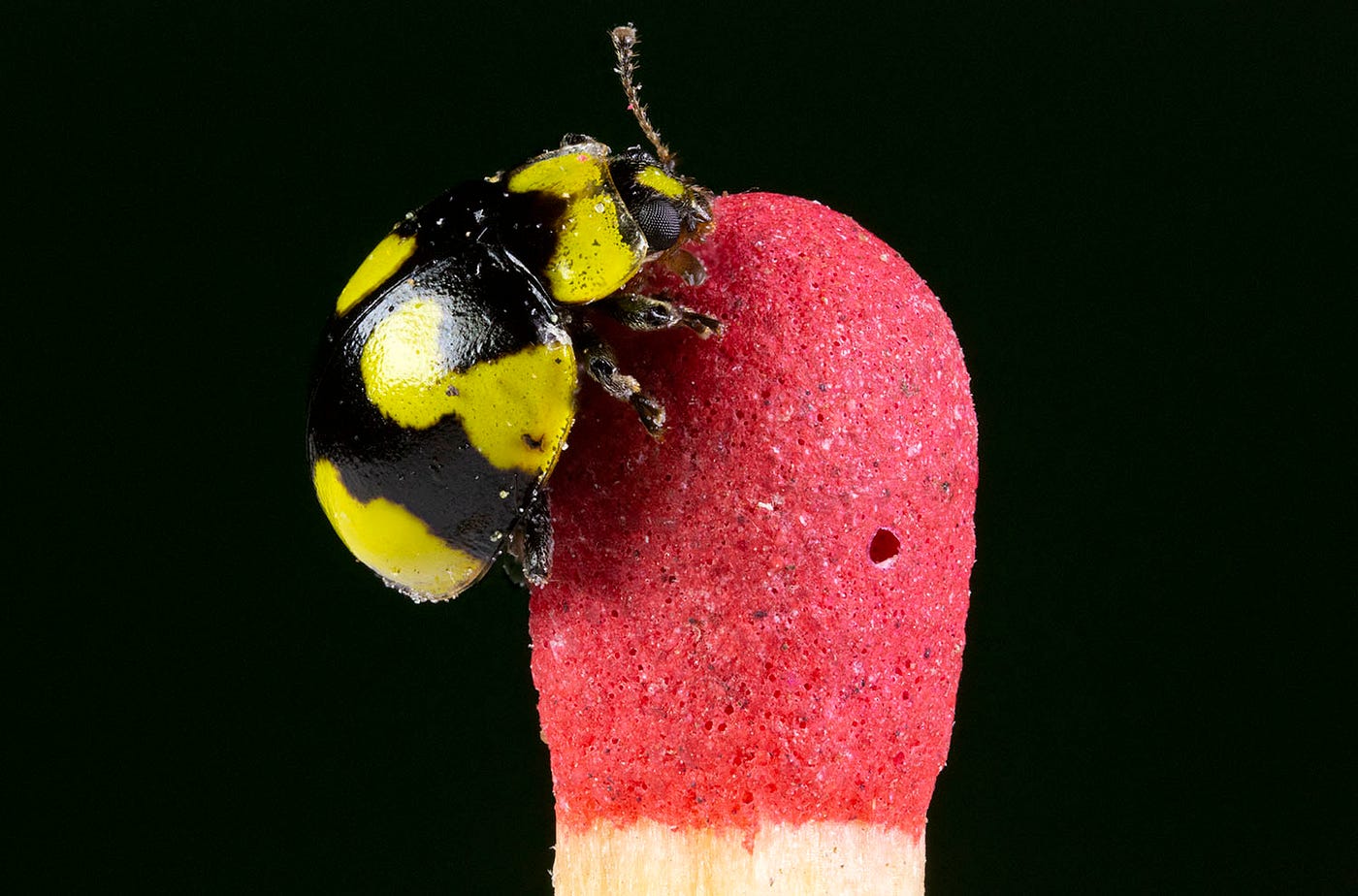
Tiny Worlds Reveal Big Secrets. Photo by the Author
Photography has always fascinated me, from my first fully manual Praktica film camera to the tens-of-megapixel mirrorless DSLRs available today. Macro photography had been on my list for quite some time, and several years ago, I bit the bullet and bought a 100mm f2.8 macro lens.
Armed with my new weapon, I set about finding subjects to photograph. Starting with an easy subject, flowers and our plants took on an amazing new perspective up close; however, this soon grew a bit tiresome, so on to something more challenging.

Carnivorous plants, left Sarracenia, centre honeydew, right venus flytraps. Photos by the Author
Insects are everywhere, so what could be difficult about photographing them?
How wrong I was on that one! Soon, realising that insects are few and far between in the winter months, it was not until the weather warmed that new targets revealed themselves.
Photographing insects outdoors proved challenging due to lighting issues, blowing foliage, and the lack of a suitable flash. So, I settled on the capture-and-release strategy. Setting up some opposing LED light panels in my studio provided a suitable setup for photographing whatever crawled or flew around our property.
All sorts of strange critters ended up in my tiny portrait studio, from tiny jumping spiders that fit on the head of a match to grey huntsman spiders the size of an adult hand.

Tiny jumping spiders (Salticidae). Photo by the Author
Spiders proved relatively easy to photograph, and they were quite happy to sit still while you fiddled with camera settings. Jumping spiders are another story, though. These little critters rarely sit still, and just when you’ve got the perfect pose, bam, they jump on you or the camera!
The most unnerving thing about photographing spiders is the eyes: all eight of them.
As I set up the camera and lighting, they would sit and watch with their strange octo-vision.
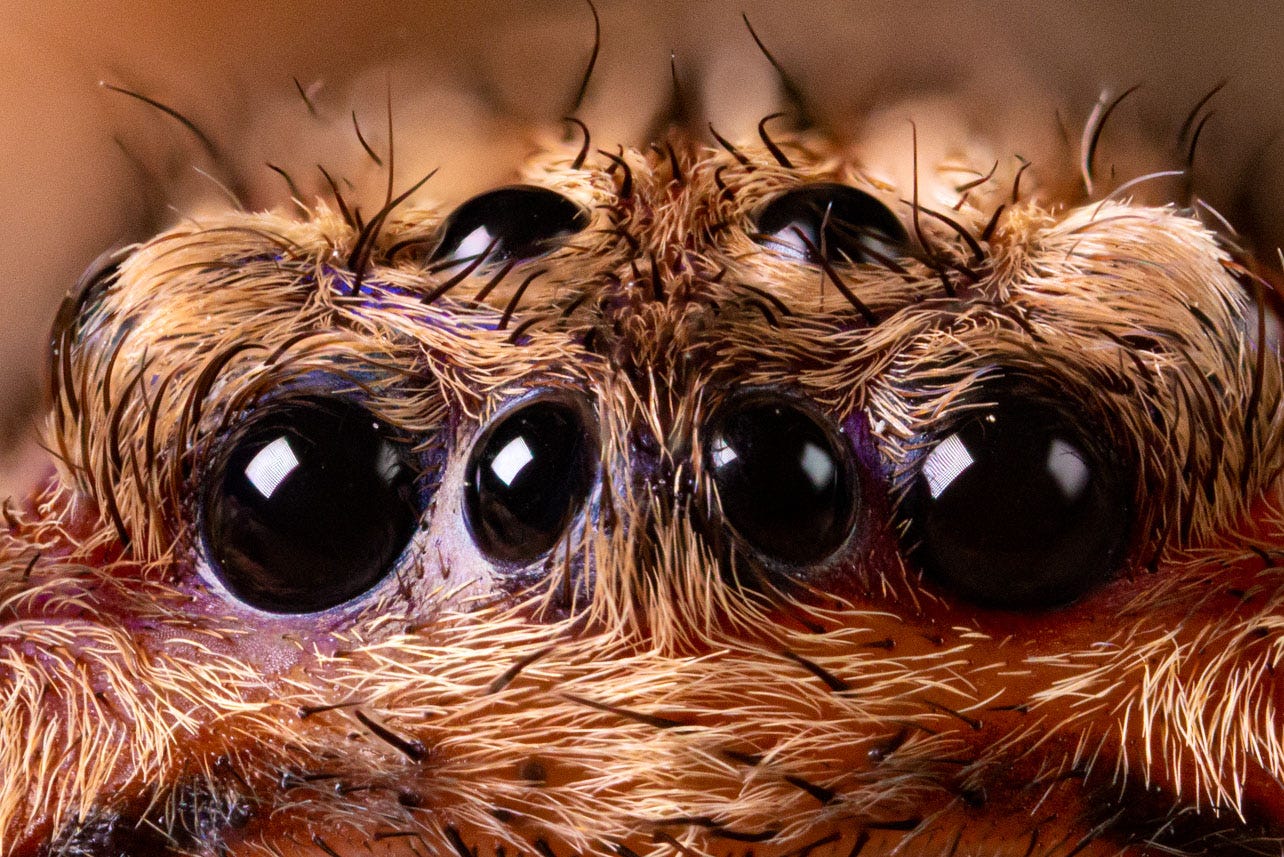
The watching eyes of a brown huntsman spider. Photo by the author.
I wondered whether there was intelligence behind those eight eyes, having read once that jumping spiders (Salticidae) show signs of intelligence.
Indeed, research reveals these little guys show remarkable behaviours and, surprisingly, advanced cognition. Salticidae have a modular vision system, comprising two larger principal eyes that have high visual acuity, see colours, and are UV-sensitive. Their three pairs of smaller secondary eyes have a wide field of vision to detect and track motion.
If you have ever observed these amazing arachnids, you may have noticed how they track your movements and turn to face you. Beyond acute vision, spiders also smell, using olfactory and contact chemoreception to detect prey, select mates, and communicate.
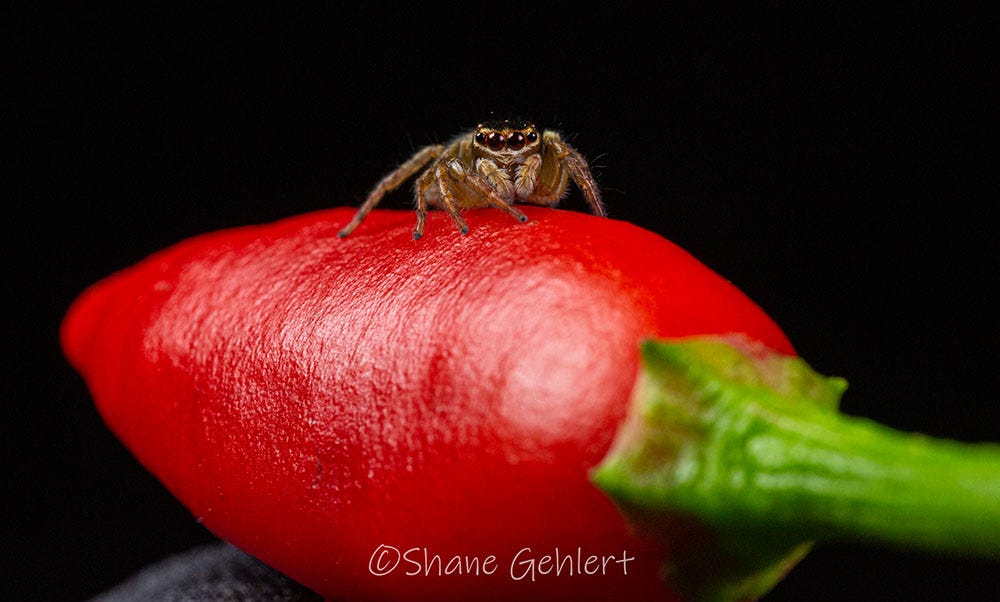
Hot chilli! Photo by the Author
Most remarkably, jumping spiders show advanced cognitive abilities, including sophisticated learning and detouring, whereby the spiders assess alternatives whilst planning a route, which involves a degree of forward planning.
Portia, a species of jumping spider that feeds on other spiders, is often called the ‘Einstein’ of spiders. Portia uses trial and error, reinforcement-based learning, and complex tactics such as mimicry, luring other spiders by manipulating the prey spider’s web to mimic a trapped insect.
They also use ‘smokescreen’ tactics, such as approaching prey spiders in windy conditions to conceal their approach. Lastly, they reveal a basic ability to count! When hunting other spiders, Portias will sit and wait near prey spiders’ nests, deciding whether to sit in ambush based on the number of other Portias nearby! All this from a brain no bigger than a pinhead with fewer than 100,000 neurons.
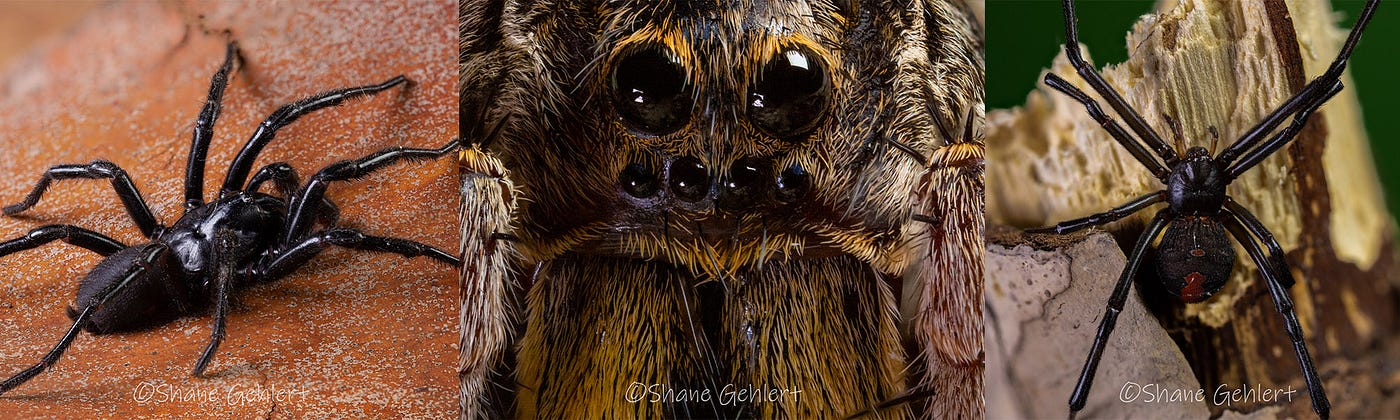
Left: funnel web spider, centre: ogre-faced spider, right: red-backed spider. Photos by the Author
Most species of spiders are harmless to humans; however, a couple of spiders I photographed demanded careful handling. The Australian funnel web spider (left) is highly venomous to humans, as too is the red back spider (right), the Australian version of the black widow spider. In contrast, the scary-looking individual in the centre is the harmless ogre-faced spider.
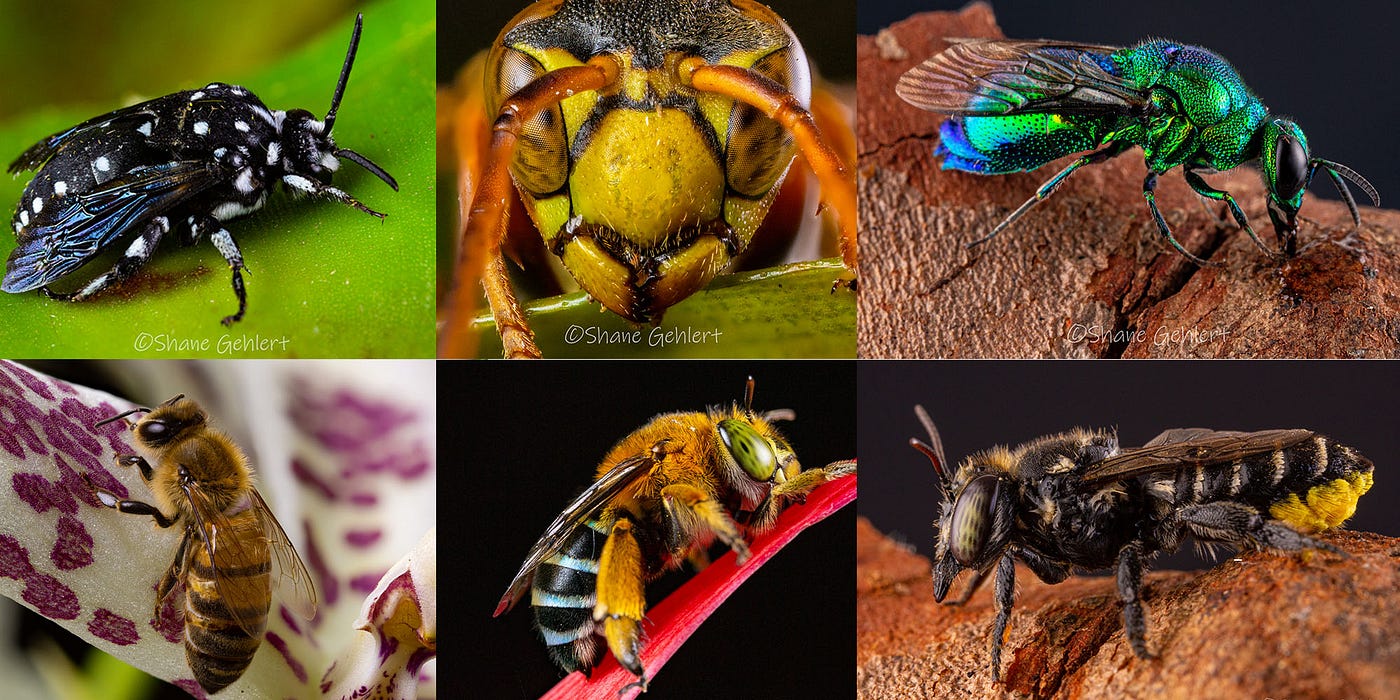
Top left to right: Cuckoo bee, mud nest wasp, cuckoo wasp, European honeybee, blue banded bee, native stingless bee. Photos by the author
Wasps and bees were tricky, although a dab of honey or sugar water kept them occupied long enough to snap some shots. Colourful cuckoo wasps, so called for laying their eggs in other wasps’ nests, were a favourite. Tiny stingless native bees are fascinating too, easy to catch and no sting to worry about!
Colourful, blue-banded bees are amazing creatures that buzz noisily around flowers, much like bumblebees. At rest, they lock their jaws to plant stems to sleep. Large orange-and-black mud-nest wasps, up to two inches long and with a nasty sting, demanded your full attention while you trapped and photographed them.
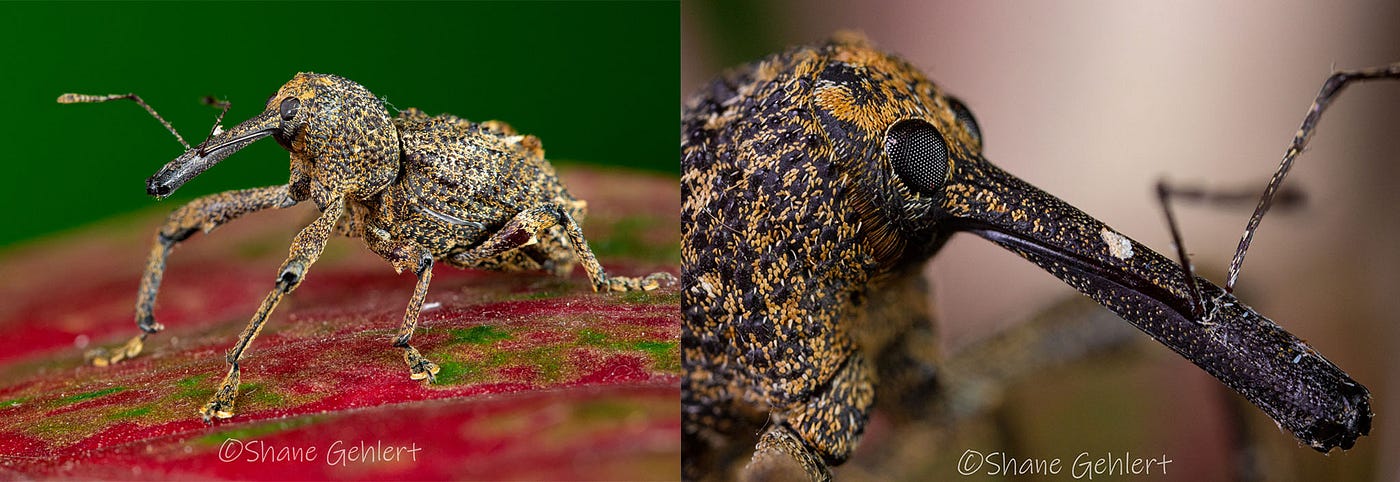
Elephant weevil beetles. Photos by the author
Beetles are intriguing, with their diverse array of sizes, shapes and colours. From the tiny and colourful but carnivorous ladybugs to the giant longicorn beetles, around four inches long. Elephant weevil beetles were a favourite, with their strange-looking,trunk-like rostrum.
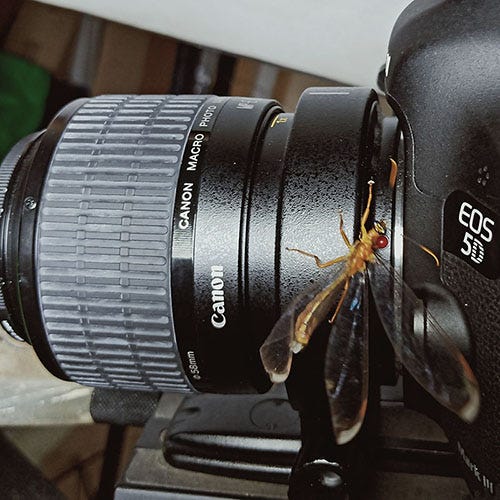
An uncooperative subject checking out the MPE-65 lens
As with most things, big is never big enough; close-up is not close enough, so another lens was needed. The Canon MPE-65 fit the bill nicely, paired with my Canon 5D Mark III DSLR. Able to zoom in on minute details, this is one beast of a lens. The trade-off is an incredibly small depth of field, which requires mounting it on a tripod with a micro-adjustment zoom plate. Along with the shallow depth of field, there was a very small focus area, resulting in most of the image being blurred.

Cicada (left) and a dragonfly’s head. Photos by the author
I soon learned that the macro geeks with their super sharp photos were using a technique called ‘image stacking.’ This was achieved by taking multiple photos at varying focus ranges. The photos were then stacked to create an image that is mostly all in focus. Photoshop can achieve this, but it’s slow and clunky. I found Helicon Focus did an excellent job and saved a mountain of time and messing around.

Colourful and dainty dragonflies. Photos by the author
Throughout the process of learning to photograph this tiny world, I learned a great deal about insect life, species, and varieties I had no idea existed. Take, for example, the robber fly or ‘assassin fly.’ A member of the fly family, Diptera, robber flies are large, mean-looking critters and top-order predators, ambushing prey or capturing them mid-flight. Most other insects form their prey, including butterflies and moths, grasshoppers, spiders and dragonflies.

Robber fly (left) and an assassin bug. Photos by the author
Then there is the deadly assassin bug, with its needle-sharp rostrum, which the ambush predator stabs into its victims, injecting a lethal cocktail of toxins and enzymes. The bug then consumes the liquified contents of its prey, a process known as extra-oral digestion.
What I soon also learned in photographing and studying insects is the enormous impact humans are wreaking on insect populations and diversity.
Back in 2014, Dirzo et al. set alarm bells ringing with their meta-analysis, which showed a 45% drop in insect populations in the last 40 years. Subsequent research paints a more nuanced picture, with further studies refuting that data. The current findings suggest that some populations are stable or increasing, whereas others are declining at around 1% per year. Butterflies and moths have declined faster than plants and animals across Britain and Europe, with agricultural practices and pesticides playing a significant role.
Anecdotally, I have observed a significant decline in insect populations on our rural property over the last decade or so. Giant rhinoceros beetles used to occasionally buzz around the porch lights in summer, whipping the dogs into a frenzy with their loud hissing defence mechanism sounds. Indeed, any outside light left on would attract thousands of diverse insect species, which this summer, is sadly no longer the case.
Recent media stories tell of the decline of the Australian Christmas beetle (Anoplognathus spp) a colourful beetle that would emerge around springtime and fly around in massive numbers through December and January. Many people report that the iconic creature is either completely absent or present only in small numbers now.
As memory is fallible and anecdotal evidence unreliable, significant studies are needed to determine whether Christmas beetles are in decline. The University of Sydney established the *Christmas beetle count project* in partnership with iNaturalist.org, using citizen science, AKA the public, to track the population of Christmas beetles and determine whether they are truly at risk.
The iNaturalist website is a fantastic place to share photos and details of the critters you find around your house, neighbourhood or on your travels. Since amassing a sizable collection of insect and animal photos, I have uploaded many of them to support future research and conservation projects.

Hawk moth eye, Macroglossum micacea. Photo by the author, image stacked, MPE-65 Canon lens
Since delving into the miniature world of insects, I have come to appreciate the diversity of life in the insect domain and just how fragile these creatures are.
I have curtailed my use of pesticides and instead use tactics like creating an invisible barrier of olive oil to keep ants from the kitchen. Give it a try, it really works! Simply wet a tissue or cotton wool ball with olive oil and wipe it along windowsills, door frames, or anywhere you want to create a barrier.
Eventually, my insect obsession waned, and I jumped to the next shiny thing that caught my attention. However, the lessons I learned from photographing and studying these tiny creatures still remain with me to this day
Next time you spot a creepy crawly, stop, don’t reach for the shoe, fly swat or can of insecticide, grab your camera instead!
References
D.L. Wagner, E.M. Grames, M.L. Forister, M.R. Berenbaum, & D. Stopak, Insect decline in the Anthropocene: Death by a thousand cuts, Proc. Natl. Acad. Sci. U.S.A. 118 (2) e2023989118, https://doi.org/10.1073/pnas.2023989118 (2021).
Nelson, X. J. (2023). A road map of jumping spider behavior. The Journal of Arachnology, 51(2), 139–154. https://doi.org/10.1636/JoA-S-22-011
메타데이터
- post_id
- 88af033a1672
- slug
- a-fantastical-world-in-miniature-88af033a1672
- url
- https://medium.com/full-frame/a-fantastical-world-in-miniature-88af033a1672
- canonical_url
- https://medium.com/full-frame/a-fantastical-world-in-miniature-88af033a1672
- author_url
- https://medium.com/@roboroos
- status
- ok
- fetched_at
- 2026-06-26 21:52:29