Claude vs Mexty: Why the Demo Is Not the Hard Part in Interactive Course Creation
Introduction
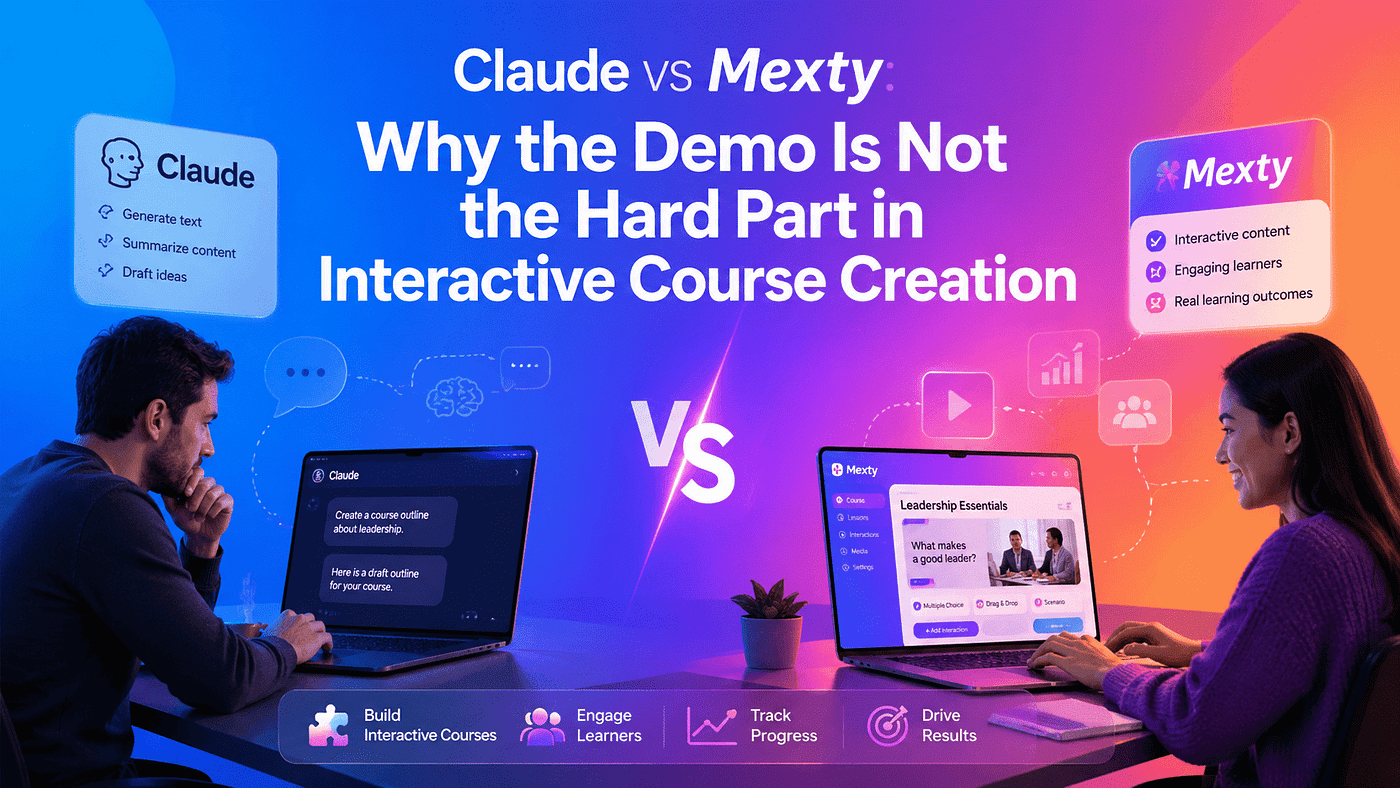
Claude vs Mexty: Why the Demo Is Not the Hard Part in Interactive Course Creation
Introduction
In 2026, creating digital learning content has never been faster. With tools like Claude, ChatGPT, and other generative AI platforms, anyone can describe a learning activity and receive a working prototype in minutes.
A branching scenario, a quiz, a simulation, or an interactive exercise can now be generated almost instantly. This is exciting, but it also creates a dangerous illusion: the idea that generating an interactive module means the learning problem is solved.
It does not.
In professional learning environments, the real challenge is rarely the demo. The real challenge is deployment. Can the content be exported? Can it be tracked? Can it work inside an LMS? Can it meet compliance requirements? Can it be edited, maintained, versioned, and scaled?
This is where the difference between using Claude and using an AI-native authoring tool like Mexty becomes critical.
The Demo Is Not the Hard Part. Deployment Is.
Anyone can generate a branching scenario in 20 minutes. You can ask Claude to create a compliance training simulation, a leadership scenario, or an interactive quiz. The result may look impressive in a browser.
But in learning design, a good-looking prototype is only the beginning.
A real learning solution must be able to live inside an actual learning ecosystem. It must support SCORM 1.2 export, completion tracking, LMS reporting, GDPR requirements, audit needs, version control, and manual editing after AI generation.
If it cannot do that, it remains a prototype, not a learning solution.
This is why “vibe-coding for elearning” is powerful, but not sufficient on its own. The future is not just about generating interactions faster. It is about creating interactive learning experiences that can actually be deployed, tracked, and scaled.
Claude: Powerful for Prototyping, Limited for Learning Deployment
Claude is a powerful tool for ideation and rapid prototyping. It can help learning designers generate branching scenarios, quizzes, simulations, role-play activities, HTML/JavaScript interactions, and decision trees very quickly.
This makes Claude valuable in the early creative phase. It helps instructional designers test ideas, explore formats, and build a first version of an interactive activity without waiting for technical development.
However, Claude is not an authoring workflow. It is a general-purpose language model.
That means it does not natively manage SCORM packaging, LMS deployment, completion tracking, reporting standards, source-of-truth validation, version control, manual authoring workflows, or enterprise governance.
Claude gives more creative capability, but it does not remove the complexity of integrating the output into a real learning environment.
This is the point where many teams hit a wall. The prototype works. The demo looks good. But then the L&D operations team asks: “How do we deploy this in the LMS? How do we track completion? How do we update it later? How do we make sure it meets compliance and data requirements?”
That is where a generic AI-generated interaction often becomes difficult to use.
Mexty: AI-Native Authoring for Real Learning Workflows
Mexty was designed differently. It is not a traditional authoring tool with AI added on top. It is an AI-native authoring tool built around a modern workflow for interactive course creation.
The difference is important.
In many traditional workflows, the process looks like this: generate an idea, copy content, rebuild it in another tool, package it for SCORM, test it in the LMS, fix issues, and deploy it.
With an AI-native interactive learning platform like Mexty, the workflow becomes more integrated: describe the learning experience, generate the interactive activity, edit it manually, validate the content, export it as SCORM-compatible learning, and deploy it inside the LMS.
This changes the role of AI. AI is no longer just a text generator or a prototype assistant. It becomes part of the authoring workflow itself.
Mexty supports interactive course creation with vibe coding, while keeping the learning designer in control. Teams can create branching scenarios, simulations, quizzes, decision-based activities, and interactive learning experiences, then refine them manually and export them for LMS deployment.
The result is not just a demo. It is LMS-ready learning.
Why SCORM-Compatible Learning Still Matters in 2026
Some people ask whether SCORM still matters in 2026. In many organizations, the answer is clearly yes.
SCORM-compatible learning remains essential in corporate L&D, compliance training, healthcare, finance, manufacturing, education, onboarding, and enterprise training environments.
Organizations still need completion tracking, learner progress, LMS reporting, certification management, audit evidence, and consistency across platforms. For many teams, SCORM 1.2 is not optional. It is a requirement.
This is why vibe coding for SCORM interactive courses is such an important evolution.
The goal is not only to create a beautiful interaction. The goal is to create an interactive course that can be exported, uploaded, tracked, and reported inside the LMS.
Without that, the course may be creative, but it is not operationally usable.
AI Course Creator vs AI-Native Authoring Tool
The eLearning market is now full of AI tools, but not all AI tools solve the same problem. It is important to distinguish between three categories.
The first category is traditional authoring tools with AI added on top. These include established platforms such as Articulate Storyline, Rise, iSpring, and Adobe Captivate. Their AI features can help generate text, quiz questions, summaries, outlines, or images. This is useful, but it does not fundamentally change the production workflow. The learning designer still has to manage the same complexity of building, editing, exporting, testing, and deploying.
The second category is AI course creators. These tools can generate a course quickly from a prompt, a topic, or a document. They are useful for speed and first drafts. However, many of them remain text-heavy and limited in interactivity. They often lack a complete authoring workflow, deep manual control, SCORM-ready deployment, or enterprise-grade learning operations.
The third category is AI-native authoring tools. This is where the real transformation happens. An AI-native authoring tool is not simply an old authoring system with AI features added later. It is designed from the beginning around AI-assisted creation, interactive learning design, manual editing, content control, and LMS deployment.
This is the category where Mexty belongs.
Why Traditional Alternatives Are Being Reconsidered
Many learning teams are now looking for Articulate Storyline alternatives, Genially alternatives, and iSpring alternatives because their needs have changed.
They are not only looking for a cheaper tool. They are looking for a better workflow.
They want to move faster. They want to create more interactive learning. They want to reduce technical complexity. They want AI support, but without losing control. They want SCORM-compatible output that works in their LMS. They want less production friction and more time for pedagogy.
This is why the best authoring tools in 2026 will not simply be the tools with the most features. They will be the tools that help learning teams move from idea to deployable learning with less friction.
Interactive Course Creation Means More Than Adding Quizzes
For years, digital learning has often been reduced to slides, knowledge checks, and completion tracking. But real interactive learning is much more than that.
An Interactive Course Creator should help learning designers create decision-making, practice, reflection, feedback, scenario branching, simulations, and learner agency.
The goal is not “next, next, quiz, complete.”
The goal is to help learners think, decide, practice, and apply.
This is where interactive course creation with vibe coding becomes powerful. Instead of manually building every branch or interaction from scratch, the learning designer can describe the learning experience they want to create.
For example, they can ask for a leadership simulation where the learner must handle a difficult employee conversation, a cybersecurity scenario where decisions affect risk, or a customer service activity where the learner chooses how to respond to a frustrated client.
The AI can generate the structure, but the learning designer keeps control over the pedagogy, tone, feedback, and final experience.
Manual Editing Is Not Optional
One of the biggest misconceptions about AI in learning is that everything should be controlled through prompts.
That is not realistic.
A learning designer should not need to write a new AI prompt just to change a color, adjust a button, rewrite feedback, move a screen, fix a learner path, or refine a scenario.
Professional authoring requires manual control.
This is why Mexty combines AI generation with manual editing. AI accelerates the first version, but the learning designer can still refine the experience directly.
This balance matters because learning design is not just about producing content quickly. It is about making intentional choices. The words matter. The structure matters. The feedback matters. The interaction design matters. The learner journey matters.
AI can help build faster, but human judgment is what makes the experience effective.
Source of Truth: Keeping AI Reliable
In learning, accuracy matters.
This is especially true in compliance training, healthcare, finance, education, product training, and internal corporate programs. AI hallucinations are not acceptable when the content has legal, operational, medical, or business consequences.
That is why a Source of Truth approach is essential.
An AI-native authoring tool should allow teams to work from validated materials: internal policies, procedures, manuals, training documents, expert-approved content, or academic sources.
This keeps AI grounded in approved information and reduces the risk of generating inaccurate content.
For learning designers, this is critical. AI should not replace content governance. It should support it.
From Prototype to LMS-Ready Learning
A prototype is useful. It helps teams test ideas and align stakeholders quickly.
But a prototype is not enough.
A real learning solution must be deployable. It must be trackable. It must be maintainable. It must work inside the systems that organizations already use.
This means SCORM-compatible export, LMS upload, completion tracking, reporting, GDPR compliance, version management, and audit readiness.
Mexty is designed to help teams move from idea to LMS-ready learning without rebuilding everything across multiple tools.
This is the difference between fast content generation and professional learning creation.
How AI-Native Authoring Gives Time Back to Pedagogy
Today, many learning designers spend too much time on technical production.
Creating digital learning often requires juggling three roles at once: pedagogy, technical production, and stakeholder coordination.
A typical balance might look like this: 35% pedagogy, 40% technical work and production, and 25% communication and coordination.
The problem is that technical work often takes too much space. Learning designers spend time building screens, managing interactivity, fixing exports, testing LMS compatibility, and handling production details.
With an AI-native authoring tool like Mexty, that balance can change.
The technical work can be reduced, while more time can be spent on pedagogy and stakeholder collaboration. Instead of spending most of the time producing, learning designers can focus more on designing real learning experiences, validating content, improving feedback, and supporting adoption.
This is the real promise of AI-native authoring: less technical work, more pedagogy.
Why This Matters for Learning Designers
AI will not replace learning designers. But it will change what learning designers spend their time doing.
The most valuable learning designers will not be the ones who manually build every screen the slowest way possible. They will be the ones who understand how to use AI-native workflows to design better experiences faster.
They will focus on learning outcomes, cognitive load, practice, scenario design, feedback, inclusion, accessibility, and performance impact.
AI can help with production. But the learning designer remains responsible for the learning quality.
This is why AI-native authoring is not about removing the human. It is about giving the human more leverage.
Why This Matters for Junior Learning Designers
AI-native authoring tools can also help junior learning designers build stronger portfolios.
A strong portfolio often matters more than certificates because it shows how someone thinks and designs.
With tools like Mexty, junior learning designers can create onboarding modules, compliance training, product training, branching scenarios, simulations, and interactive learning activities much faster.
But the goal is not only to show attractive screens. The goal is to show learning design thinking.
A good portfolio should show how the designer structures content, creates practice, gives feedback, reduces cognitive overload, supports decision-making, and prepares content for deployment.
In 2026, the strongest portfolios will not simply show “I can build a module.” They will show “I can design an interactive learning experience that works.”
Conclusion: The Future Is Deployable AI-Native Learning
Claude is powerful. It is excellent for ideation, rapid prototyping, and creative experimentation.
But Claude alone is not a deployable learning system.
Mexty is designed for the full learning workflow: creation, editing, validation, SCORM-compatible export, LMS deployment, tracking, and scale.
That is the difference between an AI prototype and an AI-native authoring tool.
The future of learning creation is not just AI that builds fast.
It is AI that builds learning experiences you can actually deploy, track, and scale.
From idea to LMS-ready learning.
That is the future of interactive course creation.
👉 Start transforming your content into interactive learning with Mexty: https://workspace.mexty.ai/lms/chat
메타데이터
- post_id
- 88b810e85986
- slug
- claude-vs-mexty-why-the-demo-is-not-the-hard-part-in-interactive-course-creation-88b810e85986
- url
- https://medium.com/@contactmexty.ai/claude-vs-mexty-why-the-demo-is-not-the-hard-part-in-interactive-course-creation-88b810e85986
- canonical_url
- https://medium.com/@contactmexty.ai/claude-vs-mexty-why-the-demo-is-not-the-hard-part-in-interactive-course-creation-88b810e85986
- author_url
- https://medium.com/@contactmexty.ai
- status
- ok
- fetched_at
- 2026-06-09 15:37:30