The King of Illusions: How Our Brains Mislead Us in a Quantum World
Modern science is a precision machine. It calculates, predicts, models. It explores the infinitely large, the infinitely small, and extreme…
The King of Illusions: How Our Brains Mislead Us in a Quantum World
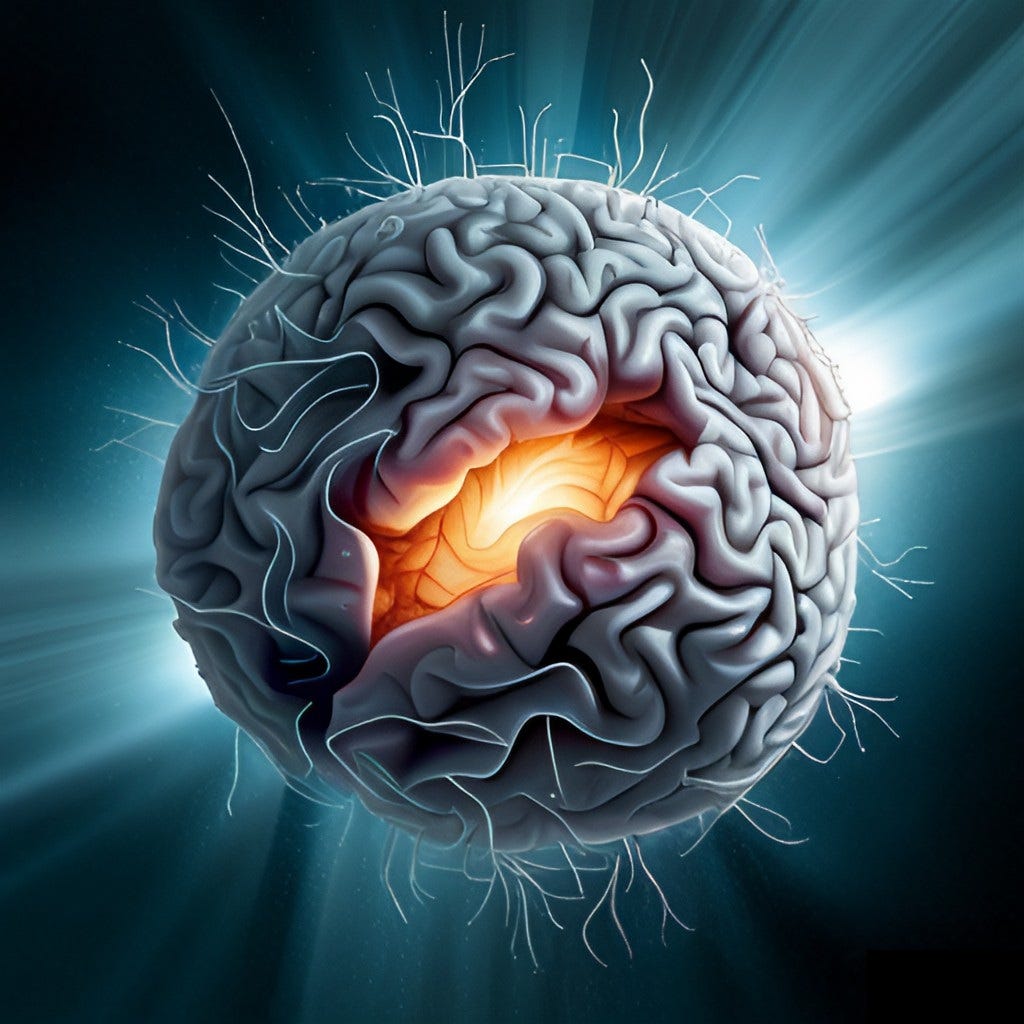
Modern science is a precision machine. It calculates, predicts, models. It explores the infinitely large, the infinitely small, and extreme complexity.
But one fact is undeniable: the more science deepens its understanding, the more its certainties crumble.
We live in a time where prestige, finance, and techno-economic urgency threaten epistemic honesty. This manifesto is not an attack on science. It is a mirror: what mathematics and quantum mechanics reveal, if one knows how to look, is not the real world itself, but our limits and our cognitive bricolage.
Here, we confront the truth: understanding is never the same as mastering, and mastery is always an illusion.
I — The Brain, Evolutionary Bricolage
The human brain is a cumulative toolkit. At its base, it remains a survival brain, a macaque facing danger, dominance, and resources.
Then appeared the abstract brain, an evolutionary bricolage extension:
- modeling, symbolization, mathematization
- creating an illusion of control, anticipation, and foresight
Today, as never before, humans have technologies to observe their own brains in depth. But can this same brain, trying to understand itself, truly grasp all its subtleties? Perhaps it remains limited in comprehending itself.
Whether human or monkey, it is not fundamentally different, and nothing in its structure makes it magical.
The human brain, as complex as it is, remains an organ like any other: it can be eaten, damaged, limited. Nothing in its structure grants it privileged access to reality. Its true power lies in its ability to deceive us, to make us believe we are exceptional, and for that, it positions itself as king of the universe.
Abstraction is not a window onto reality but an evolutionary bricolage designed to produce an illusion of mastery. And this illusion is precisely why it works so well.
II — Mathematics: Language or Mirror?
Mathematics is immensely powerful. It allows us to predict, simulate, and construct.
But when it becomes excessively complex:
- infinite renormalizations
- ad hoc parameters
- technical contortions to maintain consistency
it silently warns us: we are no longer describing reality; we are only preserving the coherence of our tools.
General criterion:
A formalism has reached its limit when it speaks more about itself than about the reality it is supposed to describe.
III — Quantum Mechanics: Mirror of Our Limits
The tunnel effect, entanglement, wave/particle duality, etc…:
- cannot be directly “seen” or “grasped”
- resist any attempt at classical description
- defy all intuition
Quantum mechanics is not a failure, but a clear signal of the ungraspable aspects of reality.
Sophisticated mathematics, advanced calculations, qubits, and other models only maintain the illusion of mastery. We can calculate with extreme precision… yet some phenomena remain ungraspable. Mathematical sophistication here reaches its own limits.
IV — Scientific Humility
Acknowledging these limits is neither pessimistic nor fatalistic. It is being adult, lucid, and honest.
- Understanding ≠ mastering
- Modeling ≠ possessing
- Complexifying ≠ knowing
Science works remarkably well precisely because it does not describe reality itself, but produces coherent abstractions. This is what it does best.
Epistemic Clarification — On Interpretation
At this point, a common objection arises: “This is only an interpretation.”
But there is no alternative.
All knowledge accessible to a biological, cognitive system is interpretative by necessity. Measurement, formalization, and modeling always require a framework, a language, and a choice of representation. There is no view from nowhere.
Interpretation is not a flaw of knowledge. It is its unavoidable condition. If there is another way to know, then let it be said — let it be shown.
The danger lies not in interpreting, but in forgetting that one is doing so.
Conclusion — The Silent Mirror
We have created models, equations, simulations. We feel we understand, control, and rise above the world.
But this impression is the product of our own brain. Cognitive bricolage gives us the feeling of being gods. It reassures us. It makes us powerful. But it does not grant access to reality.
Mathematics, as beautiful and rigorous as it may be, sometimes signals its own limits. Quantum mechanics confirms that some aspects of the world cannot be grasped.
Lucidity is the only honest stance. In the silence imposed by reality, we discover a simple, chilling truth:
We are not gods. We are observers, tinkerers, limited explorers. And it is precisely this limitation that makes our abstraction so ingenious, so alive… and so incapable of delivering the world itself.
And in this silence, there is neither anger nor despair. There is only radical clarity.
Speculate · Calculate · Illuminate ✨
메타데이터
- post_id
- 88ca082faedb
- slug
- when-science-meets-its-limits-88ca082faedb
- url
- https://medium.com/@pdi_40761/when-science-meets-its-limits-88ca082faedb
- canonical_url
- https://medium.com/@pdi_40761/when-science-meets-its-limits-88ca082faedb
- author_url
- https://medium.com/@pdi_40761
- status
- ok
- fetched_at
- 2026-06-09 15:37:30