The Planet That Wasn’t: How Scientists Once Believed the Asteroid Belt Was a Cosmic Crime Scene
For nearly 200 years, astronomers believed the asteroid belt was the shattered remains of a lost world called Phaeton. The real story…
The Planet That Wasn’t: How Scientists Once Believed the Asteroid Belt Was a Cosmic Crime Scene
For nearly 200 years, astronomers believed the asteroid belt was the shattered remains of a lost world called Phaeton. The real story turned out to be even stranger.
The Planet That Wasn’t: Why Early Scientists Thought the Asteroid Belt Was Debris From a Destroyed World
For much of scientific history, astronomers believed our Solar System was hiding a corpse.
Between Mars and Jupiter lies the asteroid belt: millions of rocky fragments orbiting the Sun in a vast, chaotic ring. Today, scientists understand it as leftover material from the birth of the Solar System. But two centuries ago, many researchers were convinced they were looking at something far more dramatic:
The shattered remains of a destroyed planet.
And honestly? The idea sounded completely reasonable.
A Missing Planet Haunted Early Astronomy
In the late 1700s, astronomers noticed something strange about planetary distances.
A mathematical pattern called the Titius–Bode Law appeared to predict where planets should orbit around the Sun. Mercury, Venus, Earth, Mars… all fit surprisingly well. But there was a problem.
There seemed to be a missing world between Mars and Jupiter.
Astronomers became obsessed with finding it.
If the pattern held true, a planet had to exist there.
So Europe’s leading sky-watchers began searching the heavens for a “fifth planet.”
Instead, they found debris.
The Discovery That Sparked the Mystery
In 1801, Italian astronomer Giuseppe Piazzi discovered an object orbiting exactly where the missing planet was supposed to be.
He named it Ceres.
At first, scientists celebrated. The missing world had finally been found.
But then things became weird.
Ceres looked far too small to be a true planet. Soon afterward, astronomers discovered Pallas, Juno, and Vesta in the same region. Then more objects appeared. And more. And more.
The “planet” wasn’t a planet at all.
It was an entire field of scattered rocks.
That realization triggered one of the most fascinating scientific theories of the 19th century:
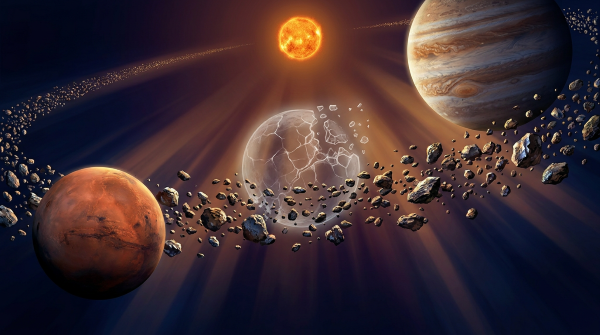
Maybe a planet had existed there once… and exploded.
Enter Phaeton: The Lost World of the Solar System
Astronomers even gave the hypothetical destroyed planet a name: Phaeton.
The name came from Greek mythology, where Phaethon, son of the Sun god Helios, lost control of the solar chariot and was destroyed catastrophically. The symbolism was perfect.
According to the theory, a massive planet once orbited peacefully between Mars and Jupiter until some ancient disaster tore it apart.
The asteroid belt, they argued, was the cosmic wreckage left behind.
For decades, the idea captured imaginations worldwide. Books, newspapers, and scientific discussions treated the asteroid belt almost like a celestial crime scene.
What killed the planet?
Scientists proposed everything from gigantic internal explosions to catastrophic collisions with another world.
Some even imagined ancient planetary wars.
The Problem With the “Exploded Planet” Theory
The theory sounded cinematic.
Unfortunately, physics had other ideas.
As astronomers gathered more data, the cracks in the hypothesis became impossible to ignore.
The biggest problem was mass.
If the asteroid belt truly came from a destroyed planet, there should be enough material left over to rebuild something roughly Earth-sized.
But there isn’t.
In fact, the total mass of the entire asteroid belt is less than our Moon.
That’s nowhere near enough material to account for a lost planet.
Then came another issue: composition.
Asteroids are wildly different from one another. Some are rocky. Some metallic. Others contain carbon-rich compounds and water ice.
They do not resemble fragments from a single shattered world.
Instead, they look like leftovers from many different regions of the early Solar System.
By the mid-20th century, the “destroyed planet” theory was collapsing.
What Scientists Believe Today
Modern astronomy paints a very different picture.
The asteroid belt is now understood as material that never managed to become a planet in the first place.
Early in the Solar System’s history, countless rocky bodies called planetesimals were colliding and merging to form planets.
But Jupiter ruined everything.
The gas giant’s immense gravity constantly disturbed the region between Mars and Jupiter, increasing collision speeds and preventing the material from clumping together into a world.
Instead of forming a planet, the region became a violent gravitational battlefield.
A failed planet was born.
Or rather… never born.
And Yet, the Story Gets Even Stranger
Ironically, modern theories have made the asteroid belt more mysterious, not less.
Some recent models suggest the asteroid belt may originally have been nearly empty. Instead of forming locally, many asteroids could have been thrown there from different parts of the Solar System during the chaotic migrations of Jupiter and Saturn.
In other words:
The asteroid belt might not be the remains of a dead planet…
It could be a giant collection of cosmic refugees.
Even Ceres — the largest object in the belt — continues to surprise scientists. NASA research suggests it may once have contained a warm subsurface ocean capable of supporting prebiotic chemistry.
So while the old “exploded planet” theory was wrong, the asteroid belt remains one of the Solar System’s most fascinating regions.
Why This Story Still Matters
Science is often portrayed as a straight march toward truth.
It isn’t.
Sometimes scientists build elegant theories that later collapse. Sometimes the universe turns out stranger than fiction. And sometimes humanity spends generations believing it has found the ruins of a dead world, only to discover something even more interesting hiding underneath.
The asteroid belt reminds us that astronomy is not just about facts and equations.
It is also about mystery.
And the Solar System still contains plenty of both.
References:
- Asteroids III — Bottke, W. F., Cellino, A., Paolicchi, P., & Binzel, R. P. (Eds.). Asteroids III. University of Arizona Press, 2002.
- Solar System Dynamics — Murray, C. D., & Dermott, S. F. Solar System Dynamics. Cambridge University Press, 1999.
- Origin of the Asteroid Belt — Morbidelli, A., Petit, J.-M., Gladman, B., & Chambers, J. “A Plausible Cause of the Late Heavy Bombardment.” Meteoritics & Planetary Science, Vol. 36, №3, 2001, pp. 371–380.
메타데이터
- post_id
- 88dbccdb62e0
- slug
- the-planet-that-wasnt-how-scientists-once-believed-the-asteroid-belt-was-a-cosmic-crime-scene-88dbccdb62e0
- url
- https://medium.com/@omarvferro/the-planet-that-wasnt-how-scientists-once-believed-the-asteroid-belt-was-a-cosmic-crime-scene-88dbccdb62e0
- canonical_url
- https://medium.com/@omarvferro/the-planet-that-wasnt-how-scientists-once-believed-the-asteroid-belt-was-a-cosmic-crime-scene-88dbccdb62e0
- author_url
- https://medium.com/@omarvferro
- status
- ok
- fetched_at
- 2026-06-09 15:37:30